


Ever watched a price chart rocket up or plummet down and thought, 'I wish I'd caught that move'? That's the exact feeling momentum indicators are built to solve.

David van der Merwe
Trader Rynków Wschodzących ·  South Africa
☕ 11 min czytania
Czego się nauczysz:
- 1What is Momentum, Really? (It's Not Just Speed)
- 2The Workhorses: RSI and MACD Explained for ZAR Pairs
- 3Practical Strategies for the JSE and Forex Markets
- 4Mistakes I've Made (So You Don't Have To)
- 5Trading ZAR Pairs: It's a Different Beast
- 6Making Momentum Part of Your Toolkit
- 7From Entry to Exit: Managing the Trade
- 8The Real Secret: Your Psychology

Ever watched a price chart rocket up or plummet down and thought, 'I wish I'd caught that move'? That's the exact feeling momentum indicators are built to solve. For us trading in South Africa, with the rand doing its own unpredictable dance, understanding momentum isn't just helpful, it's essential. It's about figuring out if a move in USD/ZAR has real steam behind it or is just about to run out of gas. I've been using these tools for over a decade, and I'll tell you straight, they've saved me from some nasty losses and helped me ride some beautiful trends. But you've got to know their quirks, especially on our local pairs.
Most folks think momentum is just how fast price is moving. That's part of it, but for trading, it's deeper. True momentum is the rate of acceleration in price. Think of it like a car. A car going 120km/h on the N1 has high speed. But a car accelerating from 80 to 120km/h in 3 seconds has high momentum. In forex, we're looking for that acceleration phase.
For a South African trader, this is crucial because our market can be jumpy. A sudden spike in USD/ZAR on a news headline might look like momentum, but if it fizzles out in 15 minutes, that was just noise, not sustainable momentum. The goal of a momentum indicator forex strategy is to filter out that noise and identify the moves with conviction behind them.
I learned this the hard way back in 2018. The rand was weakening, and USD/ZAR had a sharp 50-pip jump. I jumped in, thinking the momentum was strong. What I didn't see was that the move happened on extremely low volume (a classic warning). The price reversed and took out my stop loss within the hour. I was chasing speed, not actual momentum. The indicator I was using (a basic Rate of Change) didn't tell the full story.

Warning: Don't confuse volatility with momentum. A pair like USD/ZAR can be wildly volatile, but true momentum is a sustained directional push, not just random back-and-forth swings.

You'll find dozens of indicators out there, but two have stood the test of time for a reason: the RSI and the MACD. Let's break them down for local trading.
The Relative Strength Index (RSI)
The RSI measures the magnitude of recent price changes to evaluate overbought or oversold conditions. It oscillates between 0 and 100. The classic levels are 70 (overbought) and 30 (oversold). On USD/ZAR, I've found these levels can be more reliable than on major pairs like EUR/USD, which tend to trend harder.
Here's a local tip: I often adjust the RSI period from the default 14 to 10 on ZAR pairs. It makes the indicator a bit more sensitive to our market's moves. A reading above 70 suggests the buying might be exhausted, while below 30 suggests selling pressure may be overdone. But - and this is a big but - a market can stay overbought or oversold for a long time in a strong trend.
The Moving Average Convergence Divergence (MACD)
This is my personal favorite for trend momentum. It consists of two lines: the MACD line and the Signal line, plus a histogram. The core signal is when the faster MACD line crosses the slower Signal line. A bullish cross suggests rising upward momentum; a bearish cross suggests increasing downward momentum.
The histogram is pure gold. It shows the difference between the two lines. When the bars are getting taller, momentum is increasing. When they start shrinking, momentum is waning, even if the price is still moving in the same direction. This gave me an early exit signal on a long GBP/ZAR trade last year, saving me about 80 pips when the trend stalled.

Example: Let's say USD/ZAR is at 18.5000. The MACD line crosses above the Signal line at 18.5050. You enter. The price climbs to 18.6000, but the MACD histogram peaks and starts making lower highs. That's your warning that upward momentum is fading. You might tighten your stop or take partial profits, even though the price is still nominally going up.
For a deeper dive on setting these up, check out our guides on the RSI indicator and MACD indicator.

💡 Wskazówka Winstona
On ZAR pairs, treat an RSI reading above 75 or below 25 as 'extremely overbought/oversold.' The default 70/30 levels are often too early for our volatile market.
“True momentum is the rate of acceleration in price, not just its speed.”
You can't just slap an RSI on a chart and start printing money. You need a plan. Here are two frameworks I use regularly.
Strategy 1: Momentum Confirmation with Price Action This is about avoiding false signals. Don't act on an indicator signal alone.
- Wait for the RSI to move into oversold territory (<30) on the USD/ZAR daily chart.
- Look for a bullish price action signal on the same timeframe - like a hammer candlestick or a break of a minor resistance level.
- Only then do you consider a long entry. This filters out those times when the pair is just grinding lower in a steady downtrend.
I used this combo in early 2024. USD/ZAR was dipping, RSI hit 28. I waited. The next day, a strong bullish engulfing candle formed. That was my confirmation. Entry at 18.25, exit at 18.75. The indicator gave me the setup, but price action gave me the trigger.
Strategy 2: MACD Divergence for Reversals This is a powerful way to spot potential trend exhaustion.
- Bearish Divergence: Price makes a higher high, but the MACD makes a lower high. Suggests upward momentum is weakening.
- Bullish Divergence: Price makes a lower low, but the MACD makes a higher low. Suggests downward momentum is fading.
This works well on the 4-hour and daily charts for ZAR pairs. It's not a timing tool for immediate entry, but a warning to watch for other reversal signs or to protect profits on an existing trend trade.
Remember, these strategies work across markets. The principles for a scalping strategy on EUR/USD are similar, just on a faster chart. For longer holds, look at swing trading frameworks.
Let's get real. I've blown up accounts learning this stuff. Here's where most traders, including a younger me, go wrong with momentum indicator forex analysis.
Mistake 1: Trading Overbought/Oversold Like a Robot. Just because the RSI hits 70 doesn't mean you instantly sell. In a roaring bull market, the RSI can hug the 70-80 zone for weeks. Selling every time it touches 70 in a trend like that is a sure way to get run over. I did this constantly in 2020. The trend is your friend, even if the indicator is screaming 'overbought'.
Mistake 2: Ignoring the Timeframe. An RSI on a 5-minute chart showing oversold means nothing if the daily chart is in a strong downtrend. You're trying to catch a falling knife. Always check the higher timeframe trend. If the daily trend is down, only look for sell signals on lower timeframes, or avoid buying altogether. This is non-negotiable.
Mistake 3: No Risk Management. An indicator gives you a signal, not a guarantee. You must know your exit before you enter. What's your stop loss? What's your profit target? Where will you move your stop to breakeven? Using a position size calculator is the single most important habit you can build. I once risked 5% of my account on a 'sure thing' MACD signal. It wasn't sure. The loss set me back months.

Pro Tip: Before you place any trade based on an indicator, ask: 'What would have to happen for this signal to be wrong?' If you can't answer that, you shouldn't be in the trade. Always know your invalidation point.
💡 Wskazówka Winstona
The most reliable MACD signal isn't the line crossover itself, but the first pullback and test of the Signal line after that crossover in the direction of the new trend.
“An indicator gives you a setup, but price action gives you the trigger.”
Trading USD/ZAR, EUR/ZAR, or GBP/ZAR isn't like trading EUR/USD. Our market has unique characteristics you must respect.
Liquidity and Spreads: ZAR pairs are less liquid than majors. This means wider spreads, especially around the JSE open (9am SAST) and major data releases. A wide spread can eat into your profit on a short-term momentum play. I've seen the spread on USD/ZAR widen to 15-20 pips during volatile news. If your profit target is only 30 pips away, that's a huge chunk gone. Always check the spread before you enter.
Local Catalysts: Momentum in ZAR pairs is often driven by local news: SARB interest rate decisions, budget speeches, political developments, and load-shedding announcements. A momentum indicator might show a strong move, but if it's driven by a scheduled speech, the move might reverse once the speech is digested. You need to be aware of the economic calendar.
Choosing a Broker: Because of these factors, your broker choice is critical. You need a broker with reliable execution and competitive spreads on ZAR pairs. I've had good experiences with brokers like Exness and IC Markets for local access. Do your own research, read reviews like our Pepperstone review, and always start with a demo account to test their conditions on the pairs you want to trade.
Momentum indicators are powerful, but they're not a standalone system. They work best when combined with other types of analysis.
Support and Resistance: This is the perfect partner. Look for momentum signals at key support or resistance levels. For example, a bullish MACD crossover that occurs right at a major support level on USD/ZAR is a much higher-probability trade than the same crossover in the middle of nowhere on the chart.
Volume (Where Possible): True forex volume data is tricky, but some brokers provide tick volume, which can be a proxy. If you see a strong momentum signal (like an RSI divergence) accompanied by a spike in tick volume, it adds credibility to the move.
Trend-Following Indicators: Pair a momentum oscillator like the RSI with a trend-following tool like a moving average. The rule is simple: In an uptrend (price above key moving average), only take buy signals from momentum indicators. In a downtrend, only take sell signals. This keeps you on the right side of the market's major flow.
The key is synthesis. Don't have 10 indicators that all tell you the same thing (like three different momentum oscillators). Have a few that tell you different things: one for trend direction, one for momentum, and one for market structure (like support/resistance).

“The biggest factor in your success with momentum trading will be your discipline, not your indicator settings.”
Getting the entry right is only 20% of the battle. The other 80% is managing the trade. Here's how I use momentum to guide my exits.
Using Momentum to Trail a Stop: This is where the MACD histogram shines. In a strong uptrend, I'll set my initial stop loss below a recent swing low. As the trend progresses and the MACD histogram bars are growing, I'm happy. The moment the histogram makes a lower high (the current bar is shorter than the previous one), it's my first warning that momentum is slowing. I don't exit yet, but I might move my stop loss up to breakeven or just below the most recent minor swing low to lock in risk-free profit.
Taking Partial Profits: Momentum is rarely linear. When a strong move gets extended and my RSI is pushing above 75 (or below 25), I often take 50% of my position off the table. I bank that profit. I then move my stop on the remaining half to breakeven. This way, if the trend reverses, I've already secured a win. If the trend continues, I still have skin in the game. It's a psychological game-changer.
This is where manual management gets tough, especially if you're watching multiple pairs. Automating this process with a tool that can handle multi-part exits and trailing stops can remove emotion and save you from yourself when you're not glued to the screen.
💡 Wskazówka Winstona
If you're using momentum to enter, use it to exit too. When the momentum that got you into the trade demonstrably fades (e.g., MACD histogram peak), your reason for being in the trade is gone. Time to leave.
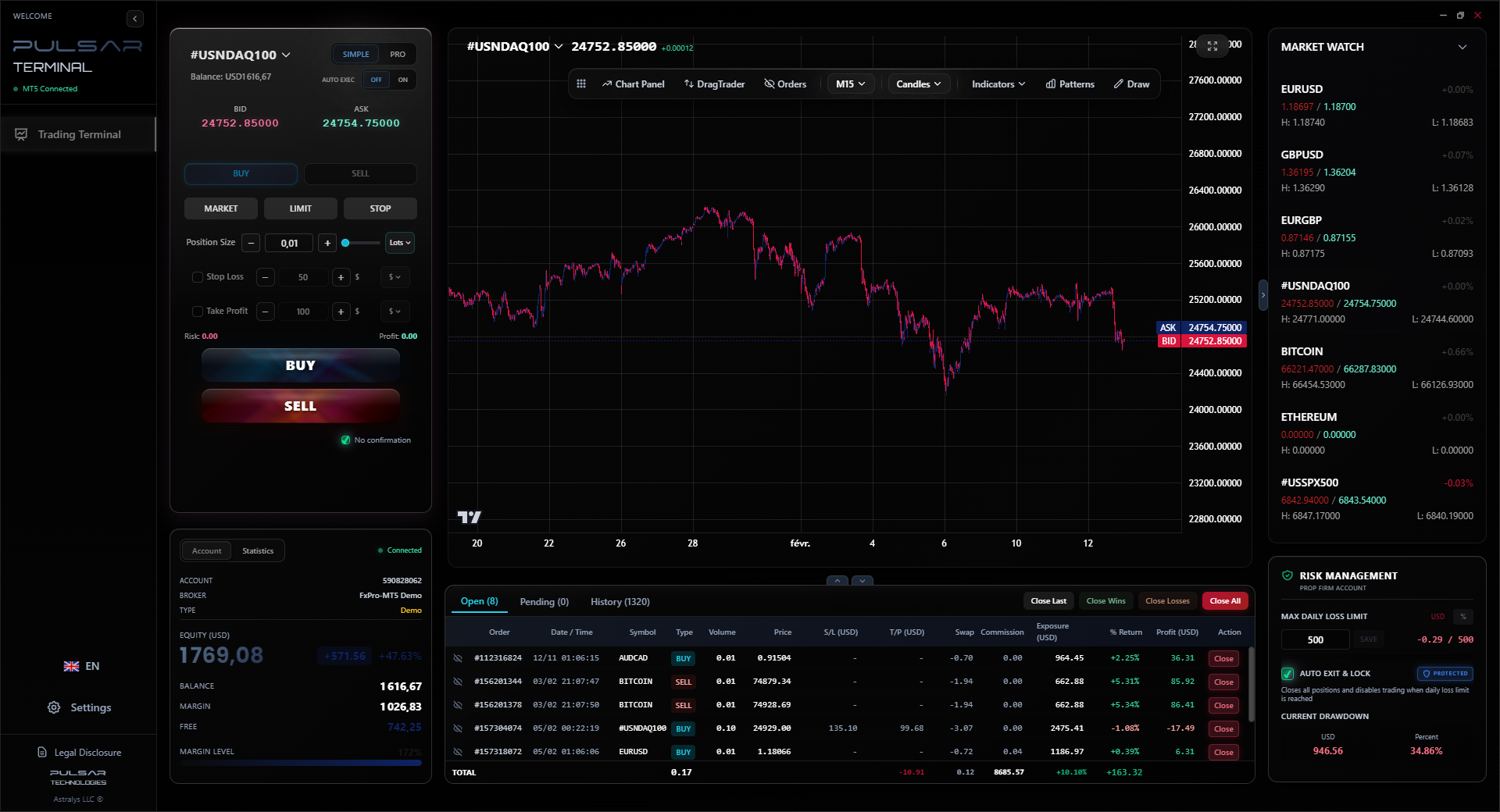
Manually trailing stops based on fading momentum is stressful; Pulsar Terminal automates dynamic trailing stops and multi-part profit-taking directly on your MT5 charts.
After all the charts and indicators, the biggest factor in your success with momentum indicator forex trading will be you. Your discipline. Your patience.
Momentum indicators are designed to give you an edge, not a crystal ball. They will give you false signals. You will have losing trades. The goal is to have your winners be bigger than your losers. That comes from rock-solid risk management, not from a magical indicator setting.
I still get the urge to jump in when I see a big green candle and an RSI starting to curl up. The FOMO is real. But now, I have a checklist. Is there a key level nearby? What's the higher timeframe trend? What's my precise entry, stop, and target? If I can't answer those, I don't touch the trade. It's boring, but it's profitable.
Start simple. Pick one pair (maybe USD/ZAR). Pick one momentum indicator (start with the RSI). Paper trade a strategy for a month. Journal every trade - why you took it, what you felt, the outcome. Only then, with real data and experience, should you consider risking real capital. This journey is a marathon for your bank account and your mindset, not a sprint. Good luck, and trade well.
FAQ
Q1What is the best momentum indicator for forex beginners in South Africa?
Start with the Relative Strength Index (RSI). It's visually simple (oscillates between 0-100), and the overbought/oversold concept is easy to grasp. Apply it to the USD/ZAR daily chart first to get a feel for how it behaves with our local currency's rhythms before moving to faster timeframes.
Q2Can I use momentum indicators for scalping ZAR pairs?
You can, but be very careful. ZAR pairs have wider spreads, which can kill scalping profits. If you do, use very short timeframes (like 1 or 5-minute charts) and a sensitive indicator setting (e.g., RSI period of 7). Always confirm the signal with immediate price action and be hyper-aware of the spread cost. A dedicated scalping strategy framework is essential.
Q3Why does my momentum indicator keep giving false signals on USD/ZAR?
You're likely using it in isolation or on the wrong timeframe. A single indicator in a choppy, news-driven market like ZAR will whipsaw. Always check the higher timeframe trend first. Also, avoid using it in ranging markets; momentum indicators work best when a trend is established. Combine it with support/resistance levels for better filtering.
Q4What's the difference between momentum and trend?
Trend is the overall direction (up, down, or sideways). Momentum is the speed or strength of the price movement within that trend. You can have a strong uptrend with weakening momentum (warning of a potential pause or reversal), or a strong momentum spike in a sideways market (which may just be a fakeout).
Q5How do I avoid a margin call when trading with momentum?
Momentum trading can lead to over-leveraging because moves look 'sure thing.' The antidote is strict position sizing. Never risk more than 1-2% of your account on a single trade. Use a stop loss on every position. Understand that a margin call happens when your losses exceed your available capital, which is always a result of poor risk management, not a bad indicator signal.
Q6Is the MACD or RSI better for spotting divergences?
The MACD is generally superior for spotting divergences, especially on the histogram. The RSI can show divergence too, but MACD's construction (using moving averages) often makes the divergence clearer and more reliable, particularly on the 4-hour and daily charts for pairs like EUR/ZAR or GBP/ZAR.
Lekcja Prof. Winstona
:
- ✓Momentum measures acceleration, not just price speed.
- ✓Always confirm RSI/MACD signals with price action or key levels.
- ✓Adjust default settings (like RSI period) for ZAR pair volatility.
- ✓Use MACD histogram shrinkage as an early warning to tighten stops.
- ✓Never risk more than 2% per trade, no matter how strong the signal.
Jak przydatny był ten artykuł?
Kliknij gwiazdkę, aby ocenić
Tygodniowe analizy tradingowe
Darmowe tygodniowe analizy i strategie. Bez spamu.
O autorze
David van der Merwe
Trader Rynków Wschodzących
Trader z Johannesburga z 11-letnim doświadczeniem w walutach rynków wschodzących. Specjalizuje się w parach ZAR, handlu regulowanym przez FSCA i analizie rynku południowoafrykańskiego.
Komentarze
Może Ci się też spodobać

Cara Trading Forex Sukses: 7 Prinsip dari Trader Profesional
Cara trading forex sukses dengan 7 prinsip trader pro: manajemen modal, disiplin, journal trading, backtest. Data nyata, bukan janji profit palsu.
Jam Trading Forex Terbaik untuk Trader Indonesia: Panduan Lengkap dengan Tabel Waktu
Panduan jam trading forex untuk trader Indonesia. Tabel 4 sesi dunia, jam emas 20:00-00:00, sesi mana yang harus dihindari. Data akurat + tips dari trader berpengalaman.
Top 5 Sàn Forex Uy Tín Nhất 2026: Review Jujur dari Trader Indonesia
Top 5 sàn forex uy tín 2026 untuk trader Indonesia. Review jujur: spread, deposit, withdraw, dukungan lokal. Exness, XM, IC Markets & lebih.
All these calculators are built into Pulsar Terminal with real-time data from your MT5 account. One-click position sizing, automatic risk management, and instant calculations.
