


I was watching 'Margin Call' for the umpteenth time during a quiet Asian session, a cup of rooibos going cold next to my screen.

David van der Merwe
Trader Rynków Wschodzących ·  South Africa
☕ 10 min czytania
Czego się nauczysz:
I was watching 'Margin Call' for the umpteenth time during a quiet Asian session, a cup of rooibos going cold next to my screen. Jeremy Irons was giving that speech about 'selling it all, today,' and my phone buzzed. It was a client, panicked because the USD/ZAR had just spiked 50 pips on some dodgy political headline. The disconnect hit me hard. The cinematic drama of collapsing banks felt a world away from the real, grinding work of managing a live ZAR position. That got me thinking: what can we, as South African traders, actually take from these movies about trading forex and finance? Let's separate the entertainment from the education.
Let's be honest, you won't find a movie where the hero spends three hours watching a EUR/USD consolidation pattern on the 4-hour chart. Hollywood needs explosions, not exhaustion. But buried in the drama are some universal truths about markets and, more importantly, about us.
The classics like 'Wall Street' and 'The Wolf of Wall Street' are really about psychology - greed, fear, and the intoxication of winning. Gordon Gekko's 'greed is good' monologue isn't a trading strategy; it's a warning label. I learned that the hard way early on. Chasing a loss on GBP/ZAR, I kept adding to a losing position, convinced the market 'owed' me. That one trade wiped out two weeks of careful profits. It was a cheap lesson in the cost of letting emotion override my plan.
Then you have the crisis films. 'The Big Short,' 'Margin Call,' and 'Too Big to Fail' are masterclasses in systemic risk and the domino effect. For us trading the Rand, this is crucial. You see, the ZAR isn't just a currency pair; it's a sentiment gauge for emerging markets. A banking scare in Europe doesn't just hit EUR/USD; it sends investors fleeing from 'riskier' assets like the Rand. Watching these movies helps you visualize the connections you can't always see on a chart.

Warning: These movies almost never show the boring, essential stuff: proper record-keeping, adjusting your position size calculator for volatility, or the mental toll of a drawdown. Don't confuse inspiration with a business plan.

💡 Wskazówka Winstona
After watching 'Rogue Trader,' I made a rule: I physically place my stop-loss order before I even consider my take-profit. The exit strategy comes first. It saved me more times than I can count.
If you watch only one film from this list, make it the BBC's 'Black Wednesday.' It's the closest thing we have to a pure forex movie. It carefully breaks down the 1992 currency crisis where George Soros famously 'broke the Bank of England.'
Why is it so good for us? It shows forex as a battle of fundamentals versus central bank intervention. The UK government was trying to artificially peg the Pound within the European Exchange Rate Mechanism (ERM). Traders like Soros saw the fundamentals - high UK interest rates, a struggling economy - and bet against the peg. The Bank of England spent billions in reserves trying to defend it, and lost.
The South African Parallel
This should ring bells. The South African Reserve Bank (SARB) doesn't peg the Rand, but it does intervene occasionally to smooth out 'disorderly market conditions.' Watching 'Black Wednesday' teaches you to watch for the gap between economic reality and official policy. When SARB talks tough on inflation but growth data is terrible, that's a tension the market will eventually price in. It taught me to always have an ear on SARB MPC statements and a eye on our foreign reserves data. Trading isn't just charts; it's about who has the deeper pockets and stronger conviction - the market or the authorities.
“Real trading is a system. The movies show the explosion; we have to build the fuse, measure the powder, and have an exit plan before we even light it.”
'Rogue Trader,' starring Ewan McGregor, is a brutal, necessary watch. It's the true story of how one trader, Nick Leeson, hid losses and eventually collapsed the 233-year-old Barings Bank. This isn't just history; it's a case study in every trading mistake rolled into one.
Leeson's fatal error wasn't a single bad trade. It was his refusal to accept a loss. He started 'doubling down' on losing positions, using unauthorized accounts to hide the mounting deficits. He was betting the bank's money that the Nikkei index would bounce. It didn't.
I see a scaled-down version of this psychology all the time. A trader gets stopped out on a USD/ZAR trade. Instead of re-analysing, they jump right back in with a bigger lot size, trying to win back their lost Rands immediately. They're no longer trading the market; they're trading their own P&L statement, which is a guaranteed path to a margin call.

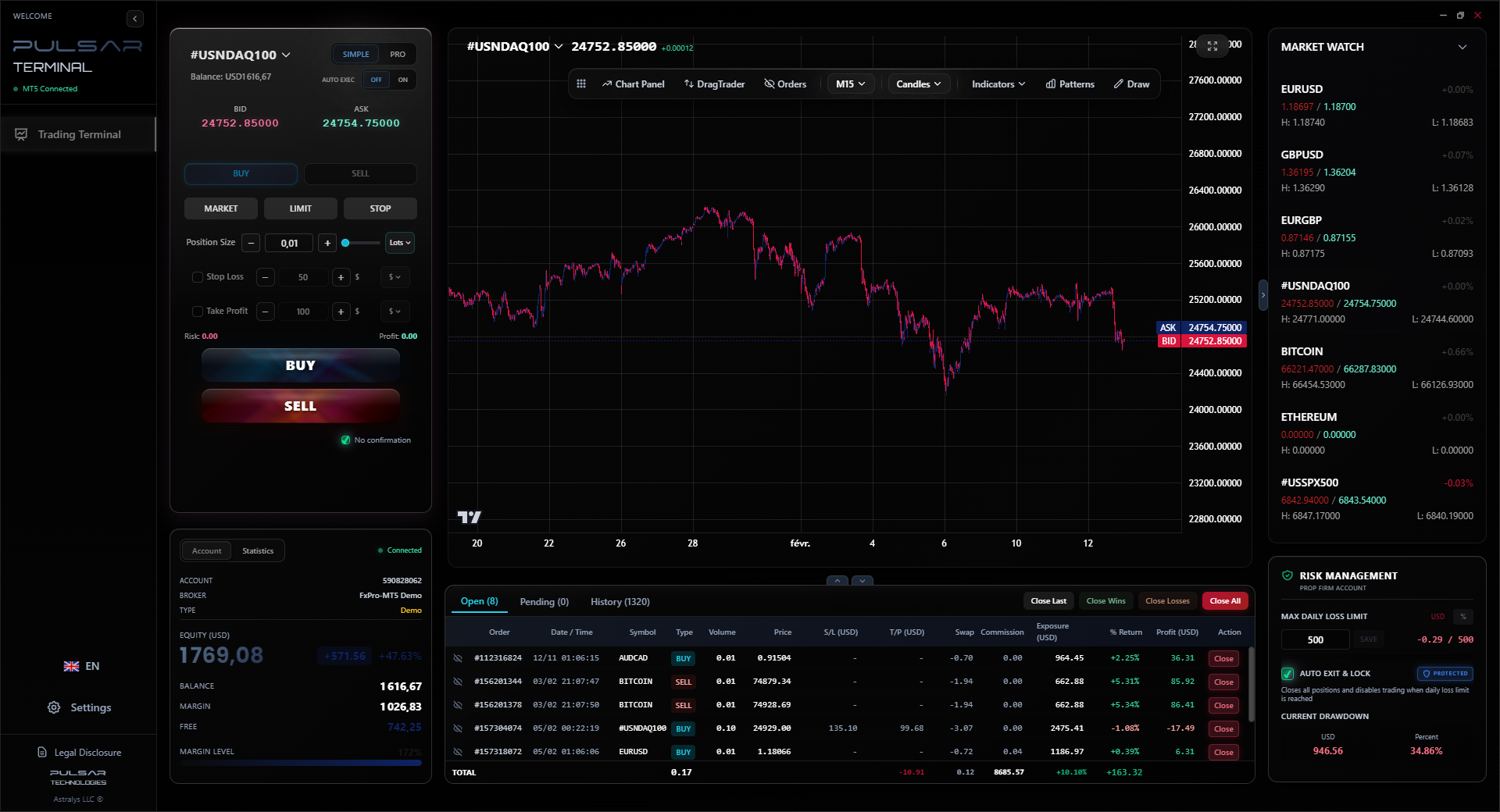
Pro Tip: The lesson from Leeson is mechanical. Use a hard stop-loss on EVERY trade, no exceptions. Treat it like a law of physics. A tool like Pulsar Terminal can attach that stop automatically the second your order is placed, removing the temptation to 'see if it comes back.' Your first loss is usually your smallest. Don't make it an audition for a movie villain.
Managing risk like the pros means automating your rules, and Pulsar Terminal lets you set multi-level take-profits and hard stop-losses on MT5 with a single drag-and-drop, so your discipline is built into every trade.
Okay, so you've binge-watched the list. Now how does that translate to trading the Rand from Cape Town or Johannesburg? Let's get practical.
1. Understand Your Local Costs: Hollywood doesn't show the spread. In South Africa, your real-world edge is chewed up by costs if you're not careful. You might get inspired by a scalping strategy from a film, but if your broker's spread on USD/ZAR is 15 pips, you're dead before you start. You need a broker with tight spreads and clear commissions. I've found brokers like IC Markets and Pepperstone offer decent ZAR pricing through their global entities, but always check the live spread on your platform before you hit buy.
2. The 30:1 use Rule: Remember the insane, unchecked use in the movies? In SA, the FSCA caps use at 30:1 for retail clients. This is a good thing. It feels restrictive when you're starting out, but it's a forced dose of sanity. At 30:1, a 3.33% move against you wipes your margin. That's still huge! Compare that to the 500:1 some unregulated offshore brokers offer - a 0.2% move would blow you up. The FSCA's rule is your first line of defence against becoming a cautionary tale.
3. The ZAR's Unique Drivers: The Rand dances to its own tune. Movies about the Fed or the ECB are useful, but you must layer on local factors:
- Eskom and Load-Shedding: Grid stability reports move the Rand. Seriously.
- Commodity Prices: Platinum, gold, and coal exports. A dip in PGM prices often weakens ZAR.
- Political Risk: This is our special ingredient. Local elections, policy uncertainty - it all gets priced in with surprising speed.
I once took a long EUR/ZAR position based purely on a technical breakout, ignoring an upcoming ANC leadership speech. The pair was up 80 pips, I was feeling like a genius... and then the speech sparked a sell-off in local bonds. I watched my profit vanish and turn into a 120-pip loss in under an hour. The chart didn't save me; the local headline did.
💡 Wskazówka Winstona
When analysing ZAR pairs, I keep two charts open: one for the currency pair and one for the USD Index (DXY). Often, the Rand's move is just the dollar's story being told in a different accent.
“The 30:1 use limit isn't a restriction; it's the FSCA's way of saying 'don't be the guy they make a movie about.'”
Forget the dramatic phone calls and the 'all-in' moments. Real trading is a system. Here’s how to build yours, inspired by the warnings in the films.
Risk Management First: This is the cardinal rule every movie villain breaks. Decide what percentage of your capital you will risk on any single trade before you even look at a chart. For most, 1-2% is sane. For a R50,000 account, that's R500-R1000 risk per trade. Use your stop-loss distance to work backwards to your correct position size. Never, ever gamble your 'rent money' on a feeling.
Find Your Edge, Then Protect It: Your edge might be understanding RSI indicator divergences on the USD/ZAR during London overlap, or tracking iron ore shipments to China. Whatever it is, document it. Backtest it (even roughly on past charts). Then, when you trade it, protect that edge with strict rules. The movies show guys winging it. We can't afford to.
Embrace the Boring: Profitable trading is profoundly boring. It's executing your plan, taking small losses without drama, and letting your winners run according to your rules. It's reviewing your trades every Friday without emotion. The excitement is in the hunt and the analysis, not in the frantic clicking of buttons.

Example: Let's say your system gives you a signal to buy USD/ZAR at 18.5000. You have a R100,000 account and risk 1% per trade (R1000). You place your stop loss at 18.4500, a 500 pip risk. How many units can you buy? Risk in Rands / (Stop Distance in Pips * Pip Value for USD/ZAR) Pip value for USD/ZAR is roughly R1 per pip per standard lot (100,000 units). So, R1000 / (500 pips * R1) = 2. You can buy 2 mini lots (20,000 units). Not glamorous, but it's sustainable.
Before you place a single trade, get your house in order. This is the unsexy foundation the movies skip.
Only Use FSCA-Regulated Brokers: This is non-negotiable. The Financial Sector Conduct Authority (FSCA) is our watchdog. A licensed broker (an Authorised Financial Services Provider, or FSP) must keep your client funds in segregated accounts, separate from their own operating money. This means if the broker goes under, your capital is (in theory) protected. Always check the FSP number on the FSCA's website. I've seen too many guys lured by offshore brokers offering 1000:1 use, only to find they have zero recourse when something goes wrong.
Tax Implications (SARS): Profits from trading are considered income for SARS, not capital gains. You need to declare it. Keep careful records of all your trades - entries, exits, fees. A simple spreadsheet works. The tax man doesn't accept 'I had a bad feeling about the Rand' as an excuse.
Start with a Demo, Then Go Small: Use a demo account to test your strategy and get used to a platform like MT5. But don't stay there forever. The psychology changes with real money. When you go live, start with an amount you can truly afford to lose. The goal of your first R5,000 account isn't to get rich; it's to learn without panic. Treat it as tuition fees.
💡 Wskazówka Winstona
If a trading idea seems too clever, like a plot twist in a movie, it probably is. The most reliable setups are often the simplest ones everyone can see. Don't overcomplicate it.
“Your first loss is usually your smallest. Don't make it an audition for a movie villain.”
Here’s my ranked list for what each film teaches a South African trader:
| Movie | Core Lesson for ZAR Traders | The Hollywood Fluff to Ignore |
|---|---|---|
| 1. Black Wednesday (BBC Doc) | Central banks can and do lose. Fundamentals trump intervention. Watch for SARB vs. Market battles. | It's a docco, so not much fluff! |
| 2. Rogue Trader | The unchecked loss is a killer. The necessity of absolute stop-loss discipline. | The personal drama. Your failure won't be this cinematic. |
| 3. Margin Call | Systemic risk and liquidity dry-ups. How contagion spreads. Be wary of correlated EM assets. | The all-night office drama. Your analysis happens in daylight. |
| 4. The Big Short | The market can stay irrational. Have conviction in your analysis, but manage risk while you wait. | The idea that you need to be a genius to see a crisis. Sometimes, it's obvious but painful. |
| 5. Trading Places | Information is everything. The orange crop report scene is a perfect lesson in trading on non-public info (illegal!) and market reaction. | The idea that two rich guys will bet on your life. |
Use these as discussion starters, not textbooks. Watch them, then go and do the real work of building a strong swing trading plan for the EUR/USD, which often dictates broader dollar strength that hits the ZAR.
FAQ
Q1Is forex trading legal in South Africa?
Yes, completely legal. But you must use a broker authorised by the Financial Sector Conduct Authority (FSCA). Trading with unregulated, offshore brokers is risky and offers you little protection if things go wrong.
Q2What's the best movie for learning about forex?
Hands down, the BBC documentary 'Black Wednesday.' It's the most direct look at a pure currency crisis, explaining how interest rates, government policy, and trader speculation collide. It's more educational than any Hollywood blockbuster.
Q3How much money do I need to start trading forex in South Africa?
You can start with very little - some brokers allow accounts with a few hundred Rand. But realistically, to practice proper risk management (risking 1-2% per trade), a starting capital of R5,000 to R10,000 lets you breathe and learn without one bad trade ending your journey.
Q4Do the FSCA use limits make it harder to profit?
They make it harder to blow up your account quickly, which is different. The 30:1 cap forces discipline. Profits come from good analysis and risk management, not insane use. High use is a shortcut to large losses, not sustainable gains.
Q5Can I trade the South African Rand (ZAR) easily?
Absolutely. Major pairs like USD/ZAR, EUR/ZAR, and GBP/ZAR are widely offered. Just be aware that spreads (the cost to trade) are often wider on these pairs than on something like EUR/USD, so factor that into your strategy. Avoid scalping on ZAR pairs unless you have ultra-tight spreads.
Q6What's the biggest mistake new traders make after watching these movies?
They confuse excitement with edge. They try to replicate the drama - going 'all in,' ignoring stop losses, chasing losses - instead of emulating the boring, systematic work that happens between the dramatic scenes. They want the climax without the plot development.
Lekcja Prof. Winstona
:
- ✓Risk a maximum of 1-2% of capital per trade.
- ✓Always verify your broker's FSCA FSP number.
- ✓USD/ZAR spreads over 10 pips will kill a scalping strategy.
- ✓The SARB's statements are as important as your chart patterns.
Jak przydatny był ten artykuł?
Kliknij gwiazdkę, aby ocenić
Tygodniowe analizy tradingowe
Darmowe tygodniowe analizy i strategie. Bez spamu.
O autorze
David van der Merwe
Trader Rynków Wschodzących
Trader z Johannesburga z 11-letnim doświadczeniem w walutach rynków wschodzących. Specjalizuje się w parach ZAR, handlu regulowanym przez FSCA i analizie rynku południowoafrykańskiego.
Komentarze
Może Ci się też spodobać

Cara Trading Forex Sukses: 7 Prinsip dari Trader Profesional
Cara trading forex sukses dengan 7 prinsip trader pro: manajemen modal, disiplin, journal trading, backtest. Data nyata, bukan janji profit palsu.
Jam Trading Forex Terbaik untuk Trader Indonesia: Panduan Lengkap dengan Tabel Waktu
Panduan jam trading forex untuk trader Indonesia. Tabel 4 sesi dunia, jam emas 20:00-00:00, sesi mana yang harus dihindari. Data akurat + tips dari trader berpengalaman.
Top 5 Sàn Forex Uy Tín Nhất 2026: Review Jujur dari Trader Indonesia
Top 5 sàn forex uy tín 2026 untuk trader Indonesia. Review jujur: spread, deposit, withdraw, dukungan lokal. Exness, XM, IC Markets & lebih.
All these calculators are built into Pulsar Terminal with real-time data from your MT5 account. One-click position sizing, automatic risk management, and instant calculations.
