


Here's a fact most Nigerian traders miss: over 90% of all daily forex volume happens during just two overlapping sessions.

Olumide Adeyemi
Pionier Tradingu w Afryce Zachodniej ·  Nigeria
☕ 11 min czytania
Czego się nauczysz:
- 1Why the New York Session is Your Prime Time
- 2The Clock is Everything: Session Timings & Overlaps
- 3What to Trade: The Pairs That Actually Move
- 4Strategies That Work: From Breakouts to News
- 5Choosing Your Tools: Brokers & Platforms for Nigeria
- 6The Hard Lessons: Risk Management & My Costly Mistakes
- 7Putting It All Together: Your New York Session Routine
Here's a fact most Nigerian traders miss: over 90% of all daily forex volume happens during just two overlapping sessions. The London-New York overlap is the main event, and if you're not structuring your day around it, you're leaving serious money on the table. I learned this the hard way, trading Lagos hours and wondering why my moves never gained traction. This guide isn't about theory. It's my 12-year journal of trading the New York session from Nigeria - the specific times, the pairs that wake up, the mistakes that cost me, and the setups that finally paid for my car.
Forget trying to force life into a dead chart during Asian hours. The New York session, which runs from 1:00 PM to 10:00 PM Nigerian Time (WAT), is when the market truly comes alive for us. This is when the big institutional players in London are still active, and the US banks and funds join the party. That overlap, from about 1:00 PM to 4:00 PM WAT, creates a surge in liquidity and volatility you simply don't get at other times.
Liquidity means your orders get filled at the price you want, not 3 pips away. Volatility means price actually moves, giving you opportunities. I used to trade in the early Lagos morning, staring at a 5-pip range on EUR/USD for hours. It was a waste of screen time and mental energy. When I shifted my focus to the New York open, everything changed. Economic data from the US (like Non-Farm Payrolls, CPI, and Fed decisions) is released during this window, often causing immediate, sharp moves. If you're not in front of your screen, you miss it.

Warning: This volatility is a double-edged sword. I once got stopped out on a perfectly good GBP/USD trade because I entered right before US Retail Sales data without a wide enough stop. The 50-pip spike in 10 seconds wiped my position. News trading requires a specific plan, not hope.
The other key reason? The Naira. Much of our economy's dollar liquidity is sourced during these overlapping London and New York hours. While you're trading EUR/USD, the underlying interbank flows that affect our own USD/NGN rates are happening right then. It doesn't mean you trade the Naira pair, but it helps you understand where the real money is moving.
“The London-New York overlap isn't just a busy time; it's the only time that matters for serious intraday profit.”
Getting the timing wrong is the most common mistake. Nigerian Time (West Africa Time, WAT) is key. Here’s your daily market map:
| Session | Local Nigerian Time (WAT) | Key Characteristic |
|---|---|---|
| Sydney Open | 10:00 PM (Previous Night) | Very quiet, range-bound. |
| Tokyo Open | 12:00 AM (Midnight) | Asian pairs (USD/JPY) get active. |
| London Open | 8:00 AM | Volatility starts to pick up. |
| New York Open | 1:00 PM | The main event begins. |
| London/New York Overlap | 1:00 PM - 4:00 PM | Peak liquidity & volatility. |
| London Close | 4:00 PM | Volume starts to dip from Europe. |
| New York Close | 10:00 PM | Day often consolidates. |
My entire trading day is built around that 1:00 PM - 4:00 PM window. That's my "office hours." Everything before 1:00 PM is for analysis, reviewing my swing trading watchlist, and setting alerts. I don't take new intraday positions before London opens at 8 AM. The 1 PM open is my trigger.
The 30-Minute Rule
I never place a trade in the first 30 minutes after New York opens (1:00 PM - 1:30 PM WAT). Why? It's pure chaos. Orders are flooding in, spreads widen, and price often makes false initial moves. I use this time to confirm the direction of the London session's trend and watch for a pullback to enter. Waiting those 30 minutes saved me from countless fakeouts.

Pro Tip: Set a phone alarm for 12:55 PM WAT. That's your 5-minute warning to be at your desk, charts ready, news calendar open. Treat it like a bell ringing for the start of a match.

💡 Wskazówka Winstona
The market's first move after the New York open is often a trap. Wait 30 minutes for the institutional orders to settle, then read the real story on the chart.
“I learned that 1:500 use isn't a tool for growth; it's a signed confession for your account's murder.”
Not all pairs are created equal during New York. You want to focus on pairs with the US Dollar (USD), as that's the home currency. Chasing exotic pairs during this time is a sure way to get eaten by unpredictable spreads.
Major Pairs (My Bread and Butter):
- EUR/USD: The most liquid pair in the world. Tends to have cleaner trends during New York, especially if European data was released earlier. It's my go-to for testing a new scalping strategy.
- GBP/USD: More volatile than EUR/USD. Reacts strongly to both UK and US news. Requires wider stops.
- USD/JPY: Moves heavily on US Treasury yield dynamics and risk sentiment. Can be tricky but very rewarding if you understand the macro picture.
- USD/CAD, AUD/USD, NZD/USD: These "commodity dollars" are highly sensitive to US economic data and risk appetite. Great for momentum plays.
A Personal Trade Example: On June 12th last year, the US CPI data was due at 1:30 PM WAT. I had been watching EUR/USD consolidate in a 20-pip range all morning. At 1:29 PM, I placed a buy stop order at 1.0825 (above the range) and a sell stop at 1.0785 (below the range), with a 25-pip stop loss on each. I used a position size calculator to risk only 0.5% of my account on the triggered trade. The data was hot, dollar spiked. My sell stop was triggered at 1.0785. Price plummeted to 1.0750 within minutes, and I took half profit, moving my stop to breakeven. It eventually hit my second target at 1.0720. A 65-pip win by letting the news decide the direction for me.
Pairs to Avoid During Peak Hours: Crosses like EUR/GBP or GBP/JPY. While they can move, their spreads often widen dramatically during news events, turning a winning trade into a loser on entry alone. I stick to the majors and the XAU/USD guide (Gold) for clarity.
“I learned that 1:500 use isn't a tool for growth; it's a signed confession for your account's murder.”
You need a plan for the different phases of the session. Here’s what I’ve found works consistently.
1. The London Breakout Retest (1:00 PM - 2:30 PM WAT)
London often establishes a direction. At New York open, price frequently pulls back (retraces) against that London trend before resuming. I wait for that pullback.
- Setup: If London drove EUR/USD up from 1.0800 to 1.0840, I wait for a pullback to 1.0820-1.0825 after 1 PM.
- Entry: Buy on a 5-minute or 15-minute candle close showing rejection (a pin bar or bullish engulfing) at a key support level or a 50% Fibonacci retracement of the London move.
- Stop Loss: Just below the pullback low. Target is a retest of the London high (1.0840) and beyond.
2. Economic Data Spike & Fade
This is advanced and requires steel nerves. Major data (NFP, CPI) causes a huge, immediate spike. That first move often gets exhausted, and price reverses as liquidity returns.
- Setup: A huge 30-40 pip spike in seconds on news.
- Entry: NOT immediately. I wait for the initial spike to stall and for a 1 or 2-minute chart to show a reversal pattern (like a double top with a bearish divergence on the RSI indicator).
- Stop Loss: Wide. Beyond the extreme of the spike. You're betting the initial move was an overreaction.
I got burned early on trying to predict the news direction. Now, I either use the stop-order method I described earlier or I wait for the post-news chaos to settle and trade the clearer technical picture that emerges 15-30 minutes later.
3. End-of-Day Squeeze (After 8:00 PM WAT)
As New York winds down, positions are squared. If there was a strong trend all day, a final push often happens. I look for a breakout of the 1-hour range that formed between 4 PM and 8 PM. This is a smaller, quicker trade, perfect for practicing discipline with a tight stop.
💡 Wskazówka Winstona
Your profit target for a New York session trade should be at least 1.5 times your stop loss distance. The volatility allows it; don't settle for small, risky gains.
“Your stop loss isn't a suggestion. It's the price you pay for admission to the New York session.”
Your strategy means nothing if your broker fails you during high volatility. Spreads widening to 20 pips or requotes on entry are account killers. Based on my experience and the local landscape, here’s the breakdown.
You need a broker that offers:
- Stable Execution during News: This is non-negotiable.
- Naira Deposit/Withdrawal: Saves you from unofficial forex rates and bank headaches.
- Relevant Regulation: While Nigerian regulation for retail forex is still developing, using a broker regulated by a reputable foreign authority (like CySEC, FSCA, FSA Seychelles) provides a layer of security.
My Experience with Top Picks:
- Exness: I keep a small account with them for raw spread testing. Their spreads on EUR/USD can go to 0.0 during calm times, which is fantastic. They offer Naira accounts and local bank transfers. However, during extreme news, I've seen slippage. Good for everyday trading, but be cautious on major news. You can read a full breakdown in our Exness review.
- IC Markets: This is where my main capital sits. Their True ECN account gives me direct access to interbank liquidity. The spreads are consistently tight, even during news, though you pay a small commission. Execution is the best I've experienced. They don't have Naira accounts, so I fund via Skrill. Their IC Markets review details the pros and cons.
- XM: A solid all-rounder, especially for beginners. Their minimum deposit is low ($5), they have great educational resources, and they offer Naira accounts. Spreads are slightly higher than IC Markets but still competitive. Check the XM review for more.
The Tax Reality: Remember, any profit you make is subject to a 10% Capital Gains Tax in Nigeria. Keep a detailed trade journal. It’s not just for your analysis; it’s for your accountant.
“Your stop loss isn't a suggestion. It's the price you pay for admission to the New York session.”
This is the most important section. The New York session’s volatility will expose poor risk management instantly.
Mistake #1: The Overleveraged Overlap. Early in my career, I saw the London-New York overlap as a chance to get rich quick. I’d use 1:500 use on a standard lot. A 10-pip move against me would wipe out 5% of my account. One afternoon, USD/JPY moved 15 pips on a vague headline. I got a margin call. Lesson learned. Now, I never exceed 1:30 use for my intraday New York session trades, and I use a calculator for every single entry.
Mistake #2: Ignoring the Spread. You see EUR/USD at 1.0850/1.0851 (1 pip spread). You place a market buy order right before US data. Your order fills at 1.0865 because the spread widened to 15 pips instantly. You’re already 14 pips in the red before price even moves. Always use limit orders to enter pre-news, or accept that you must give the trade more room with a wider stop.
My Non-Negotiable Rules Now:
- Max Risk Per Trade: 1% of my account balance. No exceptions. I calculate this using my stop loss distance in pips and my lot size.
- Daily Loss Limit: If I lose 3% of my account in a day, I shut down the platform. The New York session can tempt you to "revenge trade" back to breakeven. It never works.
- Stop Losses Are Placed Immediately: The moment the trade is open, the stop loss is in the market. Not in my head. A sudden news flash can gap price past your mental stop.

Example: Account: $2,000. 1% risk = $20. Trading EUR/USD, my stop loss is 25 pips away. Each pip movement for a micro lot (0.01) is ~$0.10. To risk $20 on a 25-pip stop: $20 / (25 pips * $0.10) = 8 micro lots. So my position size is 0.08 lots. This is the most important math you’ll do all day.
💡 Wskazówka Winstona
If you feel the urge to double your position size after a loss, close the platform instead. The New York session magnifies desperation into ruin.
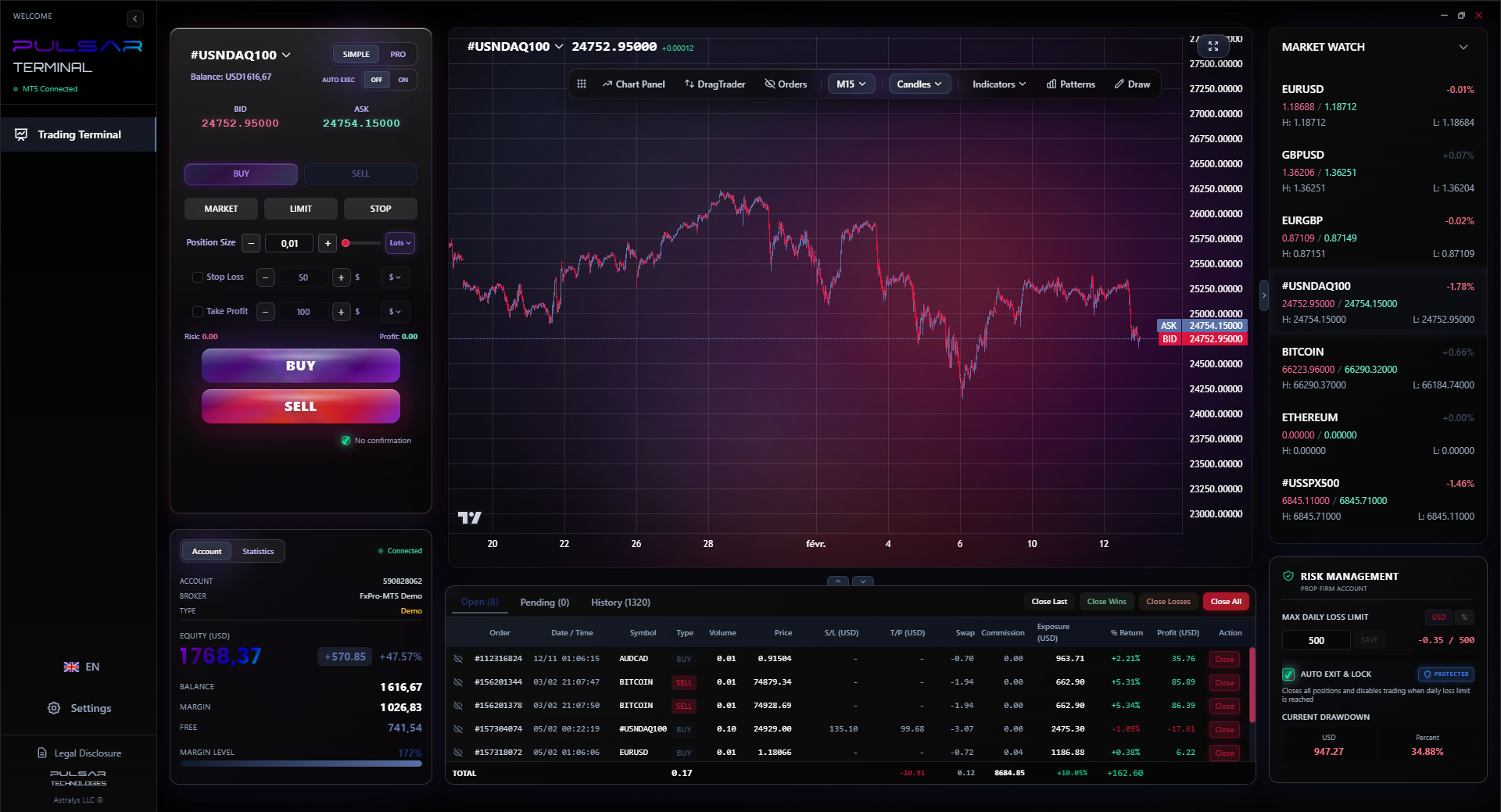
Managing multiple trades with precise stop losses and take profits during the volatile New York session is critical, and tools like Pulsar Terminal automate this directly on your MT5 platform.
“Waiting those first 30 minutes after the open isn't patience; it's letting the amateurs clear out so you can trade.”
Success is a routine, not a single trade. Here’s my exact schedule, refined over a decade.
Morning (Before 1:00 PM WAT):
- 8:00 AM - 9:00 AM: Review the overnight price action. Did London just open? What’s the sentiment? I mark key support/resistance levels on my 1-hour and 4-hour charts.
- 9:00 AM - 12:00 PM: Scan the economic calendar. What’s due at 1:30 PM WAT (US data)? I plan my approach: Will I avoid trading, use stop orders, or wait for the post-news setup? I also check for any divergence on the MACD indicator on the higher timeframes to gauge momentum.
The Session (1:00 PM - 10:00 PM WAT):
- 12:55 PM: Alarm goes off. Final prep.
- 1:00 PM - 1:30 PM: NO TRADING. I watch. I observe price reaction to the open. I confirm my morning levels.
- 1:30 PM - 4:00 PM (Peak Hours): Execute my planned setups (breakout retest, news play). I am focused, disciplined. I might take 1-3 trades max.
- After 4:00 PM: I review open trades, move stops to breakeven on winners, and look for any end-of-day squeeze setups. By 8 PM, I’m usually done for the day.
Evening (After 10:00 PM WAT):
- I journal every trade. Entry, exit, reason, emotional state. This is how you improve. I then disconnect. You cannot live on the charts.
This routine turns chaos into a process. The New York session forex is a powerful engine. This is how you learn to drive it, not be run over by it.
FAQ
Q1What is the best time to trade forex in Nigeria?
The absolute best time is during the London-New York session overlap, from 1:00 PM to 4:00 PM Nigerian Time (WAT). This 3-hour window has the highest liquidity and volatility, providing the best trading opportunities for major currency pairs.
Q2Is forex trading legal in Nigeria?
Yes, forex trading is legal for individuals in Nigeria using their personal funds. The Central Bank of Nigeria (CBN) and SEC are the main regulators, but the online retail trading space is still developing. Many Nigerian traders use internationally regulated brokers. Remember, profits are subject to a 10% capital gains tax.
Q3Which forex pairs are most active during the New York session?
Pairs with the US Dollar (USD) are most active. Focus on EUR/USD, GBP/USD, USD/JPY, and the commodity dollars (USD/CAD, AUD/USD). These pairs react directly to US economic data and the liquidity provided by US markets.
Q4What use should I use for the volatile New York session?
Use low use. The high volatility amplifies both gains and losses. I strongly recommend not exceeding 1:30 use for intraday trading during this session. High use is the fastest way to a margin call when 50-pip spikes are common.
Q5Can I fund my forex account with Naira?
Yes, many international brokers like Exness, XM, and HF Markets offer Naira-denominated accounts and accept deposits via local bank transfers. Others may require you to use e-wallets (Skrill, Neteller) or domiciliary accounts. Always check your broker's specific deposit options for Nigeria.
Q6How do I handle major US news releases like NFP?
You have three choices: 1) Avoid trading 5 minutes before and after the release. 2) Use a stop-limit order strategy (placing buy/sell stops above and below the pre-news range) to let the market choose direction. 3) Wait 15-30 minutes after the release for the initial spike to settle and then trade the established technical direction. Never guess the news outcome.
Q7What is the minimum amount needed to start trading the New York session?
While some brokers allow you to start with $5-$10, I don't recommend it. With such a small amount, proper risk management is impossible. To practically apply the strategies and manage the volatility of the New York session, a starting capital of at least $500 is more realistic. This allows you to use sensible position sizes and survive inevitable losses.
Lekcja Prof. Winstona
:
- ✓Trade only 1:00 PM - 4:00 PM WAT for peak action.
- ✓Never trade the first 30 minutes of the New York open.
- ✓Max use 1:30, max risk 1% per trade.
- ✓Focus on USD pairs: EUR/USD, GBP/USD, USD/JPY.
- ✓Use stop orders for news, never market orders.
Jak przydatny był ten artykuł?
Kliknij gwiazdkę, aby ocenić
Tygodniowe analizy tradingowe
Darmowe tygodniowe analizy i strategie. Bez spamu.
O autorze
Olumide Adeyemi
Pionier Tradingu w Afryce Zachodniej
Jeden z najaktywniejszych edukatorów tradingu forex w Nigerii. 8 lat doświadczenia tradingowego z Lagos. Specjalizuje się w strategiach niskiego kapitału i wyzwaniach prop firm dla afrykańskich traderów.
Komentarze
Może Ci się też spodobać

Cara Trading Forex Sukses: 7 Prinsip dari Trader Profesional
Cara trading forex sukses dengan 7 prinsip trader pro: manajemen modal, disiplin, journal trading, backtest. Data nyata, bukan janji profit palsu.
Jam Trading Forex Terbaik untuk Trader Indonesia: Panduan Lengkap dengan Tabel Waktu
Panduan jam trading forex untuk trader Indonesia. Tabel 4 sesi dunia, jam emas 20:00-00:00, sesi mana yang harus dihindari. Data akurat + tips dari trader berpengalaman.
Top 5 Sàn Forex Uy Tín Nhất 2026: Review Jujur dari Trader Indonesia
Top 5 sàn forex uy tín 2026 untuk trader Indonesia. Review jujur: spread, deposit, withdraw, dukungan lokal. Exness, XM, IC Markets & lebih.
All these calculators are built into Pulsar Terminal with real-time data from your MT5 account. One-click position sizing, automatic risk management, and instant calculations.
