


You're searching for 'no deposit bonus forex brokers 2019' because you want to trade without risking your own cash, right? I get it.

David van der Merwe
Trader Rynków Wschodzących ·  South Africa
☕ 10 min czytania
Czego się nauczysz:
- 1What Exactly Is a No Deposit Bonus? (It's Not What You Think)
- 2The South African Rulebook: Why the FSCA Changed Everything
- 32019 vs. Now: What Actually Changed for South African Traders?
- 4Who Actually Offers Them Now? (The 2024-2025 Shortlist)
- 5The Fine Print That Will Wipe Your Account
- 6Stop Chasing Bonuses. Do This Instead.
- 7The Final Verdict: Should a South African Trader Use One?
You're searching for 'no deposit bonus forex brokers 2019' because you want to trade without risking your own cash, right? I get it. Back in 2019, those offers were everywhere, promising free money to get you started. But here's the raw truth from someone who's been trading Rand pairs since before the FSCA even existed: the game has changed completely. That 2019 search term will lead you straight into traps if you don't understand what's actually available now, how the FSCA regulates these promotions, and what the real purpose of a no-deposit bonus should be. Let's cut through the marketing nonsense.
A no deposit bonus is exactly what it sounds like: a broker gives you trading credit without requiring you to deposit your own money first. In 2019, these were often $50, $100, even $500 offers thrown at new sign-ups. The dream was simple: turn that free money into real, withdrawable profit.
But here's where most new traders get it wrong. This isn't a gift. It's a marketing tool with strings attached so thick they could anchor a ship. The broker isn't being charitable. They're buying your attention and your trading activity. You have to trade a specific volume (usually measured in lots) before you can withdraw any profits you make. Sometimes, you can't even withdraw the bonus amount itself.
I made this mistake early on. I snagged a $100 no-deposit bonus in 2018, turned it into $300 on some lucky Gold trades, and then hit a wall. The terms required me to trade 10 standard lots before withdrawal. That's a million units of currency per lot. I blew the entire account trying to hit that target with oversized positions. Lesson learned the hard way.

Warning: A no-deposit bonus is a demo account with extra steps and psychological pressure. Never confuse it with real, risk-free capital. The trading conditions attached are designed to make you fail or deposit your own money.
If you're trading from South Africa, the Financial Sector Conduct Authority (FSCA) is your first and most important line of defense. They took over from the FSB in 2018, and by 2019, they were already tightening the screws. Their job is to stop you from getting ripped off.
The FSCA's Stance on Bonuses
The FSCA hates misleading promotions. They've made it clear: brokers can't promise guaranteed profits or use bonuses as bait for reckless trading. Any bonus offer to a South African client must be crystal clear about its terms. This has forced brokers to clean up their act. The wild west days of 2019 are over. Now, if a broker is FSCA-licensed (and they absolutely should be), their bonus terms are usually spelled out in plain English, not hidden in legal jargon.
Client Fund Protection
This is non-negotiable. An FSCA-regulated broker must keep your money in a segregated account. This means if the broker goes bankrupt (it happens), your funds are separate and should be returned to you. This protection applies to your deposited funds. That no-deposit bonus money? That's the broker's money until you've met all their conditions. Don't forget that.
Choosing an FSCA broker isn't just advice; it's a survival tactic. It gives you local recourse if something goes sideways. I once had a withdrawal delayed by an offshore broker for "compliance checks" that lasted weeks. With an FSCA broker, you can actually pick up the phone and file a complaint that means something. Start your broker search with our Exness review and IC Markets review, both of which have FSCA presence, to understand what a regulated operation looks like.

💡 Wskazówka Winstona
A broker's bonus terms are a direct reflection of how they value you as a client. Onerous terms mean they see you as a target, not a partner.
“The 2019 era of unregulated bonus madness is dead and buried in South Africa. That's a good thing.”
Let's be blunt: searching for "no deposit bonus forex brokers 2019" in 2024 or 2025 is like looking for a 2019 petrol price. The context is gone. Here’s the shift.
In 2019, regulation was still settling. International brokers flooded the market with aggressive bonuses to grab market share. You'd see banners everywhere: "Get $200 FREE!" The requirements were often brutal, but the offers were plentiful.
Fast forward to today. The FSCA is fully operational and watching. The COFI Bill is looming on the horizon (likely 2026), which will bring even stricter conduct rules. Brokers are more cautious. The bonuses haven't disappeared, but they've evolved.
The modern no-deposit bonus is smaller and more tactical. You're more likely to see a $30 or $50 offer than a $200 one. The goal is different too. It's less about locking you into impossible volume targets and more about letting you test their real trading conditions - their spreads, execution speed, and platform - with actual money on the line (just not yours). It's a demo account that hurts a little when you lose.
The brokers offering them now, like XM or Tickmill, are often large, established firms using the bonus as a genuine try-before-you-buy, not a trap. You can check the current offers and their stringent terms in our XM review. The key is that the 2019 era of unregulated bonus madness is dead and buried in South Africa. That's a good thing.
Based on what's circulating in the market right now, here are a few brokers known to offer no-deposit bonuses to South African clients. Remember, these offers change monthly, and the terms are everything.
| Broker | Typical Bonus Offer (2024-2025) | The Critical Catch (Read This First) |
|---|---|---|
| XM | Around $30 - $50 | You must trade a certain volume (e.g., 5-10 lots) to withdraw any profits. The bonus itself is not withdrawable. |
| Tickmill | $30 Welcome Account | Profits between $30 and $100 can be withdrawn only after trading a minimum of 5 lots. Account expires after 60 days. |
| InstaForex | Large offers (e.g., $3500) | Sounds too good to be true because it is. The trading volume requirements are typically astronomical. Tread very carefully. |
| FBS | $140 no-deposit bonus | Popular here, but comes with strict turnover conditions. Often paired with a 100% deposit bonus. |

Pro Tip: The size of the bonus is inversely proportional to how easy it is to cash out. A $30 bonus is a test drive. A $3500 bonus is a fantasy with a 100-page rulebook. Always, always choose the broker for their core services - regulation, spreads, execution - not for the bonus. A good place to compare core services is our Pepperstone review, even if they don't focus on bonuses.
My personal experience? I used a $30 bonus from a reputable broker in 2021 purely to test their order execution during South African market hours. I made 12 small scalping strategy trades on EUR/USD. I hit the volume requirement, withdrew a grand total of $42 in profit, and then funded a real account because I liked their platform. That's the smart way to use these.
💡 Wskazówka Winstona
The only 'free' aspect of a no-deposit bonus is the market education you get when you inevitably blow it up by breaking your own rules. Make that lesson count.
“A no-deposit bonus is a demo account with extra steps and psychological pressure.”
This is the most important section in this guide. If you ignore everything else, don't ignore this. The terms and conditions (T&Cs) are where your bonus dreams go to die. Here’s what to dissect:
1. Trading Volume Requirement (The Lot Mill): This is the big one. You must trade a multiple of the bonus amount before withdrawal. For example, "Trade 1 lot for every $1 of bonus." A $50 bonus means 50 lots. At a standard lot (100,000 units), that's R8 million+ in turnover (depending on the pair). This forces you to trade huge sizes or trade constantly, increasing your risk of a margin call exponentially.
2. Time Limits: Many bonuses expire in 30, 60, or 90 days. Any unused bonus credit vanishes. Any profits made but not yet withdrawn? Often, they vanish too. The clock is always ticking, pushing you into rushed, bad decisions.
3. Profit Withdrawal Caps: Some brokers cap how much profit you can withdraw from the bonus. You might turn $30 into $500, but the T&Cs may state, "Maximum withdrawable profit is $100." The rest goes back to the broker.
4. Restricted Instruments: You might only be allowed to trade major forex pairs with the bonus, excluding commodities, indices, or cryptocurrencies where you might have an edge.
5. The One-and-Done Rule: Almost universally, these offers are for brand new clients only. If you've ever had an account with that broker before, you're disqualified.
How do you navigate this? Use the bonus to practice strict risk management on a micro scale. Treat the $30 as if it were R3000 of your own money. Use a position size calculator religiously. This practice is more valuable than any profit you might scrape from the offer.
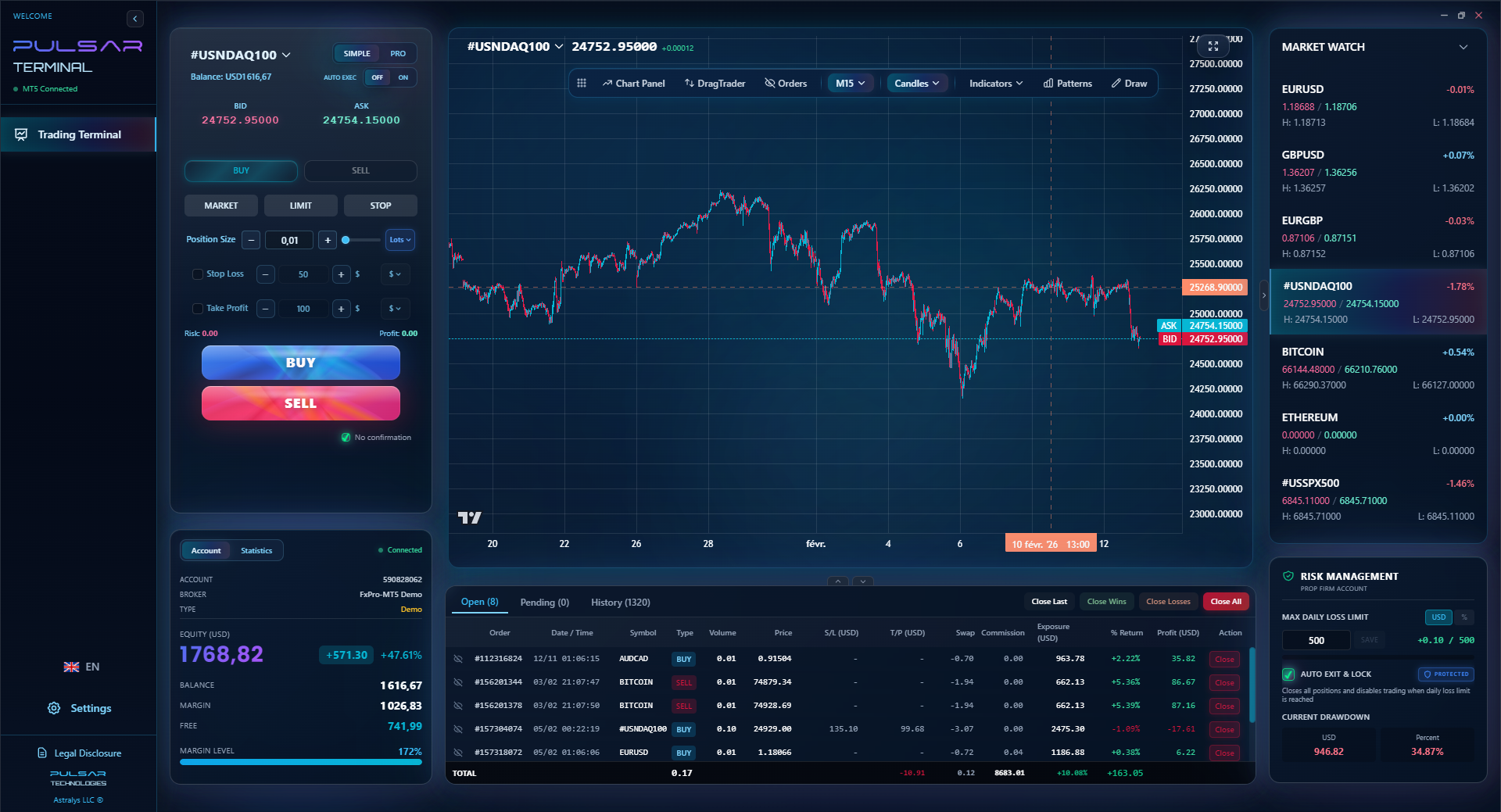
When testing a broker's platform with a bonus, managing multiple trades to hit volume targets is a headache; Pulsar Terminal's drag-and-drop order and grid trading tools let you set up and manage those precise lot requirements on MT5 without the stress.
After 12 years, I can tell you the traders who last aren't the bonus hunters. They're the process builders. Here's where to put your energy.
1. Start with a Proper Demo Account: Seriously. A full-featured demo with virtual $50,000 is infinitely more valuable than a $30 real bonus with strings. Test your strategy for months, not minutes. Get comfortable with the platform.
2. Make a Small Real Deposit: Once you're consistently profitable on demo, open a live account with a minimal deposit. For many top FSCA brokers like those mentioned, you can start with R500-R1000. This gets you used to the psychology of real risk without the bonus T&Cs distorting your behavior. Trading a real XAU/USD position with your own R100 on the line teaches you more than trading a bonus-funded EUR/USD position ever will.
3. Use a Cent Account: Some brokers offer cent accounts, where 1 USD = 100 cents in the account. This lets you trade real-market conditions with real money, but where 1 lot is effectively 0.01 lots. It's the perfect bridge between demo and standard accounts.
4. Focus on Skills, Not Free Money: Learn one strategy inside out. Master the RSI indicator or the MACD indicator in the context of swing trading. Understand what a pip really costs you and how the spread eats into your profits. These skills will make you money for decades. A bonus might buy you a beer, once, if you're lucky.
The bottom line? Use a 2024 no-deposit bonus as a controlled, finite experiment. Then move on. Your goal is to become a trader, not a coupon clipper.
💡 Wskazówka Winstona
If you find yourself calculating lot sizes to hit a bonus deadline, you've already lost. You're no longer trading the market; you're trading a spreadsheet for the broker.
“Your focus should always be on finding a rock-solid, FSCA-regulated partner for the long haul. Everything else is just noise.”
Yes, but only under these conditions:
- You treat it as a platform test, not a wealth-building strategy. Your goal is to evaluate execution speed, slippage, and how the platform feels during load-shedding, not to get rich.
- You read every single term and condition before you even click sign-up. If you don't understand them, walk away.
- You choose the broker primarily for its FSCA regulation and reputation, with the bonus being a distant secondary factor.
- You employ even stricter risk management than with your own capital. The pressure to hit volume targets is a proven account destroyer.
- You set a mental limit: "If I lose this bonus, I stop. If I hit the volume target, I withdraw the profit and re-evaluate the broker for a real deposit."
The landscape for no deposit bonus forex brokers 2019 seekers has matured. The offers are less flashy but, from reputable brokers, more transparent. They won't make you a trader, but used correctly, they can be one small step in a much longer, more serious journey. Just don't let the tail wag the dog. Your focus should always be on finding a rock-solid, FSCA-regulated partner for the long haul. Everything else is just noise.
FAQ
Q1Can I still find no deposit bonuses like they had in 2019?
Not really. The FSCA's stricter regulations since 2018 have forced brokers to scale back and clarify their offers. You'll find smaller, more tactical bonuses ($30-$50) with very clear terms, not the large, vague promotions common pre-2019.
Q2Is it possible to actually withdraw money from a no deposit bonus?
Yes, but it's designed to be difficult. You must meet all the trading volume (lot) requirements and time limits specified in the terms. Most traders fail by taking excessive risks to hit the targets, wiping out the account first.
Q3What's the best no deposit bonus for South African traders right now?
The 'best' bonus is the one from the most reputable FSCA-regulated broker with the most reasonable terms. As of now, smaller offers from established brokers like XM or Tickmill are more legitimate than huge offers from less-known entities. Always prioritize the broker's regulation over the bonus size.
Q4Do I need to verify my account (KYC) for a no deposit bonus?
Absolutely yes. Any legitimate, regulated broker will require full Know Your Customer (KYC) verification - ID, proof of address - before crediting any bonus. If a broker gives you 'free money' without verification, it's a major red flag.
Q5How much money do I really need to start trading forex in South Africa?
You can technically start with a no-deposit bonus or a minimal deposit of R100-R500. However, for meaningful trading that allows proper risk management, a starting capital of R5,000 to R20,000 is a more realistic and safer range. This lets you trade sensible position sizes without being wiped out by a few small losses.
Q6Are no deposit bonuses taxed in South Africa?
The bonus itself is not considered taxable income until you meet the conditions to withdraw it. However, any profits you generate from trading with it are subject to South African tax laws as capital gains or revenue, depending on your trading frequency. Keep a record.
Lekcja Prof. Winstona
:
- ✓Prioritize FSCA regulation over any bonus offer, every single time.
- ✓Treat a $30 bonus as real R3000 for practicing strict risk management.
- ✓Volume requirements are designed to be account killers; don't play their game.
- ✓Use bonuses to test execution, not to build capital.
Jak przydatny był ten artykuł?
Kliknij gwiazdkę, aby ocenić
Tygodniowe analizy tradingowe
Darmowe tygodniowe analizy i strategie. Bez spamu.
O autorze
David van der Merwe
Trader Rynków Wschodzących
Trader z Johannesburga z 11-letnim doświadczeniem w walutach rynków wschodzących. Specjalizuje się w parach ZAR, handlu regulowanym przez FSCA i analizie rynku południowoafrykańskiego.
Komentarze
Może Ci się też spodobać

Cara Trading Forex Sukses: 7 Prinsip dari Trader Profesional
Cara trading forex sukses dengan 7 prinsip trader pro: manajemen modal, disiplin, journal trading, backtest. Data nyata, bukan janji profit palsu.
Jam Trading Forex Terbaik untuk Trader Indonesia: Panduan Lengkap dengan Tabel Waktu
Panduan jam trading forex untuk trader Indonesia. Tabel 4 sesi dunia, jam emas 20:00-00:00, sesi mana yang harus dihindari. Data akurat + tips dari trader berpengalaman.
Top 5 Sàn Forex Uy Tín Nhất 2026: Review Jujur dari Trader Indonesia
Top 5 sàn forex uy tín 2026 untuk trader Indonesia. Review jujur: spread, deposit, withdraw, dukungan lokal. Exness, XM, IC Markets & lebih.
All these calculators are built into Pulsar Terminal with real-time data from your MT5 account. One-click position sizing, automatic risk management, and instant calculations.
