


I blew up my first prop firm challenge in 48 hours.

James Mitchell
Starszy Analityk Tradingowy
☕ 11 min czytania
Czego się nauczysz:
I blew up my first prop firm challenge in 48 hours. I paid $150 for a $25,000 account, got cocky on some SPY call options, and hit the 5% daily loss limit before I even finished my second coffee. That $150 lesson taught me more about option prop firms than any sales page ever could. These firms aren't a golden ticket. They're a high-stakes filter designed to find the 10% of traders who won't lose their capital. If you're thinking about using an option prop firm to trade with 'house money,' you need to understand the real game you're playing.
Let's clear this up right away. An option prop firm is not a broker. It's not an investment fund. It's a company that uses your trading performance as a risk filter to allocate its own capital.
You pay them a fee (usually called a challenge or evaluation fee) to prove you can trade profitably under specific rules. If you pass, they give you access to a simulated or live account with their money. You keep a large chunk of the profits (typically 70-90%), and they keep the rest. Your risk? The fee you paid and your time. Their risk? The capital they've allocated to you.
The key legal loophole they operate under is that they're trading their own proprietary capital, not managing client funds like a traditional broker or hedge fund. This has kept them in a regulatory gray area for years, but that's changing fast, as we'll discuss later. The entire model is built on a simple, brutal statistic: only about 10% of people who take these challenges actually get funded. The other 90% are paying tuition for a very expensive lesson in risk management.

Warning: Don't confuse a prop firm with a signal service or a managed account. A legitimate prop firm never promises returns. You're paying for an evaluation, not an investment. If a site guarantees profits, run.

💡 Wskazówka Winstona
Your challenge fee is tuition, not a ticket. If you learn one thing about risk management from failing, it was worth it. If you just get angry and try again with the same plan, you're wasting money.
“Only about 10% of people who take prop firm challenges actually get funded. The other 90% are paying tuition.”
Forget the marketing. Here are the actual numbers you'll deal with, straight from the industry in 2026. These aren't estimates; this is what you'll see when you go to sign up.
The Upfront Price of Admission
You don't make a deposit. You buy a test. The cost scales with the account size you want to qualify for.
| Desired Account Size | Typical Challenge Fee |
|---|---|
| $5,000 | $17 - $37 |
| $10,000 | $50 - $80 |
| $25,000 | $100 - $150 |
| $50,000 | $200 - $300 |
| $100,000 | $399 - $600 |
These are one-time fees for most challenges, though some firms have moved to a monthly subscription model. If you blow the challenge, you'll often pay a reset fee of $60-$80 to try again. Pass, and you might face a one-time activation fee to get your funded account, which can be anywhere from $0 to $800.
The Profit Split (The Only Number That Matters)
This is your potential payoff. Most firms offer a standard 70% to 90% split in your favor. The better firms are at 80% or above. I've seen some aggressive offers for 95% or even 100% on the first chunk of profits to attract talent. Don't get blinded by the top number. A 90% split with high commissions and slippage is worse than an 80% split on a clean, direct market access platform like those offered by brokers such as IC Markets or Pepperstone.
The Hidden Costs of Trading
You're trading the firm's capital, but you still pay the costs of doing business.
- Commissions: For futures options, expect ~$3-$4 per contract, per side. A round trip is $6-$8.
- Spreads: Some forex-focused firms advertise raw spreads from 0.0 pips, but charge a commission per lot (e.g., $5 per 100k).
Every dollar in commission is a dollar less in your profit split. A scalping strategy that works on a demo account can become unprofitable once you factor in these real transaction costs. Always use a position size calculator that includes commissions.

Example: Let's say you pass a $50,000 challenge. You make a $5,000 profit in your first month. With an 80% split, you get $4,000. But if you traded 100 futures contracts to get there, at $7 round trip, you paid $700 in commissions. Your net profit for the firm was $4,300. Your actual take-home is $4,000. The firm made $300 + their 20% ($860) = $1,160. You did the work; they got a solid return on their allocated capital and your fee.
“Your first goal in any challenge is not to make money. It's to avoid hitting the daily loss limit.”
This is where most traders get wrecked. The challenge rules aren't just about making a profit. They're about proving you can trade without taking catastrophic risk. Violate any of these, and you're out, fee gone.
1. The Daily Loss Limit: This is the silent account killer. It's usually a fixed dollar amount or a percentage of your starting balance (e.g., 5%). For a $25,000 account, a 5% daily loss limit is $1,250. Hit that, and your challenge is over immediately. No warning. This rule punishes revenge trading and poor intraday risk management harder than anything. It's why my first challenge ended so fast.
2. The Maximum Drawdown (Overall Loss Limit): This is your total allowed loss from your starting equity high. It's often around 10-12%. If you start at $25,000, run up to $27,000, then fall back to $24,500, you might hit your max drawdown. Why? Because your drawdown is calculated from your peak equity ($27,000). A 10% drawdown from the peak is $2,700. $27,000 - $2,700 = $24,300. If your balance hits $24,300, you fail. This rule makes it incredibly dangerous to let winning trades turn into losers.
3. The Profit Target: You usually need to hit a target (e.g., 8-10% of the account size) within a certain time frame (30-60 days) without violating the loss rules. This forces you to trade actively, which can lead to overtrading.
4. Minimum Trading Days: You might be required to trade on a set number of days (e.g., 5-10 days) to pass. This prevents someone from passing on one lucky scalping trade.
The psychological pressure of these combined rules is immense. It's not just "be profitable." It's "be profitable, don't lose too much on any day, don't lose too much overall, trade consistently, and do it all in a month." This is the filter. The 90% who fail usually trip on a loss rule, not the profit target.

Pro Tip: Your first goal in any challenge is not to make money. It's to avoid hitting the daily loss limit. Trade tiny. A 0.5% risk per trade means you'd need 10 consecutive losers to hit a 5% daily limit. That gives you room to breathe and think.
💡 Wskazówka Winstona
The daily loss limit is your master. Plan every trade so that ten consecutive losses won't breach it. This forces position sizes so small it feels silly. That's the point.
Manually tracking daily loss limits and max drawdowns against your peak equity is a spreadsheet nightmare that Pulsar Terminal automates in real-time, directly on your MT5 chart.
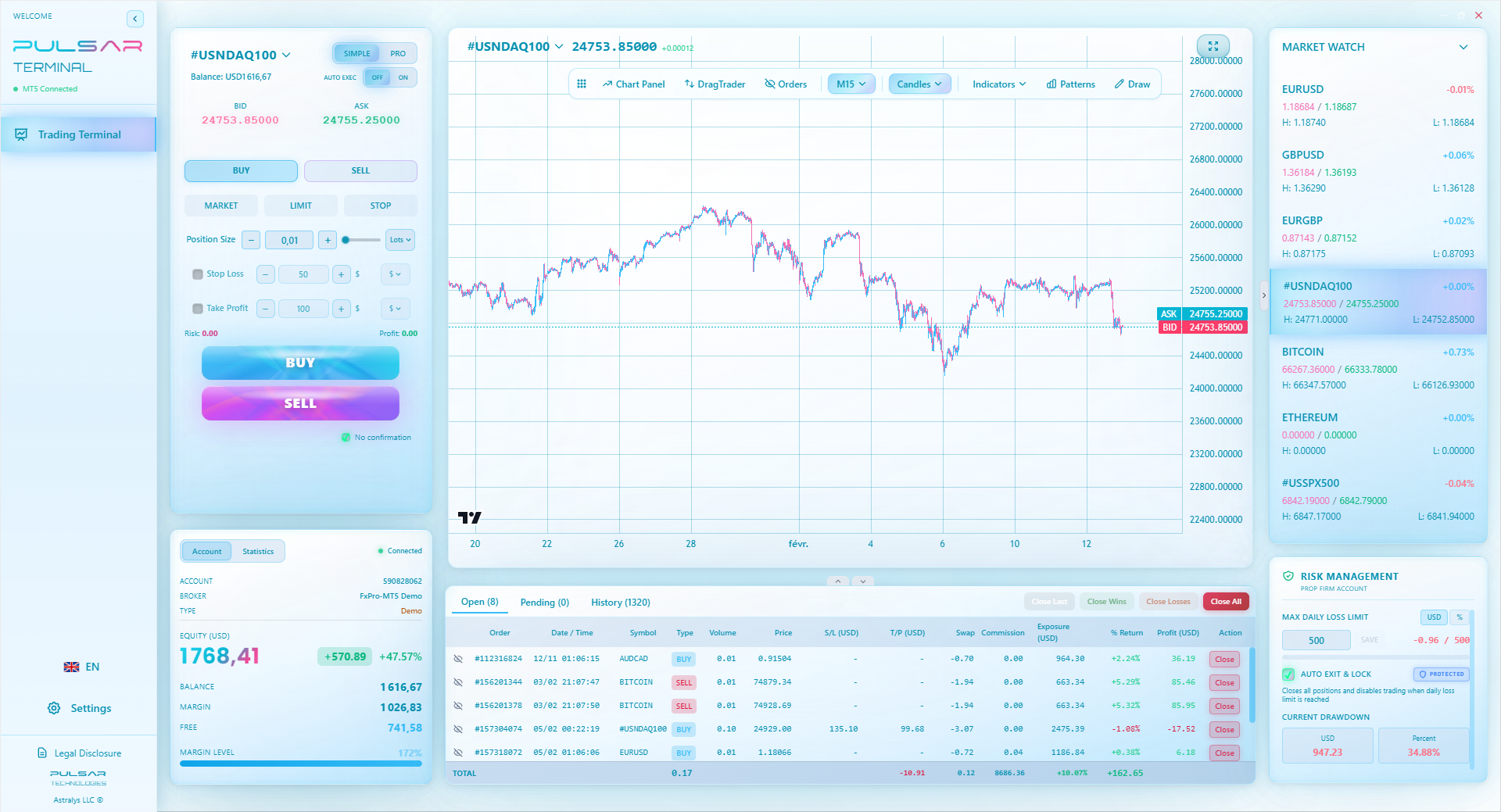
“Your first goal in any challenge is not to make money. It's to avoid hitting the daily loss limit.”
The Trading Platforms
You won't be using some janky in-house platform. Reputable firms partner with or provide access to professional-grade software. For US options traders, the big ones are:
- ThinkorSwim (by Charles Schwab): The gold standard for retail options analysis.
- TradeStation: A powerhouse with excellent options analytics and scripting.
- Interactive Brokers: The go-to for direct market access and low costs.
- Sterling Trader Pro & NinjaTrader: Popular for futures and futures options.
If you're trading forex or CFDs, you'll see MetaTrader 5 (MT5), cTrader, or DXtrade. The platform matters. You need to be comfortable with its options chain, analytics, and order execution speed.
The Tax Headache (1099 Time)
This is critical for US traders. When you get paid, the prop firm will issue you a 1099-MISC or 1099-NEC form for your earnings. Your profit share is considered self-employment income. You owe income tax on it, plus you have to pay the self-employment tax (Social Security and Medicare, ~15.3%). There's no employer withholding anything. Set aside at least 30-35% of every payout for taxes. I learned this the hard way with my first big payout and got slaughtered the following April.
Payout Schedules
Most firms have a first-payout threshold (e.g., you need $1,000 in profits) and then pay out bi-weekly or monthly. Payment methods are usually ACH bank transfer (takes 2-5 business days), PayPal, or even crypto for faster access. The process is generally smooth once you're funded, but read the fine print on processing times.
“The profit split is the sizzle, but the loss limits are the steak. They're what actually determine your survival.”
The party in the gray area is ending. Regulators have finally caught up to the prop firm model, and massive changes are underway.
The Crackdown Has Started: In February 2024, the SEC adopted new rules (3a5-4 and 3a44-2) that broadened the definition of a "dealer." This could potentially sweep in active proprietary traders. The CFTC and NFA are also intensifying scrutiny. They're no longer buying the argument that these are just "educational evaluations."
What's Coming by 2026:
- Mandatory Licensing: Prop firms offering futures and options access will likely need to register, possibly as Commodity Trading Advisors (CTAs) or Introducing Brokers. This means capital requirements, audits, and formal disclosures.
- Stricter KYC/AML: Expect deeper background checks, identity verification, and fraud monitoring. It'll be more like opening a brokerage account.
- Broker-Level Rules: Regulators will apply broker-style expectations - like clear risk disclosure and conflict-of-interest rules - even though the firms don't hold client funds.
- Fee Transparency: The days of hiding fees in the fine print are numbered. You'll see clearer breakdowns of challenge costs, resets, and activations.
What This Means For You:
- Safer Firms: The shadier operations will be forced out. The firms that survive will be more legitimate, but also more bureaucratic.
- Higher Costs: Compliance costs money. These costs may be passed on through slightly higher fees or tighter trading rules.
- Potential for Grandfathering: If you're already funded with a good firm when new rules hit, you'll probably be okay. But new applicants might face stricter hurdles.
The bottom line? The regulatory winds are shifting from a light breeze to a gale. Trade with a firm that's preparing for this, not one that's pretending it won't happen. This environment makes rock-solid risk management non-negotiable. A single margin call event in a volatile options market could end your funded account fast.
“The profit split is the sizzle, but the loss limits are the steak. They're what actually determine your survival.”
Let's be brutally honest. An option prop firm is right for a very specific type of trader:
You might be a good candidate if:
- You have a proven, written trading plan with clear entry/exit rules for options.
- You have at least 6-12 months of consistently profitable demo or small live account trading.
- You understand options Greeks (Delta, Gamma, Theta, Vega) and how they impact your position.
- You have the discipline to risk 0.5-1% per trade without deviation.
- You treat the challenge fee as a sunk cost for a business opportunity, not a lottery ticket.
You are absolutely not ready if:
- You're looking for "free money" or a quick fix.
- You don't know what a spread is or how time decay (Theta) works.
- Your risk management is an afterthought.
- You've never traded options with real money (even a small amount).
- A $150 loss on a challenge fee would cause you financial stress.
My advice? Before you give a prop firm a dime, paper trade your strategy for a month under their exact rules. Use a spreadsheet to track your daily P&L against their daily loss limit and max drawdown. If you can't survive that simulated gauntlet, you're just donating your money.
For some, a prop firm is the best path to trading meaningful capital. For most, it's an expensive lesson. The difference isn't luck. It's preparation, discipline, and an unemotional acceptance of the rules of the game.
💡 Wskazówka Winstona
Before you pay a single challenge fee, simulate it for 30 days in a demo account with a hard stop at the firm's daily and max drawdown limits. If you can't do it with fake money, you won't do it with real pressure.
“Regulatory winds are shifting from a light breeze to a gale. The gray area is turning black and white.”
Throwing yourself at prop firm challenges isn't the only path. Consider these, especially with the regulatory uncertainty.
1. Trade Your Own Capital (The Hardest, But Cleanest Way) Start small. Seriously small. A $500 account risking $5 per trade. The lessons you learn managing real, personal risk are useful. Scaling up slowly with your own profits is the ultimate validation of your edge. You keep 100% of the profits and answer to no one's rules but your own. All the tools you need - like the RSI indicator or MACD - are available on any retail platform.
2. Specialized Retail Brokers Brokers like Exness or XM offer use that, while risky, can amplify a small account. The key is using that use responsibly, not as a crutch for poor swing trading ideas. You have full control and direct market access.
3. Find a Mentor or Join a Trading Desk Some old-school proprietary trading desks still exist, where you train in-house and trade the firm's capital after a probation period. These are harder to find and often require relocation, but they offer real training, not just a pass/fail test.
The prop firm model is seductive because it offers big capital with limited personal risk. But that limitation is an illusion. The real risk is to your time, your psychology, and your bank account from repeated challenge fees. Building your own track record with personal capital, even if it's slow, gives you a skill no one can take away.
FAQ
Q1What's the main difference between a prop firm and a regular broker?
A broker (like Interactive Brokers) holds your money, executes your trades, and charges you commissions/fees. A prop firm uses its own money. You pay them a fee for a chance to trade their capital and share in the profits. You don't deposit trading funds with a prop firm.
Q2Are option prop firms legal in the United States?
Currently, they operate in a legal gray area by trading proprietary capital and framing their services as evaluations. This is under intense regulatory scrutiny. By 2026, expect new rules requiring registration, licensing, and stricter transparency, which will force many firms to change or shut down.
Q3What is a typical profit split with a prop firm?
Most firms offer between 70% and 90% of profits to the trader, with 80% being a common standard. Some offer promotional splits up to 95% or 100% for initial targets. Always read the fine print, as the split can change based on performance tiers.
Q4How do taxes work with prop firm payouts?
In the US, your profit share is considered self-employment income. The firm will send you a 1099 form. You must pay income tax plus self-employment tax (about 15.3% for Social Security/Medicare). Set aside at least 30-35% of every payout for tax season.
Q5Can I trade any options strategy in a prop firm challenge?
No. Most firms have rules against certain high-risk strategies like selling naked options (uncovered calls/puts) or holding positions over earnings announcements. Always check the firm's allowed instruments and strategy restrictions before you start.
Q6What happens if I pass the challenge but then blow the funded account?
Most firms have a "risk of ruin" rule. If you hit the maximum drawdown on your live funded account, you lose the account. Some firms offer a one-time reset for a fee, but you often have to start back at a lower capital level. It's not a lifetime grant.
Q7Is it better to start with a small or large account challenge?
Start small. The rules are the same, but the psychological pressure and dollar-value of the loss limits are lower. Passing a $10,000 challenge proves you understand the game. You can always scale up later. Blowing a $100,000 challenge on day one is just an expensive ego trip.
Lekcja Prof. Winstona
:
- ✓Treat the challenge fee as a sunk cost, not an investment.
- ✓Risk a maximum of 0.5% per trade to survive daily limits.
- ✓Set aside 35% of every payout for taxes immediately.
- ✓Paper trade the exact rules for 30 days before paying.
- ✓The 5% daily loss limit is the most common failure point.
Jak przydatny był ten artykuł?
Kliknij gwiazdkę, aby ocenić
Tygodniowe analizy tradingowe
Darmowe tygodniowe analizy i strategie. Bez spamu.
O autorze
James Mitchell
Starszy Analityk Tradingowy
Z siedzibą w Nowym Jorku, ponad 9 lat doświadczenia w tradingu. Koncentruje się na głównych parach USD, wyzwaniach prop firm i amerykańskim otoczeniu regulacyjnym.
Komentarze
Może Ci się też spodobać

Cara Trading Forex Sukses: 7 Prinsip dari Trader Profesional
Cara trading forex sukses dengan 7 prinsip trader pro: manajemen modal, disiplin, journal trading, backtest. Data nyata, bukan janji profit palsu.
Jam Trading Forex Terbaik untuk Trader Indonesia: Panduan Lengkap dengan Tabel Waktu
Panduan jam trading forex untuk trader Indonesia. Tabel 4 sesi dunia, jam emas 20:00-00:00, sesi mana yang harus dihindari. Data akurat + tips dari trader berpengalaman.
Top 5 Sàn Forex Uy Tín Nhất 2026: Review Jujur dari Trader Indonesia
Top 5 sàn forex uy tín 2026 untuk trader Indonesia. Review jujur: spread, deposit, withdraw, dukungan lokal. Exness, XM, IC Markets & lebih.
All these calculators are built into Pulsar Terminal with real-time data from your MT5 account. One-click position sizing, automatic risk management, and instant calculations.
