


You know how to spot a setup.

Olumide Adeyemi
Pionier Tradingu w Afryce Zachodniej ·  Nigeria
☕ 10 min czytania
Czego się nauczysz:
- 1The Market Order: Your Get-In-Now Button (And Its Dangers)
- 2Pending Orders: Limit and Stop Orders (Your Strategic Weapons)
- 3Stop-Loss & Take-Profit: Non-Negotiable Survival Tools
- 4Advanced Orders: Trailing Stops & OCOs
- 5The Nigerian Reality: Naira, Brokers, and Latency
- 6The Mistakes I See Every Day (And How to Fix Them)
You know how to spot a setup. You've got your RSI indicator and MACD indicator lined up. But when it's time to pull the trigger, you just click 'buy' or 'sell' and pray? That's how you get wrecked. The difference between a consistent trader and a broke one isn't just analysis, it's execution. Your order type is your contract with the market. Get it wrong, and you're handing your money to someone who knows better. Let's fix that.
A market order is the simplest of all order types in forex. You tell your broker to buy or sell at the absolute best price available right now. No fuss, no waiting. It's like hailing a danfo bus - you get on immediately, but you don't get to haggle over the fare.
For highly liquid pairs like EUR/USD, it's usually fine. The spread (the difference between buy and sell price) is tight, and you get filled almost instantly. I use it all the time for my scalping strategy entries when momentum is screaming.
But here's where Nigerian traders get burned. You try this during low liquidity - maybe late Friday night or around a major Naira-related news event from the CBN. The spread can widen violently. I learned this the hard way trading GBP/NGN a few years back. I placed a market sell order for 0.5 lots. The quoted price was 1,520. My fill? 1,535. A 15-pip spread eaten instantly, which on that position was about $75 gone before the trade even moved. That's a classic 'slippage' event.

Warning: Never use a market order on exotic pairs or during major news (like CBN policy announcements) unless you're okay with paying a potentially massive, hidden fee via spread widening. That's not trading, it's donating.
When a Market Order Makes Sense
Use it when speed is everything and the pair is liquid. Entering a fast-moving trend on EUR/USD? Sure. Trying to catch a breakout on USD/JPY? Go ahead. Just know the exact cost. Most platforms show you the estimated spread before confirming. If that number looks fat, walk away.

💡 Wskazówka Winstona
Your first loss is your best loss. A stop-loss isn't a failure, it's a pre-paid lesson. Letting a loss run is the only real failure.
This is where you stop being a passenger and start driving. Pending orders let you set a trade to execute only if the market reaches your specified price. The two main types are limit orders and stop orders.
A limit order is your bargain-hunting tool. You set a price better than the current market price. Buy limit below the market, sell limit above it. You're saying, "I'll only buy if it gets cheaper," or "I'll only sell if it gets more expensive." I use buy limits religiously for pullbacks in an uptrend. For instance, if EUR/USD is rallying and pulls back to a key support level at 1.0850, I'll set a buy limit there. It automates the entry, so I don't have to stare at the screen.
A stop order (often called a stop-entry order) is your breakout catcher. You set a price worse than the current market. Buy stop above the market, sell stop below it. This is for trading breakouts. If GBP/USD has been consolidating between 1.2650 and 1.2700, I might place a buy stop at 1.2710. If price rockets up through resistance, the order triggers, and I'm in.

Pro Tip: Your broker's server location matters for these. If their servers are in London and you're in Lagos, there's a latency delay. That stop order at 1.2710 might get filled at 1.2725 on a fast move. Use brokers with good local infrastructure or low-latency connections.
The real magic? Combining these with your stop-loss and take-profit from the get-go. Don't just set the entry and forget. A pending order without a stop-loss is a recipe for a margin call. Always attach your risk management before you walk away.
“A limit order gives you price control. A market order gives you execution certainty. You rarely get both.”
If you remember nothing else, remember this: entering a trade without a stop-loss (SL) and take-profit (TP) is financial suicide. It's not debatable. These aren't just 'order types in forex'; they are your life support system.
A stop-loss order is an instruction to close your trade at a specific price to cap your loss. It's an admission that you can be wrong. My rule? I decide my SL before I calculate my position size. I never risk more than 1% of my account on a single trade. If my stop is 20 pips away, I use a position size calculator to figure out how many lots I can trade so that 20 pips = 1% of my account.
Let me give you a real, painful example. Early on, I went long on XAU/USD (gold) at $1,800. I didn't set a stop. "It'll come back," I thought. It didn't. It dropped to $1,750. A 50-pip move on gold is huge. I watched a $5,000 loss mount up, frozen. I finally closed at $1,745. That loss took me six months of disciplined trading to recover. Never again.
A take-profit order does the opposite. It locks in profit when your target is hit. The psychology here is harder than it seems. Greed makes you move your TP further away. Fear makes you close it early. The solution? Set it based on your strategy's risk-reward ratio. If my SL is 20 pips, my TP should be at least 40 pips away for a 1:2 ratio. Then I walk away. Let the order do its job.

Example: You have a 1 million Naira account (1% risk = 10,000 Naira). You want to buy USD/NGN, with a SL 50 pips away. If the pip value for 1 standard lot is roughly 1,000 Naira, then 50 pips would be 50,000 Naira risk - way too high. You'd need to trade a micro lot (0.1) to keep your risk near 10,000 Naira. This math is everything.
Brokers like Exness and IC Markets let you attach these orders directly to your main trade ticket. There's no excuse not to use them.
💡 Wskazówka Winstona
If you're manually moving a stop-loss to avoid a loss, you've already lost. You're just refusing to admit it. The market doesn't care about your pride.
Once you've mastered the basics, these tools can seriously upgrade your game. They automate processes that are emotionally difficult.
A trailing stop is a dynamic stop-loss. Instead of a fixed price, it's set at a certain distance (in pips or percentage) from the current market price. As the price moves in your favor, the stop-loss follows it, locking in profit. If the price reverses, the stop gets triggered.
I use these for strong trend-following trades. Say I'm in a swing trading position on EUR/USD in a clear uptrend. I set a 50-pip trailing stop. Price goes up 100 pips, my stop moves up 100 pips, now 50 pips below the current high. If it then drops 51 pips, I'm out with about 50 pips profit. It lets profits run without me having to manually drag my stop-loss every hour.
The catch? You need a platform that supports it properly on all account types. Some brokers only offer it on their proprietary platforms, not MT4/5.
A One-Cancels-the-Other (OCO) order is a pair of pending orders linked together. When one is triggered, the other is automatically canceled. It's perfect for trading a range or an impending breakout where you're not sure of the direction.
Imagine USD/NGN is squeezing in a tight range. You think it's about to explode, but you don't know if it'll be up or down. You can place a buy stop above the range and a sell stop below the range as an OCO pair. Whichever way it breaks, you get in, and the opposite order is canceled. It's a strategic way to trade volatility without having two opposing positions open.
These aren't for beginners. Get your basic risk management rock-solid first. But when you're ready, they're powerful.
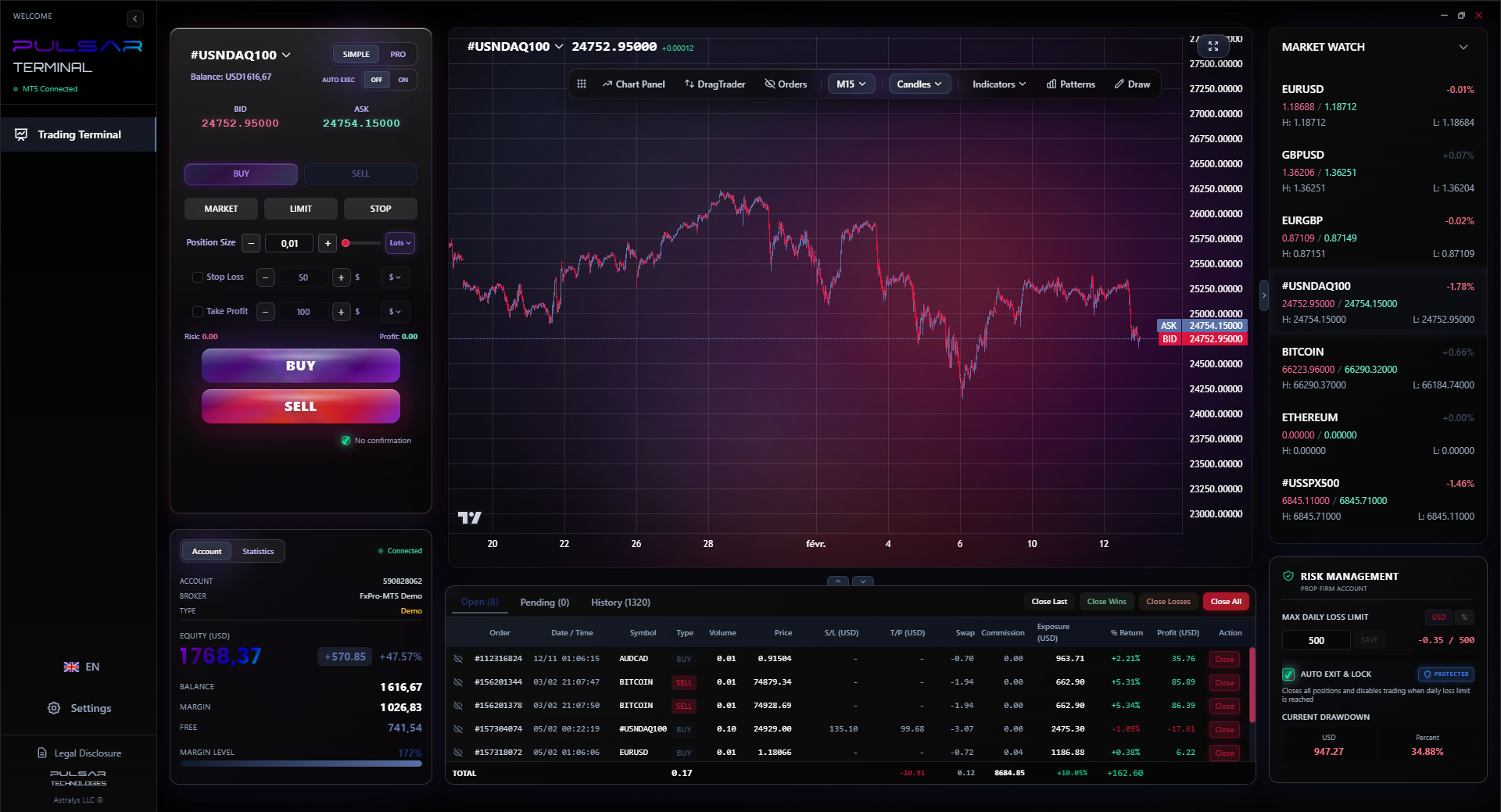
Managing multiple take-profit levels and trailing stops manually is a headache, which is why tools like Pulsar Terminal automate these advanced order types directly within your MT5 platform.
“The difference between a consistent trader and a broke one isn't just analysis, it's execution.”
Trading from Nigeria isn't the same as trading from London or New York. Our context changes everything about how we use these order types in forex.
First, the Naira. Trading pairs like USD/NGN or EUR/NGN is a whole different beast compared to majors. Liquidity can be thinner, and spreads can be monstrous, especially around CBN policy windows. A market order on these during a volatile period? You're asking for trouble. Always use limit orders to specify your exact entry price.
Second, broker choice is critical. Many international brokers like XM or Pepperstone accept Nigerians, but they often do so under their offshore entities (Seychelles, BVI). This can affect order execution quality and dispute resolution. Look for brokers with a physical presence or strong reputation in Africa. Check their average spreads on the pairs you trade and, crucially, their deposit/withdrawal methods for Naira. You don't want your profit stuck in some obscure e-wallet.
Third, internet and power. A trailing stop is useless if your internet drops and the platform disconnects. Most brokers execute orders on their server side, so once set, a stop-loss should still work. But if you're trying to place an order during load-shedding and your generator hiccups... you see the problem. I've missed entries because of this. The solution? Have a backup - a mobile phone with data, or set your orders well in advance of volatile periods.
Finally, taxes. The FIRS wants 10% of your capital gains. That's a fact. Factor that into your profit targets. A 50-pip win isn't 50 pips after costs and taxes. Your order strategy needs to account for this overhead, aiming for higher-probability, better risk-reward setups to clear the hurdle.
💡 Wskazówka Winstona
A limit order is a patient hunter. A market order is a hungry dog. Decide which one you are before you open the platform.
After mentoring traders here for years, the same errors pop up constantly. Let's kill them off.
Mistake 1: Placing a stop-loss too close. You're scared of loss, so you put your SL 5 pips away on a pair that routinely has 3-pip spreads and 10-pip noise. You get stopped out by normal market wobble, then watch the trade go your way. It's infuriating. Fix: Place your stop-loss beyond recent swing highs/lows or key technical levels. Give your trade room to breathe.
Mistake 2: Chasing with market orders. You see GBP/USD flying, FOMO kicks in, and you hammer the buy button with a market order. You get filled at the worst possible moment, right before a pullback. Fix: If you miss the initial move, don't chase. Wait for a retracement and use a buy limit order at a support level, or wait for a new consolidation and use a buy stop order above it.
Mistake 3: Not understanding the spread cost. You think a trade is profitable if it moves 2 pips in your direction. But if the spread was 1.5 pips, you're barely breaking even after commissions. Fix: Know the typical spread for your pair and broker. On a standard account with IC Markets, EUR/USD might be 0.8 pips. On a raw spread account with a $3.50 commission, it might be 0.0 pips plus the fee. Factor this into your minimum target.
Mistake 4: Forgetting about weekend gaps. You hold a trade over the weekend with a stop-loss. Major news hits Sunday night, the market opens Monday with a huge gap, and your stop is executed far beyond your intended price. Fix: For swing trading, either close positions before the weekend or use a guaranteed stop-loss (if your broker offers it, for a fee). Or, just accept that gap risk is part of the game and size your positions accordingly.
The core fix for all of this? Have a written trading plan that specifies which order type you'll use for entry, where your SL and TP will go, and why. Then follow it like your account depends on it. Because it does.
FAQ
Q1What is the most basic order type in forex?
The market order. It's an instruction to buy or sell at the best available price right now. It's simple but can be expensive due to slippage if used at the wrong time, like during low liquidity or high volatility.
Q2Should I use a stop-loss on every single trade?
Yes. Absolutely, 100% yes. No exceptions. A stop-loss defines your risk. Trading without one is gambling, not trading. It's the single most important of all order types in forex for protecting your capital.
Q3What's the difference between a stop-loss and a stop order?
A stop-loss is an order to close an existing trade to limit a loss. A stop order (or stop-entry order) is used to open a new trade when the market reaches a specified price (e.g., to trade a breakout). The terminology is confusing, but the context (opening vs. closing) is key.
Q4Are limit orders better than market orders?
Not 'better,' but different. Limit orders give you price control but no execution guarantee (the price might never reach your level). Market orders give you execution certainty but no price control. Use limits for strategic entries at specific levels and markets when you need immediate entry on liquid pairs.
Q5How do I choose a good broker for order execution in Nigeria?
Look for low and consistent spreads on your preferred pairs (check EUR/USD and any Naira pairs), reliable Naira deposit/withdrawal options, and a platform (like MT5) that supports all the order types you need. Regulation by a reputable authority (like ASIC or FSCA) is a plus, even if it's their offshore branch. Read reviews like our Exness review for specifics.
Q6What is slippage and how can I avoid it?
Slippage is when your order is filled at a different price than you requested. It happens with market orders and triggered stop-losses during fast-moving markets. To minimize it, avoid trading during major news events, use limit orders where possible, and trade the most liquid currency pairs (like EUR/USD).
Q7Do I pay tax on profits from forex trading in Nigeria?
Yes. The FIRS considers forex trading profits as capital gains, taxable at 10%. You are responsible for declaring this income and paying the tax. Keep clear records of all your trades, profits, and losses.
Lekcja Prof. Winstona
:
- ✓Always use a stop-loss. No excuses.
- ✓Understand the spread cost before you click buy.
- ✓Use limit orders for precise, strategic entries.
- ✓Factor in 10% capital gains tax on all profits.
- ✓Choose a broker with reliable execution for Nigeria.
Jak przydatny był ten artykuł?
Kliknij gwiazdkę, aby ocenić
Tygodniowe analizy tradingowe
Darmowe tygodniowe analizy i strategie. Bez spamu.
O autorze
Olumide Adeyemi
Pionier Tradingu w Afryce Zachodniej
Jeden z najaktywniejszych edukatorów tradingu forex w Nigerii. 8 lat doświadczenia tradingowego z Lagos. Specjalizuje się w strategiach niskiego kapitału i wyzwaniach prop firm dla afrykańskich traderów.
Komentarze
Może Ci się też spodobać

Cara Trading Forex Sukses: 7 Prinsip dari Trader Profesional
Cara trading forex sukses dengan 7 prinsip trader pro: manajemen modal, disiplin, journal trading, backtest. Data nyata, bukan janji profit palsu.
Jam Trading Forex Terbaik untuk Trader Indonesia: Panduan Lengkap dengan Tabel Waktu
Panduan jam trading forex untuk trader Indonesia. Tabel 4 sesi dunia, jam emas 20:00-00:00, sesi mana yang harus dihindari. Data akurat + tips dari trader berpengalaman.
Top 5 Sàn Forex Uy Tín Nhất 2026: Review Jujur dari Trader Indonesia
Top 5 sàn forex uy tín 2026 untuk trader Indonesia. Review jujur: spread, deposit, withdraw, dukungan lokal. Exness, XM, IC Markets & lebih.
All these calculators are built into Pulsar Terminal with real-time data from your MT5 account. One-click position sizing, automatic risk management, and instant calculations.
