


I was staring at my screen, AUD/USD ticking at 0.6825.

Sarah Collins
Strateg Tradingowy ·  Australia
☕ 12 min czytania
Czego się nauczysz:
- 1What the Hell is a Pip, Really?
- 2Calculating Pip Value: Your Dollar and Cents
- 3Pips, Spreads & Commissions: The Real Cost of Trading
- 4ASIC Rules & use: How They Change the Pip Game
- 5Using Pips for Real Risk Management
- 6Trading Strategies Through a Pip Lens
- 7Pip Pitfalls: Mistakes I've Made (So You Don't Have To)
- 8Putting It All Together: Your Pip Action Plan
I was staring at my screen, AUD/USD ticking at 0.6825. My stop loss was set at 0.6815. Ten pips away. A news spike hit, and the price sliced through my stop like a hot knife through butter, settling at 0.6803. I'd just lost 22 pips, not 10. That moment, years ago, taught me more about the real cost of a pip than any textbook ever could. It's not just a unit of measure, it's the fundamental building block of your profit, loss, and survival. For us trading from Australia, with our unique rules and favourite 'Aussie' pair, understanding pips isn't beginner stuff, it's the core of the craft.
Let's cut through the jargon. A pip is simply the smallest standard move a currency pair can make. For most pairs, like EUR/USD or our beloved AUD/USD, that's a movement at the fourth decimal place: 0.0001. If AUD/USD moves from 0.6750 to 0.6751, it's up one pip.
Now, the Japanese Yen throws a spanner in the works. For pairs like USD/JPY, a pip is a move at the second decimal place: 0.01. So, from 150.00 to 150.01 is one pip. Keep that straight, or your risk calculations will be a disaster.
Then you've got the 'pipette' or 'tenth-pip'. Brokers quote to a fifth decimal place (or third for JPY) to show tighter spreads. So a move from 0.67500 to 0.67501 is one pipette, or 0.1 of a standard pip. Don't get bogged down in it. For all your planning, use the standard pip (4th decimal, 2nd for JPY). The pipette is just for precision on entry/exit.

Example:
- AUD/USD moves from 0.6650 to 0.6660 = 10 pips.
- USD/JPY moves from 151.40 to 151.30 = 10 pips.
- AUD/USD moves from 0.66500 to 0.66505 = 0.5 pips (or 5 pipettes).
The real magic (and terror) isn't in counting pips, it's in what they're worth. And that depends entirely on your trade size.
This is where most new traders screw up. They think a 50-pip win is always a 50-pip win. It's not. The monetary value of a pip changes based on three things: the currency pair, your trade size (lot size), and the current exchange rate.
Forget the complex formulas for a second. Here's the practical cheat sheet for an Aussie trading a standard lot (100,000 units):
- For pairs where AUD is the quote currency (second), like USD/AUD: 1 pip = AUD 10.
- For pairs where AUD is the base currency (first), like AUD/USD: 1 pip = USD 10. You then convert that to AUD at the current rate.
- For pairs with no AUD, like EUR/USD: 1 pip = USD 10, converted to AUD.
The Lot Size Multiplier
Your trade size is everything. You're not always trading 100,000 units.
- Standard Lot: 100,000 units. 1 pip (AUD/USD) = ~USD 10.
- Mini Lot: 10,000 units. 1 pip = ~USD 1.
- Micro Lot: 1,000 units. 1 pip = ~USD 0.10.
I made my first major mistake here. I'd been trading micro lots, making $1 per 10 pips. Got cocky, switched to a mini lot without adjusting my stop-loss distance. A 20-pip loss suddenly cost me $20 instead of $2. It wiped out a week's work in minutes. Always, always use a position size calculator before you enter a trade. It's non-negotiable.

Pro Tip: Most trading platforms have a built-in calculator. In MT4/MT5, right-click on your open order and select 'Modify or Delete Order'. The window that pops up will often show the pip value for your pending order based on its size. Check it. Every. Single. Time.

💡 Wskazówka Winstona
A pip is just a measurement. The only measurement that matters is the percentage of your account you're risking on the trade. Always think in percentages, not pips.
“You don't start making money the second your trade goes green. You start making money after it recovers the spread.”
You don't start making money the second your trade goes green. You start making money after it recovers the spread. The spread is the difference between the buy (ask) and sell (bid) price, measured in pips. It's the broker's cut.
Let's say AUD/USD is quoted at 0.6750 / 0.6752. The spread is 2 pips. If you buy at 0.6752, the price needs to rise 2 pips just for you to break even. That's your immediate handicap.
In Australia, thanks to fierce competition among ASIC-regulated brokers, spreads can be tight.
- Major Pairs (AUD/USD, EUR/USD): You can find raw spreads from 0.0 pips on ECN accounts at brokers like IC Markets or Pepperstone. But there's a catch.
- The Commission Trade-Off: That "0.0 pip" spread usually comes with a commission per lot traded. For example, you might pay $7 round turn (in and out) per standard lot. So, a 5-pip win on a standard lot of EUR/USD ($50) becomes a $43 win after commission. You need to factor this into your profit targets.
- Standard Accounts: Often have no commission but wider spreads (e.g., 1.1 pips on AUD/USD).
Which is better? It depends on your strategy. For scalpers taking 5-10 pip profits, the raw spread + commission model is usually cheaper. For swing traders holding for 50+ pips, the wider spread/no commission account might be fine. Do the math for your own typical trade.
I learned this trading the EUR/USD guide on a standard account. I was scalping for 8-pip profits with a 2-pip spread. My effective win was only 6 pips before costs. Switching to a raw account with a 0.2 pip spread and a $5 commission turned that into a 7.8-pip effective win. That 1.8-pip difference compounded massively over hundreds of trades.
💡 Wskazówka Winstona
The spread isn't a fee, it's the first leg of your journey. If your target is only 8 pips away and the spread is 2, you're asking the market to move 25% of your target just for you to break even. Choose your battles wisely.
This is the critical Aussie-specific context. Since March 2021, ASIC has capped use for retail clients. For major forex pairs like AUD/USD, the max is 30:1. That means you need at least 3.33% of the trade's value in your account as margin.
Why does this matter for pips? Because use amplifies the monetary impact of every single pip movement on your account equity.
Pre-ASIC Cap: You could get 500:1 use. A $1,000 account could control a $500,000 position (5 standard lots). On AUD/USD, a move of just 2 pips against you would be a $100 loss (10% of your account!).
Post-ASIC Cap (30:1): That same $1,000 account can now control roughly $30,000 (0.3 standard lots). A 2-pip move against you is now about a $6 loss (0.6% of your account).
The cap is a blessing in disguise. It forces sane position sizing. Before the caps, I saw too many blow up accounts because they didn't respect the pip. They'd put on a huge position, a routine 15-pip retracement would trigger a margin call, and they'd be done. Now, the rules provide a guardrail.
The New Math
With 30:1 use on AUD/USD:
- Margin Required per Standard Lot: ~$3,333 AUD (1/30th of $100,000).
- Pip Value per Standard Lot: ~$10 USD.
- So, a 30-pip move against you on a full position would use up your entire margin. It forces you to trade smaller sizes relative to your account, making each pip's monetary impact less catastrophic. Use this to your advantage. Plan your trades in pips, then use the use rules to determine a sane lot size.
“Manage your trades based on the dollar value at risk, not the pip count.”
This is the only reason you need to understand pips. Not to brag about a 100-pip win, but to survive.
Your entire risk management plan should be built in pips first, dollars second.
- Determine Your Risk in Pips: Before you enter, identify your stop-loss level. How many pips is it from your entry? Let's say it's 25 pips on an AUD/USD trade.
- Determine Your Risk in Dollars: Decide what percentage of your account you're willing to lose on this one trade. For most, 1-2% is sane. On a $10,000 account, 1% is $100.
- Calculate Your Position Size: You now know you can risk $100 over 25 pips. $100 / 25 pips = $4 per pip. To risk $4 per pip on AUD/USD, you'd need to trade a position size of approximately 0.4 standard lots (since 1 standard lot = ~$10/pip).
This method decouples your ego from the trade. You're not thinking "I need to make $500." You're thinking "The setup has a 25-pip risk, and I can afford to lose that."

**Warning: A common mistake is placing a stop-loss based on a dollar amount ("I'll risk $50") without checking if that stop is in a logical market structure level. Always place your stop based on the chart (e.g., below the last swing low). Then, adjust your position size so that if that stop is hit, you only lose your predetermined dollar amount. The chart dictates the pip distance, your wallet dictates the position size.
Tools that allow for easy multi-level take-profits and stop-losses are useful here. For instance, if you're scaling out of a position, you can lock in profit on part of your trade while letting the rest run, all managed by precise pip distances from your entry.
💡 Wskazówka Winstona
ASIC's use caps are your friend. They're the government-mandated voice in your ear saying 'Don't be an idiot.' Listen to it.
Different strategies live in different pip worlds.
Scalping: This is a razor's edge game of 5-15 pips. I used to run a scalping strategy on the AUD/NZD during the Asian session. Profits were tiny: 7-10 pips per trade. The spread was the enemy. A 3-pip spread meant I needed a 4-pip move just to be up 1 pip. I had to use a raw spread account and be ruthlessly selective. Commission costs ate into profits, so win rate was paramount. A 55% win rate wasn't enough; I needed 65%+ to be profitable after costs.
Swing Trading: This is my bread and butter now. I'm looking for moves of 50-200 pips over days or weeks. Here, a 2-pip spread is noise. My stop-losses are wider (40-80 pips), so my position size is smaller. The key is the risk-to-reward ratio. A 60-pip stop targeting a 180-pip profit is a 1:3 ratio. I can be wrong twice for every time I'm right and still break even. This is where tools like the MACD indicator or RSI indicator can help identify longer-term momentum shifts for these bigger moves. Check out our guide on swing trading for the full framework.
The 'Aussie' Pairs (AUD/USD, EUR/AUD, AUD/JPY): These often have wider spreads than EUR/USD. EUR/AUD might have a 2-3 pip spread. That doesn't make them bad trades, it just means your profit target needs to be further away. Don't try to scalp 10 pips on EUR/AUD; you're just paying the broker. Aim for the 50+ pip swings these commodity-driven currencies are known for.
Managing multiple take-profit levels and a trailing stop based on precise pip distances is far easier with a tool that lets you drag and drop those orders directly onto your MT5 chart.
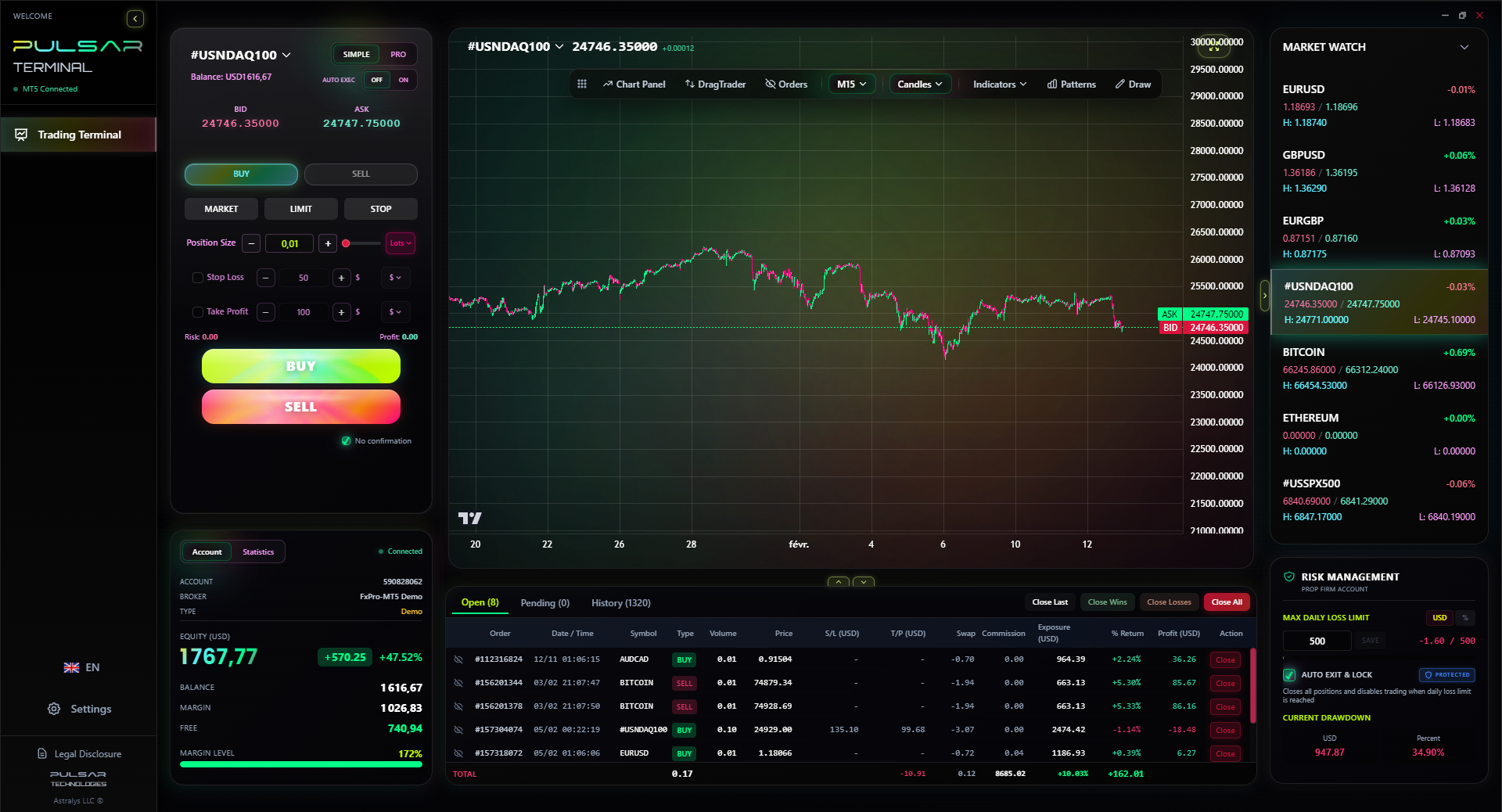
“By building your entire process around the cold, hard math of pips, you take the first step towards disciplined trading.”
Let's get honest. I've blown up part of an account. Here's how pips were involved.
Mistake 1: Ignoring Pip Value on Exotics. I once traded USD/TRY (Turkish Lira) because the chart looked great. I used my standard 0.1 lot size. What I didn't check was the pip value. On that pair, due to the exchange rate, one pip was worth about $1.40, not $0.10. A 70-pip move against me (common in exotics) cost nearly $100 instead of the $7 I was expecting. Lesson: Always check the pip value for the specific pair and your lot size.
Mistake 2: Confusing Pips with Percentages. Early on, I thought a 100-pip move on AUD/USD (from 0.7500 to 0.7600) was a 1% move. It's not. It's roughly a 1.33% move (0.01/0.75). The lower the price, the larger the percentage move for the same pip change. This affects volatility. At 0.6500, a 100-pip move is over 1.5%. Keep this in mind when assessing risk.
Mistake 3: Chasing 'Pip Count' Over Quality. I'd hold a losing trade in EUR/USD because "it's only 20 pips down," while exiting a winning trade in GBP/JPY at 30 pips up. But 20 pips on my full-size EUR trade was a $200 loss, and 30 pips on my small GBP/JPY trade was a $150 win. I was winning the pip battle but losing the money war. Manage your trades based on the dollar value at risk, not the pip count.
Mistake 4: Not Accounting for Overnight Financing (Swap). Holding a position overnight incurs a credit or debit based on the interest rate differential. This is charged in pips. On some pairs (like longing AUD/JPY in certain conditions), you can get a small credit. On others (like longing USD/TRY), the debit can be massive - sometimes 50+ pips worth per lot, per night! If you're a swing trader, these costs add up. Check the swap rates on your platform before you decide to hold for weeks.
Alright, let's wrap this into a practical checklist you can use before hitting the buy or sell button.
- Identify the Trade: See a setup on AUD/USD. Entry: 0.6650. Stop Loss: 0.6625 (25 pips away). Take Profit: 0.6725 (75 pips away).
- Check the Spread: Is it 0.8 pips or 2 pips? Know your immediate cost. If you're buying, your real breakeven is at 0.6650 + spread.
- Calculate Your Risk in Dollars: You have a $5,000 account and risk 1% per trade = $50 max risk.
- Calculate Position Size: $50 risk / 25 pips = $2 per pip. On AUD/USD, a pip is ~USD 10 for a standard lot. To get $2/pip, you need 0.2 standard lots (or 20,000 units).
- Check use: 0.2 lots on AUD/USD is $20,000 position value. At 30:1 use, required margin is ~$667. Your $5,000 account has plenty. No issue.
- Calculate Potential: 75-pip target x $2/pip = $150 potential profit (3% account gain). Risk: $50 (1%). Reward:Risk = 3:1. Solid.
- Execute and Manage: Place the trade. Consider using a trailing stop after it moves 50 pips in your favour to lock in some profit. Never move your initial stop-loss further away. If the market hits it, you were wrong. Take the 25-pip, $50 loss and live to trade the next setup.
Pips are your measuring tape, your ruler, your scale. They are objective. Your feelings about the market are not. By building your entire process around the cold, hard math of pips, you take the first and most important step towards disciplined, professional trading. Now go on, and measure your success one pip at a time.
FAQ
Q1How much is 1 pip in AUD?
It depends on the pair and trade size. For a standard lot (100k units) of a pair where AUD is the quote currency (e.g., USD/AUD), 1 pip is AUD 10. For AUD/USD, 1 pip is USD 10, which you then convert to AUD at the current rate. For a micro lot (1k units), divide those values by 100.
Q2What is a good pip spread for AUD/USD in Australia?
On a standard retail account with no commission, a spread of 0.8 to 1.2 pips is competitive. On a raw/ECN account that charges a commission, you can find spreads from 0.0 to 0.3 pips. The "best" depends on your trading style: scalpers need the tightest raw spreads, while swing traders can often tolerate slightly wider ones.
Q3How many pips should I aim for per day?
This is the wrong question. Aim for a consistent process, not a pip target. Chasing a daily pip goal leads to overtrading and forcing bad setups. Focus on your risk-per-trade (e.g., 1% of your account) and your strategy's win rate and risk-to-reward ratio. The pips will follow over time.
Q4Why is my profit/loss different from the pip movement?
Three main reasons: 1) Your position size (pip value). 2) The spread (you start in a hole). 3) For pairs that don't have your account currency, the profit/loss is converted at the current rate. Also, check if you're being charged a commission per trade.
Q5How do ASIC's use rules affect my pip calculations?
They don't change the value of a pip, but they drastically limit how many units (lot size) you can trade with a given account balance. This automatically reduces the dollar value of each pip movement on your account, forcing more conservative position sizing. It makes a 50-pip loss less likely to blow up your account, which is a good thing.
Q6What's the difference between a pip and a pipette?
A pip is the standard unit (0.0001 for most pairs). A pipette (or 'tenth-pip') is one-tenth of that, representing a move at the fifth decimal place (0.00001). Brokers use pipettes to quote tighter spreads. For all your planning and risk management, use pips.
Q7Can I make a living trading just 10 pips a day?
Technically, yes, but it's incredibly stressful and difficult. If you risk 5 pips to make 10, that's a 2:1 reward:risk. You'd need a very high win rate to be consistent, and the spread/commission becomes a huge hurdle. It's the domain of expert scalpers. For most, aiming for larger swing moves of 50+ pips with a solid risk management plan is a more sustainable path.
Lekcja Prof. Winstona
:
- ✓A pip's dollar value changes with pair, lot size, and price.
- ✓Always calculate position size using pip distance to your stop-loss.
- ✓ASIC's 30:1 use cap forces safer position sizing.
- ✓The spread is your first cost; factor it into every profit target.
Jak przydatny był ten artykuł?
Kliknij gwiazdkę, aby ocenić
Tygodniowe analizy tradingowe
Darmowe tygodniowe analizy i strategie. Bez spamu.
O autorze
Sarah Collins
Strateg Tradingowy
Londyńska strateg tradingowa z 12-letnim doświadczeniem na rynkach finansowych. Była analityczka w brokerstwie w City of London. Obejmuje pary GBP, rynki europejskie i handel regulowany przez FCA.
Komentarze
Może Ci się też spodobać

Cara Trading Forex Sukses: 7 Prinsip dari Trader Profesional
Cara trading forex sukses dengan 7 prinsip trader pro: manajemen modal, disiplin, journal trading, backtest. Data nyata, bukan janji profit palsu.
Jam Trading Forex Terbaik untuk Trader Indonesia: Panduan Lengkap dengan Tabel Waktu
Panduan jam trading forex untuk trader Indonesia. Tabel 4 sesi dunia, jam emas 20:00-00:00, sesi mana yang harus dihindari. Data akurat + tips dari trader berpengalaman.
Top 5 Sàn Forex Uy Tín Nhất 2026: Review Jujur dari Trader Indonesia
Top 5 sàn forex uy tín 2026 untuk trader Indonesia. Review jujur: spread, deposit, withdraw, dukungan lokal. Exness, XM, IC Markets & lebih.
All these calculators are built into Pulsar Terminal with real-time data from your MT5 account. One-click position sizing, automatic risk management, and instant calculations.
