


Only about 7% of traders who buy a prop firm challenge ever see a payout.

James Mitchell
Starszy Analityk Tradingowy
☕ 12 min czytania
Czego się nauczysz:
- 1What Exactly Is a Prop Firm Account? (It's Not What You Think)
- 2The US Regulatory Maze: What's Legal and What's Changing
- 3The Real Numbers: Costs, Fees, and Sobering Statistics
- 4Inside the Challenge: The Rules You Can't Afford to Miss
- 5The Funded Phase & Getting Paid: Now the Real Work Begins
- 6How to Choose a Prop Firm (US-Friendly Options)
- 7The Pitfalls: Where I (And Everyone Else) Went Wrong
- 8The Future: Is the Prop Firm Model Sustainable?

Only about 7% of traders who buy a prop firm challenge ever see a payout. Let that sink in. The industry is worth over $20 billion, with search interest exploding by over 5,500% since 2020, but most people are just buying expensive lessons in failure. I've been there. I've blown funded accounts, celebrated payouts, and watched the regulatory ground shift under my feet. This isn't a sales pitch. It's a journal from the trenches, covering what these firms really are, how the rules are changing, and whether chasing that funded dream is even worth your time anymore.
Most people get this wrong from the start. A prop firm account isn't a brokerage account where you deposit your own money. It's a performance-based audition for the firm's capital.
You pay a fee - anywhere from $100 to over $500 - to take a trading challenge. If you pass their specific profit and risk rules, they give you a simulated account with "virtual" capital. When you make profits in that sim account, the firm pays you a real split (usually 80-90%) from their own treasury. You're trading their money in a simulated environment, but the payouts are very real.

Warning: The capital isn't "yours." You don't own the account. You're a contractor being paid for profitable performance in their system. This distinction is crucial for understanding the risk and the recent regulatory crackdowns.
I learned this the hard way. Back in 2021, I passed a challenge with a $100k account. I treated it like my personal money, got emotionally attached to trades, and blew the daily loss limit on a single bad EUR/USD move. Poof. Account gone. That $100k was never mine to lose, but the psychological impact felt just as real. The first lesson is to detach. You're a hired gun, not an owner.
The appeal is obvious: access to serious size without risking your life savings. But that access comes with strings - very tight strings in the form of drawdown limits, time constraints, and often restrictive rules.

💡 Wskazówka Winstona
Never calculate your potential profits based on the full account size. Always base your position size on your max risk (daily loss limit), not your greed.
Here's where it gets messy, and honestly, a bit scary if you're not paying attention. For years, prop firms operated in a gray area. They argued they weren't brokers or investment advisors, but rather companies running skill-based evaluations. This let them sidestep direct SEC and CFTC oversight.
That free pass is ending. Fast.
The SEC "Dealer" Rule (And Its Rollercoaster)
In early 2024, the SEC adopted new rules that would classify many active proprietary trading firms as "dealers," forcing them to register with the SEC and FINRA. This would mean capital requirements, compliance overhead, and a potential gutting of their business model. The industry panicked. Then, in February 2025, the SEC withdrew its appeal on a related case, leaving the rule's future uncertain. Don't get comfortable. The intent is clear: regulators are looking closely.
The CFTC's CTA Ambitions
This is the bigger threat, in my opinion. The Commodity Futures Trading Commission (CFTC) is actively considering classifying evaluation-based prop firms as Commodity Trading Advisors (CTAs). If this sticks, it's a game-ender for many. CTAs must register, provide formal disclosures, and meet capital rules. The CFTC already amended Rule 4.7 in late 2024. The CLARITY Act, passed by the House in mid-2025, could drag crypto prop firms into this net too.
What This Means For You, The Trader
Regulatory risk is now your number one due diligence item. A firm that isn't thinking about this is a firm that could vanish overnight. Look for transparency. Do they explain their legal structure? Are they preparing for potential registration? When choosing a broker for your personal account, regulation is key. It's doubly key for the firm holding your potential payout.
The landscape is shifting from the wild west to a monitored frontier. Your chosen firm's ability to navigate this will directly impact your ability to get paid.
“The golden era of easy, unregulated prop firm money is over.”
Let's talk numbers. This is where dreams get priced.
The Fee Structure:
- Evaluation Fee: Your ticket to the dance. $100-$500 is common, but I've seen "premium" challenges for large accounts cost thousands. Some firms offer a refund on your first payout.
- Platform/Data Fees: Often hidden. You might pay $10-$30 a month for the platform (MT5, etc.) and another $15-$25 for live futures or equity data feeds. This adds up.
- Commissions: They often charge per trade. For example, one firm charges $5 per standard lot on forex. This is deducted before your profit split is calculated. It murders scalping strategies.
- Withdrawal/Inactivity Fees: Read the fine print.
The Profit Split: The standard offer is 80% to you, 20% to the firm. Some scale up to 90% or even 100% for top performers. Always calculate your net after commissions.
The Brutal Statistics:
- First-time pass rate: 5-10%. Let me repeat that. 90-95% of people fail their first try.
- Overall payout rate: Only about 7% of all traders who buy a challenge ever receive a single payout.
- My experience: I failed three challenges before my first pass. That was over $1,200 in fees before I made a dime. My first successful payout was $2,800. It took me 14 months from my first challenge purchase to be net positive.

Example: You buy a $300 challenge. You pay $50/month for platform and data during your 2-month evaluation. Your total cost is $400 before you even place a trade. To break even on your costs after an 80% split, you need to generate $500 in simulated profit ($500 * 0.8 = $400). Now add in the psychological pressure. It's a high bar.
These aren't get-rich-quick schemes. They are high-stakes tests. You need a proven, disciplined swing trading or trend-following approach, not just hope.
Passing the challenge is a tactical exercise. It's not just about making money. It's about surviving their specific obstacle course.
The Universal Rules:
- Profit Target: Usually 8-10% within 30 days. Sounds easy? It's not with the next rules.
- Maximum Daily Loss: Often 3-5%. This is your tripwire. Hit it, and you're out instantly. This is what got me on my first funded account. You must use a hard stop on every single trade. A position size calculator isn't a suggestion here; it's your lifeline.
- Maximum Overall Loss (Drawdown): Typically 10-12% from the starting balance. This includes floating losses. A trade going against you eats into this global limit.
The Devil in the Details:
- Time Limits: Some require you hit the target within a specific period (e.g., 30 days). Others give you unlimited time but charge monthly fees.
- Trading Style Restrictions: Historically, many banned news trading or holding over weekends. This is changing in 2026, with more firms allowing it. Always check the current rules.
- Minimum Trading Days: You might need 5-10 different trading days to prevent one lucky trade from passing you.
My Passing Strategy: I stopped trying to hit the 10% target quickly. I aimed for 0.5% per day, risking only 0.5% per trade. It was boring. It felt slow. But it kept me far away from the daily loss limit. I used the RSI indicator and simple support/resistance to find high-probability, low-risk entries. The goal was consistency, not heroics.
Managing the psychological pressure is 80% of the battle. That virtual money feels real when your fee and dream are on the line.
💡 Wskazówka Winstona
Treat the challenge fee as a sunk cost the moment you pay it. Trading to "get your fee back" is a guaranteed path to breaking rules.
“Your edge should never be the prop firm's model. Your edge must be in your own trading.”
Congratulations, you passed. Now forget the celebration. This is where most people fail again.
The funded account usually has slightly relaxed rules (e.g., a bigger drawdown). But the core pressure is different. Before, you risked your challenge fee. Now, you risk an active income stream. The fear of losing the "golden ticket" can paralyze you.
The Scaling Plan: Most firms offer scaling. Make consistent profits for 3-4 months, and they might increase your account size by 25-50%. This is how you get to $200k, $500k, $1M. But with size comes greater scrutiny and often tighter risk controls.
The Payout Process: This is critical. Most firms offer bi-weekly or monthly payouts. You request a withdrawal, they calculate your profit (minus their split and commissions), and send it via bank wire or crypto. The first payout can take 5-10 business days.

Pro Tip: Document everything. Take screenshots of your trade history and payout requests. I had a firm once "dispute" a profitable trade after I closed it. My screenshot of the MT5 terminal was the only thing that got me paid.
The Hidden Hurdle - Taxes: In the US, your profit share is income. You'll get a 1099-MISC or similar form. You are responsible for self-employment taxes (Social Security & Medicare) on top of income tax. Set aside 25-30% of every payout immediately. My first tax bill on prop earnings was a brutal wake-up call.
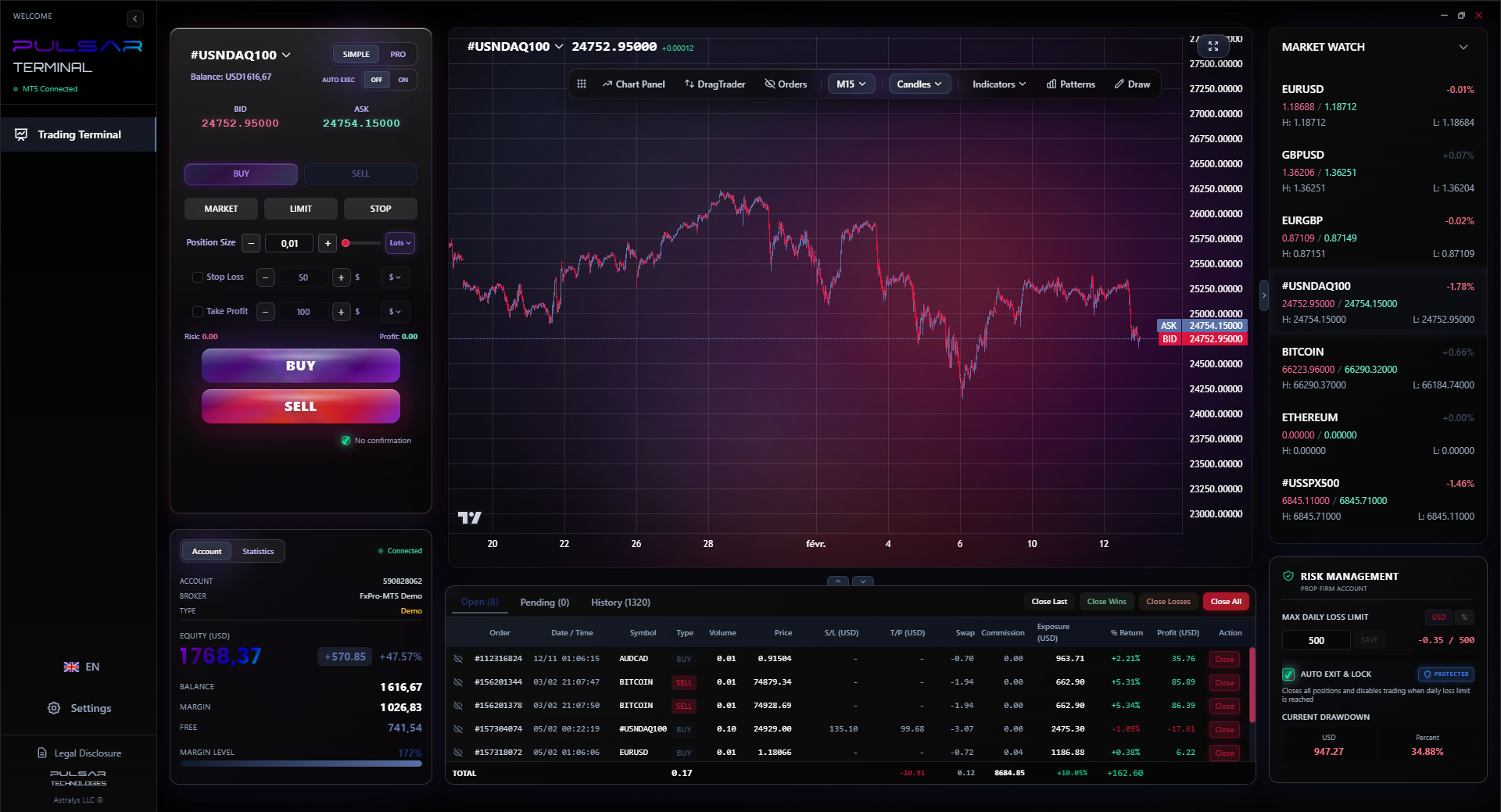
The funded phase requires more discipline than the challenge. The goal shifts from passing a test to running a sustainable, small business. One of the best tools I added was a trade journal that forced me to review every decision, a habit that tools like Pulsar Terminal now help me automate directly on my charts.
Managing the strict daily loss limits of a prop firm challenge is non-negotiable, which is why I use Pulsar Terminal to set automated, rules-based stop losses on every trade directly in MT5.
With over 2,000 firms globally and about 62% based in the US, choice is overwhelming. Don't just pick the one with the flashiest ads. Due diligence is everything.
Key Selection Criteria:
- Transparency: Can you easily find all rules, fees, and payout terms? Are their legal documents clear?
- Regulatory Posture: Are they addressing the SEC/CFTC changes? Do they have a compliance page? Silence is a red flag.
- Payout Proof & Reputation: Search for user reviews on independent forums (not just their site). Look for consistent complaints about payout delays.
- Trading Conditions: Check spreads (some offer 0.0 pips on majors), commissions, and platform choice (MT5, cTrader, etc.).
- Rule Flexibility: Do they allow your style? If you trade news, you need a firm that permits it.
A Note on US-Friendly Firms: Many global firms restrict US traders due to regulatory complexity. Firms that actively accept US clients (like Apex Trader Funding, Topstep, or Earn2Trade) have structured their models specifically for this market. This doesn't make them "safer," but it means they're already thinking about US regulations.
My Personal Vetting Process: I create a spreadsheet. I list 5 firms. I then:
- Find their full rulebook and read it.
- Calculate the total cost of a challenge (fee + 2 months of platform/data).
- Search "[Firm Name] + payout problem" and "[Firm Name] + review".
- Check their website for a compliance or legal section.
- Only then do I consider their profit split or account size.
The biggest account size is meaningless if you can't get your money out. Prioritize reliability over shiny promises.

“Regulatory risk is now your number one due diligence item.”
Let's normalize failure. Here's my hall of shame, so you can avoid it.
1. Overleveraging to Hit the Target: This is the number one killer. You're at 8% profit with 2 days left. You see a "sure thing" and triple your normal size to get the last 2%. The trade reverses, triggers your daily loss, and fails you. I've done this. Twice. The challenge is a test of patience, not aggression.
2. Ignoring the True Cost: I didn't factor in data fees and commissions. My "profitable" month on a funded account was actually a small net loss after costs. You must trade a strategy that accounts for the commission drag. High-frequency scalping is often a loser in this model.
3. Strategy Hopping: During a drawdown, I abandoned my plan. I switched from my core trend-following method to a mean-reversion MACD indicator crossover strategy I barely understood. Disaster. Stick to one proven, mechanical system.
4. Emotional Attachment to the Account: You start seeing "Funded Trader" as your identity. Losing the account feels like a personal failure, not a business setback. This leads to fear-based trading. Remember, it's a simulation contract. There are always other challenges.
5. Not Preparing for a Margin Call Scenario: Prop firms don't issue margin calls like a broker would. They just close your account. Their daily loss limit is your margin call. You must have absolute, automated risk controls. I now use tools that automatically move my stop to breakeven after a certain profit, protecting me from my own greed or hesitation.
💡 Wskazówka Winstona
Your first funded account goal isn't a Lamborghini. It's a second, identical funded account. Diversify your risk across firms.
Standing here in 2026, the industry is at a crossroads. The insane growth (over 5,500% in search interest) has attracted regulators. The consolidation has begun - 80-100 firms shut down in 2024 alone.
Trends Shaping Tomorrow:
- Futures Dominance: Futures trading is now more searched than forex among prop traders. Firms are rushing to offer CME products. This aligns with US regulatory frameworks, making futures a safer bet for firms.
- The Professionalization Shift: The low-barrier, "anyone can try" model is being squeezed. The surviving firms will look more like professional trading shops with stricter vetting, better education, and clearer paths to real capital allocation (not just sim).
- Technology Integration: Success will depend on tools. Firms and traders will use more automation for risk management, journaling, and strategy execution to remove emotion and ensure rule compliance.
My Honest Take: The golden era of easy, unregulated prop firm money is over. What's emerging is a more serious, potentially more legitimate industry. For you, the trader, this is good and bad. Good because the shady operators will be weeded out. Bad because it will be harder, more expensive, and require more professionalism.
Is it still worth it? If you approach it as a serious business venture - with a tested strategy, proper risk management, and an understanding of the tax and regulatory landscape - yes. It can be a powerful way to scale. If you're looking for a lottery ticket, save your money. The 7% payout rate tells the real story.
The final lesson? Your edge should never be the prop firm's model. Your edge must be in your own trading. The prop account is just a lever. A shaky lever on shifting ground, but a lever nonetheless.
FAQ
Q1Is my money safe with a prop firm?
Not in the traditional sense. You don't have a deposited balance protected by insurance like SIPC. Your "safety" depends entirely on the firm's solvency and integrity. Your challenge fee is at risk if you fail. Your earned profits are at risk if the firm goes bankrupt or refuses to pay. Due diligence is your only protection.
Q2What's the difference between a prop firm and a broker like Exness or XM?
A broker (like Exness or XM) provides you a platform to execute trades with your own deposited capital. You own the account and the money (subject to losses). A prop firm provides simulated capital after you pass their test. You trade their money in a sim, and they pay you a share of the simulated profits. You never deposit trading capital with them.
Q3Can I really make a living from a prop firm account?
A small percentage of traders do. It requires passing a challenge, then consistently generating profits month after month on a funded account, and then successfully scaling up. You must account for taxes, fees, and the constant risk of breaching rules and losing the account. It's a high-stress, performance-based income, not a stable salary.
Q4Why are the challenge rules so strict?
The rules (daily loss, overall drawdown) are designed to identify traders who can manage risk consistently. The firm's business model depends on funding traders who won't blow up their virtual capital. The strict filters ensure only a small percentage pass, which is mathematically necessary for their profitability.
Q5How are prop firms able to offer such high use?
Because you're trading simulated capital, not real money in a regulated brokerage environment. The use limit (e.g., 1:100) is a software setting in their simulation platform, not a reflection of real, borrowed capital under regulatory limits. This is another area of regulatory scrutiny.
Q6What happens if I breach a rule by just one pip?
You fail. Instantly. The rules are almost always automated and binary. There is no "close enough." This is why precise position sizing and an understanding of the spread at the moment of your stop-loss placement are non-negotiable.
Q7Should I use a prop firm or just trade my own small account?
Trade your own account first. If you can't grow a $1,000 account to $2,000 with strict risk management, you will not pass a prop challenge. The prop firm is for scaling a proven strategy, not for finding one. Master the basics of making and managing money with your own capital before trying to manage someone else's.
Lekcja Prof. Winstona
:
- ✓Pass rates are 5-10%. Plan for multiple attempts.
- ✓Calculate ALL costs: fees, data, commissions.
- ✓The daily loss limit is your absolute, non-negotiable red line.
- ✓Set aside 30% of every payout for taxes immediately.
Jak przydatny był ten artykuł?
Kliknij gwiazdkę, aby ocenić
Tygodniowe analizy tradingowe
Darmowe tygodniowe analizy i strategie. Bez spamu.
O autorze
James Mitchell
Starszy Analityk Tradingowy
Z siedzibą w Nowym Jorku, ponad 9 lat doświadczenia w tradingu. Koncentruje się na głównych parach USD, wyzwaniach prop firm i amerykańskim otoczeniu regulacyjnym.
Komentarze
Może Ci się też spodobać

Cara Trading Forex Sukses: 7 Prinsip dari Trader Profesional
Cara trading forex sukses dengan 7 prinsip trader pro: manajemen modal, disiplin, journal trading, backtest. Data nyata, bukan janji profit palsu.
Jam Trading Forex Terbaik untuk Trader Indonesia: Panduan Lengkap dengan Tabel Waktu
Panduan jam trading forex untuk trader Indonesia. Tabel 4 sesi dunia, jam emas 20:00-00:00, sesi mana yang harus dihindari. Data akurat + tips dari trader berpengalaman.
Top 5 Sàn Forex Uy Tín Nhất 2026: Review Jujur dari Trader Indonesia
Top 5 sàn forex uy tín 2026 untuk trader Indonesia. Review jujur: spread, deposit, withdraw, dukungan lokal. Exness, XM, IC Markets & lebih.
All these calculators are built into Pulsar Terminal with real-time data from your MT5 account. One-click position sizing, automatic risk management, and instant calculations.
