


Here's a number that should make you pause: the real pass rate for most prop firm challenges isn't the 10-15% they advertise.

James Mitchell
Starszy Analityk Tradingowy ·  Canada
☕ 10 min czytania
Czego się nauczysz:
- 1What Exactly Are You Buying?
- 2The Real Costs (They're Never Just the Fee)
- 3The Three Psychological Killers (Why You'll Blow Up)
- 4The Only Strategy That Consistently Passes
- 5Picking Your Poison: A Canadian Comparison
- 6You Passed. This Is Where the Real Test Begins.
- 7The Honest Alternative: Building Your Own 'Prop Firm'
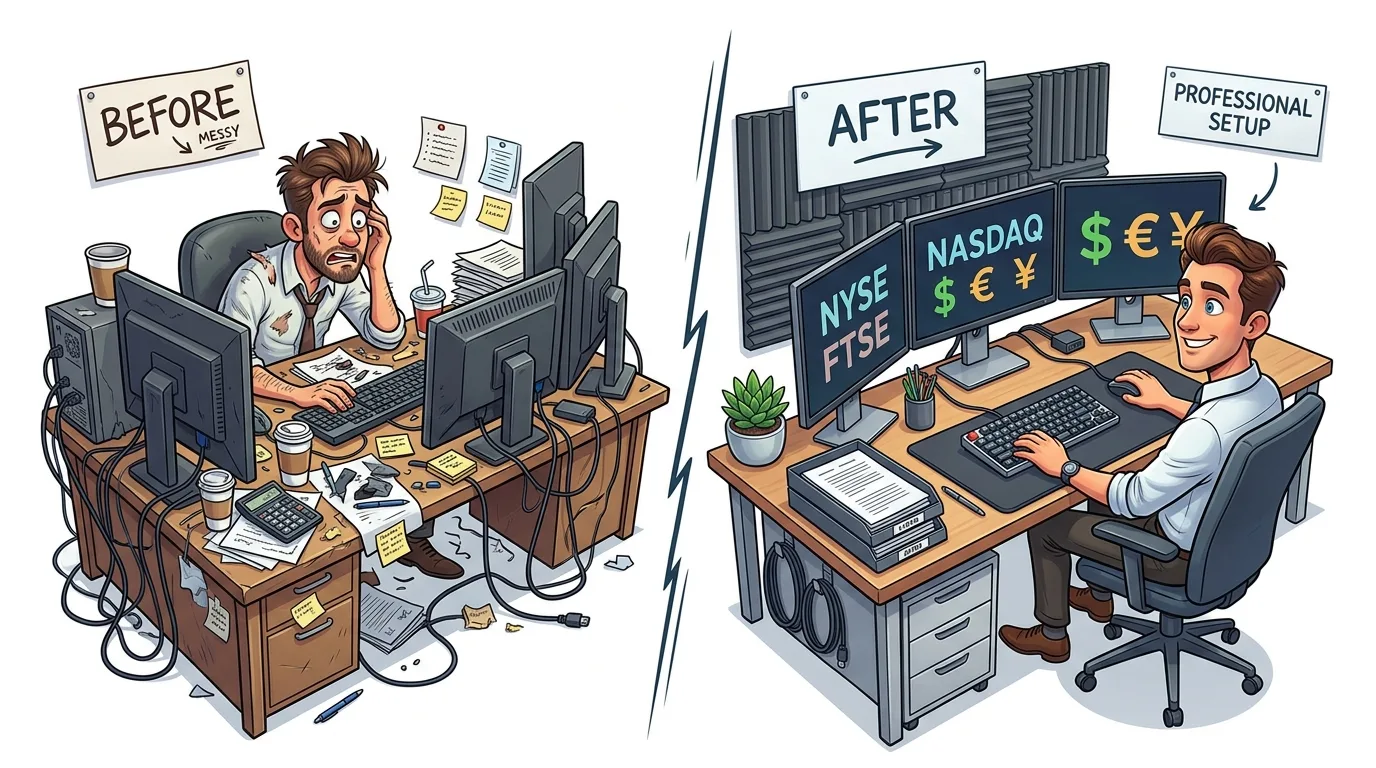
Here's a number that should make you pause: the real pass rate for most prop firm challenges isn't the 10-15% they advertise. It's closer to 4-5%. I've seen the internal dashboards. For every 100 hopeful Canadian traders who drop $500 on a challenge, maybe five get a live account. The rest? They're just paying the firm's overhead. The promise is seductive - trade with 'their' capital, keep most of the profits. But the structure is designed for you to fail. Let's break down why, and more importantly, how you can be one of the few who makes it through.
When you pay for a prop firm challenge, you're not buying a job or an investment. You're buying a very expensive, highly restrictive test. Think of it like paying a casino for the privilege of trying to win a high-stakes poker tournament seat. The house always has the edge.
Most challenges follow the same basic format. You pay an upfront fee (anywhere from $200 to $1000 CAD). They give you a simulated account with a specific target, say, make 10% profit. Sounds easy, right? Here's the catch: you also have a maximum daily loss (often 5%) and a maximum total loss (often 10%). Breach either, and you're instantly disqualified. No second chances, no refunds.

Warning: The 'profit target' is a distraction. The real challenge is the loss limits. They force you into a risk/reward ratio that is completely unnatural for consistent trading. To hit a 10% target without ever hitting a 5% daily drawdown, you need near-perfect timing. It's a different game than real trading.
I learned this the hard way. Back in 2019, I blew a $600 challenge in two days. I was up 3% on day one, feeling smart. On day two, I took a standard 2% risk trade on EUR/CAD. It went against me, I averaged down (a terrible idea in a challenge), and hit the daily loss limit before I could blink. Game over. $600 gone for two days of 'practice.' That experience taught me more about challenge psychology than any win ever could.

“The 'profit target' is a distraction. The real challenge is the loss limits.”
Let's do some math in Canadian dollars, because brokerage fees and currency conversion matter for us.
Say you choose a popular two-phase challenge. Phase 1 costs $500 CAD. You pass. Now you must pay for Phase 2, another $400 CAD. You pass that. Congratulations! Now you get a 'funded' $100,000 account. But wait, there's usually an admin or setup fee to get the live account - another $150 or so.
Your total cash outlay before placing one real trade: $500 + $400 + $150 = $1,050 CAD.
Now you start trading. You make a $5,000 profit in your first month. The typical profit split is 80/20 in your favor. So you get $4,000. Minus your $1,050 in fees, your real net profit is $2,950. That's a great return, but it's not $4,000. And that's assuming you pass both phases on the first try. Most don't.

Example: The Break-Even Reality If you fail your first $500 challenge and then pass on your second attempt, your cost basis doubles before you even start. Now your total fees are ~$1,550. To just break even on fees, you need to generate nearly $2,000 in profits for your share from the live account. That's a 2% return on the $100k simulated capital, just to get back to zero.
This is why firms love offering 'discounts' on retakes. They know the statistics. They want you to keep trying, because your fees are their primary revenue stream. Always calculate your total projected cost, not just the first challenge fee. A tool like our position size calculator is non-negotiable here, as a 0.5% mistake can end your entire challenge.

💡 Wskazówka Winstona
The market doesn't know you're in a challenge. It doesn't care about your 5% daily limit. Trade the price action, not your P&L.
“Passing a challenge and being a consistently profitable trader are two different skills.”
Failure in a prop firm challenge is rarely about bad analysis. It's about psychology under artificial constraints. I've coached dozens of traders through these, and the blow-ups are eerily similar.
1. The Deadline Pressure
You have 30 days to hit a profit target. This creates an urgency that corrupts every decision. You start chasing trades you'd normally ignore. You see a scalping strategy setup on the 1-minute chart and jump in, even though your plan was swing trading the 4-hour. The clock is ticking, and it makes you stupid.
2. The Loss Limit Anxiety
Knowing you have a 5% daily loss limit changes everything. A normal trade goes 1% against you. In a regular account, you might hold, managing it. In the challenge, your brain screams, "That's 20% of my daily allowance gone!" You close it for a small loss, then watch the trade reverse and hit your original target. This erodes your confidence and capital in tiny, frustrating bites.
3. The "Almost There" Disaster
This is the most common killer. You're at 8% profit, target is 10%. Two days left. You're so close you can taste it. So you do something incredibly reckless: you triple your position size on a "sure thing" like a news play on EUR/USD. The trade moves 1% against you, but with your oversized position, that's a 6% loss. You not only wipe out your gains but trigger the daily loss limit. Game over. I've done this. The shame is memorable.
The environment actively selects for a hyper-cautious, almost robotic style that most profitable traders don't use. It's why passing a challenge and being a consistently profitable trader are two different skills.

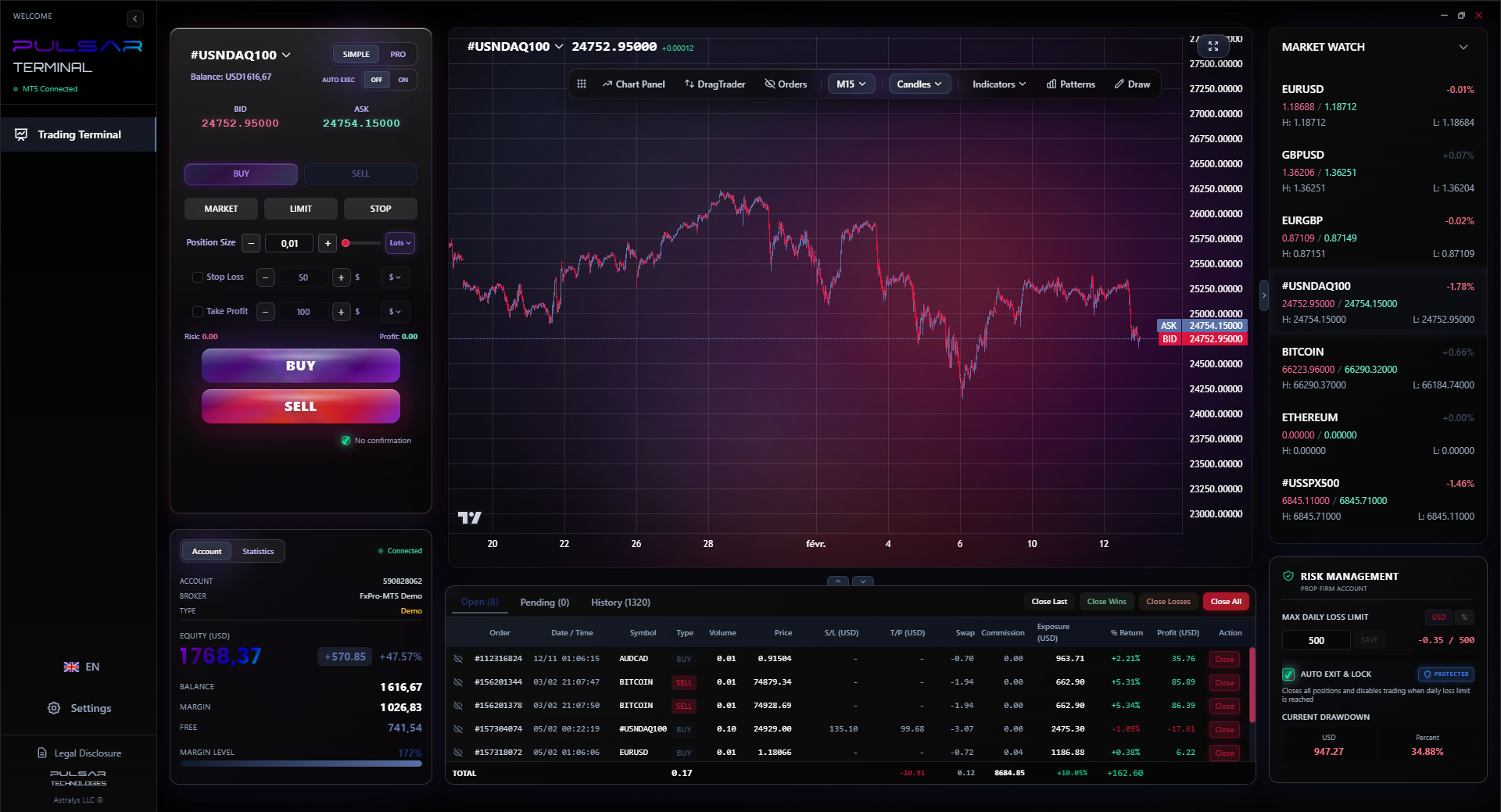
Managing the strict daily loss limits of a prop firm challenge is a constant mental battle, which is why automating your risk with a tool like Pulsar Terminal's daily loss protection feature is a game-saver.
“Passing a challenge and being a consistently profitable trader are two different skills.”
Forget complex indicators or guru systems. The strategy for passing a prop firm challenge is boring, mechanical, and focused entirely on survival.
The 1% Grind. Your goal each day is not to hit the profit target. Your goal is to make 0.5% to 1% without ever risking more than 1% of the account on a single trade, and never letting a trade go more than 0.5% against you. You are a sniper taking one, maybe two high-probability shots per day.
Here’s exactly how I passed my last one:
- Instrument: Only one. I traded XAU/USD exclusively. Why? Less noise than forex pairs during my trading hours (Toronto time).
- Setup: I waited for a clear break of the Asian session range with a retest. No fancy MACD indicator crossovers, just pure price action.
- Execution: Entry, set a 0.5% stop-loss immediately, set a 1% take-profit. Walk away. No moving stops, no adding to losers.
- Daily Rule: If I hit 1% profit, I stopped trading. If I had two losing trades in a day (a 1% total loss), I stopped trading. My daily loss limit was 5%, but my personal limit was 1%.
It took 14 trading days to hit the 10% target. The most exciting day was a 0.8% gain. It was mind-numbing. But it worked. This approach turns the challenge from a trading test into a discipline test. You're proving you can follow rules, not that you're a market wizard.

Pro Tip: Use a broker with ultra-low latency and tight spreads for this. Every pip definition matters when you're grinding out 1% gains. I used IC Markets for their raw spread account during my challenge. The difference between a 0.1 and 0.6 spread definition on gold is the difference between a profitable trade and a scratch.
💡 Wskazówka Winstona
If you feel the urge to 'make up' for a loss, close the platform. That urge is the sound of your challenge fee evaporating.

“The environment actively selects for a hyper-cautious, almost robotic style that most profitable traders don't use.”
Not all prop firms are created equal. For Canadian traders, you need to consider currency, regulation (or lack thereof), and payout reliability. Here’s a blunt comparison based on my experience and trader forums.
| Feature | Firm A (Global Giant) | Firm B (Challenge-Focused) | Firm C (Newer Player) |
|---|---|---|---|
| Challenge Fee | $550 CAD | $400 CAD | $300 CAD |
| Profit Split | 80/20 | 90/10 after first payout | 75/25 |
| Payout Method | Bank Wire (slow, fees) | Crypto (fast, volatile) | Wise/CurrencyFair |
| Realistic Pass Rate | ~4% | ~6% (easier rules) | Unknown (risky) |
| Biggest Risk | Opaque evaluation, slow support | Firm longevity, crypto risk | Could vanish tomorrow |
My advice? Go with the established name, even if it's harder. The newer firms with 'easier' rules often have shaky finances. I've seen two disappear with trader profits. The giant firms are a grind, but they do pay out if you follow their mile-long rulebook.
Also, read the funded account agreement, not just the challenge rules. Some firms have hidden clauses like minimum trading days or rules against certain strategies like news trading. You don't want to pass the challenge only to get your account closed for a rule you missed. Checking reviews on sites like our Pepperstone review page can give insights, even if it's for a different broker, as the trader comments often discuss prop firm experiences.
“The environment actively selects for a hyper-cautious, almost robotic style that most profitable traders don't use.”
Getting the funded account is like getting your driver's license. The real learning starts now, on the highway, with real consequences.
The psychology shifts dangerously. "It's not my money" is a toxic thought that creeps in. You might become reckless, taking risks you never would with your own capital. Or, you might become paralyzed, afraid to lose the opportunity you worked so hard for.
The first month on a live $100k simulated account is the most dangerous period. You need to treat it with more caution than the challenge itself. Start with position sizes HALF of what you used in the challenge. Your goal for the first two weeks is not to make money. It's to not blow up. Get used to the platform, the order execution, the pressure of seeing a larger P&L.
I made $2,100 in my first week funded. I got cocky. The next week, I gave back $1,800 of it in three bad trades because I started thinking in dollar terms, not percentage terms. I had to step back, remember my position size calculator, and reset. The funded account has the same loss limits as the challenge. A single margin call scenario, even if it's just a volatile spike, can end it all.
Remember, the firm makes money when you make money. But they make more money when you fail and re-take the challenge. Your long-term success is not their primary business model. That's on you.
💡 Wskazówka Winstona
Your first funded account withdrawal is not for a new car. It's to reimburse yourself for every challenge fee you ever paid. Then you're playing with true profit.

“Your long-term success is not their primary business model. That's on you.”
Let's be brutally honest. If you can pass a prop firm challenge using the 1% grind strategy, you have the discipline to trade profitably. So why not apply that discipline to your own, smaller account?
Instead of spending $1,050 on challenge fees over several months, what if you saved that money? Combine it with another $1,000. You now have a $2,000 CAD trading account. Your goal is to grow it by 10% ($200) without a drawdown of more than 5% ($100). Sound familiar? It's your own personal prop firm challenge, but with three critical advantages:
- No Time Limit: You can take 6 months if you need to.
- All the Profits: You keep 100%, not 80%.
- Real Skill Development: You're learning to manage real emotions with real money, not playing a simulation game with arbitrary rules.
Use a reputable, well-regulated broker for this journey. For Canadians, brokers like XM or Exness offer decent access, though always check their specific Canadian regulations. Grow your $2,000 to $2,200. Then, take out your original $1,050 (your 'challenge fee' savings) and now trade with the house's money - your house.
This path is slower. It's less sexy. There's no certificate or Instagram badge. But the trader you build through this process is the one who lasts for decades, not the one who gets a funded account and blows it in a month because they never learned real risk management.

FAQ
Q1What's the single biggest mistake in a prop firm challenge?
Averaging down on a losing trade. In a normal account, it's a risky strategy. In a challenge with a strict daily loss limit, it's a guaranteed account killer. One bad move can wipe out your entire daily allowance.
Q2Are prop firm challenges worth it for a complete beginner?
Absolutely not. It's like paying to take the bar exam before law school. You will fail and waste money. You need at least 6-12 months of consistent, profitable demo and small live account trading before a challenge makes any sense.
Q3How do Canadian taxes work on prop firm payouts?
This is crucial. The CRA views your profit share as self-employment income. You must declare it. Keep careful records of all fees (challenge, retake, admin) as these are deductible business expenses. Don't get caught out.
Q4Can I use automated trading or EAs in a challenge?
Most firms explicitly forbid it. They have detection software. If you're caught, you're banned without a refund. The challenge is meant to test your discretion, not a robot's.
Q5What happens if I hit the profit target in the first week?
You stop trading immediately. Do not take another trade. Many firms have a rule that you must trade a minimum number of days, but if you hit the max target, you wait. Continuing to trade only introduces risk of breaching the loss limit.
Q6Is it better to go for a $50k or $100k challenge?
Start with the smallest, cheapest challenge the firm offers. The rules and psychology are identical, but your fee risk is lower. Prove you can pass the system at the lowest level before investing more money.
Lekcja Prof. Winstona
:
- ✓Real pass rates are near 5%, not 10%.
- ✓Calculate total fees, not just the first challenge.
- ✓The 1% daily grind is the only viable strategy.
- ✓Funded account psychology is harder than the challenge.
Jak przydatny był ten artykuł?
Kliknij gwiazdkę, aby ocenić
Tygodniowe analizy tradingowe
Darmowe tygodniowe analizy i strategie. Bez spamu.
O autorze
James Mitchell
Starszy Analityk Tradingowy
Z siedzibą w Nowym Jorku, ponad 9 lat doświadczenia w tradingu. Koncentruje się na głównych parach USD, wyzwaniach prop firm i amerykańskim otoczeniu regulacyjnym.
Komentarze
Może Ci się też spodobać

Cara Trading Forex Sukses: 7 Prinsip dari Trader Profesional
Cara trading forex sukses dengan 7 prinsip trader pro: manajemen modal, disiplin, journal trading, backtest. Data nyata, bukan janji profit palsu.
Jam Trading Forex Terbaik untuk Trader Indonesia: Panduan Lengkap dengan Tabel Waktu
Panduan jam trading forex untuk trader Indonesia. Tabel 4 sesi dunia, jam emas 20:00-00:00, sesi mana yang harus dihindari. Data akurat + tips dari trader berpengalaman.
Top 5 Sàn Forex Uy Tín Nhất 2026: Review Jujur dari Trader Indonesia
Top 5 sàn forex uy tín 2026 untuk trader Indonesia. Review jujur: spread, deposit, withdraw, dukungan lokal. Exness, XM, IC Markets & lebih.
All these calculators are built into Pulsar Terminal with real-time data from your MT5 account. One-click position sizing, automatic risk management, and instant calculations.
