


Here's a statistic that'll make you pause: over 90% of traders who sign up for a stock prop firm challenge fail it.

James Mitchell
Starszy Analityk Tradingowy
☕ 9 min czytania
Czego się nauczysz:
- 1What Are Stock Prop Firms, Really? (It's Not Free Money)
- 2The Evaluation Challenge: Where Most Dreams Die
- 3The Real Money Talk: Profit Splits, Payouts & Hidden Fees
- 4Stocks vs. Forex Prop Firms: A World of Difference
- 5How to Pick a Stock Prop Firm (The Due Diligence Checklist)
- 6The Final Verdict: Are Stock Prop Firms Worth It?

Here's a statistic that'll make you pause: over 90% of traders who sign up for a stock prop firm challenge fail it. Not 70%, not 80%. Over ninety percent. Everyone's chasing the dream of trading a six-figure account with someone else's capital, but the reality of prop firms for stocks is a minefield of rules, splits, and psychological traps. I've traded with three of them over the years, and I'm here to tell you what the shiny sales pages won't.
Forget the Instagram ads showing Lambos. A proprietary trading firm for stocks is a company that provides you with capital to trade in exchange for a chunk of your profits. You're not a customer. You're a contractor. Your job is to pass their evaluation - a simulated trading challenge with strict profit targets and loss limits - to prove you can be profitable without blowing up their cash.
Once you pass, you get access to a funded account. The catch? You're trading their capital, but you're also trading their rulebook. Every firm has a different set: maximum position sizes, minimum holding periods, restrictions on news events, and daily loss limits that are tighter than a drum. Violate one, and you're out, no questions asked.
The big appeal for US traders is use. You can't get 10:1 or 20:1 on stocks with a retail broker like Schwab or Fidelity due to Regulation T. But a prop firm can offer simulated use within their own system, letting you control much larger notional positions. It's not real margin in the traditional sense, but it mimics the effect.

Warning: This 'use' is often the bait. It lets you hit profit targets faster in the challenge, but it also magnifies losses against those ultra-tight daily drawdown rules. It's a double-edged sword that cuts most people first.
This is the gatekeeper. You pay a fee - anywhere from $50 to $500 - to take a simulated trading test. The structure is almost always the same: hit a profit target (e.g., 10%) without violating a maximum loss rule (e.g., 5% total, 2% daily). Sounds simple, right? It's designed to be anything but.
The Psychology of the Clock
You're trading against a deadline. This pressure alone causes more mistakes than any bad technical analysis. I remember my first challenge with a now-defunct firm. I needed 8% in 30 days. I got 7.5% in week one, got greedy, gave half of it back trying to force a win, and then spent the next three weeks in a panic, overtrading myself into a max drawdown violation. I blew the fee and learned a $249 lesson about patience.
The Rule You'll Hate: Consistency
Many firms have a 'minimum trading days' rule. You can't just nail one big trade and pass. You have to trade actively over a period, which forces you to take sub-optimal setups just to log days. This directly conflicts with the core trading principle of waiting for your edge. It's a game, and you have to play by their arbitrary rules, not market logic.
Real Numbers From My Last Attempt
I passed a challenge for a $100k account last year. Here's the raw data:
- Fee Paid: $299
- Profit Target: $8,000 (8%)
- Max Daily Loss: $2,000
- Days to Pass: 14
- Trades Taken: 27
- Biggest Win: $1,850 (on NVDA)
- Biggest Loss: $980 (on TSLA) I passed, but I was mentally drained. The constant check against the daily loss calculator was exhausting. I was managing the firm's rules more than my trades.

💡 Wskazówka Winstona
Professor Winston always said: 'The market doesn't know you paid a $299 fee. It doesn't care about your 10% target. Trade the price action, not your desperation.'

“You're not trading the market; you're trading the firm's rulebook.”
Let's talk about what you actually keep. The advertised 80% or 90% profit split is often a best-case scenario, not the starting point. You usually have to earn your way up to that tier by consistently hitting profit milestones. You might start at 50/50.
| Firm Example | Starting Split | Payout Threshold | Payout Frequency | Scaling Plan? |
|---|---|---|---|---|
| Firm A | 80% | After first $1k profit | Bi-Weekly | Yes, after 4 payouts |
| Firm B | 50% | After first $500 profit | Monthly | Yes, gradual increase to 90% |
| Firm C | 100% (first $25k) | $25k minimum | First Friday each month | No, fixed account size |

Example: You make $10,000 in profit on a $100k account with an 80/20 split. You get $8,000, the firm gets $2,000. But wait. Did you account for the initial challenge fee? That's a sunk cost. What about platform data fees? Some firms charge you a monthly fee for the trading platform, which comes out of your profits. Suddenly, that $8,000 is more like $7,500.
And here's the kicker: the payout. It's never instant. You might have to wait 30-45 days after the end of the month to get paid. That's a long time if you're counting on that income. I once had a payout held up for a 'routine audit' for 60 days. It was frustrating, to say the least.
You also need to understand the tax implications. You'll receive a 1099-MISC or 1099-NEC. You're responsible for self-employment tax (about 15.3%) on top of your income tax. That 80% split effectively becomes more like 65% after taxes. Plan accordingly. A good position size calculator is non-negotiable here, because overtrading to chase a payout can trigger a margin call in their system and lose you the account.
If you're coming from the forex world, adjust your expectations. Forex prop firms are a dime a dozen, with challenges often based on simple lot size and pip targets. Stock prop firms are a different beast.
- Instruments: You're trading individual equities (TSLA, AAPL) and sometimes ETFs. This requires fundamental knowledge, not just technicals. Earnings reports matter. FDA approvals matter. This isn't just watching EUR/USD bounce off a support level.
- Hours: You trade market hours (9:30 AM - 4:00 PM ET). No 24/5 action. This can be a pro or a con, but it demands intense focus during that window.
- Rules on News: Most firms ban or restrict trading around earnings announcements and other major news. You can't just buy calls before Apple's earnings and ride the volatility. This removes a key strategy for many stock traders.
- use Model: As mentioned, it's simulated. Your buying power is amplified, but you don't own the underlying asset. This affects your mindset and how you use tools like a scalping strategy.
The trading style that works in forex often fails in stocks under a prop firm's rules. The slower pace of swing trading can be a better fit, but you still have to navigate the minimum trading day requirements. It's a constant balancing act.
💡 Wskazówka Winstona
Calculate your effective hourly wage. Add up all the hours spent on the challenge and managing the funded account, then divide by your net profit share. You might find you're working for less than minimum wage.

“Over 90% of traders fail the initial challenge. The house always wins.”
Don't just click the first Google ad. Do this homework.
- Read the Rulebook. Twice. I mean it. Print it out. Highlight the daily loss, maximum position size, and restricted securities. This is your bible.
- Check Payout Proof. Any reputable firm has a track record. Look for real payout screenshots or videos from traders, not just testimonials. Search the firm's name + "payout" on Twitter or trading forums.
- Understand the Platform. Most use a third-party platform like TraderSync, MetaTrader 5, or a custom web platform. Make sure you're comfortable with it. Slippage and spread can be issues on their simulated feeds.
- Customer Support Test. Email them a question before you sign up. See how long they take to respond and how helpful they are. If they're slow now, imagine when you have a payout issue.
- Start Small. Don't go for the $500,000 account challenge right away. Try a $25k or $50k challenge first. The rules are the same, but the fee is lower, and the psychological pressure is more manageable. It's a cheaper way to learn their system.
Based on my experience and that of colleagues, firms with clear rules and a track record (like some reviewed for forex such as FTMO's counterparts) are a better bet, but always verify their specific stock offering. The broker's execution matters less here since it's simulated, but the firm's integrity is everything.

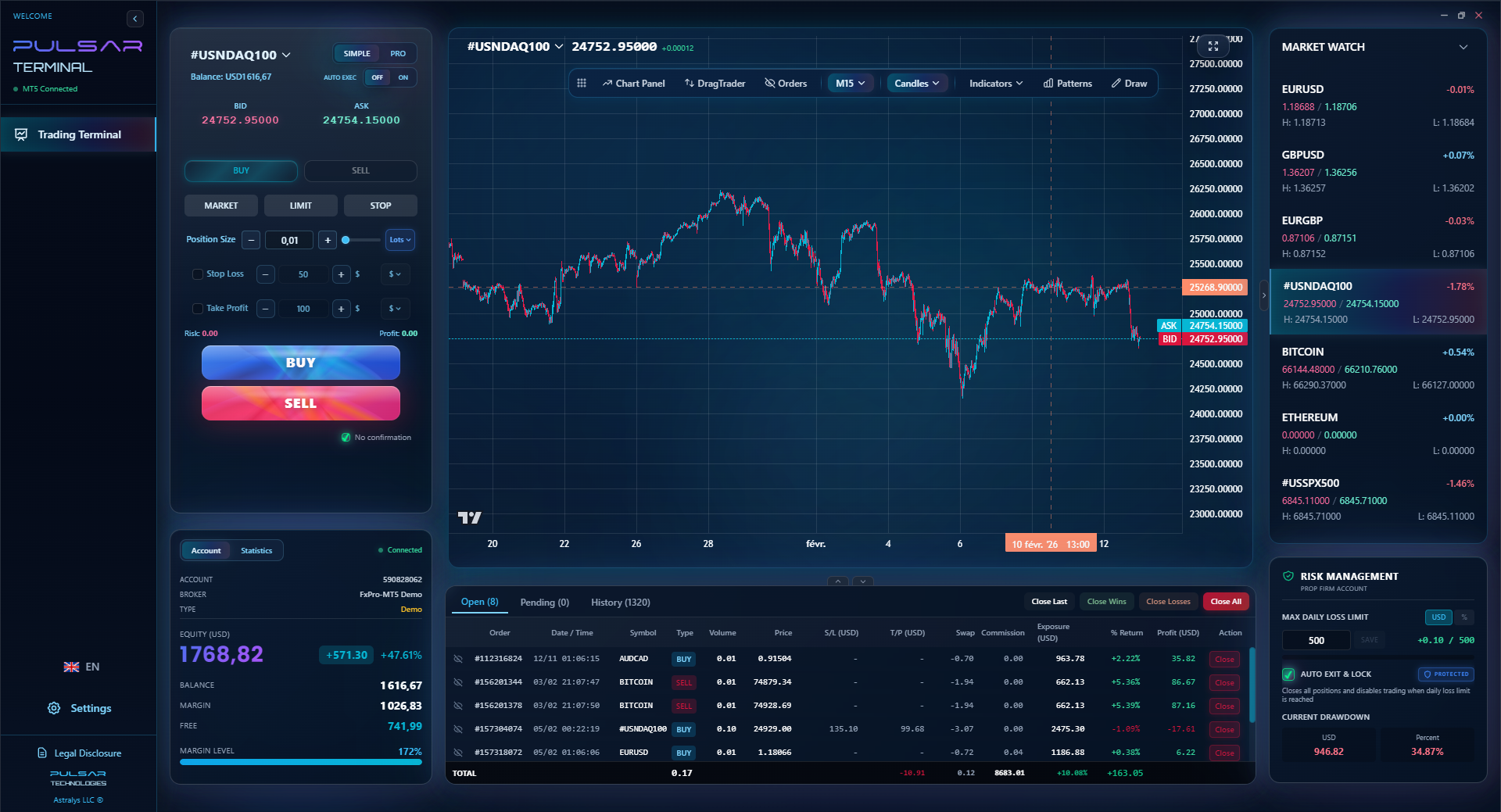
Managing a prop firm's daily loss limit is a constant headache, but tools like Pulsar Terminal can set hard stop-loss alerts and track your daily P&L in real-time, automating the rule enforcement that keeps you in the game.
This is the million-dollar question. Here's my blunt take.
For most retail traders, no. The combination of challenge fees, rigid rules, and profit splits means you're likely better off slowly building your own capital. The mental tax of trading under their microscope is immense and can ruin your own trading psychology.
Who are they good for? Two types of people:
- The disciplined, already-profitable trader who needs more capital than they have and can treat the challenge like a job interview. They can follow the weird rules without breaking their own process.
- The trader who needs structured accountability. The strict rules force discipline, but this is a costly way to get it.
I used a prop firm for six months. My total profit share was about $22,000. After fees, taxes, and the sheer stress, it netted out to a decent side income, but it wasn't life-changing. What it did give me was confidence in managing larger position sizes, which I later applied to my personal account. That was the real value.

Pro Tip: Before you give a prop firm a dime, prove to yourself you can pass their rules in a paper trading account for two months. Track every rule violation. If you can't do it with fake money, you won't do it with the pressure of a fee on the line.
The dream is seductive. Trading half a million dollars of 'someone else's money.' But remember, it's not yours. You're a profit-share contractor with a very strict boss. Make sure the math, and your mindset, adds up.

FAQ
Q1Can I trade options with a stock prop firm?
Almost never. The vast majority of stock prop firms only allow trading of the underlying equity shares (e.g., buying or selling AAPL stock). Options, futures, and other derivatives introduce too much complexity and risk for their model. Always check the allowed instruments list in the rulebook.
Q2What happens if I lose money on a funded account?
You lose the account. That's it. You don't owe the firm money (this is a crucial feature of a legitimate prop firm - no debt liability). You just lose your status and any profit in the account that hadn't been paid out. Some firms offer a 'reset' option where you can pay a reduced fee to restart the account instead of doing a full new challenge.
Q3How do taxes work with prop firm profits?
In the US, you are considered an independent contractor. The firm will send you a 1099 form (usually 1099-NEC) for your profit shares. You must report this as self-employment income. This means you pay income tax PLUS the 15.3% self-employment tax (Social Security & Medicare). Set aside at least 25-30% of every payout for taxes.
Q4Are stock prop firms a scam?
Not inherently, but the space is riddled with bad actors. A legitimate firm makes money from your profit split, not from you failing challenges. Scam firms design challenges to be nearly impossible to pass, making their revenue from endless challenge fees. Due diligence is critical: look for verifiable payout proofs, clear rules, and no hidden fees.
Q5Can I use my own trading strategy?
Yes, but only if it fits within their rulebook. If your strategy involves holding through earnings, you can't. If it requires large, infrequent positions, the minimum trading day rule might kill it. If it's a high-frequency scalping strategy, the platform's execution speed might be an issue. Your strategy must adapt to their container.
Q6What's the biggest mistake traders make with prop firms?
Overtrading to hit a profit target. The pressure of the clock causes traders to take low-probability setups, ignore risk management, and violate the daily loss limit. The second biggest mistake is not understanding the daily loss rule inside and out. It's the most common account killer.
Lekcja Prof. Winstona
:
- ✓The challenge fee is a sunk cost. Never trade to recover it.
- ✓Simulated use amplifies both gains and rule violations.
- ✓Your first goal isn't profit; it's not hitting the daily loss limit.
- ✓Taxes take a 25-30% bite out of every payout.
Jak przydatny był ten artykuł?
Kliknij gwiazdkę, aby ocenić
Tygodniowe analizy tradingowe
Darmowe tygodniowe analizy i strategie. Bez spamu.
O autorze
James Mitchell
Starszy Analityk Tradingowy
Z siedzibą w Nowym Jorku, ponad 9 lat doświadczenia w tradingu. Koncentruje się na głównych parach USD, wyzwaniach prop firm i amerykańskim otoczeniu regulacyjnym.
Komentarze
Może Ci się też spodobać

Cara Trading Forex Sukses: 7 Prinsip dari Trader Profesional
Cara trading forex sukses dengan 7 prinsip trader pro: manajemen modal, disiplin, journal trading, backtest. Data nyata, bukan janji profit palsu.
Jam Trading Forex Terbaik untuk Trader Indonesia: Panduan Lengkap dengan Tabel Waktu
Panduan jam trading forex untuk trader Indonesia. Tabel 4 sesi dunia, jam emas 20:00-00:00, sesi mana yang harus dihindari. Data akurat + tips dari trader berpengalaman.
Top 5 Sàn Forex Uy Tín Nhất 2026: Review Jujur dari Trader Indonesia
Top 5 sàn forex uy tín 2026 untuk trader Indonesia. Review jujur: spread, deposit, withdraw, dukungan lokal. Exness, XM, IC Markets & lebih.
All these calculators are built into Pulsar Terminal with real-time data from your MT5 account. One-click position sizing, automatic risk management, and instant calculations.
