


I was staring at the E-mini S&P 500 chart on a Tuesday afternoon, up $1,800 on a funded $100k account.

James Mitchell
Starszy Analityk Tradingowy
☕ 12 min czytania
Czego się nauczysz:
- 1What Are Prop Firms Futures, Really?
- 2The Real Costs (And Why The Math Is Stacked Against You)
- 3Key Rules (And How to Survive Them)
- 4The Regulatory Wildfire (2024-2026)
- 5Picking Your Battleground: Which Futures to Trade
- 6A Realistic 30-Day Path to Getting Funded
- 7Life After Funded (Where Most Actually Blow Up)
- 8Final Verdict: Is It Worth It?
I was staring at the E-mini S&P 500 chart on a Tuesday afternoon, up $1,800 on a funded $100k account. My profit target was a clean $2,000. Then, a headline hit. The market reversed 15 points in 90 seconds. I watched my unrealized gain evaporate to $400, then slip into a $300 loss before I finally hit the sell button. That $2,100 swing - from potential profit to a real loss - wasn't just bad luck. It was a perfect example of why most traders blow up in prop firms futures, even after they get funded. The game isn't about making money. It's about not losing it in the three minutes it takes for the news to digest.
Let's cut through the marketing. A prop firm futures operation isn't giving you a magical loan. You're paying a fee - anywhere from $99 to over $500 - to take a test. If you pass, they let you trade a simulated account with their rules. If you make a profit in that sim, they might pay you a split of those simulated profits. The firm itself is typically trading one massive, aggregated account with a real broker like NinjaTrader or Tradovate. Your trades are just a line in their risk management software.
The appeal is obvious. You get to trade size you couldn't afford on your own. A $100,000 futures account controlling 2-3 micro E-mini contracts feels a lot different than a $5,000 retail account. But you're not a partner. You're a risk-managed user in their system. Your success is tightly controlled by drawdown limits, daily loss limits, and consistency rules that have nothing to do with market wisdom and everything to do with protecting the firm's capital. Understanding this power dynamic is your first step to not getting chewed up.

Warning: Don't confuse a funded account with owning capital. You have no ownership. The firm can change rules, increase fees, or shut down your account based on their terms. You're a contractor, not an owner.

💡 Wskazówka Winstona
The market doesn't know you have a profit target. Trading to hit an arbitrary number is a surefire way to abandon your process and take stupid risks.
Everyone talks about the profit split. Nobody talks about the expected value, which is brutally negative for most traders. Let's use real 2026 numbers.
You buy a $199 evaluation for a $100k account. Industry data shows only about 5-10% pass on the first try. Let's be generous and say 15%. If you fail, you can often reset for a fee, maybe $80. So your expected cost to even get funded isn't $199, it's more like $199 + (probability of failure * reset cost). It adds up fast.
Now, let's say you get funded. Only about 7% of all traders who buy a challenge ever see a payout. The average payout is about 4% of the account size. So on that $100k account, the average successful trader makes a $4,000 payout. If you're on an 80/20 split, you keep $3,200.
But wait. You paid $199 for the challenge, maybe $80 for a reset, and many firms have an "activation fee" of $100-$150 once you pass. So your net take, if you're in that tiny 7% winner's circle, is more like $2,800. And that's before taxes.
The firms know this math cold. Their business model thrives on the churn of hopeful traders buying evaluations. It's not a scam, but it is a probabilistic business that benefits from overconfidence. I learned this the hard way early on, blowing three evaluation accounts in a row on the Nasdaq futures because I was over-trading to hit the profit target quickly. I was a perfect revenue statistic.

Example:
- Your Cost: Challenge Fee ($199) + One Reset ($80) + Activation Fee ($149) = $428
- Your Potential: Average Payout for a $100k account ($4,000) * 80% Profit Split = $3,200
- Your Net (If You Succeed): $3,200 - $428 = $2,772 This assumes you're in the ~7% who get a payout. The other 93% just pay the fees.
“Only about 7% of all traders who buy a challenge ever see a payout. The average payout is about 4% of the account size.”
The rules aren't suggestions. They are tripwires designed to eliminate you. Your job is to navigate them while actually trying to trade.
The Daily Loss Limit
This is the silent account killer. It's usually a fixed dollar amount or a percentage of your starting balance. Hit it, and your account is dead for the day, or worse, failed. The trap? It's calculated on your running daily P&L, not per trade. You could be up $800 in the morning, give back $500, and then a single bad trade that loses $400 could breach the limit because your daily net loss is now -$100. You must track this number religiously. I keep a post-it note on my monitor with the daily number updated after every trade.
The Maximum Drawdown
This is your overall loss buffer. It's often a trailing threshold based on your account's peak equity. If you start at $100,000 and hit $102,000, your new max drawdown level might trail up to $101,000. If your equity then falls back to $100,900, you're okay. If it hits $100,999, you're failed. This rule punishes volatility and rewards steady, incremental gains. It makes aggressive swing trading after a win extremely dangerous.
The Profit Target
You have to hit this to pass the evaluation. This is where most traders self-destruct. They see a 10% target on a $50k account ($5,000) and try to get it in a week. They increase position size, take marginal setups, and inevitably get smacked by a loss that blows through their daily limit. The smart approach? Ignore the target. Focus on executing high-probability trades with strict risk management. The target will be hit as a byproduct of consistency, not as a goal. Using a position size calculator for every single entry is non-negotiable here.

Pro Tip: Your first goal in any prop firm challenge is not to make money. It's to not lose money. Trade tiny - even one micro contract - until you have a buffer. Protecting capital is the only skill that matters in the beginning.
The landscape you're entering in 2026 was shaped by a regulatory inferno. Back in 2024, MetaQuotes (the company behind MT4/MT5) cracked down on prop firms using their platforms for evaluations, wiping out 80-100 firms overnight. It was a bloodbath. Traders lost ongoing evaluations and pending payouts. This exposed the fundamental fragility of the model: you have zero protection if the firm folds.
Now, the SEC and CFTC are circling. In 2024, the SEC adopted new rules that could force some active prop firms to register as "dealers," subjecting them to capital requirements and exams. The CFTC is considering mandatory registration for firms offering futures access. They've also warned that any AI tools used for trading or risk management must be properly supervised - a shot across the bow of firms using automated systems.
What does this mean for you in 2026?
- Stick with established, transparent firms. The cowboys are getting regulated out of the game. Look for firms that clearly explain their broker relationships and payout processes. Reviews on sites like Topstep or Apex Trader Funding can give you a sense of stability.
- Your funds are not protected. You are not a customer of a CFTC-regulated Futures Commission Merchant (FCM). Your evaluation fee and any profits are only as safe as the prop firm's solvency and ethics.
- Rules can change. As regulatory pressure mounts, firms may adjust their programs - stricter drawdowns, new fees - to maintain profitability. Read the terms of service, especially the parts about rule changes.
The era of the wild west prop shop is closing. This is good for long-term trader protection but means you need to do more due diligence than ever before.
💡 Wskazówka Winstona
If you can't explain your edge in one sentence and back it up with at least 100 historical trades, you don't have an edge. You have a hope. Don't waste your money on a challenge.
“Your first goal in any prop firm challenge is not to make money. It's to not lose money.”
Not all futures contracts are created equal for prop firm rules. You need liquidity, manageable volatility relative to your drawdown, and clear patterns.
E-mini S&P 500 (ES): The king. High liquidity, tight spreads, and moves almost constantly during NY session. The danger? It can have explosive, news-driven moves that can blow through your daily loss limit in minutes if you're over-leveraged. A 10-point move on a single standard contract is $500. On a $50k account with a $2,500 daily loss limit, that's 20% of your daily buffer in one swing.
Micro E-mini S&P 500 (MES): This is your best friend, especially in evaluations. One-tenth the size of the ES. It lets you practice precise position sizing and manage risk in dollar amounts that make sense for typical prop firm drawdowns. You can scale in and out more gracefully.
Nasdaq-100 (NQ/MNQ): Higher volatility, bigger swings. Can accelerate profits but also losses dramatically. I'd avoid this in an evaluation unless you have extensive experience with its personality. It's prone to sharp, emotional reversals.
Treasury Futures (ZB, ZN): More sedate, trend-oriented. Excellent if you are a patient, technical trader. The spreads are wider, and liquidity can thin out at times, so execution matters more.
Gold (GC/MGC) & Crude Oil (CL/MCL): These are driven by specific fundamentals (geopolitics, OPEC, inflation data). You can't just trade the chart. You need to be aware of the economic calendar. A surprise inventory report can send CL on a $2 run in seconds - that's $2,000 per standard contract.
My personal rule? Start with the Micro E-mini (MES). The psychological benefit of trading a smaller, less financially terrifying instrument is immense. It allows you to focus on the rules and your process, not the flashing P&L. Once funded and comfortable, you can scale up to the ES. For more on specific instruments, our XAU/USD guide covers gold's unique drivers, which apply directly to GC futures.
Forget the "get funded in 7 days" YouTube hype. Here's a boring, methodical plan that might actually work.
Week 1: Paper Trade the Rules. Don't even buy a challenge. Take a sim account and pretend the prop firm rules are active. Track your daily loss limit and max drawdown on a spreadsheet. Your only goal is to trade for five days without breaching a rule. Not to make money. If you can't do this in sim, you will 100% fail with real money on the line.
Week 2: Execute the Micro Plan. Buy your chosen challenge. Trade ONE micro contract only. Your risk per trade should be a tiny fraction of your daily limit - think 5-10%. For a $2,500 daily limit, that's $125-$250 risk per trade. Your goal is 5-10 high-quality trades, focusing on the best setups you know. Ignore the profit target completely. At the end of the week, assess: did I follow my rules? Did I manage my daily P&L?
Week 3-4: Gradual Scaling. If you have a cushion (e.g., you're up $500), you can consider adding a second micro contract. This is not about greed; it's about efficiency. Two MES contracts is still only one-fifth the size of one standard ES. Continue to prioritize rule adherence. The profit target will likely get hit somewhere in this period if you're consistently slightly profitable.
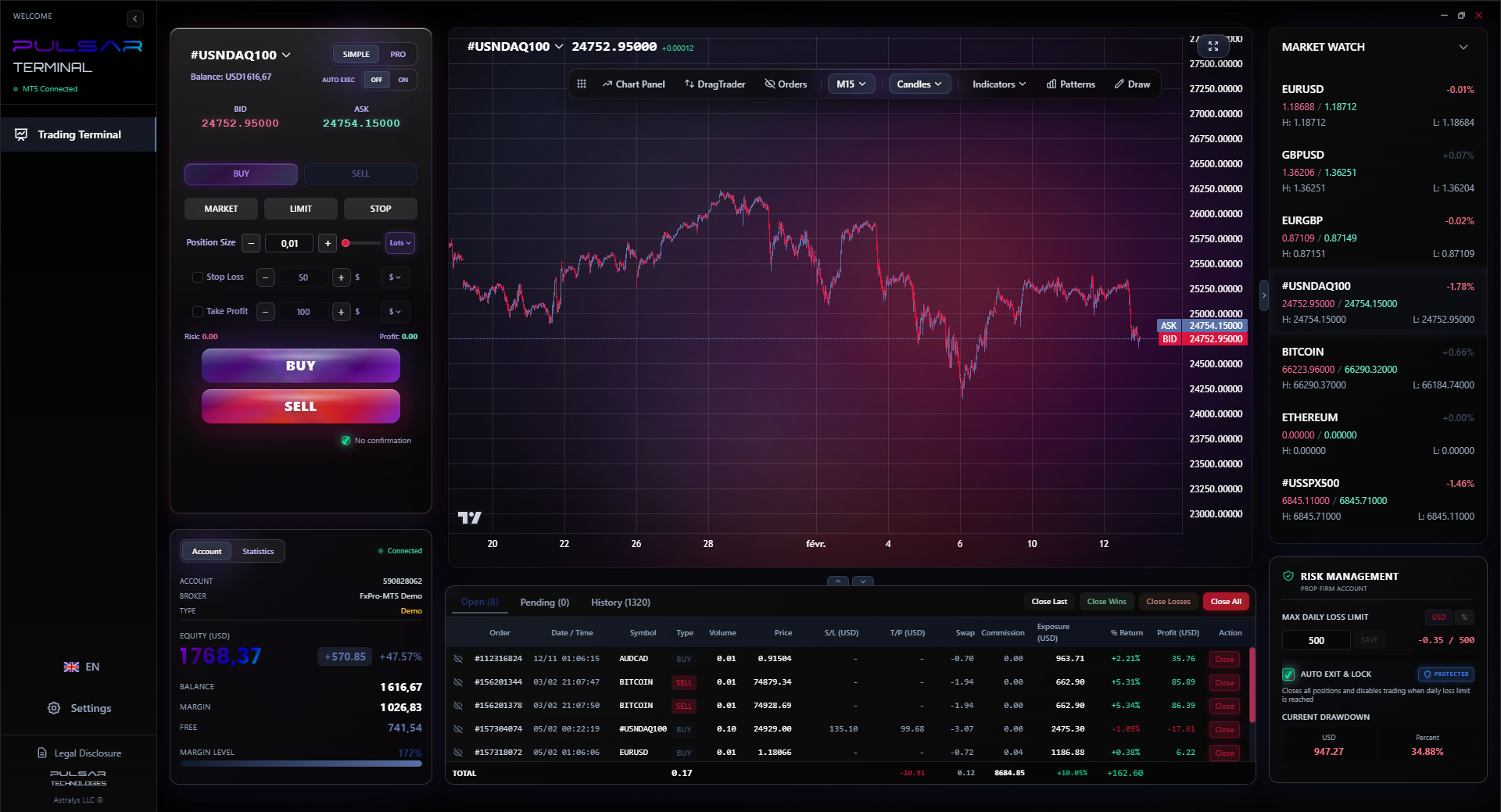
The mental shift is critical. You are not a trader trying to pass a test. You are a risk manager auditioning for a job. Every decision filters through that lens. Tools that automate rule-tracking are useful here. For example, passing a prop firm challenge requires iron-clad loss management, which tools like Pulsar Terminal can handle automatically, setting hard stops based on your daily max loss so you literally can't break the rule.
Passing a prop firm challenge requires iron-clad loss management, which tools like Pulsar Terminal can handle automatically, setting hard stops based on your daily max loss so you literally can't break the rule.
“Getting the funded account is the easy part. Keeping it is where the real challenge begins.”
Getting the funded account is the easy part. Keeping it is where the real challenge begins. This is when psychological pressure changes. It feels like real money now (because payouts are possible), and that triggers greed and fear in new ways.
I made this exact mistake. On my first funded account, I made a steady $1,200 in the first week. Feeling invincible, I took a large position on the ES right before the Fed minutes, convinced we'd break resistance. We didn't. The reversal took out my stop and half my daily loss limit in one trade. I spent the next three days trading scared, trying to "make it back," and promptly blew the entire account. I broke every rule I'd followed to get funded.
The funded account has the same, often stricter, rules as the evaluation. The drawdown might be trailing now. You must develop a withdrawal ritual. Take profits out regularly. This does two things: it locks in gains, and it psychologically resets your account balance to "zero," preventing you from seeing unrealized profits as your money to play with.
Also, understand the payout process. Most firms have a minimum payout threshold (e.g., $500) and a processing period. Don't plan on this income for urgent bills. It's unreliable, especially in your first few months. Treat trading the funded account as a new, harder evaluation. The finish line doesn't exist. For managing the ongoing risk of a live account, understanding concepts like a margin call is crucial, even if the prop firm's internal system handles it for you.
💡 Wskazówka Winstona
Your first withdrawal from a funded account is a milestone. Your second withdrawal is a habit. Make it a non-negotiable rule to pull out a percentage of profits every month. It builds real capital and proves the model works.
For most retail traders? No. The expected value is negative. The psychological gauntlet is extreme. You'd likely be better off slowly building a small personal account with rigorous risk management.
However, for a specific type of trader, prop firms futures can be a legitimate path. You are the trader who:
- Has a proven, mechanical edge verified over hundreds of trades.
- Possesses monk-like discipline and emotional control.
- Views the evaluation fees as a necessary educational/business cost, not a lottery ticket.
- Can withstand the statistical likelihood of needing multiple attempts.
If that's you, then go in with eyes wide open. Pick a reputable firm with clear rules. Start with the smallest, cheapest evaluation you can. Trade micros. Obsess over the rules, not the profits.
The prop firm futures arena is a filter. It's designed to find the few traders who can generate alpha while operating inside a straitjacket. That's a valuable skill, but acquiring it is expensive and brutal. Make sure you're paying for training, not just buying a dream. Before you commit, ensure your basic toolkit is solid, from understanding the spread definition on your chosen futures to having a reliable scalping strategy or swing approach that fits the time-based rules.
FAQ
Q1What is the best prop firm for futures trading in 2026?
There's no single 'best.' Look for firms that survived the 2024 shakeout, have transparent rules, and no hidden fees. Firms like Topstep, Apex Trader Funding, and Take Profit Trader are established, but you must compare their specific rules (drawdown type, daily loss, profit target) against your trading style. Read the latest reviews, as terms change frequently.
Q2Can you actually make a living trading for a prop firm?
A tiny fraction of traders do, but it's a terrible plan A. The average payout is only about 4% of account size. To make $100k/year, you'd need to consistently manage and profit from the equivalent of $2.5 million in funded capital across multiple accounts. The volatility of payouts, rule changes, and firm stability make it an unreliable primary income for most.
Q3What's the biggest mistake traders make in futures prop firm challenges?
Overtrading to hit the profit target. They increase size, take low-probability setups, and violate their own risk management. The goal of the challenge is to survive and demonstrate consistency, not to be a hero. The second biggest mistake is not understanding the trailing drawdown rule and how it locks in after you have a winning period.
Q4Are prop firms futures legal in the United States?
The current model operates in a regulatory gray area. They are not typically registered as brokers or investment advisors. They position themselves as educational evaluators. This is under increased scrutiny from the SEC and CFTC. While not illegal, it means you, the trader, have very few regulatory protections if the firm fails or disputes a payout.
Q5How much money do I need to start with a futures prop firm?
You need enough for the evaluation fee, which can range from $55 to over $500 for account sizes from $25k to $300k. Crucially, you should have enough living expenses saved so that you are not dependent on passing or quick payouts. The mental pressure of needing the money guarantees poor trading decisions.
Q6What's the difference between a one-step and a two-step evaluation?
A one-step (or 'express') challenge has a single phase with a profit target and drawdown limit. A two-step challenge has an initial evaluation (Phase 1) with a profit target and often stricter rules, followed by a verification phase (Phase 2) where you trade for a shorter period with a smaller target, proving consistency. Two-step processes are often harder and longer.
Lekcja Prof. Winstona
:
- ✓Expected Value is negative for 93% of traders.
- ✓Average funded account payout is just 4% of capital.
- ✓Daily Loss Limits kill more accounts than bad analysis.
- ✓Trade Micro contracts (MES) to manage rule psychology.
- ✓Regulatory change is the biggest unseen risk in 2026.
Jak przydatny był ten artykuł?
Kliknij gwiazdkę, aby ocenić
Tygodniowe analizy tradingowe
Darmowe tygodniowe analizy i strategie. Bez spamu.
O autorze
James Mitchell
Starszy Analityk Tradingowy
Z siedzibą w Nowym Jorku, ponad 9 lat doświadczenia w tradingu. Koncentruje się na głównych parach USD, wyzwaniach prop firm i amerykańskim otoczeniu regulacyjnym.
Komentarze
Może Ci się też spodobać

Cara Trading Forex Sukses: 7 Prinsip dari Trader Profesional
Cara trading forex sukses dengan 7 prinsip trader pro: manajemen modal, disiplin, journal trading, backtest. Data nyata, bukan janji profit palsu.
Jam Trading Forex Terbaik untuk Trader Indonesia: Panduan Lengkap dengan Tabel Waktu
Panduan jam trading forex untuk trader Indonesia. Tabel 4 sesi dunia, jam emas 20:00-00:00, sesi mana yang harus dihindari. Data akurat + tips dari trader berpengalaman.
Top 5 Sàn Forex Uy Tín Nhất 2026: Review Jujur dari Trader Indonesia
Top 5 sàn forex uy tín 2026 untuk trader Indonesia. Review jujur: spread, deposit, withdraw, dukungan lokal. Exness, XM, IC Markets & lebih.
All these calculators are built into Pulsar Terminal with real-time data from your MT5 account. One-click position sizing, automatic risk management, and instant calculations.
