


Everyone in South Africa wants to know who the richest forex trader is.

David van der Merwe
Trader Rynków Wschodzących ·  South Africa
☕ 9 min czytania
Czego się nauczysz:
Everyone in South Africa wants to know who the richest forex trader is. It's a seductive question, promising a shortcut to wealth if you just follow the right guru. I'm here to tell you that's a dangerous myth. Chasing a single name or net worth figure is a distraction from the real work. The truth is, verified personal wealth from pure trading is almost never public. What you see online are often estimates tied to education businesses, not verified trading accounts. Let's set the record straight by looking at the figures we can verify: regulations, real costs, and the actual strategies that separate the wealthy from the washed-out.
Let's talk about the names you've heard. Ref Wayne, Jabulani Ngcobo, Sandile Shezi. Headlines throw around figures like $500 million or even $2.4 billion. I need you to understand something critical: these numbers are almost always unverified estimates. More importantly, they rarely represent wealth accumulated solely from placing trades in a personal account.
In most cases, the significant wealth associated with these figures is built on the business of trading education - selling courses, seminars, and mentorship programs. There's nothing inherently wrong with that, but conflating it with pure trading success is misleading. A trader with a R5 million personal account who teaches 10,000 students is going to be 'richer' than a silent pro with a R50 million account. The public face isn't the same as the most skilled.
I learned this the hard way early on. I chased a popular 'guru's' system, paying for a premium course. The strategy was overly complex, required constant screen time, and blew up my first real account of R15,000 in under a month. The guru was rich from my subscription, not from using that system himself. The real pros are often quiet. They're the fund managers, the prop desk leads, the individuals who treat it like a business, not a personality cult. Your goal shouldn't be to find the richest name; it should be to understand the principles that allow anyone to build sustainable capital.

Warning: Be deeply skeptical of any 'trader' whose primary evidence of wealth is luxury cars and watches in Instagram photos. Real wealth from trading is quiet. The loudest voices are usually selling something.

💡 Wskazówka Winstona
A trader once told me his secret was to treat every trade like it's only worth R100, no matter his account size. It removes the emotion. The money follows the discipline, not the other way around.
“Verified personal wealth from pure trading is almost never public.”
If you want to build real, lasting capital, you start by playing on a legal, secure field. In South Africa, that means the Financial Sector Conduct Authority (FSCA) is your new best friend, or your worst enemy if you ignore them.
The Non-Negotiables: Licensing and use
Every legitimate broker offering services to South Africans must hold an FSP license from the FSCA. Don't just take a broker's word for it. Go to the FSCA's website and verify their license number in the public register. This is your first line of defense against scams. Since 2021, the FSCA has also imposed a crucial safety rule: a maximum use of 30:1 for retail traders. This is a game-saver, not a game-spoiler.
I remember when use was virtually unlimited with some offshore brokers. I thought I was a genius using 500:1. A single bad trade on GBP/JPY wiped out 80% of my account because my position size calculator was screaming numbers I chose to ignore. The 30:1 limit forces discipline. It makes a margin call less likely and gives you room to breathe when you're wrong.
Taxes and Using International Brokers
Yes, your trading profits are taxable income. Keep a careful journal of all trades. Use a spreadsheet or proper software. When SARS comes knocking, 'I forgot' isn't a valid excuse. Also, while you can use international brokers, know that if something goes wrong with an unregulated offshore entity, the FSCA can't help you. The peace of mind from using a locally regulated broker like an FSCA-regulated Exness or IC Markets is worth potentially slightly higher costs.
The structure is there to protect you. Working within it isn't a limitation; it's the foundation of a professional approach.
“The 30:1 use limit is a game-saver, not a game-spoiler.”
Forget the Lamborghinis for a second. Let's talk about the money that actually leaves your account. This is where dreams get a reality check.
Your main cost is the spread - the difference between the buy and sell price. On a major pair like the EUR/USD, a 'good' spread might be 0.7 pips on a standard account. On a ZAR pair like USD/ZAR, it can be 50 pips or more. That's not a typo. You're already 50 pips in the red the second you enter. This makes short-term trading on exotic pairs nearly impossible for retail traders.
Here’s a breakdown of typical costs you will face:
| Cost Type | Typical Example (ZAR) | What It Means For You |
|---|---|---|
| Minimum Deposit | R500 - R4,000 | Start small. You can open an account with R500, but R2,000 gives you more room to practice proper risk management. |
| Spread (EUR/USD) | 0.7 - 1.5 pips | On a R10,000 account, a 1-pip move is about R7. Your first R7 is just covering cost. |
| Commission (Pro Accounts) | ~R90 per standard lot | Often charged on top of razor-thin spreads. Better for high volume. |
| Overnight Swap | Variable, can be +/- R50 | Holding positions long-term? This can add up or occasionally work in your favor. |
| Bank Withdrawal Fee | Up to R350 | Your bank may charge this for an international transfer from your broker. Factor it in! |
I made a classic error when I started: I funded an account with just R1,000 and traded mini lots. After spreads and a few small losses, I was below the broker's minimum withdrawal amount. I was effectively locked in until I deposited more or blew up. Start with capital that allows you to trade small and withdraw comfortably. And always, always calculate your risk per trade before you think about profit. A good scalping strategy accounts for spread costs first and foremost.
“Your primary job isn't picking tops and bottoms. It's managing risk.”
So how do people actually build significant wealth from trading? It's boring. It's systematic. It has nothing to do with the flashy headlines.
The Power of Consistent Returns
Forget 100% returns a month. That's a one-way ticket to ruin. Aim for consistency. A 5-10% return per month, compounded, is astronomical over years. Let's say you start with R100,000 and average 7% per month. In one year, with compounding, you'd have over R225,000. In three years, you're looking at over R1.1 million. This is the real math of the 'richest forex trader in south africa' – patience and compounding, not lottery tickets.
Risk Management is Your Real Job
Your primary job isn't picking tops and bottoms. It's managing risk. Never, ever risk more than 1-2% of your account on a single trade. On a R50,000 account, that's a R500-R1,000 max loss. This single rule is the Great Filter. It keeps you in the game after a string of losses. I use a hard stop-loss on every single trade, no exceptions. The one time I thought 'I'll just watch it and manually close,' I got distracted, came back, and saw a loss that took three weeks of good trading to recover. It was a R2,200 lesson in discipline.
Choose Your Style and Stick To It
Are you a swing trader, holding for days or weeks? Or do you prefer the fast pace of scalping? Your strategy dictates everything: your charts, your indicators (like the RSI indicator or MACD indicator), and your screen time. I'm a swing trader at heart. I found scalping destroyed my psychology. I'd make R300, then lose R500, and end the day stressed and down. Swing trading lets me analyze, place a trade, set my stop and target, and walk away. Find what suits your personality.

Pro Tip: The most powerful tool you have is a trading journal. Log every trade: entry, exit, reason, emotion, and screenshot. Review it weekly. Your biggest edge will come from understanding your own repetitive mistakes.
💡 Wskazówka Winstona
The market doesn't care about your rent, your car note, or your ego. Trade the price you see, not the price you need. Needing to make money is the quickest way to lose it.
“Your primary job isn't picking tops and bottoms. It's managing risk.”
Your broker and tools are your foundation. You wouldn't build a house on sand, so don't build a trading career on a shady platform.
For South Africans, I strongly recommend brokers that are either directly FSCA-regulated or have a strong global reputation and offer ZAR accounts. This simplifies deposits and withdrawals and gives you legal recourse. Brokers like Pepperstone (via their AU regulation, which is top-tier) and XM are popular for good reason: they offer the MetaTrader platforms, competitive spreads, and reliable execution.
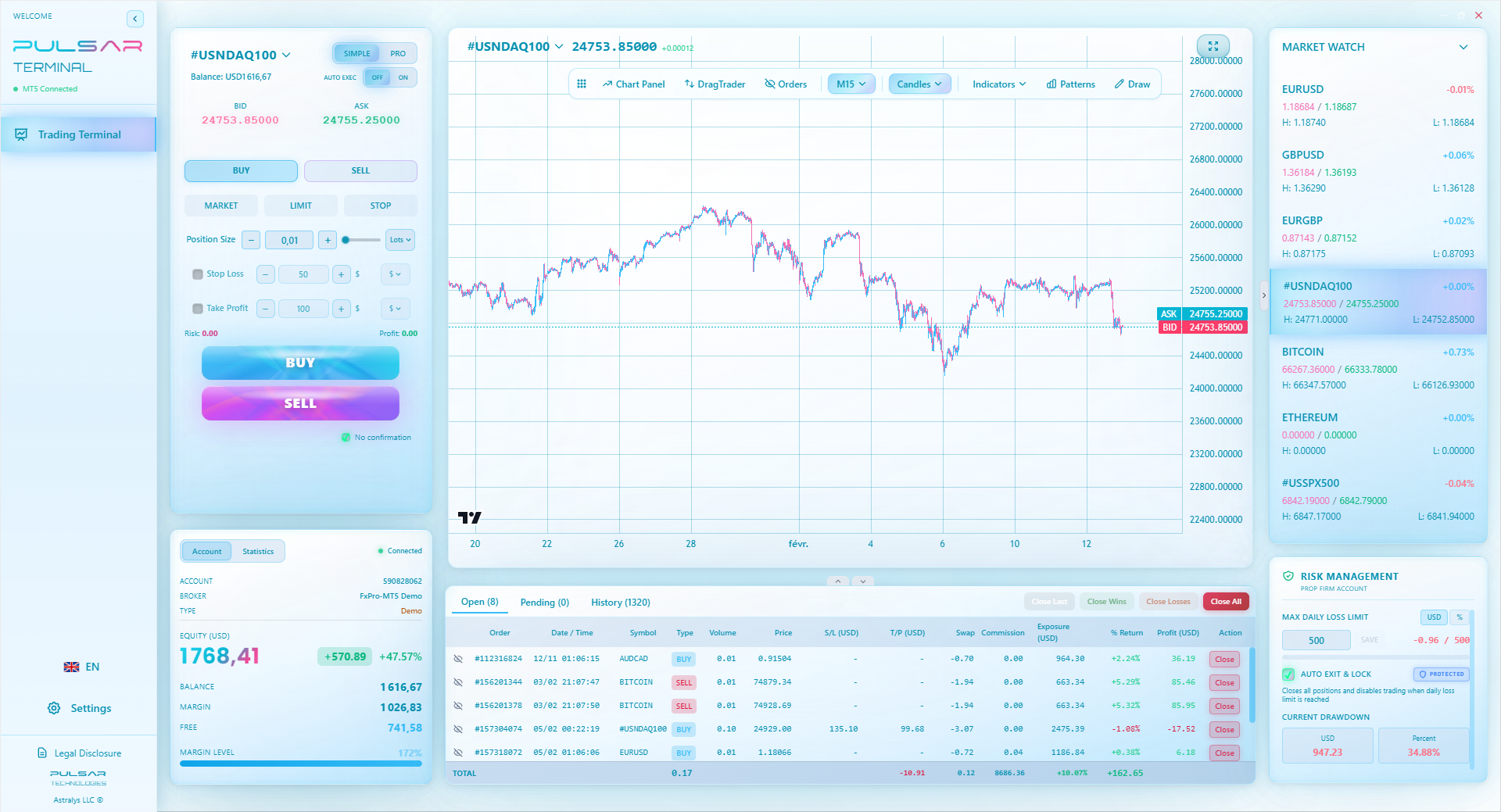
You'll live on a trading platform. MetaTrader 5 (MT5) is the modern standard, offering more timeframes and assets than MT4. But the real edge comes from how you use it. This is where professional tools come in. Managing multiple trades with different take-profit levels and trailing stops on MT5 can be clunky. Automating this process is a force multiplier for your strategy.

Example: Let's say you're trading XAU/USD and want to scale out of a position. You buy at $2,350, with a first profit target at $2,370 and a final target at $2,390. Manually moving stops and closing partial lots is stressful and error-prone. The right tool does this automatically, letting you focus on analysis.
Managing complex trades with multiple take-profit levels and trailing stops is where most traders fail manually; a tool like Pulsar Terminal automates this execution directly on your MT5, turning a good strategy into a disciplined one.
“The path to being in the minority is not a secret indicator. It's a grind.”
Here's the raw truth you won't get from the 'get rich quick' YouTube ads: most people lose money. The figures from European regulators (ESMA) consistently show 70-80% of retail CFD traders lose. South Africa is no different. The path to being in the minority is not a secret indicator. It's a grind.
It starts with a demo account. Not for a week, but for at least 3-6 months. Prove to yourself you can be consistently profitable in a simulated environment. Then, start live with money you can absolutely afford to lose. Your first R10,000 account is tuition, not retirement funding.
Education is continuous, but be selective. Learn about price action, support/resistance, and economic fundamentals. Understand what moves the Rand. The real 'richest forex trader in south africa' is likely someone who combined trading with other income - like running a legitimate fund or a related business - and used extreme financial discipline. That's your model: discipline over hype, process over prediction, and risk management over reckless ambition. That's the only path that leads anywhere worth going.
FAQ
Q1Is forex trading legal in South Africa?
Yes, it's completely legal and regulated by the Financial Sector Conduct Authority (FSCA). Always use an FSCA-licensed broker to ensure your funds are protected under South African law.
Q2What is the maximum use I can use in South Africa?
For retail traders, the FSCA has capped use at 30:1. This is a protective measure. While it may seem limiting, it prevents the kind of catastrophic, account-blowing losses that are common with extreme use of 500:1 or higher.
Q3How much money do I need to start forex trading in South Africa?
Technically, you can start with as little as R500 with some brokers. However, I realistically recommend a minimum of R2,000 to R5,000. This allows you to trade sensible position sizes, absorb the inevitable learning-curve losses, and practice proper risk management without being wiped out by a few bad trades.
Q4Do I pay tax on my forex trading profits?
Absolutely. Profits from trading are considered taxable income by SARS. You are required to declare them and pay income tax. Keep detailed, accurate records of all your trades, deposits, and withdrawals for your tax return.
Q5Who is truly the richest forex trader in South Africa?
There is no publicly verifiable answer. The wealthiest individuals often combine trading with highly successful education businesses, fund management, or other ventures. Focusing on a specific name is a distraction. Focus instead on the proven principles of risk management, consistent strategy, and compounding returns, which are the real drivers of sustainable trading wealth.
Q6Is it better to use a South African broker or an international one?
For beginners and most retail traders, an FSCA-regulated broker is the safer choice for peace of mind and legal protection. Experienced traders might also consider major international brokers with top-tier global regulation (like ASIC in Australia) that accept South African clients and offer ZAR accounts, such as Pepperstone or IC Markets.
Lekcja Prof. Winstona
:
- ✓Wealth estimates are hype; verified trading results are truth.
- ✓Never risk more than 2% of your capital on a single trade.
- ✓Consistent 5-10% monthly returns compound into real wealth.
- ✓FSCA regulation and 30:1 use are your protective armor.
Jak przydatny był ten artykuł?
Kliknij gwiazdkę, aby ocenić
Tygodniowe analizy tradingowe
Darmowe tygodniowe analizy i strategie. Bez spamu.
O autorze
David van der Merwe
Trader Rynków Wschodzących
Trader z Johannesburga z 11-letnim doświadczeniem w walutach rynków wschodzących. Specjalizuje się w parach ZAR, handlu regulowanym przez FSCA i analizie rynku południowoafrykańskiego.
Komentarze
Może Ci się też spodobać

Cara Trading Forex Sukses: 7 Prinsip dari Trader Profesional
Cara trading forex sukses dengan 7 prinsip trader pro: manajemen modal, disiplin, journal trading, backtest. Data nyata, bukan janji profit palsu.
Jam Trading Forex Terbaik untuk Trader Indonesia: Panduan Lengkap dengan Tabel Waktu
Panduan jam trading forex untuk trader Indonesia. Tabel 4 sesi dunia, jam emas 20:00-00:00, sesi mana yang harus dihindari. Data akurat + tips dari trader berpengalaman.
Top 5 Sàn Forex Uy Tín Nhất 2026: Review Jujur dari Trader Indonesia
Top 5 sàn forex uy tín 2026 untuk trader Indonesia. Review jujur: spread, deposit, withdraw, dukungan lokal. Exness, XM, IC Markets & lebih.
All these calculators are built into Pulsar Terminal with real-time data from your MT5 account. One-click position sizing, automatic risk management, and instant calculations.
