


Let's cut the nonsense.

David van der Merwe
Trader Rynków Wschodzących ·  South Africa
☕ 11 min czytania
Czego się nauczysz:
- 1Myth vs. Reality: What a 'Salary' Really Means Here
- 2The Real Numbers: What Traders Actually Make (2026)
- 3The Silent Salary Killers: Costs & Fees
- 4The Only Path to a Consistent 'Paycheck'
- 5The Prop Firm Shortcut (And Its Traps)
- 6SARS Wants Its Cut: Tax on Your 'Salary'
- 7The Final Verdict: Can You Make a Real Salary?
Let's cut the nonsense. The 'salary of a forex trader' is a myth sold by gurus to sell courses. You don't get a salary. You get paid only when you're right, and the market agrees. In South Africa, that reality hits harder with Rand volatility and FSCA use caps. I've seen traders blow R50,000 in a week and others consistently pull in R40k a month. This guide isn't about dreams. It's about the concrete, often ugly, numbers behind what you can actually earn trading forex from Cape Town to Johannesburg, and the specific path that separates profit from loss.
When you ask about a salary, you're thinking like an employee. That's your first mistake. A salary implies a guaranteed monthly deposit from an employer. In forex, your employer is the market, and it's a ruthless, unforgiving boss that doesn't care about your bills.
Your 'salary' is your net profit after all losses, spreads, commissions, and platform fees. It's wildly inconsistent. One month you might net R25,000. The next, you might lose R15,000. Averaging that out to a 'R10,000 monthly salary' is technically true but emotionally bankrupt. The stress of that swing is what breaks most people.
In South Africa, you have an added layer. The FSCA capped use at 30:1 for retail traders. Good for safety, terrible for the get-rich-quick fantasy. That cap alone slashes the potential size of the home runs (and the strikeouts) you might hear about from unregulated spaces. Your earning potential is now mathematically tied to the real capital you risk. Speaking of risk, your number one job is to avoid a margin call, which wipes out your capital and your so-called salary permanently.

Warning: If you need a predictable income to pay rent or school fees, forex trading is a terrible, terrible idea. Treat it as a high-risk business venture, not a job replacement. The stats don't lie: most lose money.
I learned this the hard way in 2015. I had three great months, netting around R18k each time. I felt like a genius and started planning my 'salary'. The fourth month, a stubborn trade on USD/ZAR blew up and wiped out R22,000 - more than my total 'salary' for the previous quarter. That's the reality.

💡 Wskazówka Winstona
Your first profit target should be to end the year with at least 80% of your starting capital. Preservation is the foundation of all future salaries.
“Your 'salary' is your net profit after all losses, spreads, commissions, and platform fees. It's wildly inconsistent.”
Let's talk specific Rands and cents. These are ranges I've seen consistently among traders I've mentored and in the professional circles here. Forget the offshore guru nonsense. This is the South African reality.
The Beginner Phase (First 1-2 Years)
This isn't about salary. It's about survival. Your goal is to lose as little as possible while learning. Most beginners I track lose their first R5,000-R20,000 stake. The few who are disciplined might scrape a small profit.
- Monthly P&L: R0 to R5,000 (profit is rare, loss is common).
- Focus: Not blowing up the account. Learning what a pip really costs.
The Intermediate Grind (Years 2-4)
You've stopped the major bleeding. You have a plan, you're using a position size calculator, and you might be dabbling in tools like the RSI indicator. Consistency is the battle.
- Monthly P&L: R10,000 to R50,000 (but with volatile months).
- Real Example: A student of mine, with a R80,000 account, averaged R12,500 per month over 18 months using a strict swing trading plan on majors like EUR/USD. Some months were R25k, others were R2k.
The Professional Mindset (5+ Years, Consistent Capital)
This is where the 'salary' concept starts to look plausible, but it's still a business profit. You have a proven edge, iron discipline, and significant capital (often R100,000+).
- Monthly P&L: R50,000 to R300,000+.
- Real Example: I know a prop trader who, using a firm's capital, targets 5-10% monthly return. On a R1,000,000 allocation, that's R50k-R100k monthly. His 'salary' is a 50% profit split. So he takes home R25k-R50k. It's good money, but it's tied directly to performance.
The Institutional Salaried Trader
This is the only true 'salary of a forex trader'. Banks and funds pay these. The latest data for 2026 shows:
| Position | Average Annual Salary (ZAR) | Notes |
|---|---|---|
| Entry-Level Dealer (1-3 yrs) | R571,278 | Salaried, with bonuses tied to desk P&L. |
| Senior Dealer (8+ yrs) | R935,386 | Includes average bonus of ~R185k. |
This path requires finance degrees, internships, and working your way up in a corporate environment. It's a real job, but it's not the 'trade from the beach' dream.
“If you need a predictable income to pay rent or school fees, forex trading is a terrible, terrible idea.”
Your gross profit isn't your salary. These costs chip away at it every single trade. Ignore them, and your 'salary' projections are fantasy.
The Spread: This is the broker's cut. On the EUR/USD, a good spread might be 0.6 pips. On a standard lot (R1.5 million notional value at 15.00 USD/ZAR), that's R90 gone before your trade even starts. Do 20 trades a week? That's R1,800 a week, or over R7,000 a month in pure cost. Brokers like Pepperstone or IC Markets offer raw spreads (near 0.0 pips) but charge a commission (e.g., $7 per lot). Do the math for your volume.
Slippage & Requotes: During news events, your perfect entry slips. You wanted 18.5000 on USD/ZAR, you get filled at 18.5025. That's an instant, unrecoverable cost.
Platform & Data Fees: Some advanced platforms or data feeds cost money. It's a business overhead.
The Psychological Tax: This is the big one. A losing streak causes fear. You skip the next set-up, which was a winner. That missed profit is a real cost. Conversely, a win makes you overconfident. You size up too big on the next trade and give half back. I've 'taxed' myself out of tens of thousands this way.

Example: You aim for a R20,000 monthly 'salary'. If your trading costs (spreads, commissions) are R5,000/month, you now need to gross R25,000. If you have 2 losing months a year (say, -R10,000 each), you need to make an extra R20,000 across the other 10 months just to break even on those losses. Suddenly, your R20k target requires grossing R27,000 in your profitable months. See how it erodes?
“If you need a predictable income to pay rent or school fees, forex trading is a terrible, terrible idea.”
You want that reliable monthly income? The formula is boring, but it's the only one that works.
1. Treat It Like a Business, Not a Lottery. You need a business plan. What's your edge? What's your monthly expense (cost of living + trading costs)? What's your profit target? How much capital do you need to generate that target with sane risk (e.g., risking 1% per trade)?
2. Master One Thing. Don't jump from scalping USD/ZAR to swing trading XAU/USD. Pick a pair, a time frame, and a strategy. I made real progress only when I focused purely on London session breakouts on GBP pairs. My MACD indicator setup became second nature.
3. Your 'Salary' is a Percentage, Not a Rand Figure. Pros don't say 'I need to make R15k this month.' They say, 'I aim for a 5% return on my risk capital this month.' If your capital is R200,000, that's R10,000. If it's R400,000, that's R20,000. This mindset detaches you from emotional money needs and attaches you to mathematical probability.
4. Withdraw Profits Religiously. This is your actual salary. If you have a R100k account and make R10k in a month, withdraw R5k. Put it in a savings account. Pay yourself. This psychologically reinforces profit-taking and prevents you from over-trading a bloated account.
5. Use Every Tool to Minimize Mistakes. Emotional exits and poor order management are a massive tax. This is where technology can be a force multiplier for your consistency.

Pro Tip: The fastest way to see if you have a real edge is to track your net profit per trade, after all costs, over at least 100 trades. If it's not positive, you don't have a business. You have an expensive hobby.
💡 Wskazówka Winstona
If you can't articulate your edge in one sentence - 'I buy when X happens on the 4H chart of Y pair' - you don't have a business, you have a hope.
“The promise of a big salary from a prop firm is only valid if you're already a consistently profitable, disciplined trader.”
Prop trading firms are huge in SA right now. They offer a potential shortcut to trading larger capital without risking your own life savings. The pitch is seductive: pass a challenge, get a funded account, keep a large share of the profits. It can look like a guaranteed 'salary' path.
Here's the real deal. The challenge rules are designed for you to fail. They test extreme discipline under pressure. The daily loss limits are brutal. You might have a R1,000,000 simulated account, but a R10,000 loss in a day (1%) can shut you down.
I passed a challenge with a firm similar to the models here. The profit target was 10% over 30 days with a 5% max loss. I used a conservative, high-probability strategy and hit 10.2% in 19 days. My 'salary'? For the first R50,000 I make on the funded account, I keep 80% (R40,000). After that, the split increases.
But here's the trap: the psychological pressure to perform for that 'salary' can ruin your trading. You start forcing trades to hit targets. You break your rules. The firms know this. Your edge isn't just market analysis, it's flawless risk management under evaluation constraints.
The key is to trade the challenge exactly as you would your own money, just smaller. If you can't be profitable with a R10,000 demo account under their rules, you won't be with R1,000,000. The promise of a big salary from a prop firm is only valid if you're already a consistently profitable, disciplined trader. It's an amplifier, not a creator, of skill.
Managing the strict daily loss limits of a prop firm challenge is a huge psychological burden, which is why automating your risk with a tool like Pulsar Terminal can be the difference between passing and failing.
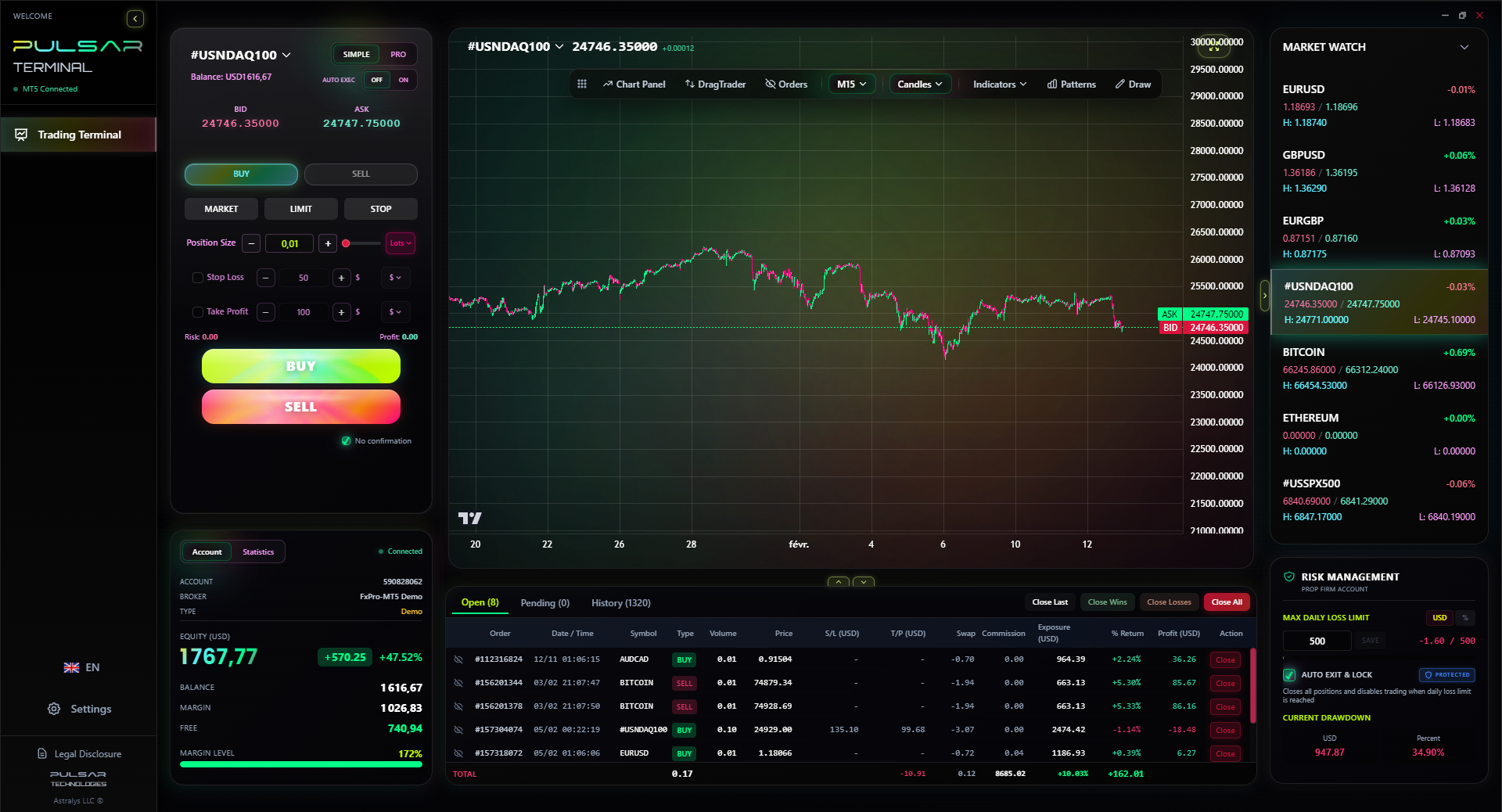
“The promise of a big salary from a prop firm is only valid if you're already a consistently profitable, disciplined trader.”
This is non-negotiable and where many 'home traders' get a nasty surprise. The South African Revenue Service (SARS) views your net trading profits as income from a business (if you trade regularly) or as capital gains. For active traders, it's almost always income.
- You Must Declare: All profits, even if held in an offshore broker like Exness or XM, must be declared on your annual tax return (ITR12).
- You Can Deduct Expenses: This is crucial. Your legitimate business expenses reduce your taxable income. This includes:
- Broker commissions and spreads (the cost of sales).
- Platform/subscription fees (Bloomberg, TradingView, etc.).
- Internet and data costs for trading.
- Home office expenses (portion of rent, electricity) if you trade professionally.
- Education (books, courses, seminars).
- Keep careful Records: A simple spreadsheet won't cut it. You need a full trade journal and receipts for everything. The onus is on you to prove your numbers to SARS.
Let's say your net profit for the year is R240,000 (a R20k 'monthly salary'). After deducting R40,000 in proven expenses, your taxable trading income is R200,000. That gets added to your other income and taxed at your marginal rate. Not declaring it is tax evasion, pure and simple. Get an accountant who understands trading.
💡 Wskazówka Winstona
Withdraw your first R1,000 of profit and spend it on something stupid. Celebrate the process. Then get back to work. This game is a marathon of sprints.
“For 95% of people who try, the 'salary of a forex trader' will be negative. They will pay the market, not the other way around.”
Yes, but not in the way you imagine.
You can build a business that generates a consistent average monthly profit that covers your living costs. That profit will be volatile, stressful, and hard-earned. It will require years of study, significant starting capital (at least R50,000-R100,000 to generate meaningful returns at 2-5% monthly), and a psychological fortitude most people lack.
The institutional salary of R800k+ a year is a real career, but it's a corporate finance job with a suit and a commute.
The prop firm path is a potential accelerator, but it's a high-pressure test, not a free lunch.
For 95% of people who try, the 'salary of a forex trader' will be negative. They will pay the market, not the other way around. Your mission is to join the 5%. That journey starts by throwing the word 'salary' out the window and replacing it with 'business profit'. It starts with risking R100 per trade, not dreaming of R100,000 months. It starts today, with a plan tighter than you think you need.
I've been on both sides of this. I've had months where my trading 'salary' was a negative R18,000. I've also had quarters where the average was a positive R35,000. The difference wasn't a better indicator. It was a better version of me - more patient, more disciplined, and brutally honest about the numbers. You need to become that person first. The money follows, maybe.
FAQ
Q1What is the average monthly salary for a forex trader in South Africa?
For a self-employed retail trader, there's no reliable 'average' as most lose money. For those who are profitable, intermediate traders might average R10,000-R50,000 per month, while experienced traders with solid capital can aim for R50,000-R200,000. The only true average salary is for institutional dealers, which is around R68,000 per month (R812k/year) before bonuses.
Q2How much do I need to start trading forex for a 'salary' in SA?
To realistically generate a meaningful income that could replace a salary, you need enough capital that a conservative monthly return (e.g., 3-5%) covers your costs. If you need R20,000 per month, and you target a 4% return, you need at least R500,000 in trading capital. Starting with R10,000 and expecting a R20k salary is a surefire path to losing your R10,000.
Q3Do forex traders pay tax in South Africa?
Absolutely yes. SARS considers regular trading profits as taxable income. You must declare your net profit (gross profit minus allowable business expenses like spreads, commissions, and platform fees) on your annual tax return. Failure to do so is tax evasion.
Q4Can I make R100,000 a month trading forex?
It's mathematically possible but statistically unlikely for a retail trader. To make R100k a month with a 5% monthly return, you'd need R2,000,000 in risk capital. Alternatively, you could use higher risk on a smaller account, but that dramatically increases your chance of blowing up the account. The traders who consistently hit those numbers either have very large capital, work for a prop firm with a large allocation, or are taking unsustainable risks.
Q5Is the salary from a prop trading firm real?
The profit split you earn from a funded account is real money. However, it's not a salary. It's a performance-based payout. You only get paid if you are profitable and adhere to their strict risk rules. It's a business partnership, not employment.
Q6What's the biggest mistake people make when calculating their potential salary?
They forget costs and variance. They see a R5,000 win on one trade and multiply it by 20 trades a month, dreaming of R100,000. They ignore the 10 losing trades that cost R3,000 each (-R30,000), the R8,000 in spreads/commissions, and the fact that wins and losses don't come in neat order. They calculate their best-case gross, not their likely net.
Lekcja Prof. Winstona
:
- ✓A salary is a myth; you earn business profit or suffer losses.
- ✓Realistic monthly earnings range from R0 (beginner) to R300k+ (expert with capital).
- ✓Trading costs (spreads, slippage) are a silent tax on your profits.
- ✓SARS taxes net trading profit as income - declare and deduct expenses.
- ✓Prop firms amplify existing skill; they don't create a salary from nothing.
Jak przydatny był ten artykuł?
Kliknij gwiazdkę, aby ocenić
Tygodniowe analizy tradingowe
Darmowe tygodniowe analizy i strategie. Bez spamu.
O autorze
David van der Merwe
Trader Rynków Wschodzących
Trader z Johannesburga z 11-letnim doświadczeniem w walutach rynków wschodzących. Specjalizuje się w parach ZAR, handlu regulowanym przez FSCA i analizie rynku południowoafrykańskiego.
Komentarze
Może Ci się też spodobać

Cara Trading Forex Sukses: 7 Prinsip dari Trader Profesional
Cara trading forex sukses dengan 7 prinsip trader pro: manajemen modal, disiplin, journal trading, backtest. Data nyata, bukan janji profit palsu.
Jam Trading Forex Terbaik untuk Trader Indonesia: Panduan Lengkap dengan Tabel Waktu
Panduan jam trading forex untuk trader Indonesia. Tabel 4 sesi dunia, jam emas 20:00-00:00, sesi mana yang harus dihindari. Data akurat + tips dari trader berpengalaman.
Top 5 Sàn Forex Uy Tín Nhất 2026: Review Jujur dari Trader Indonesia
Top 5 sàn forex uy tín 2026 untuk trader Indonesia. Review jujur: spread, deposit, withdraw, dukungan lokal. Exness, XM, IC Markets & lebih.
All these calculators are built into Pulsar Terminal with real-time data from your MT5 account. One-click position sizing, automatic risk management, and instant calculations.
