


Let's be brutally honest: most 'guru' stories in South Africa are polished for social media, leaving out the messy, expensive lessons.

David van der Merwe
Trader Rynków Wschodzących ·  South Africa
☕ 10 min czytania
Czego się nauczysz:
Let's be brutally honest: most 'guru' stories in South Africa are polished for social media, leaving out the messy, expensive lessons. Shaun Benjamin's story is different, not because he's infallible, but because his journey from Newcastle to millionaire by 21 exposes the raw mechanics of trading success. It's not about a secret indicator. It's about a specific mindset and a ruthless approach to risk that most people can't stomach. I've traded through bull markets, crashes, and everything in between for over a decade. In this guide, I'll strip away the hype around the Shaun Benjamin forex trader phenomenon and show you the actual framework - the rules, the costs, the psychological grind - that can work for you right here in SA, with our unique market quirks and regulatory landscape.
Shaun Benjamin isn't just another face on a YouTube ad. His background is crucial to understanding his approach. Having to drop out of engineering studies due to finances, then working a mining learnership before quitting to trade full-time? That's not a glamorous start. It creates a certain kind of trader - one who understands the value of a Rand because he's had to work for it, and one who knows that a backup plan isn't always an option.
His core message, which I've found to be the single most important factor in my own career, is that mindset trumps methodology. You can have the best strategy in the world, but if your psychology is weak, you'll give back all your profits. Benjamin's academy focuses on this, often providing free training, which is a point worth respecting in a space filled with overpriced courses.

Warning: The 'millionaire by 21' story is powerful, but don't let it set unrealistic expectations. For every Shaun, there are thousands who blow their accounts. Your timeline will be your own. My first profitable year took 18 months of consistent, small losses before something clicked.
The real lesson from his story isn't the destination; it's the grind. It's the discipline to treat trading like a professional skill, not a lottery ticket. This is the foundation everything else is built on.

💡 Wskazówka Winstona
A 'demo account' is for testing strategy mechanics, not for building false confidence. The moment real money is on the line, your psychology changes. Transition to a live micro account as soon as you understand the platform.
“The real lesson from Shaun Benjamin's story isn't the destination; it's the grind.”
Trading from South Africa isn't the same as trading from London or New York. We have our own set of rules, costs, and opportunities. Ignoring this is the fastest way to lose money.
The Regulatory Gatekeeper: FSCA
Your first filter for any broker must be the Financial Sector Conduct Authority (FSCA). An FSP license isn't a nice-to-have; it's a legal requirement for them to hold your money. This means client funds are segregated, and the broker is subject to South African law. I learned this the hard way early on, depositing with an unregulated offshore broker that suddenly 'had technical issues' when I tried to withdraw R15,000. Poof. Gone. Stick to FSCA-regulated entities like AvaTrade or Exness (SA).
The Real Cost of a Trade
Forget just the spread. You need to calculate your all-in cost per trade to know your true break-even point.
Let's break down a typical R100,000 (1 standard lot) trade on EUR/USD:
| Cost Type | Example from a Raw Account | Example from a Standard Account |
|---|---|---|
| Spread | 0.1 pips | 1.2 pips |
| Commission | $7 (≈ R130) per lot | R0 |
| Total Cost in Rands | ~R130 + (0.1 pip value) | ~R240 (1.2 pip value) |
See the difference? The 'zero spread' account isn't free. You must do this math. A tool like our position size calculator is non-negotiable for this.
The SARB and Your Money
This is a big one that many new traders miss. The South African Reserve Bank (SARB) controls capital flows. The recent 2026 changes are a game-changer for us. The Single Discretionary Allowance (SDA) doubling to R2 million per year means it's significantly easier to fund international broker accounts or repatriate profits without a tax PIN for each transaction. This flexibility is massive. Before this, moving larger sums was a bureaucratic headache.
Local Payment Sweet Spot
Always opt for a ZAR-denominated account if your broker offers it. Depositing and withdrawing in Rands via Instant EFT or local bank transfer avoids the 1-2% currency conversion fees that silently eat your capital. Brokers like XM and Exness offer this, and it saves you hundreds, if not thousands, over a year.
“use is a tool, not a multiplier for dreams. Use it like a scalpel, not a sledgehammer.”
Shaun Benjamin talks about mindset for a reason. In SA, with load-shedding, volatile ZAR news, and economic pressure, your head is your biggest asset or your worst liability.
Patience is a Strategy, Not a Virtue. I used to chase every pip. If EUR/USD moved 20 pips without me, I felt FOMO and jumped in late, usually at the worst possible time. I blew a R5,000 account in 2012 doing that. Benjamin's emphasis on waiting for your specific setup means you might only take 2-3 high-quality trades a week. That's okay. Boredom is part of the job.
Risk Management is Your Salary Negotiation. You wouldn't work a job where your employer could randomly deduct 50% of your monthly salary. So why trade with a 5% risk per trade? The Benjamin Forex Academy drills this. My rule, which took years to stick to, is never risk more than 1% of my account on a single trade. For a R20,000 account, that's R200. It sounds small, but it means you can survive 10 losing trades in a row and still be in the game. This is how you avoid a margin call.
Journal Everything, Especially the Losses. This is the most underrated tool. Every trade. Entry, exit, why you took it, your emotional state. I reviewed my journal from Q4 2023 and saw a pattern: 80% of my losses came from trades taken after 10 PM when I was tired. That single insight saved me more money than any indicator ever has. Discipline is built through these tiny, honest audits.

Pro Tip: Your first profit target should always be to get to breakeven. Move your stop loss to your entry point once the trade is in profit by 1.5x your risk. This turns a potential loser into a free trade and completely changes your psychology.
💡 Wskazówka Winstona
Your trading plan is useless if it's not written down. A written plan is a contract with yourself. It removes ambiguity in the heat of the moment, which is when you need clarity the most.
“Your first profit target should always be to get to breakeven.”
Theory is useless without execution. Here’s a simplified, actionable framework inspired by the principles behind successful traders like Benjamin, adapted for our market.
The Instrument: Keep It Simple
Start with one major pair. EUR/USD is the classic for a reason: high liquidity, tight spreads, and plenty of clear data. Don't complicate things with exotic pairs like USD/ZAR initially; the spreads are wider and moves can be erratic. Master one market first. Our EUR/USD guide dives deep into its rhythms.
The Chart: Price Action is King
Forget the 20-indicator soup. Start with a clean chart. I use:
- A 200-period Simple Moving Average (SMA) on the daily chart to define the long-term trend.
- Horizontal Support and Resistance lines at obvious swing highs and lows.
- Candlestick patterns (like pin bars, engulfing bars) at those support/resistance levels.
That’s it. The strategy? Wait for price to approach a key level in line with the daily trend, and look for a price action rejection candle. Enter on a break of that candle's high/low.
The Execution Plan (A Real Trade Example)
In January 2026, with the Rand strengthening, I was watching EUR/USD.
- Context: Daily chart was in a downtrend (price below 200 SMA).
- Level: Previous support at 1.0850 had become resistance.
- Setup: Price rallied to 1.0845 and formed a clear bearish engulfing candle on the 4-hour chart.
- Action: I sold at 1.0835 (below the engulfing candle's low).
- Stop Loss: Placed at 1.0885 (50 pips above my entry, protecting against a false break).
- Take Profit: Set at 1.0735 (100 pips target, a 1:2 risk-reward ratio).
Result: The trade ran down to my target in 3 days. A R200 risk (1%) netted a R400 profit. It wasn't glamorous, but it was textbook. This is the grind.
Tools for the Modern SA Trader
MT4/MT5 is the standard, but the real edge comes from tools that manage risk for you. This is where technology bridges the discipline gap.
“Your first profit target should always be to get to breakeven.”
Let me save you some money and heartache by sharing my most expensive lessons.
Pitfall 1: Overleveraging the 'Small' Account. You deposit R2,000, see that you can control R200,000 with 100:1 use, and think you're a genius. I did this. A 10-pip move against you on a full position wipes out 100% of your capital. use is a tool, not a multiplier for dreams. Use it like a scalpel, not a sledgehammer.
Pitfall 2: Revenge Trading. You take a R500 loss. The anger hits. You jump right back in with a double-sized position to 'make it back fast.' This is how a bad day becomes a catastrophic week. I turned a R1,000 loss into a R3,500 hole in one afternoon in 2018. The rule now: after two consecutive losses, I shut the platform down for the day. No exceptions.
Pitfall 3: Ignoring SA-Specific News. Trading EUR/USD during a SARB interest rate announcement or a national budget speech is like driving blindfolded. The ZAR reacts violently, which spills over into all major pairs due to market sentiment and carry trade unwinds. I got stopped out of a perfectly good GBP/USD trade because I didn't know the Finance Minister was speaking. Now, I keep a calendar with SARB meetings, CPI data releases, and major political events.
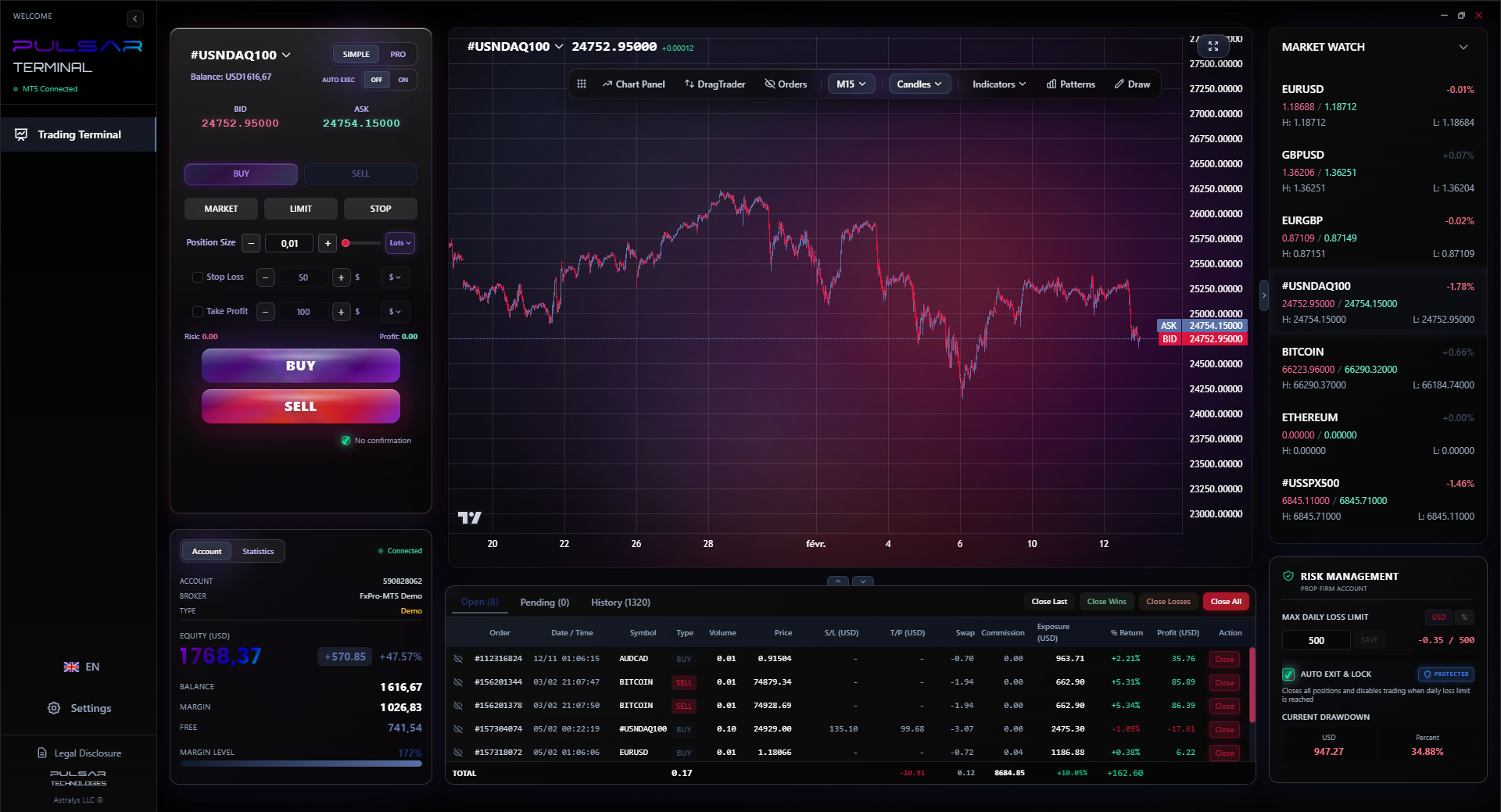
Pitfall 4: Chasing Prop Firm Hype Without a Strategy. Prop firm challenges are everywhere. They can be a great capital-access tool, but they have strict drawdown rules. You need a strategy with high consistency, not just high returns. A tool that can automate daily loss limits and trailing stops is critical here, as one emotional mistake can fail the entire challenge. This is where a structured approach separates the funded trader from the perpetual challenger.
💡 Wskazówka Winstona
The most successful traders I've known are not the ones with the highest win rate, but the ones with the best loss management. They know exactly how much they can lose on a bad day and have a system to enforce it.
Managing the strict rules of a prop firm challenge or your own emotional biases requires automated discipline, which is exactly what Pulsar Terminal builds directly into your MT5 platform.
“The market doesn't care about your dreams, your bills, or your background. It only responds to consistent, disciplined action.”
So, where do you start tomorrow?
Phase 1: Education & Simulation (Months 1-3) Don't deposit real money. Open a demo account with an FSCA broker like IC Markets or Pepperstone. Practice the one-setup strategy. Your goal isn't profit; it's consistency. Can you execute the same plan 20 times in a row without deviation?
Phase 2: Micro-Funding (Months 4-6) Deposit the minimum amount you can - maybe R500 or R1000. The goal is to feel real risk. A R10 loss on a 0.01 lot micro trade should feel meaningful. Practice your 1% risk rule religiously. At this stage, you're paying for an education, not buying a Lamborghini.
Phase 3: Scaling & Specialization (Month 6+) Once you have 3 consecutive months of demonstrable, small profits, you can consider scaling your capital. This might mean adding a second instrument (maybe XAU/USD which often moves inversely to the Dollar) or exploring different timeframes for swing trading.
The story of Shaun Benjamin the forex trader resonates because it proves it's possible from South Africa. But the blueprint isn't in his specific trades; it's in the discipline, the risk management, and the relentless focus on process over payout. The market doesn't care about your dreams, your bills, or your background. It only responds to consistent, disciplined action. Your job is to provide it.
FAQ
Q1Is Shaun Benjamin's forex academy worth the money?
The value depends on you. The core principles of mindset and risk management he teaches are foundational and correct. If you need structured guidance and mentorship, it could accelerate your learning. However, the same core knowledge is available for free if you're disciplined enough to seek it out and piece it together through reputable sources, demo trading, and rigorous self-review. Never expect any course to be a 'secret key' to guaranteed profits.
Q2What is the minimum amount I need to start forex trading in South Africa?
Technically, you can start with as little as R180 (Exness) or $5 (XM). But realistically, you need enough to practice proper risk management. A R2,000 account risking 1% per trade gives you a R20 risk per trade, which is a reasonable starting point for micro lots. The minimum deposit is less important than having enough capital to survive the inevitable learning curve without blowing up.
Q3Can I trade forex legally in South Africa?
Yes, absolutely. It is legal for individuals to trade forex through brokers regulated by the Financial Sector Conduct Authority (FSCA). You must use an FSCA-licensed broker to ensure your funds are protected under South African law. Trading with unregulated international brokers is not illegal for you, but it carries significantly higher risk as you have no local legal recourse if something goes wrong.
Q4How do I avoid currency conversion fees as a South African trader?
The simplest way is to open a trading account denominated in South African Rands (ZAR). Many international brokers catering to SA, like Exness and XM, offer this. Then, fund your account via a local bank transfer (EFT) or Instant EFT. This way, your deposit, trading equity, and withdrawals are all in Rands, bypassing foreign exchange fees on every transaction.
Q5What's more important for a beginner: strategy or psychology?
Psychology, without a doubt. A simple strategy with iron-clad discipline will beat a complex, brilliant strategy executed poorly every single time. A beginner with perfect psychology will follow their rules, manage risk, and survive to learn. A beginner with a great strategy but poor psychology will override their stops, revenge trade, and blow their account before the strategy ever has a chance to work.
Q6Are prop firm challenges a good way to start trading?
No, they are a terrible way to start. Prop firm challenges have strict, often ruthless, drawdown rules designed to test already-profitable traders. You need a proven, consistent strategy and rock-solid psychology first. Start with your own capital in a live micro account. Once you can generate consistent profits for 6+ months, then consider a prop challenge as a way to access larger capital.
Q7How do SARB interest rate decisions affect my forex trading?
Massively, even if you're not trading the ZAR. SARB rate changes influence the Rand's yield attractiveness. A rate hike can cause the ZAR to strengthen, which often leads to selling in other emerging market currencies and can trigger risk-off sentiment, boosting the US Dollar (USD). This USD strength then impacts all major pairs like EUR/USD and GBP/USD. Always check the economic calendar for SARB meeting dates.
Lekcja Prof. Winstona
:
- ✓Mindset and risk management are 90% of the game.
- ✓Never risk more than 1% of your account on a single trade.
- ✓Use ZAR accounts and local EFT to avoid conversion fees.
- ✓Always verify your broker's FSCA license before depositing.
- ✓Journal every trade to find your personal failure patterns.
Jak przydatny był ten artykuł?
Kliknij gwiazdkę, aby ocenić
Tygodniowe analizy tradingowe
Darmowe tygodniowe analizy i strategie. Bez spamu.
O autorze
David van der Merwe
Trader Rynków Wschodzących
Trader z Johannesburga z 11-letnim doświadczeniem w walutach rynków wschodzących. Specjalizuje się w parach ZAR, handlu regulowanym przez FSCA i analizie rynku południowoafrykańskiego.
Komentarze
Może Ci się też spodobać

Cara Trading Forex Sukses: 7 Prinsip dari Trader Profesional
Cara trading forex sukses dengan 7 prinsip trader pro: manajemen modal, disiplin, journal trading, backtest. Data nyata, bukan janji profit palsu.
Jam Trading Forex Terbaik untuk Trader Indonesia: Panduan Lengkap dengan Tabel Waktu
Panduan jam trading forex untuk trader Indonesia. Tabel 4 sesi dunia, jam emas 20:00-00:00, sesi mana yang harus dihindari. Data akurat + tips dari trader berpengalaman.
Top 5 Sàn Forex Uy Tín Nhất 2026: Review Jujur dari Trader Indonesia
Top 5 sàn forex uy tín 2026 untuk trader Indonesia. Review jujur: spread, deposit, withdraw, dukungan lokal. Exness, XM, IC Markets & lebih.
All these calculators are built into Pulsar Terminal with real-time data from your MT5 account. One-click position sizing, automatic risk management, and instant calculations.
