


Let's cut through the noise.

David van der Merwe
Trader Rynków Wschodzących ·  South Africa
☕ 11 min czytania
Czego się nauczysz:
- 1What Exactly Is Spot Forex (And Why South Africa's Different)
- 2The Rulebook: FSCA, Taxes, and Staying Legal
- 3The Real Costs: From Minimum Deposit to Hidden Fees
- 4Choosing Your Broker and Platform in SA
- 5Building a Strategy That Works (And Not Blowing Up)
- 6The Classic South African Pitfalls & Your First 100 Trades
Let's cut through the noise. The biggest myth about spot forex trading in South Africa is that it's a quick ticket to a mansion in Camps Bay. Spoiler: it's not. It's a grind, a skill, and a business that will test you more than a load-shedding schedule. I've blown accounts, celebrated six-figure months, and learned the hard way what works here. This guide isn't about getting rich quick. It's about understanding the real landscape: the FSCA's 30:1 use cap, why your USD/ZAR trade costs you more than you think, and how to actually keep what you make away from SARS. Let's get into it.
Spot forex is the simple act of buying one currency and selling another, right now, at the current market price. You're speculating on the exchange rate. If you think the Rand will weaken against the Dollar, you buy USD/ZAR. That's it. No ownership of the actual currency, no futures contracts, just a direct bet on the price movement.
But here's the South African twist. We're not just trading EUR/USD from a couch in Sandton. We have skin in the game with our own currency. The ZAR is a major emerging market currency, accounting for about 1% of all global forex volume. That might sound small, but it translates to serious liquidity and volatility, especially in pairs like USD/ZAR and EUR/ZAR. This local angle is a double-edged sword. You have an intuitive feel for what might move the Rand (Eskom news, political drama, commodity prices), but that same familiarity can make you overconfident and sloppy.
I learned this lesson painfully in 2020. I was convinced, based on local news, that the Rand was due for a massive recovery. I went heavy long on USD/ZAR at 18.50, ignoring the global dollar strength. It ran to 19.80 against me. I lost R42,000 in a week because I traded my bias, not the chart. The global macro picture drowned out the local story. Spot forex trading here means you're a local trader in a global arena. Never forget that.

Warning: Trading ZAR pairs isn't 'easier' because you follow local news. Often, the opposite is true. The emotional connection can cloud your judgment. Treat USD/ZAR with the same cold, technical discipline you'd use for USD/JPY.
“Trading ZAR pairs isn't 'easier' because you follow local news. Often, the opposite is true.”
You can't play the game if you don't know the rules. In South Africa, the referee is the Financial Sector Conduct Authority (FSCA).
The FSCA License is Non-Negotiable
Only trade with a broker holding a valid FSCA license. This isn't a suggestion, it's your primary protection. It means client funds are segregated (your money is kept separate from the broker's operating money), and you have a local recourse if things go south. You can check any broker's FSP number on the FSCA's online register. I only use FSCA-regulated brokers like IC Markets or Pepperstone for my serious capital. Yes, you can sign up with offshore brokers, but if they vanish with your money, the FSCA can't help you. It's not worth the risk.
The 30:1 use Cap
Since 2021, the FSCA has capped use for retail traders at 30:1. This is a good thing. The brokers advertising 1000:1 to international clients? That's a quick way to obliterate an account. At 30:1, a 3.33% move against you wipes you out. That's still plenty of risk. I rarely use more than 10:1 on my core positions. use is a tool, not a strategy.
SARS Wants Its Share
This is where many new traders get a nasty surprise. Your forex profits are not capital gains. SARS views frequent trading as income. That means your profits are added to your salary and taxed at your marginal income tax rate (which can be up to 45%). You must keep careful records: every trade statement, every deposit and withdrawal slip. I use a simple spreadsheet and save monthly statements from my broker. When tax season comes, it's all there. Trying to hide it is a fool's errand and not worth the audit.
The R1 Million and R10 Million Rules
Need to move serious money? Be aware of exchange controls. Transfers over R1 million out of the country require a banking form. Over R10 million? You're looking at a mountain of paperwork and potential approval processes. For most traders, this isn't a daily concern, but if you hit a big prop firm payout, you need to know the drill.

💡 Wskazówka Winstona
Your first R10,000 in profits should go straight to a tax savings account. SARS is the most consistent winner in this game. Don't get caught short.
“The advertised 'minimum deposit' is often a trap.”
Let's talk numbers, because this is where dreams meet reality. The advertised 'minimum deposit' is often a trap.
The Minimum Deposit Lie
Yes, you can open an account with XM for $5 (about R70). Technically, you can trade. Practically, you'll achieve nothing except learning how to blow a tiny account. With 30:1 use on that R70, your position size is a joke. You need room to breathe and withstand normal market noise. My firm advice? A realistic starting capital for meaningful, educational trading is R1,500 to R5,000. For treating this as a serious side business, think R5,000 to R20,000. This lets you use sensible position sizes and actually apply risk management.
Spreads, Commissions, and the ZAR Surcharge
Costs eat returns. You need to understand them.
| Cost Type | What It Is | Typical Example (Major Pair) | ZAR Pair Reality Check |
|---|---|---|---|
| Spread | Difference between buy & sell price | EUR/USD: 0.3 pips on a raw account | USD/ZAR: 5-8 pips (much wider) |
| Commission | Fee per lot traded | $7 per standard lot (100k units) | Often built into wider spread on ZAR pairs |
| Swap/Overnight | Interest for holding past 5pm NY time | Can be positive or negative | Usually negative for long ZAR pairs (you pay) |
That wider spread on USD/ZAR is critical. If the spread is 6 pips, the market needs to move 6 pips in your favor just for you to break even. This makes scalping ZAR pairs very difficult. It's better suited for swing trading where you target larger moves.
Bank Fees Are a Killer
You fund your account in Rands, your broker might convert it to USD. Your local bank will charge for the international transfer. Capitec, for example, charges R250 to send money overseas and R350 to receive it. If you're making small, frequent withdrawals, these fees will destroy you. Plan your cash flow. Withdraw larger amounts less frequently.

Example: You make a R2000 profit and withdraw it. Capitec's R350 receiving fee takes 17.5% of your profit instantly. Ouch. This is why using a broker with a local ZAR account (like Khwezi Trade) can be a huge cost saver.
“Strategy without risk management is a donation to the market.”
Your broker is your gateway, and your platform is your cockpit. Choose wrong, and you're fighting with one hand tied behind your back.
FSCA-Regulated Brokers Worth a Look
Here's a quick, opinionated rundown based on my experience and the community's pulse:
- For Raw Spreads & Active Trading: IC Markets or Pepperstone. Their Razor/Raw accounts offer tight spreads (even on ZAR pairs) with a commission. If you're trading size, this is often cheaper overall.
- For Beginners & Micro Lots: XM or Exness. Low minimum deposits, good educational material, and they allow you to trade tiny cent/micro lots to learn without massive risk.
- The Local Option: Khwezi Trade. Proudly South African, FSCA licensed, ZAR accounts. Spreads are competitive, and you avoid forex conversion on your deposit. A solid choice if you want to keep everything local.
MT4/MT5 is Still King
In South Africa, MetaTrader 4 and 5 are the undisputed champions. Every broker supports them. They're stable, have countless indicators (like the RSI and MACD), and allow for automated trading. cTrader is gaining ground, especially with Pepperstone, and offers a cleaner interface for pure price action. But if you're starting, learn MT5. It's the lingua franca.
The platform is just the base. The real edge comes from how you use it. Manually moving stop losses or calculating position size for every trade is inefficient and error-prone.

Pro Tip: Don't just download MT5 and stare at a naked chart. Build a consistent workspace. Have your favorite 2-3 indicators ready, know how to set alerts, and most importantly, learn how to use the trade terminal to set stop-loss and take-profit orders BEFORE you click buy. Emotional exits are losing exits.
💡 Wskazówka Winstona
If you can't explain your trade setup in one sentence ('I'm buying this pullback to the 50 EMA in an uptrend'), you shouldn't be in the trade. Complexity is the enemy of execution.
“Strategy without risk management is a donation to the market.”
Strategy without risk management is a recipe for donating money to the market. I'll say it again: strategy without risk management is a donation.
The 1% Rule is Your Sacred Law
Never, ever risk more than 1% of your account capital on a single trade. On a R10,000 account, that's R100. You use this to determine your position size via a position size calculator. This single rule has saved me from ruin more times than I can count. In 2022, I had a streak of 7 losing trades in a row. It happens. Because I was risking 1%, my total drawdown was under 8%. Annoying, but not catastrophic. I recovered the next month. If I'd been risking 5% per trade, I'd have been down 35% and probably too scared to place the winning trade that followed.
Have a Clear Edge, Not Just a Hunch
Your strategy needs a defined entry, exit, and stop-loss. Are you trading breakouts? Pullbacks to moving averages? Divergence on the RSI indicator? It doesn't have to be complicated. My most consistent profits come from a simple trend-following setup on the 4-hour chart. I wait for a clear trend, wait for a pullback to a key level, and enter with a stop below the recent swing low. Boring. Effective.
The Psychology of the ZAR
Trading USD/ZAR is emotionally charged. You see it on the news every night. You must divorce your personal feelings about South Africa from the chart. The chart doesn't care about your patriotism or your pessimism. It only cares about price. Use technical levels to guide you, not headlines.
Protecting Profits and Cutting Losses
This is the hardest part. You must let winners run and cut losers fast. A tool that automates this is a game-changer. Setting a trailing stop, for instance, locks in profit as the market moves your way without you having to babysit the screen all day.
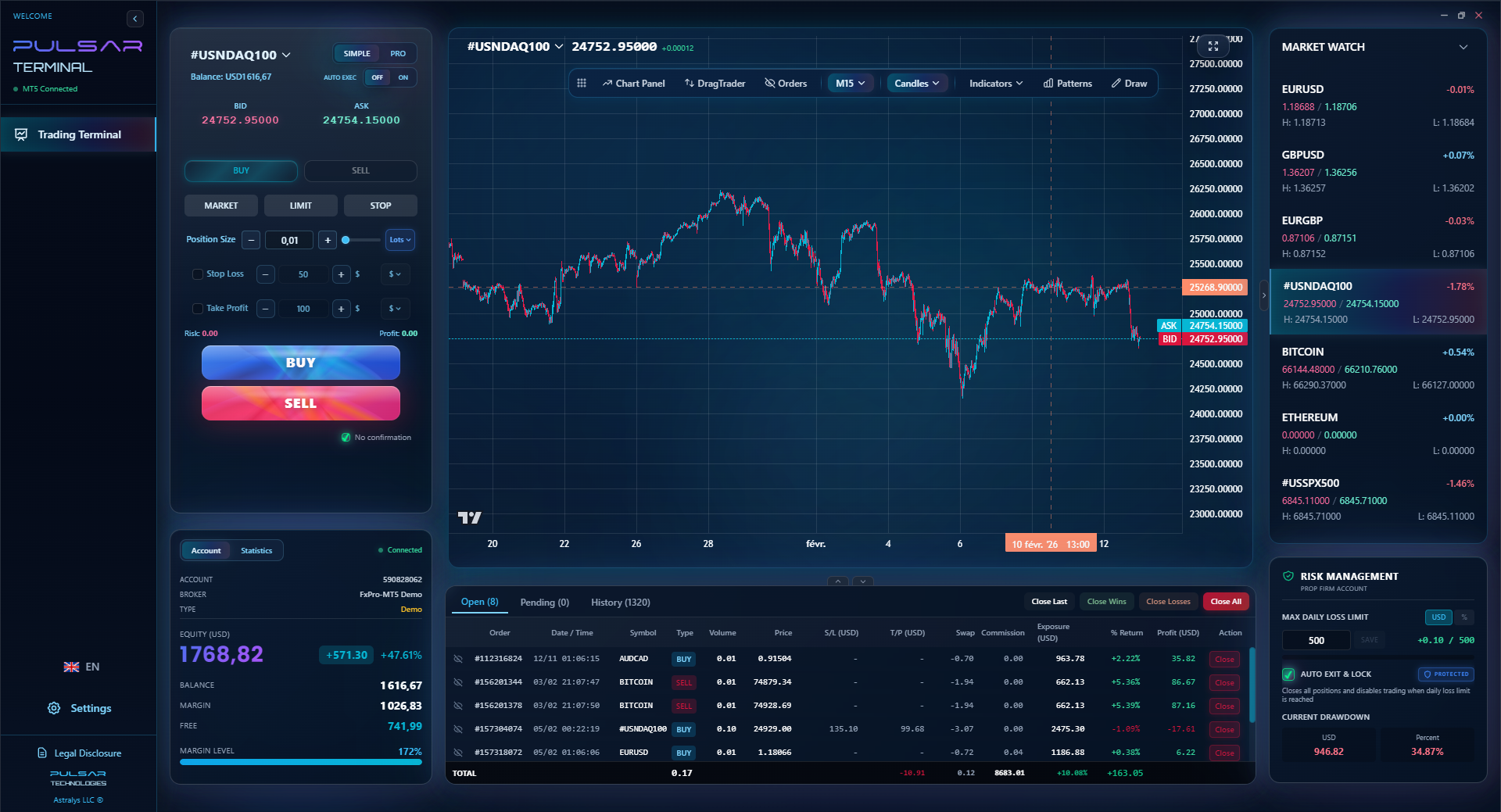
Manually trailing stops and managing multiple profit targets on volatile pairs like USD/ZAR is stressful; Pulsar Terminal automates these risk management rules directly on your MT5 platform.
“Your first 100 live trades have one goal: to execute your plan perfectly. Profit is a secondary bonus.”
I've seen these mistakes destroy more accounts than any black swan event.
- Chasing Prop Firm Dreams First: Everyone wants the 'free' capital from a prop firm challenge. They're great, but they have strict daily loss limits. Going straight into a challenge without 6-12 months of consistent, profitable demo and live trading is like trying to run Comrades without training. You'll blow the challenge, lose the fee, and get discouraged. Trade your own small account first. Prove you can be consistent.
- Overleveraging on ZAR Pairs: "The Rand is moving fast, let me crank up the use!" This is how you get a margin call. ZAR pairs are volatile. Use lower use on them, not higher.
- Ignoring Swap Rates on Long-Term Holds: If you're going long (buying) a ZAR pair like EUR/ZAR for weeks, you're likely paying a daily swap fee. This can significantly eat into your profit. Factor it into your calculation.
Your Action Plan for the First 100 Trades
- Open a Demo Account: Pick an FSCA broker. Use their MT5 demo. Don't just gamble. Practice your 1% risk rule. Practice your entry/exit strategy. Do this for at least 200 trades. Yes, 200.
- Fund a Live Micro Account: Deposit a small, meaningful amount (R1,500-R5,000). The money needs to be enough that you care about the outcome, but not so much that a loss hurts your life.
- Trade Your Plan, Journal Everything: For your first 100 live trades, your only goal is to execute your plan perfectly. The profit is a secondary bonus. Journal every trade: why you took it, your emotional state, the outcome. Review weekly.
- Withdraw Your First Profit: When you're consistently profitable over 50+ trades, withdraw your initial deposit. Now you're playing with the house's money. The psychological boost is incredible.
Spot forex trading is a marathon of discipline. In South Africa, with our unique rules and volatile currency, that discipline is even more critical. It's not easy, but for those who treat it as a serious skill, the opportunity is very real.
💡 Wskazówka Winstona
The best indicator for a South African trader is the swap rate column. Knowing whether you're getting paid or paying to hold a ZAR pair overnight can be the difference between a profit and a loss on a swing trade.
FAQ
Q1Is forex trading legal and tax-free in South Africa?
Yes, it's completely legal when using an FSCA-regulated broker. No, it is absolutely not tax-free. SARS treats trading profits as taxable income, added to your other income and taxed at your marginal rate. You must declare it.
Q2What's a realistic monthly income from forex trading in SA?
It varies wildly. A disciplined beginner might aim for R1,000-R10,000. An intermediate trader with a solid system could make R10,000-R50,000. Experienced, well-capitalised traders can exceed R50,000-R300,000+. These figures assume consistent risk management, not gambling.
Q3Can I use international brokers like Exness or IC Markets?
Yes, you can. The key is to use their South African entity which holds an FSCA license. For example, use 'Exness (ZA) Ltd' (FSP 51024) or 'IC Markets (SA) Pty Ltd'. Never use an unregulated offshore branch of a broker.
Q4Why are the spreads so wide on USD/ZAR compared to EUR/USD?
Liquidity and risk. The EUR/USD is the most traded pair in the world, so spreads are razor-thin (often below 0.5 pips). USD/ZAR has less liquidity and is more volatile, so brokers charge a wider spread (5-8 pips is common) to cover their risk. This makes short-term trading harder.
Q5What's the single biggest mistake new South African traders make?
Overleveraging on ZAR pairs because they 'have a feeling' about the Rand. They ignore the 1% risk rule, use the full 30:1 use, and a normal 2% move against them wipes out 60% of their account. They trade patriotism, not price action.
Q6Do I need a lot of money to start forex trading?
You need enough to trade properly. R70 is pointless. With R1,500-R5,000, you can trade micro lots, apply real risk management, and learn meaningfully. Anything less and you're just playing a video game, not learning a business.
Q7How do I verify if my broker is really FSCA regulated?
Go to the FSCA's official website (www.fsca.co.za). Use their 'Search for an authorised Financial Service Provider' tool. Enter the broker's name or the FSP number they provide. If they're not on that list, walk away.
Lekcja Prof. Winstona
:
- ✓Risk max 1% per trade on any account size.
- ✓FSCA regulation is your only real safety net.
- ✓Budget for a 30-45% tax hit on all profits.
- ✓ZAR pairs need wider stops, not higher use.
Jak przydatny był ten artykuł?
Kliknij gwiazdkę, aby ocenić
Tygodniowe analizy tradingowe
Darmowe tygodniowe analizy i strategie. Bez spamu.
O autorze
David van der Merwe
Trader Rynków Wschodzących
Trader z Johannesburga z 11-letnim doświadczeniem w walutach rynków wschodzących. Specjalizuje się w parach ZAR, handlu regulowanym przez FSCA i analizie rynku południowoafrykańskiego.
Komentarze
Może Ci się też spodobać

Cara Trading Forex Sukses: 7 Prinsip dari Trader Profesional
Cara trading forex sukses dengan 7 prinsip trader pro: manajemen modal, disiplin, journal trading, backtest. Data nyata, bukan janji profit palsu.
Jam Trading Forex Terbaik untuk Trader Indonesia: Panduan Lengkap dengan Tabel Waktu
Panduan jam trading forex untuk trader Indonesia. Tabel 4 sesi dunia, jam emas 20:00-00:00, sesi mana yang harus dihindari. Data akurat + tips dari trader berpengalaman.
Top 5 Sàn Forex Uy Tín Nhất 2026: Review Jujur dari Trader Indonesia
Top 5 sàn forex uy tín 2026 untuk trader Indonesia. Review jujur: spread, deposit, withdraw, dukungan lokal. Exness, XM, IC Markets & lebih.
All these calculators are built into Pulsar Terminal with real-time data from your MT5 account. One-click position sizing, automatic risk management, and instant calculations.
