


Let me guess.

Olumide Adeyemi
Pionier Tradingu w Afryce Zachodniej ·  Nigeria
☕ 9 min czytania
Czego się nauczysz:
Let me guess. You've seen the ads. 'Make 3000 pips a month!' 'Follow our signals and get rich!' It's everywhere on WhatsApp and Telegram, promising you easy money while you sleep. I fell for it too, early on. Sent $150 to a 'guru' and watched my account get liquidated in a week following his 'surefire' calls. The truth is, finding a reliable signal provider in Nigeria is like navigating a minefield blindfolded. But it's not all hopeless. I've been trading here for over a decade, and I'll show you the real landscape - the good, the bad, and the outright dangerous - so you can make an informed choice without losing your shirt.
At its core, a forex signal is just a suggestion to buy or sell a currency pair at a specific price and time. It usually includes an entry price, stop loss, and take profit levels. Think of it as getting a tip, but for the market.
They come in a few flavors. Some are generated by algorithms scanning the charts 24/7. Others are sent out by a human trader (or a team) based on their analysis. Then you have the copy trading platforms, where you automatically mirror another trader's live account. This is popular on brokers like AvaTrade through ZuluTrade.
Here's the part nobody tells you upfront: a signal is just one piece of information. It doesn't account for your specific broker's spreads, your account size, or your personal risk tolerance. I once took a signal for GBP/JPY that had a 50-pip stop loss. Sounded fine. But on my broker at the time, the spread was 8 pips wide during the Asian session. That meant I was down 8 pips the second I entered. My effective risk was suddenly 58 pips, throwing the entire risk-reward out the window. You must understand your own spread definition and use a solid position size calculator for every single signal you consider.

Warning: A signal is not a strategy. If you don't understand why the trade was suggested, you're just gambling. You'll have no idea when to hold, when to fold, or how to adjust if the market turns.

💡 Wskazówka Winstona
A verified track record is non-negotiable. No myfxbook, no money. Period.
This is critical for every Naija trader to understand. The space for retail forex and signal providers is, frankly, poorly regulated. The SEC Nigeria and CBN are the main bodies, but their rules aren't clearly built for our kind of trading.
The SEC Crackdown
The SEC has been very active lately. They're shutting down unregistered companies that take money from people to trade forex with 'guaranteed returns.' If a signal provider asks you to send them money directly to manage for you, that's a massive red flag. Unless they are a licensed fund manager (which almost none are), it's illegal. They are not protecting your funds.
The CBN's New FX Code
In early 2025, the CBN launched the Nigerian Foreign Exchange Code. This is big for the institutional market, aiming for more transparency. For us retail traders, the key takeaway is the environment is becoming more formalized, but slowly. It doesn't directly regulate Telegram signal sellers.
Your Money, Your Responsibility
Because of this gray area, you are your own first line of defense. The most important thing you can do is use a reputable, internationally regulated broker. I stick with brokers like IC Markets or Pepperstone that are regulated by top-tier authorities like ASIC. This ensures your deposit is safe in a segregated account. If a signal service tells you to use some obscure, unregulated broker, run.
And remember the taxman. Profits from forex trading are subject to Capital Gains Tax in Nigeria. It's 10% on your gross profits. Keep clean records.
“Because of Nigeria's regulatory gray area, you are your own first line of defense.”
Anyone can make a fancy Telegram channel and post screenshots. I've seen manipulated statements that would make you weep. Here’s how to separate the wheat from the chaff.
Demand Verifiable, Real-Time Results: A true track record is everything. Look for a verified myfxbook or FXBlue link. These are third-party sites that connect directly to a live trading account and cannot be easily faked. If they only post screenshot 'wins' after the fact, assume they're hiding the losses.
Analyze the Strategy, Not Just the Profit: What's their average win vs. average loss? What's the win rate? A provider with a 40% win rate can be profitable if their winning trades are much bigger than their losers. A 90% win rate with tiny profits can be wiped out by one loss. Ask about their core strategy. Do they use swing trading on the daily chart, or are they a scalping strategy service? It needs to match your style.
Check Their Risk Management: This is the biggest giveaway. Do their signals always have a stop loss? Is their suggested risk per trade consistent (e.g., never more than 2% of an account)? A provider that says 'just ride it, it'll come back' is a recipe for a margin call.
Look for Community and Consistency: How long have they been providing signals? Do they have an active, transparent community? Are they responsive to questions? A scammer will often use high-pressure tactics ('Join now, subscription doubles tomorrow!'). A genuine service will be confident in their offering.

Pro Tip: Test any provider with a demo account first for at least a full month. Track every signal manually. See how they perform across different market conditions - ranging, trending, high-volatility news events. Don't give them a single kobo until you've done this.
💡 Wskazówka Winstona
The moment a signal service mentions 'guaranteed returns,' you've found a scam. The market guarantees nothing.
Let's talk about some names you'll encounter. Remember, this isn't an endorsement, just my analysis based on what's in the market.
MetaTrader Signals Market: Built right into your MT4 or MT5 platform. The upside is convenience. The massive downside is a lack of serious vetting. Anyone can list signals. I've found a few gems over the years, but you have to dig through mountains of rubbish. Always check the detailed statistics and drawdown history.
Copy Trading Platforms (ZuluTrade, DupliTrade, CopyFX): These are offered by brokers like RoboForex and AvaTrade. You automatically copy a chosen trader. The good: it's fully automated. The bad: you are copying their exact lot size relative to their capital. If you have a $500 account and copy a trader with $50,000, a 2% risk for them could wipe out 20% of your account in seconds if not configured correctly. Use the risk-limiting tools they provide.
Independent Signal Services (Learn2Trade, FXPremiere, etc.): These are the Telegram/WhatsApp groups. FXPremiere, for example, claims a huge community and targets high pip counts. Be extremely skeptical of any 'guaranteed' pip count like '3100 pips monthly.' The market doesn't work that way. Learn2Trade is more established, but again, verify everything. I subscribed to a similar UK-based service in 2022. Their annual fee was $199. Over 6 months on a $1,000 demo, I made a 12% return, but the drawdown was nerve-wracking at 25%. It wasn't for me.
The Local 'Gurus': We have countless of these in Nigeria. 99% are frauds selling a dream. They often use fake luxury lifestyle photos and pressure you into 'masterclass' fees. If a Nigerian provider isn't showing a verifiable, multi-year myfxbook statement, assume it's a scam. It's that simple.
“Relying on signals forever is a dead end. You remain dependent, you don't grow, and you'll always be skeptical.”
Okay, let's say you've found a provider that passes your checks. Here's how to integrate them without blowing up your account.
1. Always Adjust for Your Reality. The signal says: Buy EUR/USD at 1.0850, SL 1.0820, TP 1.0900. That's a 30-pip risk. But what's the spread on your EUR/USD guide pair with your broker? If it's 1.5 pips, your real risk is 31.5 pips from your entry. Recalculate your position size based on that number. Never use their suggested lot size.
2. Use a Demo Account First. I can't stress this enough. Run the signals in a demo that mirrors your live account size for a minimum of 30 trades. This tests consistency.
3. Never Risk More Than You Usually Would. If your personal rule is to risk 1% per trade, stick to that. Don't get greedy because 'this signal has a 90% win rate.' I broke this rule once. A gold (XAU/USD guide) signal provider was on a hot streak. I upped my risk to 5% per trade. The streak ended, and I lost 20% of my account in four consecutive trades. It took me three disciplined months to get it back.
4. Understand the 'Why' Behind the Trade. Try to reverse-engineer the signal. Is it based on a MACD indicator divergence on the 4-hour chart? A key support level on the daily? If you see it's based on an RSI indicator being overbought, you'll start to learn the strategy yourself.
5. Have an Exit Plan for the Provider. Decide in advance under what conditions you'll stop following them. For example: 'If I have a 15% drawdown over 20 signals, I unsubscribe.' Emotion must be removed.

Example: Your account is ₦500,000. Your max risk per trade is 1% = ₦5,000. A signal has a 35-pip stop loss (including spread). Your position size = (₦5,000) / (35 pips * pip value). If trading USD/NGN, the calculation is different from a major pair. Know your numbers.
💡 Wskazówka Winstona
Use signals to learn a strategy, not to avoid learning. Your greatest asset is your own educated judgment.
Manually managing multiple signal-based trades with different TPs and SLs is chaotic; Pulsar Terminal's drag-and-drop order and multi-TP/SL tools let you set up the entire trade plan from a signal in seconds on your MT5 chart.
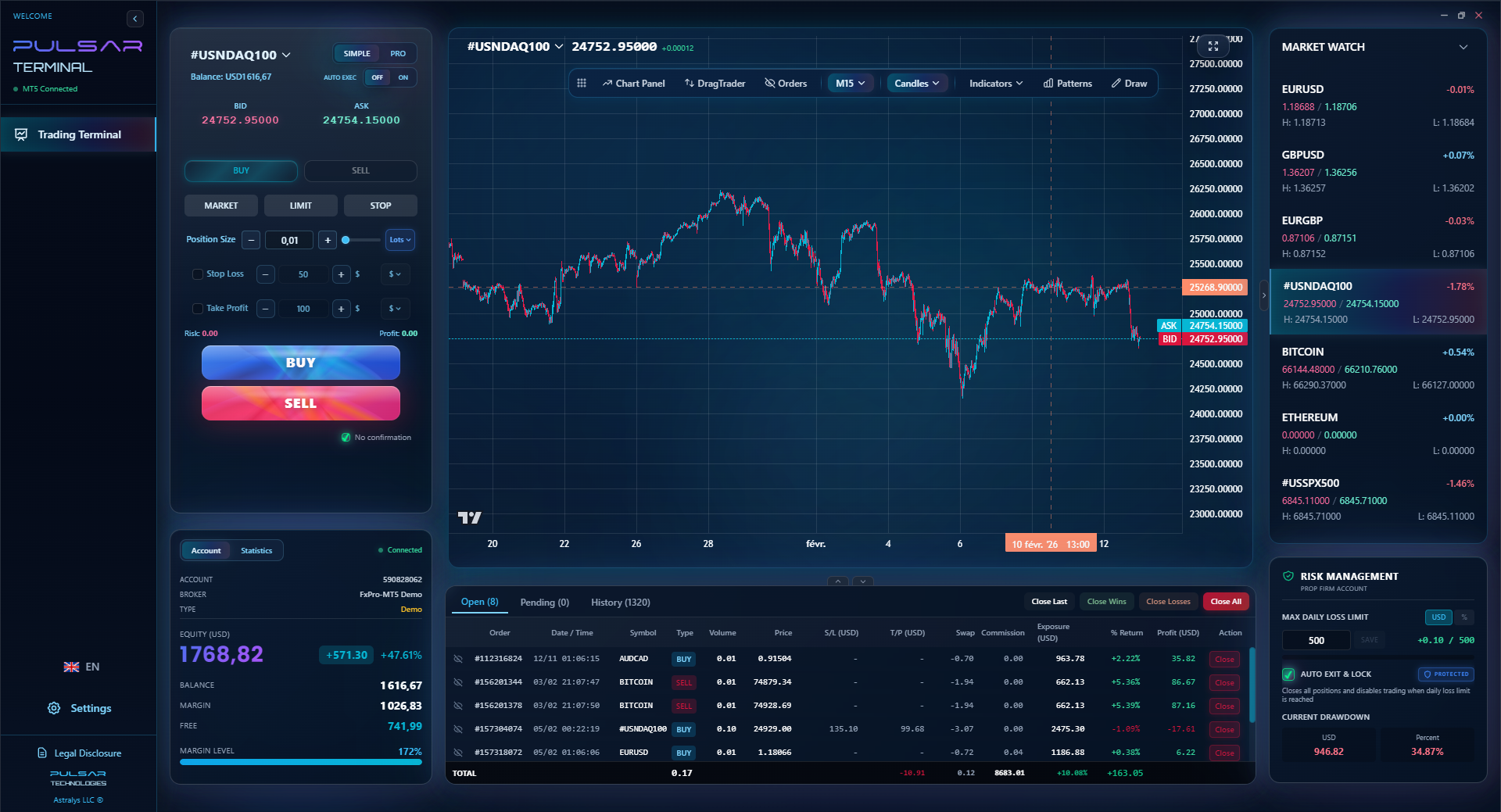
Here's the real talk from someone who's been in your shoes. Relying on signals forever is a dead end. You remain dependent, you don't grow, and you'll always be skeptical.
The most valuable thing you can do is use signals as a learning tool, not a profit crutch. Follow a provider you respect, but don't just blindly execute. Journal every signal. Ask yourself: Why did they enter here? Why is the stop loss there? How does the market move after the entry?
Gradually, you'll start to see patterns. You'll begin to anticipate their calls. This is how you start building your own trading edge. It's slower, and it requires work - studying price action, backtesting strategies, learning about MACD indicator and other tools. But this knowledge is yours forever. No one can take it away, and no subscription fee can ever cancel it.
I spent two years and over $1,000 on various signal services before I finally committed to learning. It was the best investment I never made in a 'guru.' Start with one pair, one timeframe, and one simple strategy. Master that. You'll be far richer - in knowledge and likely in capital - than any signal follower ever will be.
FAQ
Q1Are forex signals legal in Nigeria?
Yes, using forex signals is legal. However, the industry is poorly regulated. It's illegal for a provider to directly manage your funds or offer guaranteed returns unless they are a licensed fund manager with the SEC Nigeria. Always use signals with your own account at a reputable, regulated broker.
Q2What is the best free forex signal provider?
Honestly, 'best' and 'free' are dangerous combinations. Many free signals are loss-leaders to hook you into a paid service, or worse, they're completely reckless. If you must use free signals, treat them as educational examples only. Never risk real money on them until you've extensively verified the source's track record on a demo account.
Q3How much do forex signal services cost in Nigeria?
Costs vary wildly. You might see everything from '₦5,000 monthly WhatsApp groups' to international services charging $50-$300 per month. Some, like FXPremiere, offer a 4-month package for about $97. Remember, a higher price doesn't guarantee better quality. The most expensive service I ever used ($150/month) was also the most inconsistent.
Q4Can I make a living from following forex signals?
It's incredibly risky and unlikely. Signal providers have no obligation to you. They can have a losing month, change their strategy, or simply disappear. Your income would be entirely at their mercy. Building your own trading skill is the only sustainable path to treating this as a potential profession.
Q5What's safer: copy trading or manual signal following?
Copy trading on a major platform (like those offered by Exness or RoboForex) can be safer in one sense: trades execute automatically, removing emotional delay. However, the financial risk is the same or greater if you don't set risk limits. Manual following forces you to engage with each trade, which is better for learning. Both require extreme due diligence on the trader you're copying.
Q6How do I verify a signal provider's track record?
Demand a third-party verified statement. Myfxbook and FXBlue are the gold standards. A link to their verified profile should show years of live trading history, including profit factor, max drawdown, average win/loss, and the exact strategy used. If they refuse or only offer PDF statements, assume they are fake.
Q7Do I need a VPS for using forex signals?
If you are copy trading or relying on very short-term signals (scalping) where speed matters, then a Virtual Private Server (VPS) can be useful to ensure you don't miss trades if your internet or power goes out. For most swing traders following daily signals, it's not strictly necessary, but it's a good practice for consistency.
Lekcja Prof. Winstona
:
- ✓Always verify with Myfxbook/FXBlue, not screenshots.
- ✓Test every service for 30+ trades on demo first.
- ✓Never let a signal override your personal 1-2% risk rule.
- ✓Use signals to learn, not as a permanent crutch.
Jak przydatny był ten artykuł?
Kliknij gwiazdkę, aby ocenić
Tygodniowe analizy tradingowe
Darmowe tygodniowe analizy i strategie. Bez spamu.
O autorze
Olumide Adeyemi
Pionier Tradingu w Afryce Zachodniej
Jeden z najaktywniejszych edukatorów tradingu forex w Nigerii. 8 lat doświadczenia tradingowego z Lagos. Specjalizuje się w strategiach niskiego kapitału i wyzwaniach prop firm dla afrykańskich traderów.
Komentarze
Może Ci się też spodobać

Cara Trading Forex Sukses: 7 Prinsip dari Trader Profesional
Cara trading forex sukses dengan 7 prinsip trader pro: manajemen modal, disiplin, journal trading, backtest. Data nyata, bukan janji profit palsu.
Jam Trading Forex Terbaik untuk Trader Indonesia: Panduan Lengkap dengan Tabel Waktu
Panduan jam trading forex untuk trader Indonesia. Tabel 4 sesi dunia, jam emas 20:00-00:00, sesi mana yang harus dihindari. Data akurat + tips dari trader berpengalaman.
Top 5 Sàn Forex Uy Tín Nhất 2026: Review Jujur dari Trader Indonesia
Top 5 sàn forex uy tín 2026 untuk trader Indonesia. Review jujur: spread, deposit, withdraw, dukungan lokal. Exness, XM, IC Markets & lebih.
All these calculators are built into Pulsar Terminal with real-time data from your MT5 account. One-click position sizing, automatic risk management, and instant calculations.
