


I remember staring at the screen in late 2023, my AUD $249 evaluation fee for a $25k account about to evaporate.

Sarah Collins
Strateg Tradingowy ·  Australia
☕ 11 min czytania
Czego się nauczysz:
- 1What Is a Prop Firm, Anyway? (And Is It Legal Here?)
- 2What Actually Makes a 'Top' Prop Firm? (Beyond the Hype)
- 3The Best Prop Firms for Aussies Right Now (2026)
- 4The Fine Print: Hidden Fees & How They *Really* Make Money
- 5Passing the Challenge: A Realistic Game Plan
- 6Traps, Red Flags, and How to Avoid Them
- 7You're Funded. Now What? (Life on the Other Side)
I remember staring at the screen in late 2023, my AUD $249 evaluation fee for a $25k account about to evaporate. I was up 4.9% on the week, feeling good. Then the RBA news hit, AUD/USD spiked 50 pips against me, and I clipped my 5% daily loss limit. Game over. That sting taught me more about choosing the right prop firm than any glossy ad ever could. Let's talk about what really matters when you're looking at the top prop firms from down under.
Right, let's clear this up first. A prop (proprietary) trading firm gives you its capital to trade. You pass their test - usually a challenge or evaluation - and if you succeed, you get a funded account. You keep a big chunk of the profits, they keep the rest. It's not a broker; you're not depositing your own cash to trade with.
Here's the big question for us: is it legal in Australia? Yes, completely. But there's a catch you need to understand. Most of these firms aren't ASIC-regulated like your standard broker (think Pepperstone or IC Markets). ASIC's rules, like the 30:1 use cap from a few years back, are for firms handling client money. Prop firms argue they're just giving their own money to contractors (that's you) after testing them. It's a legal grey area they operate in, but it's a common and accepted model globally.
A few, like N P Financials, do hold an AFSL, but they're the exception. For you, the trader, this means you're not protected under the same financial services laws as you would be with a retail broker. Your protection is the firm's own terms and conditions. So reading every single line? Non-negotiable.

Warning: Don't confuse a prop firm with a bucket shop. A legit firm makes money when you make money. A shady one might make money when you blow your evaluation fee. Your first job is telling the difference.
“Your protection with a prop firm isn't ASIC regulation; it's the firm's own terms and conditions. So reading every single line? Non-negotiable.”
Marketing departments love the word 'top.' I look at five concrete things. If a firm nails these, they're in the conversation.
1. The Profit Split. This is your paycheck. The baseline for a decent firm is 80% to you. Anything less, and I'd walk away. The real top prop firms are pushing 90%, with some offering 100% on your first $10k or similar promotions. E8 Markets (formerly E8 Funding) has built a reputation on high splits. If you're a consistently profitable trader, that extra 10% is life-changing money over time.
2. The Rules (The Real Ones). Not the shiny ones on the homepage. The fine print. You need to know the maximum drawdown (often 10% total) and the daily loss limit (often 3-5%). These are your guardrails. I learned the hard way that a 5% daily loss can hit faster than you think, especially if you're not using a solid position size calculator. Also, watch for 'hidden' rules like consistency rules or minimum trading days.
3. Payout Reliability & Speed. What's the point of making money if you can't get it? The best firms process withdrawals in 1-3 business days. Some even do weekly payouts. You'll see this praised in independent reviews. Always check the minimum withdrawal amount too - $100 is standard, $500 starts to get annoying.
4. The Platform & Tools. You'll likely be on MT4, MT5, or maybe cTrader or TradeLocker. Make sure you're comfortable with it. Can you use your EAs? What's the data feed like? Slippage in a prop eval can mean the difference between passing and failing.
5. Scaling Plan. You start with $50k. You make 10% profit. Now what? A proper scaling plan clearly outlines how you can grow your account size, often automatically after hitting profit targets. A firm that caps you at your starting size isn't a long-term partner.

Example: Firm A offers an 80/90 split (80% up to a target, 90% beyond) with 1-day payouts. Firm B offers a flat 85% split with 7-day payouts. Firm A is probably the better choice for a serious trader, even though the base split is lower. The faster access to capital and reward for high performance matters.

💡 Wskazówka Winstona
The evaluation fee is the cost of your business license. Don't risk it on a strategy you haven't back-tested for at least 100 trades in a demo. Hope is not a strategy.
“The baseline for a decent firm is an 80% profit split to you. Anything less, and I'd walk away.”
The scene changes fast. Based on community feedback, payout consistency, and terms that suit our market, here are the standouts. Remember, 'best' depends on your style. A scalper needs different conditions than a swing trader.
For the Forex & Indices Trader
If you live on the EUR/USD or the ASX 200, look at firms partnered with solid brokers. Fundedprime and Profitex are both linked to Eightcap, a well-known Australian broker. This often means tighter spreads and reliable execution. Their rules are clear, and they've built a good rep for timely payouts. use is typically 1:30, aligning with sensible risk management.
For the Crypto Enthusiast
Crypto volatility is a double-edged sword. You need a firm with clear crypto rules and decent use. Goat Funded Trader (launched 2022) gets a lot of love for its straightforward approach and good crypto offerings. Just be extra mindful of drawdowns - crypto can blow through a 5% daily limit before you can blink.
For the High-Stakes Player
Want to aim for a million-dollar account? Lux Trading Firm and PipFarm have serious scaling paths. We're talking potential growth to $1.5M, even $10M. The evaluation fees are higher, and the rules are strict, but the ceiling is massive. This is for traders with a proven, disciplined system, not for testing new ideas.
The 'No Time Limit' Option
Hate the pressure of a 30-day challenge? Firms like E8 Markets popularised the one-step evaluation with no time limit. You just focus on the profit target and not breaking the drawdown rules. It removes a huge psychological hurdle and is fantastic for a swing trading approach.
| Firm Type | Good For | Watch Out For |
|---|---|---|
| Broker-Linked (e.g., Fundedprime) | Forex/Indices, stable execution | Slightly stricter drawdowns |
| Crypto-Focused (e.g., Goat) | High volatility strategies | Wider spreads, rapid drawdown hits |
| High-Ceiling (e.g., Lux) | Scalable, proven strategies | High evaluation fees, intense rules |
| Flexible (e.g., E8) | Newer traders, swing strategies | Profit target might be higher |
My personal experience? I use a firm with an Eightcap partnership for my forex trades. The peace of mind from knowing the trade execution is solid is worth its weight in gold. I had a trade on XAU/USD during a news event last year; the slippage was minimal, and I didn't get any nonsense requotes. That's the stuff you don't appreciate until you've had the opposite experience with a shady setup.
“The baseline for a decent firm is an 80% profit split to you. Anything less, and I'd walk away.”
Let's be cynical for a minute. Prop firms are businesses. They need to make money. Understanding their revenue model tells you where the traps are.
1. The Evaluation Fee. This is the most obvious one. You pay $200-$600 to take a challenge. For many firms, this is a significant income stream from traders who never pass. It's not inherently evil - it covers their costs - but it means their incentive isn't only for you to succeed.
2. The 'Reset' or 'Retry' Fee. You blow your account 80% through the challenge. They offer a 50% discount to restart. It feels like a lifeline, and it's another revenue line. Sometimes it's worth it, but ask yourself if you need to refine your strategy first.
3. Platform Fees. Some firms charge a small monthly fee for the trading platform (MT5, etc.) on a funded account. It's usually nominal, like $10-$20, but it comes out of your profits.
4. Withdrawal Fees. This is a big one. A top firm will charge nothing for withdrawals, or just the bank's wire fee. A less-good one might take a flat $30 or a percentage. Always check. A 2% withdrawal fee on a $5,000 payout is $100 gone.
So, how do the good ones make money if you're successful? Simple: they take their cut of your profits. If you're in an 80/20 split, they make 20 cents on every dollar you make. Their goal is to fund profitable traders who generate that ongoing revenue. That's the firm you want - one whose success is perfectly aligned with yours.
I made a mistake early on by not factoring in a $25 monthly platform fee. On my first $1,000 profit month, that fee (plus a withdrawal charge) took my net from $800 to $750. Not a disaster, but it taught me to run the numbers on net profit, not gross.
💡 Wskazówka Winstona
Your daily loss limit is your most important number. Calculate it, write it on a sticky note, and stick it to your screen. If you hit 50% of it, take a 30-minute walk. Discipline is what they're really testing.
“Risk a maximum of 0.5% of the account per trade in an eval. It feels tiny, but it means you can have 10 losing trades in a row and still not hit your daily limit.”
Forget the 'get funded in 7 days' YouTube hype. Here's a boring, effective plan.
Phase 1: Strategy Selection. Don't use the challenge to test something new. Use your most reliable, boring strategy. High-win-rate, low-risk-per-trade setups are king. This is about consistency, not home runs. If you're a scalper, have your scalping strategy down to a science.
Phase 2: Risk Calculation. This is the most important step. Your daily loss limit is your absolute circuit breaker. Let's say it's 5% on a $50k account. That's $2,500. You should be risking FAR less than that per trade. I risk a maximum of 0.5% of the account per trade in an eval. That's $250. It feels tiny, but it means I can have 10 losing trades in a row and still not hit my daily limit. It keeps me in the game. Use that position size calculator religiously.
Phase 3: The Execution. Trade your plan. Ignore the profit target. Focus on not hitting the drawdown. The profit will come if your edge is real. Use basic indicators to keep you disciplined - the RSI indicator to avoid overbought entries, the MACD indicator for trend confirmation. Nothing fancy.
Phase 4: The Psychology. You will have losing days. The rule is to stop. Hit your daily loss limit? Close the platform. Walk away. The number one cause of failure is trying to 'win it back' and violating rules. The goal is to get funded, not to be a hero during the eval.

Pro Tip: Treat the drawdown as a hard floor, not a buffer. If your max drawdown is 10%, mentally set your own limit at 8%. That 2% is your safety net for slippage or a mistake. This simple mental trick has saved my account more than once.
Managing prop firm drawdown rules manually is stressful; Pulsar Terminal's Daily Loss Protection feature can automatically halt your trading for the day when you hit a predefined limit, directly on MT5.
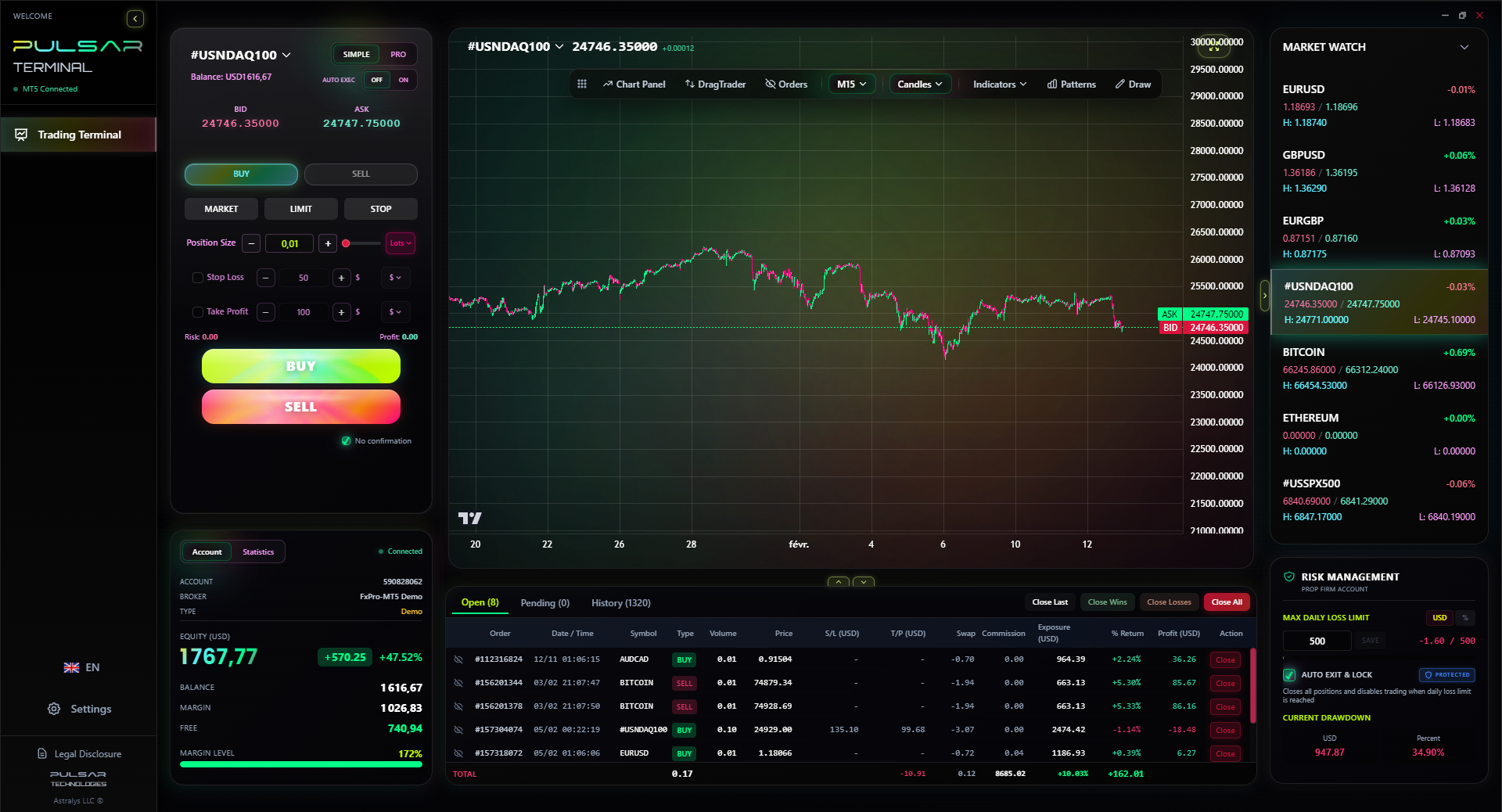
“Risk a maximum of 0.5% of the account per trade in an eval. It feels tiny, but it means you can have 10 losing trades in a row and still not hit your daily limit.”
Not all that glitters is gold. Here's what should make you hit the back button.
1. Overly Complex Rules. If you need a law degree to understand the drawdown calculation (is it based on balance? equity? peak equity?), run. Look for simple, static rules: "Maximum Drawdown: 10% from starting balance." Clear as day.
2. No Verifiable Payout Proof. Any reputable firm has traders sharing payout screenshots on forums or Trustpilot. If you can't find any recent, verifiable proof of people getting paid, that's a massive red flag.
3. 'Guaranteed' Funding. Nothing is guaranteed in trading. Any firm promising this is selling a fantasy.
4. Ridiculously High use Offers. While some firms offer 1:100, be wary. High use is a tool, but in a prop challenge with tight drawdowns, it's often a trap that leads to a quick margin call. Stick to what you know; 1:30 is more than enough.
5. Poor Communication. Email them a specific question about their rules before you buy. See how long they take to respond and if the answer is clear. If it's days later with a vague copy-paste, imagine trying to get help with a withdrawal.
A red flag I missed once was a firm that had a 'minimum trading activity' rule buried deep in the FAQ. It required 10 trades per week, which forced me into terrible setups just to hit the number. I broke my own rules to meet theirs and failed. Lesson learned: dig deeper than the sales page.
“The goal is to get funded, not to be a hero during the eval.”
Congratulations! You passed. This is where the real work begins, but also where the rewards come.
Your First Payout. Withdraw some money early. Even if it's just the minimum. It builds trust in the process and gives you a psychological win. That first payment hitting your account (via Wise, crypto, or direct bank transfer) is the ultimate validation.
Don't Change a Thing. The strategy and risk management that got you funded will keep you funded. Do not suddenly triple your position size because it's 'not your money.' It is your money - your future profit share. Stick to your percentages.
Communicate. If you have a losing week, it's okay. Just stick to your rules. If you're in a firm with a scaling plan, understand the targets to grow your account. The goal now is longevity and steady growth, not just one big score.
Keep Records. Track everything. Your trades, your profits, your payout dates and amounts. This is data for your own improvement and protection.
Getting funded with a $100k account was a career highlight. But my first month was nerve-wracking. I traded smaller than my rules allowed, scared to lose it. My mentor's advice was golden: 'The firm already knows you can do this. That's why they gave you the capital. Now go execute like you did before.' It shifted my mindset from scared to professional.
💡 Wskazówka Winstona
When funded, your first withdrawal should be to cover your initial evaluation fee. Once your own capital is back in your pocket, you're trading with pure house money. The psychological relief is immense.
FAQ
Q1What's the main difference between a prop firm and a broker like IC Markets?
A broker (like IC Markets or Pepperstone) provides a platform for you to trade your own deposited money. You keep 100% of profits but also bear 100% of losses. A prop firm gives you their capital after you pass an evaluation. You trade their money, and you split the profits (e.g., 80/90 in your favour). You risk no personal trading capital beyond the initial evaluation fee.
Q2Are prop firm profits taxable in Australia?
Yes. The profit share you receive is considered taxable income. You must declare it to the ATO. It's typically treated as personal services income. Keep careful records of all your payouts and consult with a tax professional familiar with trading income.
Q3Which prop firms have the fastest payout times for Australians?
As of 2026, firms like Fundedprime, E8 Markets, and Profitex are known for fast processing, often within 1-3 business days. Payouts via cryptocurrency (USDT) are usually the fastest, often same-day. Always check the firm's latest terms, as policies can change.
Q4Can I use Expert Advisors (EAs) or trade algorithms with a prop firm?
Most top prop firms allow EAs and automated trading, but you MUST check their specific rules. Some may restrict certain strategies like high-frequency trading or arbitrage. It's always your responsibility to ensure your EA complies with their risk and trading rules.
Q5What happens if I hit the maximum drawdown?
Your funded account or evaluation challenge is immediately terminated. It's game over. This is why understanding drawdown type (balance vs. equity) and maintaining a large buffer from that limit is the most critical part of risk management in prop trading.
Q6Is there a minimum trading period for a funded account?
Usually, no. Once funded, you can trade as much or as little as you like, provided you follow the risk rules. However, some firms have 'inactivity fees' if you don't place a trade for several months, so check the terms.
Lekcja Prof. Winstona
:
- ✓Choose firms with 80%+ profit splits & 1-3 day payouts.
- ✓Risk max 0.5% per trade during evaluations.
- ✓Treat the max drawdown as a hard floor, not a buffer.
- ✓Verify recent, real payout proofs before paying any fee.
Jak przydatny był ten artykuł?
Kliknij gwiazdkę, aby ocenić
Tygodniowe analizy tradingowe
Darmowe tygodniowe analizy i strategie. Bez spamu.
O autorze
Sarah Collins
Strateg Tradingowy
Londyńska strateg tradingowa z 12-letnim doświadczeniem na rynkach finansowych. Była analityczka w brokerstwie w City of London. Obejmuje pary GBP, rynki europejskie i handel regulowany przez FCA.
Komentarze
Może Ci się też spodobać

Cara Trading Forex Sukses: 7 Prinsip dari Trader Profesional
Cara trading forex sukses dengan 7 prinsip trader pro: manajemen modal, disiplin, journal trading, backtest. Data nyata, bukan janji profit palsu.
Jam Trading Forex Terbaik untuk Trader Indonesia: Panduan Lengkap dengan Tabel Waktu
Panduan jam trading forex untuk trader Indonesia. Tabel 4 sesi dunia, jam emas 20:00-00:00, sesi mana yang harus dihindari. Data akurat + tips dari trader berpengalaman.
Top 5 Sàn Forex Uy Tín Nhất 2026: Review Jujur dari Trader Indonesia
Top 5 sàn forex uy tín 2026 untuk trader Indonesia. Review jujur: spread, deposit, withdraw, dukungan lokal. Exness, XM, IC Markets & lebih.
All these calculators are built into Pulsar Terminal with real-time data from your MT5 account. One-click position sizing, automatic risk management, and instant calculations.
