


Most lists of the 'best trading books forex' are useless.

James Mitchell
Starszy Analityk Tradingowy
☕ 11 min czytania
Czego się nauczysz:
Most lists of the 'best trading books forex' are useless. They're filled with get-rich-quick fantasies and outdated technical analysis that will get you slaughtered in today's regulated US market. The truth is, 70-80% of retail traders lose money consistently, and the wrong book can set you on that path from day one. I'm going to show you the handful of books that teach you how to survive, and explain why the flashy bestsellers are often the most dangerous.
Walk into any bookstore and you'll see them. The covers promise secrets, systems, and shortcuts to millions. I bought them all when I started. It's a trap.
The fundamental problem with 90% of trading books is they're written by people who made more money selling the book than trading. They sell a fantasy of easy profits, complex indicators, and perfect entries. In the real US market, with its 1:50 use cap, FIFO rule, and no hedging, that fantasy evaporates fast. These books ignore the single most important factor: probability and risk management.
I learned this the hard way. Early on, I devoured a popular book on a specific candlestick pattern system. I was convinced I'd found the key. I took a $5,000 account, risked 5% ($250) per trade based on these 'high-probability' patterns. In three weeks, I was down $1,800. The patterns worked in the book's cherry-picked examples, but in live markets with slippage and spread, they were no better than a coin flip. I was following the rules perfectly, but the rules were flawed. The book never mentioned the spread definition eating into my edge or how to use a position size calculator to stay alive.

Warning: Any trading book that spends less than 30% of its pages on money management, psychology, and risk is selling you a dream, not a profession. The math doesn't lie. If you have a 50% win rate (which is good), poor position sizing will still blow up your account.
These books create overconfident, under-prepared traders. They focus on the 'attack' but forget to teach you how to build a fortress. In a market where the CFTC data shows most people fail, starting with the wrong foundational text is a sure way to join them.

💡 Wskazówka Winstona
A library of a thousand trading strategies is worthless without the one book that teaches you how to lose properly. Start there.
Forget the 50-book lists. You need three. Maybe four. These aren't about flashy strategies; they're about building an unshakable trader's mindset and a bulletproof process. This is the boring, critical work almost everyone skips.
1. The Risk Bible
"Trading in the Zone" by Mark Douglas. This isn't a strategy book. It's a psychology manual. Douglas argues that consistent success is 80% psychology, 20% methodology. He's right. He drills into the concept of probabilistic thinking - accepting that any single trade is meaningless, and only the series matters. This book will help you detach from outcomes, follow your plan through losing streaks, and avoid the revenge trading that kills accounts. It's the antidote to the emotional chaos most beginners experience.
2. The Money Management Manual
"The Universal Principles of Successful Trading" by Brent Penfold. This is the most practical, no-BS guide to risk management you'll find. Penfold breaks down exactly how to construct a trading plan around expectancy, position sizing, and drawdown control. He gives you the formulas. He forces you to confront the math of ruin. After reading this, you'll understand why risking 2% per trade isn't just a suggestion, it's the law. It directly informs how you should use a position size calculator before every single entry.
3. The Market Reality Check
"Market Wizards" by Jack D. Schwager. Don't read this for specific strategies. Read it for the interviews. You'll hear from legendary traders who all have wildly different methods (trend following, arbitrage, discretionary), but share identical core beliefs: extreme discipline, relentless risk control, and the humility to be wrong. It shows there's no single 'right' way, just right principles. It's inspiring and grounding at the same time.

Pro Tip: Read these in order: 1) Market Wizards (for inspiration and philosophy), 2) Trading in the Zone (for psychology), 3) Penfold's book (for the concrete rules). This builds your trading identity from the inside out.
“The fundamental problem with 90% of trading books is they're written by people who made more money selling the book than trading.”
A huge flaw in generic trading books forex lists is they ignore jurisdiction. A strategy built for an offshore broker with 1:500 use and hedging is a death wish in the US. Our regulatory environment isn't a limitation; it's a forced risk management system you must understand.
use Limits (1:50 Majors, 1:20 Others): Most books discuss using high use to amplify small moves. In the US, you can't. This is a blessing. It forces you to focus on quality setups and proper position sizing. A book telling you to risk 10% of your margin on a scalping strategy is irrelevant here. You have to be more selective.
The FIFO Rule (First-In, First-Out): This prohibits you from choosing which specific lot to close. It simplifies tax reporting but complicates certain trade management styles. You can't just close your winning lot and let a loser run. Your exit strategy must be planned for the entire position.
No Hedging: You cannot hold a buy and a sell position on the same pair simultaneously. Many advanced 'grid' or 'hedging' strategies from books are illegal. This forces clarity in your directional bias.
My own painful lesson came from not adjusting. I read a book on a sophisticated multi-order mean reversion strategy for the EUR/USD guide. It involved placing a grid of orders around a price. I tried to replicate it on my US broker platform and immediately hit the 'no hedging' rule. My orders were blocked. I then tried a clumsy workaround that violated FIFO. I ended up with a tangled mess of positions, got a margin call, and took a $1,200 loss that was entirely due to regulatory ignorance, not market movement.
Your education must include these constraints. It filters out 50% of the 'advanced' tactics you'll read about. Focus on books that emphasize clean, directional trades with clear stops - the kind of trading that works within the NFA's framework.
The technical analysis section of a bookstore is a minefield of indicator worship. You don't need to know 50 indicators. You need to understand price action and volume. One book stands above the rest for this.
"Technical Analysis of the Financial Markets" by John J. Murphy. Consider this the textbook. It's complete, but more importantly, it's objective. Murphy covers chart patterns, trends, and major indicators like the MACD indicator and RSI indicator without hype. He presents them as tools, not magic. The key takeaway is the concept of 'intermarket analysis' - how bonds, commodities, and stocks influence forex. Understanding why the USD moves when the S&P 500 drops is more valuable than any obscure pattern.
Why not the others? Most TA books become obsessed with predictive patterns ("When you see this, the price will go up 83% of the time!"). This is nonsense in live trading. Murphy gives you the vocabulary and the core concepts. It's your job to learn how to use them in a probabilistic framework, which goes back to your foundation books.
For example, he explains support and resistance. A bad book tells you to buy at support with a tight stop. Murphy explains what it represents - an area of prior price equilibrium. It's then up to you, using your risk principles, to decide if it's a valid area for a trade, how wide your stop needs to be (respecting the market's noise), and what your risk/reward is. It's a tool, not a signal.
Combine this with the deep order flow and auction market principles found in resources on Volume Profile (a tool beyond basic books), and you move beyond drawing lines to understanding why price might react at a certain level.
💡 Wskazówka Winstona
If a trading book doesn't make you slightly uncomfortable by confronting your own likely failures, it's not doing its job. Comfort is the enemy of growth in this business.
“Your trade journal is more important than your next book.”
Let's be blunt. Certain types of trading books are intellectual poison for a new trader.
- The 'Secret System' Book: Any book with a proprietary named system ("The XYZ Diamond Method!") that promises high win rates. If it was that good, the author wouldn't be selling it for $29.95. These systems are curve-fitted to past data and fall apart in real-time.
- The Autobiography of a 'Genius': Books where the main takeaway is the author's brilliance. They're entertainment, not education. You learn nothing replicable, just a story.
- Overly Complex Quantitative Finance Tomes: As a beginner, you don't need to understand stochastic calculus. It's a form of intellectual procrastination - feeling like you're learning while avoiding the hard work of placing and managing real trades.
- Any Book That Downplays Losses: If a book says 'risk management is important' in one chapter but then shows examples of 10% risk per trade, throw it away. Consistency is key.
I have a shelf of these books. My most expensive was a $150 'institutional manual' that was just repackaged basic concepts with fancy jargon. It felt smart to read it, but it made me a worse trader because I started looking for overly complex solutions to simple problems. Trading is simple, but not easy. The books that make it seem complex are usually hiding the fact that their simple idea isn't valuable.
Once your plan is built from the right books, executing it with precision is critical; tools like Pulsar Terminal automate complex order management and risk rules directly on your MT5 platform, turning your written plan into disciplined action.
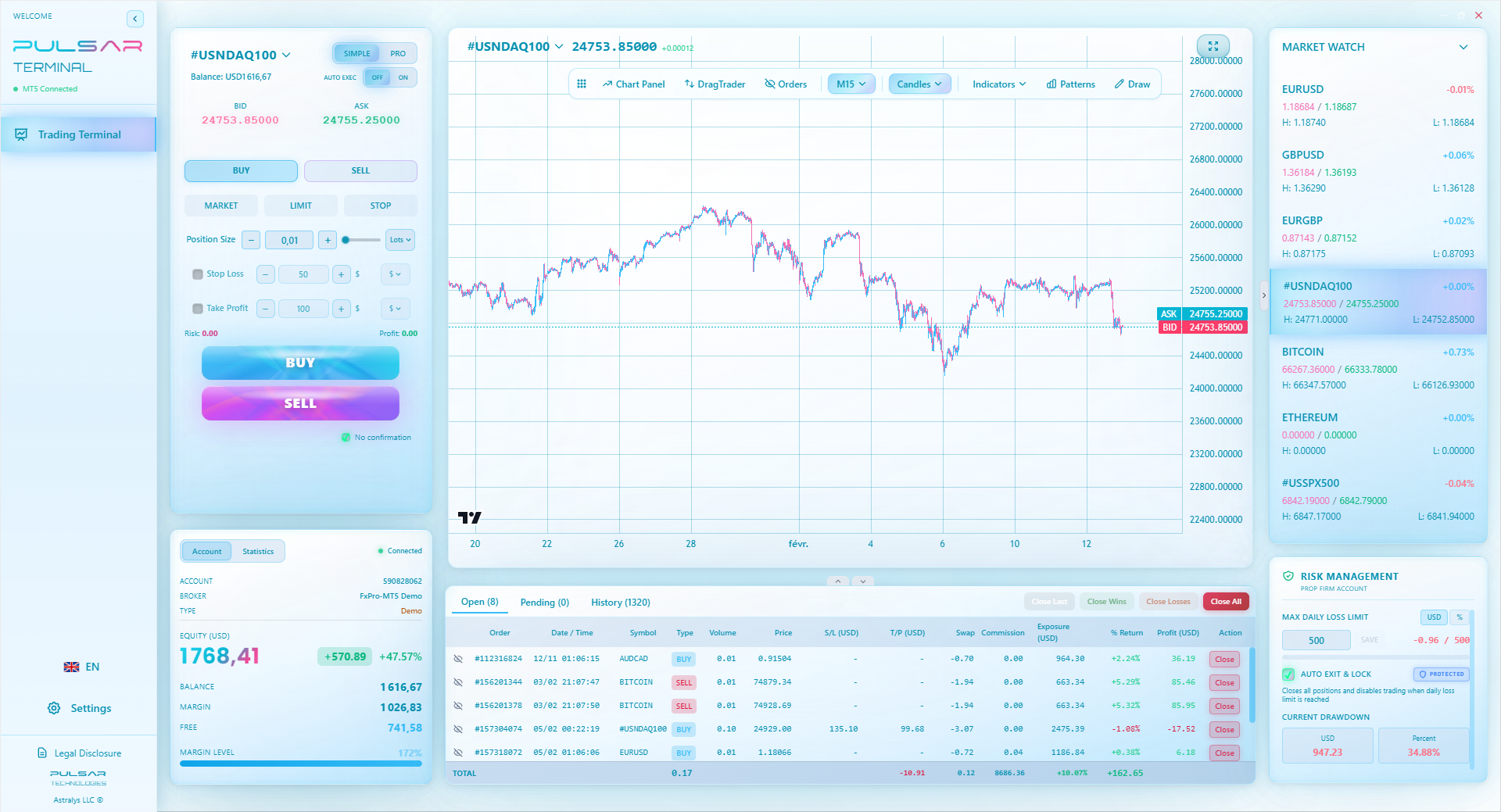
Reading is passive. Trading is active. The bridge between them is where most fail. Here's how to use books properly.
Step 1: Read with a Notepad. Don't just highlight. Write down the 3-5 core principles from each book. From Douglas: "I am a probabilistic trader." From Penfold: "I will never risk more than 2%."
Step 2: Build Your Plan FIRST. Before you even look at a chart, write a one-page trading plan. It must include:
- Your allowed instruments (e.g., EUR/USD, XAU/USD guide only).
- Your maximum daily/weekly loss limit (e.g., -5% daily, -15% weekly).
- Your position sizing formula (e.g., 1% risk per trade, using a position size calculator).
- Your entry criteria (in simple terms from Murphy).
- Your exit rules: profit target and stop loss placement logic.
Step 3: Backtest and Forward Test. Use your broker's demo platform (from a reputable firm like those in our OANDA review or FOREX.com review) to test your plan. Don't test for profitability first. Test for discipline. Can you follow the rules 100 times in a row, even through 5 losing trades? That's the real test.
Step 4: Journal Relentlessly. Your trade journal is more important than your next book. For every trade, note: entry/exit reason, emotional state, adherence to plan. This is where you'll see if you've internalized "Trading in the Zone" or just read it.
I'll give you a real example from my journal years ago, after reading Penfold: Trade: EUR/USD Short Entry: 1.1050 | Stop: 1.1080 (30 pip risk) | Target: 1.0950 (100 pip reward) Risk: 1% of $10,000 account = $100. Pip Value Calc: $100 / 30 pips = $3.33 per pip. Position size: ~33,000 units (a mini lot). Result: Stopped out at 1.1080. Loss: $100. Journal Note: "Setup met criteria. Price spiked on ECB headline. Stop was logical at prior swing high. No emotional reaction. Loss was within plan parameters. Good trade." That last sentence - 'Good trade' on a loss - is the mark of a probabilistic thinker. That came from the books, but the execution came from the plan.
“You can have a mediocre strategy with superb psychology and be profitable. You can have a brilliant strategy with poor psychology and you will blow up.”
Once the foundation is solid, you can explore. But stay focused. Think of it like university: you get your core credits (psychology, risk, market basics) before your electives.
For Advanced Risk & Strategy:
- "The Daily Trading Coach" by Brett Steenbarger. A year of practical psychological exercises. It's a workbook, not a theory book.
- "Advances in Financial Machine Learning" by Marcos López de Prado. This is graduate-level. Only go here after years of experience. It will teach you how to properly test strategies and avoid statistical pitfalls, a reality check for anyone thinking they've found a 'edge.'
For US Trader Practicality: Spend less on books and more on quality data and tools from your broker. Learn the ins and outs of your platform, whether it's Thinkorswim, MetaTrader, or a proprietary system. Understand their order types, how they handle stops, and their execution reports. This operational knowledge will save you more money than a dozen advanced strategy books.
Finally, remember that the market evolves. A book on swing trading from 1995 won't account for algorithmic dominance. The timeless principles are psychology and risk management. The tactical edge comes from contemporary understanding of market structure, which often comes from courses, mentorships, or deep-dive resources on tools like Market Profile, which you can learn to apply through advanced trading terminals.

Example: Your book budget for Year 1: $100. Spend it on the 3 foundation books. Your software/tool budget for Year 1: $500. Spend it on a reliable data feed and a journaling tool. That ratio will keep you alive and learning.
FAQ
Q1What is the single best trading book for a complete forex beginner in the US?
Start with "Trading in the Zone" by Mark Douglas. It won't teach you a single chart pattern, but it will install the probabilistic mindset you need to survive. Without this, any strategy you learn will be applied emotionally and will fail. Follow it immediately with Brent Penfold's book on risk principles.
Q2Are books about trading psychology really that important?
They are the most important. You can have a mediocre strategy with superb psychology and discipline and be profitable. You can have a brilliant strategy with poor psychology and you will blow up your account. The market is a constant test of your emotions - greed, fear, hope, regret. Psychology books give you the tools to pass that test.
Q3I see a lot of books on price action trading. Are they worth it?
Be very selective. Many are just repackaged basic support/resistance with a fancy name. Price action is simply reading raw price movement. John Murphy's book gives you the foundation. Beyond that, practice screen time is more valuable than another book. Look for books that focus on auction market theory and volume-price relationships, which get closer to the 'why' behind price moves.
Q4How do I apply ideas from books written before modern US regulations (FIFO, no hedge)?
You must translate them. If a book discusses a complex hedging strategy, discard that section. If it discusses trade management that involves closing specific lots, adapt it to manage your entire position. Always filter the strategy through the US regulatory constraints. This often simplifies the approach, which is a good thing.
Q5Should I read books about other markets (stocks, futures) as a forex trader?
Absolutely, especially books on futures. The forex spot market is heavily influenced by the futures and bond markets. Books on market profile (developed in futures pits) and intermarket analysis (like Murphy covers) are extremely valuable. The core principles of risk and psychology are universal across all markets.
Q6How many books should I read before I start trading with real money?
It's not a number. It's a milestone. You're ready after you've: 1) Read the 3 foundation books, 2) Written a detailed trading plan that includes your risk limits, 3) Demonstrated you can follow that plan for at least 100 trades on a demo account without deviating, and 4) Accepted that you will still have losing trades. This process takes months, not weeks.
Lekcja Prof. Winstona
:
- ✓Prioritize psychology & risk books over strategy books.
- ✓US regulations (FIFO, 1:50 use) invalidate many generic forex strategies.
- ✓A 2% maximum risk per trade is non-negotiable for survival.
- ✓Backtest discipline, not just profitability.
Jak przydatny był ten artykuł?
Kliknij gwiazdkę, aby ocenić
Tygodniowe analizy tradingowe
Darmowe tygodniowe analizy i strategie. Bez spamu.
O autorze
James Mitchell
Starszy Analityk Tradingowy
Z siedzibą w Nowym Jorku, ponad 9 lat doświadczenia w tradingu. Koncentruje się na głównych parach USD, wyzwaniach prop firm i amerykańskim otoczeniu regulacyjnym.
Komentarze
Może Ci się też spodobać

Cara Trading Forex Sukses: 7 Prinsip dari Trader Profesional
Cara trading forex sukses dengan 7 prinsip trader pro: manajemen modal, disiplin, journal trading, backtest. Data nyata, bukan janji profit palsu.
Jam Trading Forex Terbaik untuk Trader Indonesia: Panduan Lengkap dengan Tabel Waktu
Panduan jam trading forex untuk trader Indonesia. Tabel 4 sesi dunia, jam emas 20:00-00:00, sesi mana yang harus dihindari. Data akurat + tips dari trader berpengalaman.
Top 5 Sàn Forex Uy Tín Nhất 2026: Review Jujur dari Trader Indonesia
Top 5 sàn forex uy tín 2026 untuk trader Indonesia. Review jujur: spread, deposit, withdraw, dukungan lokal. Exness, XM, IC Markets & lebih.
All these calculators are built into Pulsar Terminal with real-time data from your MT5 account. One-click position sizing, automatic risk management, and instant calculations.
