


For years, I treated swap rates like a footnote.

David van der Merwe
Trader Rynków Wschodzących ·  South Africa
☕ 8 min czytania
Czego się nauczysz:
- 1Swap Explained: It's Not Magic, It's Interest
- 2Calculating Swap on ZAR Pairs: A Real Example
- 3Long vs. Short: Why You Pay or Get Paid
- 4How Swap Impacts Your Trading Style (Scalper vs. Swing Trader)
- 5Practical Ways to Manage Swap Costs in SA
- 6Why Swap Rates Differ Between Brokers
- 7Beyond the Basics: Tom/Next and Central Banks

For years, I treated swap rates like a footnote. A tiny, ignorable cost of doing business. That was until a long-term USD/ZAR short I was holding slowly bled me for over R4,000 in negative swap fees over three months, turning what should have been a solid win into a break-even mess. Most guides talk about swap in theory. I'm going to show you what it actually means for your bottom line here in South Africa, trading pairs like USD/ZAR and EUR/ZAR. Let's get into the real cost of holding positions overnight.
At its core, a forex swap answers a simple question: what does it cost to borrow one currency to buy another? When you buy EUR/USD, you're borrowing US Dollars to buy Euros. Banks charge interest on borrowed money. That interest, calculated daily for any position you hold open past 5 PM New York time (which is around midnight our time, depending on daylight savings), is the swap.
Think of it like this: you're running two simultaneous loans. One long, one short. The swap is the net difference between the interest you earn on the currency you bought and the interest you pay on the currency you sold. Your broker does this calculation for you, but understanding the source is key. It's not a random fee; it's derived from the interbank interest rates of the two countries involved.

Warning: The swap is applied every single trading day you hold the position overnight, including weekends. Since banks are closed, the swap for Friday night is typically triple (covering Saturday and Sunday). This 'weekend rollover' can be a nasty surprise if you're not ready for it.
Let's make this real with South Africa's favourite pair: USD/ZAR. The swap rate isn't fixed. It changes based on the South African Repo Rate and the US Federal Funds Rate. When the SARB is hiking rates to fight inflation, like they were through 2022 and 2023, the swap on ZAR pairs can get very significant.
Here’s the formula brokers use: Swap = (Lot Size × Point Size × Swap Rate in Points) / 10
The 'Swap Rate in Points' is what your broker quotes. It can be positive or negative. Let's say you're using a broker like Exness review or IC Markets review and their platform shows a swap rate for USD/ZAR.
My Costly Lesson on USD/ZAR
In early 2023, I was short 1 standard lot (100,000 units) of USD/ZAR. I was betting the Rand would strengthen. The swap rate for a short position was -12.5 points. Here’s the math for one night:
- Lot Size: 100,000
- Point Size for USD/ZAR: 0.0001 (this is one pip definition for most pairs, but ZAR pairs are often quoted to 4 decimals)
- Swap Rate: -12.5
- Calculation: (100,000 × 0.0001 × -12.5) / 10 = -12.5
That’s $12.50 debit per night. At an exchange rate of roughly R18/$, that was about R225 coming out of my account every morning. Over 60 weekdays, that’s R13,500! My trade was profitable on price movement, but the swap ate a massive chunk. I learned to always check the swap rate before entering a long-term position.

Example: If you buy (go long) EUR/ZAR and the swap rate is +8.0 points, you would earn money each night. (100,000 × 0.0001 × 8.0) / 10 = $8.00 credit. This happens when the interest rate of the currency you bought (hypothetically based on Euro rates) is higher than the one you sold (ZAR).

💡 Wskazówka Winstona
Treat swap as a known transaction cost, like the spread. Factor the estimated total swap cost into your risk-reward calculation before you enter any swing trade. If it turns a 2:1 R:R into a 1.5:1, you need to know that upfront.
“Swap isn't a random fee; it's the net interest for borrowing one currency to buy another.”
This is where most traders get confused. The swap isn't automatically a cost. It can be a small income stream. Whether you pay or receive depends entirely on the direction of your trade and the interest rate differential.
| Position on USD/ZAR | You Are... | Typical Swap (When SA Rates > US) | Effect |
|---|---|---|---|
| LONG (Buy USD, Sell ZAR) | Borrowing ZAR to buy USD | Negative | You PAY swap each night |
| SHORT (Sell USD, Buy ZAR) | Borrowing USD to buy ZAR | Positive | You EARN swap each night |
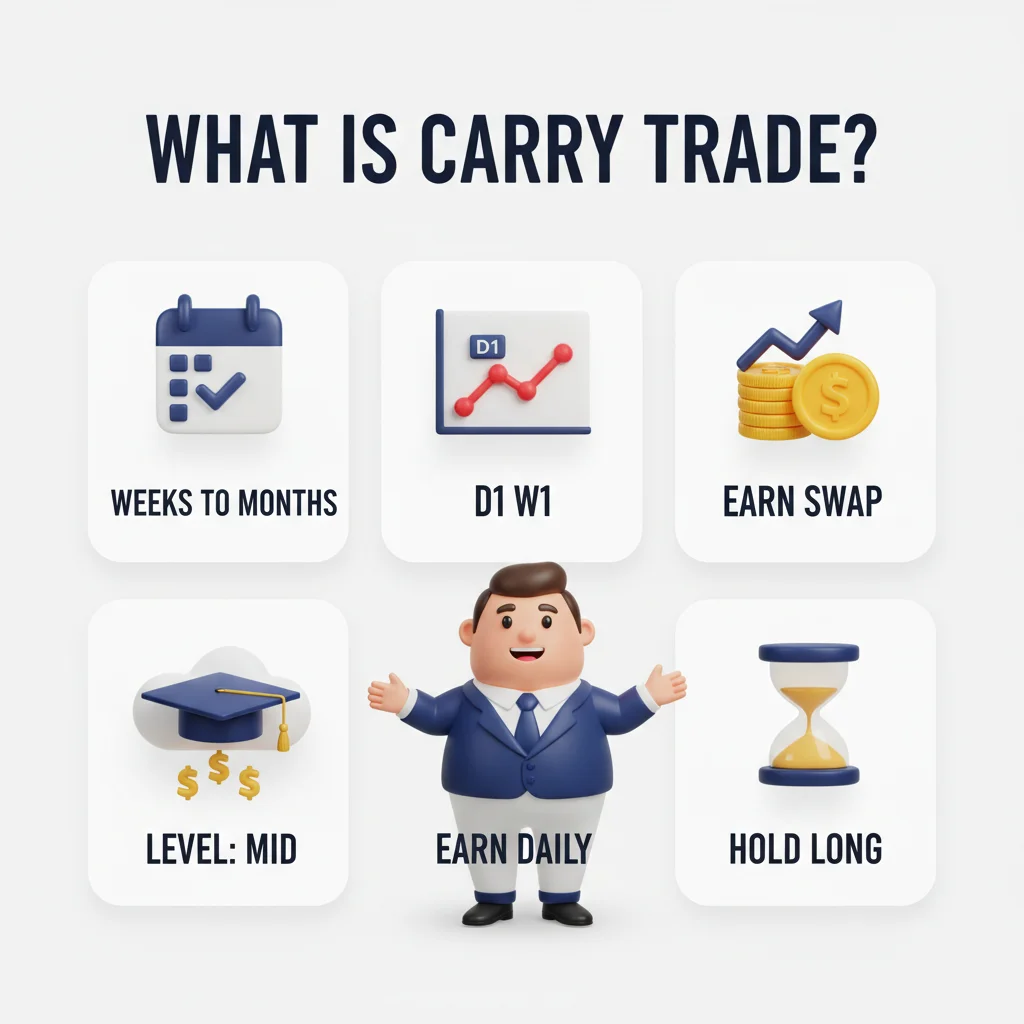
Why? If South Africa's interest rate is 8% and the US rate is 5%, you earn that 3% differential for holding the high-yielding currency (ZAR) and pay for holding the low-yielding one (USD). So, shorting USD/ZAR (buying ZAR) often pays positive swap. This is the foundation of a carry trade strategy, where traders aim to profit primarily from the swap, not just price movement.

Pro Tip: Always check the swap rates for both long and short positions on your broker's platform before entering a trade. Don't assume. I've seen rates flip from positive to negative between brokers like XM review and Pepperstone review due to how they apply their mark-up.

Your trading timeframe dictates how much you should care about swap.
For Scalpers: If you're in and out of trades within minutes, swap is irrelevant. You'll never hold past the daily cut-off time. Your focus is purely on the spread definition and immediate price action. A scalping strategy ignores swap completely.
For Day Traders: Similar story. You close all positions by midnight SA time. Swap is a non-issue.
For Swing Traders and Investors: This is where swap becomes a critical part of your profit & loss. If you hold trades for weeks or months, like in swing trading, swap can be your silent partner or your silent enemy. A negative swap on a 2-month trade can easily add up to 1-2% of your position size in costs. You must factor this into your risk-reward calculation. A trade with a 3% target but a 1.5% estimated swap cost has a much worse real-world payoff.
I once held a long position on XAU/USD guide (Gold) for 45 days. The swap was small but negative. It cost me about $9 per night. By the time I exited, I had paid over $400 in swap fees. The trade was a winner, but my effective profit was 18% instead of the 20% my chart showed. Now, I use a position size calculator that lets me input estimated holding time and swap to see my true potential net profit.
“Ignoring swap on a long-term trade is like ignoring a slow leak in your car's tyre.”
You can't avoid swap if you hold overnight, but you can manage it intelligently.
- Trade Swap-Free (Islamic) Accounts: Most brokers offer these. They charge no swap, but often have a wider spread or a fixed daily administration fee instead. Do the math. For short-term holds, a wider spread might cost more. For long-term holds, a swap-free account can save you thousands. It's perfect for swing trading ZAR pairs with a negative swap.
- Factor Swap into Your Trade Plan: Before you click buy, know the nightly cost. If your stop-loss is 50 pips away, and swap costs 0.5 pips per night, a 10-day hold adds 5 pips of 'hidden' cost to your trade.
- Consider the Carry Trade: Actively look for pairs where you can earn positive swap. This turns time into your ally. For example, going short on EUR/USD guide when the Fed has higher rates than the ECB can generate a small daily income.
- Mind the Wednesday/Weekend Effect: The triple swap on Friday is applied to positions held on Wednesday night (for most brokers). If you don't want to pay triple, avoid opening positions just before Wednesday's rollover or close them before Friday.
The biggest mistake is ignoring it. I did, and it hurt. Now, I treat swap like a second spread – a known transaction cost that must be accounted for.
💡 Wskazówka Winstona
For long-term ZAR positions, the swap-free account is often your best friend. The fixed daily fee is almost always cheaper than the relentless debit of a negative swap over weeks.
Managing multiple swing trades with different swap calculations is complex, but tools like Pulsar Terminal can help you visualize and manage all your positions and their associated costs from one MT5 dashboard.

You might check USD/ZAR swap rates at two different South African-friendly brokers and see different numbers. Why? Brokers don't just pass on the interbank rate. They add a mark-up. This is how they make money on swaps, similar to how they make money on the spread.
This mark-up can vary wildly. One broker might quote -12.5 pips for a short, another -15.0. Over a month, that difference adds up. It's another reason to shop around. A broker with tighter spreads but much higher swap mark-ups might be more expensive for your specific trading style.
Also, some brokers have a fixed swap rate, while others have a floating rate that changes more frequently with the underlying interest rates. Always check your broker's specification sheet. This is as important as checking their margin call policy. Your choice of broker directly impacts your answer to 'what does swap mean in forex' for your pocket.
“Your choice of broker directly impacts what swap means for your bottom line.”
Two more concepts are useful for the serious trader.
Tom/Next Rate: This is just the fancy financial term for the swap rate. It stands for 'Tomorrow Next,' meaning the rate for rolling a spot position to the next value date. When you see 'swap,' think Tom/Next.
Central Bank Decisions Are Key: Swap rates are a direct function of central bank policy. When the SARB announces a repo rate change, the swap rates on all ZAR pairs will shift within a day or two. Trading around these announcements requires understanding this link. A rate hike can suddenly make shorting USD/ZAR (earning ZAR interest) much more attractive, influencing both price and your swap income.
Monitoring tools that track interest rate expectations can give you a clue where swap rates might head. I pair this with technical analysis from indicators like the RSI indicator or MACD indicator to find trades with both a technical edge and a favourable swap tailwind.
FAQ
Q1Is swap charged on weekends?
Yes. While financial markets are closed, interest accrues. To account for this, the swap charged on Wednesday night (for most brokers) is typically triple the normal amount, covering Saturday and Sunday. Always check your broker's specific rollover schedule.
Q2Can I avoid paying swap fees?
Yes, by using a swap-free (Islamic) trading account offered by most brokers. However, these accounts often compensate the broker through wider spreads or a fixed daily fee. Calculate which is cheaper for your typical holding period.
Q3Do I pay swap if I'm day trading?
No. Swap is only applied to positions held open past your broker's daily rollover time (usually around midnight SA time). If you close all trades before this cut-off, you will not incur any swap charges.
Q4Why did I earn swap on a losing trade?
Swap and trade profit/loss are separate. Swap is purely a function of interest rates and your trade direction. You can earn positive swap daily on a trade that is moving against you price-wise, and vice-versa.
Q5How do I find the swap rates for a currency pair?
Swap rates are listed in your trading platform (like MT4/MT5). Look for a 'Specification' or 'Contract Details' window for the symbol. They are shown as separate values for long and short positions, usually in points.
Q6Does swap affect my margin or use?
No, not directly. Swap is a cash debit or credit to your account balance. However, a large negative swap over time can reduce your balance, which in turn affects your free margin and could increase your risk of a margin call if your trade is also losing money.
Lekcja Prof. Winstona
:
- ✓Swap can cost 1-2% of position size on long-term holds.
- ✓Always check swap rates for LONG and SHORT before trading.
- ✓Wednesday's swap is often triple (covers the weekend).
- ✓Use a swap-free account for negative-swap swing trades.
Jak przydatny był ten artykuł?
Kliknij gwiazdkę, aby ocenić
Tygodniowe analizy tradingowe
Darmowe tygodniowe analizy i strategie. Bez spamu.
O autorze
David van der Merwe
Trader Rynków Wschodzących
Trader z Johannesburga z 11-letnim doświadczeniem w walutach rynków wschodzących. Specjalizuje się w parach ZAR, handlu regulowanym przez FSCA i analizie rynku południowoafrykańskiego.
Komentarze
Może Ci się też spodobać

Cara Trading Forex Sukses: 7 Prinsip dari Trader Profesional
Cara trading forex sukses dengan 7 prinsip trader pro: manajemen modal, disiplin, journal trading, backtest. Data nyata, bukan janji profit palsu.
Jam Trading Forex Terbaik untuk Trader Indonesia: Panduan Lengkap dengan Tabel Waktu
Panduan jam trading forex untuk trader Indonesia. Tabel 4 sesi dunia, jam emas 20:00-00:00, sesi mana yang harus dihindari. Data akurat + tips dari trader berpengalaman.
Top 5 Sàn Forex Uy Tín Nhất 2026: Review Jujur dari Trader Indonesia
Top 5 sàn forex uy tín 2026 untuk trader Indonesia. Review jujur: spread, deposit, withdraw, dukungan lokal. Exness, XM, IC Markets & lebih.
All these calculators are built into Pulsar Terminal with real-time data from your MT5 account. One-click position sizing, automatic risk management, and instant calculations.
