


Staring at your MT5 screen right now, wondering what to trade on forex today? You're not alone.

David van der Merwe
Trader Rynków Wschodzących ·  South Africa
☕ 10 min czytania
Czego się nauczysz:
Staring at your MT5 screen right now, wondering what to trade on forex today? You're not alone. Every morning, thousands of us in South Africa face the same blank charts, the same overwhelming choice of 80+ pairs, and the same pressure to find that one good setup. The truth is, knowing what to trade isn't about chasing the hottest tip. It's about understanding which markets suit your time, your capital, and your psychology - especially with our unique 30:1 use limit and ZAR exposure. I've blown accounts trading the wrong things at the wrong times. Let me save you that pain.
Before we even look at a chart, you need to understand the playing field. We trade under specific rules that change the game compared to our friends in the UK or Australia.
The big one? use. Since 2021, the FSCA caps retail use at 30:1. That sounds restrictive if you're used to hearing about 500:1 offshore, but honestly, it saved me more money than it cost. Early in my career, I blew R15,000 on a USD/JPY trade using 100:1 use with an unregulated broker. The market moved 1% against me, and I was done. That 30:1 limit forces better position size calculator discipline from day one.
Another critical point: you cannot legally speculate directly against the Rand with a local broker. This means you can't short USD/ZAR hoping the Rand strengthens for pure profit. You can, however, trade ZAR pairs as a hedge if you have underlying USD exposure from a business or investments. Most of us trade ZAR crosses (like EUR/ZAR) for this reason.

Warning: Trading with an unregulated offshore broker for higher use bypasses all South African consumer protection. If they vanish with your deposit, the FSCA can't help you.
Finally, remember SARS. Your trading profits are viewed as income, taxed at your marginal rate. I keep a simple spreadsheet: every trade, deposit, and withdrawal. Come tax season, it's a lifesaver. Starting with this reality check isn't sexy, but it's what separates the gamblers from the traders who last.

💡 Wskazówka Winstona
Your first profit target should be your stop-loss. Before entering, know exactly where you're wrong and get out. Protecting capital is job one.
A 'good trade' isn't just a winning one. It's a trade that fits. I learned this the hard way trying to copy a London-based scalping strategy while sitting in Johannesburg. The spreads were too wide, and the timing was off. For us, a good trade today usually has three things.
First, it has clear liquidity. You want to trade when the relevant market is open and active. Trading AUD/USD at 10 PM South African time? You're fighting the Sydney session close, and the spread definition will often widen, eating into your profit before you even start.
Second, it has a definable edge. This is just a fancy way of saying you have a specific reason for entering beyond a gut feeling. Maybe it's price bouncing off a key support level on the 4-hour chart, or the RSI indicator showing divergence on the EUR/USD daily. My worst trades were always 'maybe this is the bottom' trades with no clear plan.
Third, and most importantly, it fits your risk tolerance. With our 30:1 use, a 2% move against you can wipe out 60% of your margin. A good trade has a stop-loss level that, if hit, loses an amount you can emotionally and financially afford to lose. I never risk more than 1.5% of my account on a single idea. This single rule has kept me in the game for over a decade.
“A 'good trade' isn't just a winning one. It's a trade that fits your time, your capital, and your psychology.”
For most South African traders starting out, the major currency pairs are where you should live. EUR/USD, GBP/USD, USD/JPY, and USD/CHF. Why? Three simple reasons: tight spreads, massive liquidity, and predictable session movements.
Let's talk about EUR/USD specifically. It's the most traded pair in the world. The average daily range is about 70-100 pips. For a South African trader, the sweet spot is often between 10 AM and 3 PM our time. This overlaps with the late London session and the early New York open, when volume (and opportunity) spikes.
I have a soft spot for GBP/USD. It's more volatile than the Euro, often moving 100-150 pips a day. Back in 2016 during the Brexit vote, I learned a brutal lesson about news volatility. I was long GBP/USD at 1.4300. The result came out, and within minutes it crashed to 1.3220. That was a R8,000 loss. The takeaway? Know when major news is due (like SARB or Fed announcements) and either stay out or have incredibly wide stops.

Pro Tip: Use a broker with raw spreads on majors. I use IC Markets review for this. On EUR/USD, I often see a spread definition of 0.1 pips with a small commission. That low cost makes a huge difference when you're scalping strategy or trading multiple lots.
The majors are less about explosive, get-rich-quick moves and more about consistent, technical trading. They're perfect for practicing your strategy without the noise of exotic pairs. My first consistent profitability came from just focusing on EUR/USD and its clear correlation with the MACD indicator on the 1-hour chart.
This is where we have a potential information edge. Trading EUR/ZAR, GBP/ZAR, or AUD/ZAR, you're dealing with a currency you intuitively understand. You feel when load-shedding is hitting business confidence, or when a strong commodity report comes out.
But they're tricky. The spreads are wide. I'm talking 10-25 pips on a good day. You can't scalping strategy these. They are pure swing trading instruments. You need to think in terms of 200-500 pip moves and hold for days or weeks.
Trading ZAR Pairs as a Hedge
This is their most powerful use for South Africans. Let's say you run an import business and have a future USD expense. If you're worried the Rand will weaken (USD/ZAR go up), you could buy USD/ZAR. This isn't speculation for profit; it's locking in a future rate. It's complex and I'd consult a financial advisor, but understanding the principle is key.
The Volatility Trap
ZAR pairs are seductive. They move big. I once caught a 400-pip move on GBP/ZAR in two days. But for every one of those, I've been stopped out by a 50-pip whipsaw that was just normal noise. The key is position size. Because the pip definition value is higher on these pairs (a pip on EUR/ZAR is worth more than a pip on EUR/USD), you must trade smaller lots. Use a position size calculator religiously.
Brokers like Pepperstone review offer decent access to ZAR crosses. Just be prepared for the wider spreads and treat them with the respect a volatile, emerging market currency deserves.
“Knowing what not to trade is half the battle. Some days, the right answer to 'what to trade' is 'nothing'.”
XAU/USD (Gold) and USOIL (Crude Oil) aren't forex pairs, but every major broker offers them as CFDs. They are fantastic diversifiers because they often move independently of currencies.
Gold (XAU/USD) is my go-to 'fear trade'. When global uncertainty spikes, money flows into gold. During the early COVID market panic in March 2020, while stocks and some currencies crashed, gold shot up. I entered a long position at $1,480 and rode it to $1,700. That trade alone funded my trading account for a year. It's also great for technical analysis, respecting support and resistance beautifully. For a deeper look, check out our XAU/USD guide.
Oil is a beast. It's driven by geopolitics (OPEC meetings, Middle East tensions), inventory data, and global growth hopes. It can gap up or down at the open. I treat it like a ZAR pair: wide stops, swing trading mindset, and small position sizes. The volatility can be punishing, but the trends are often strong and persistent.

Example: Let's say you buy 1 lot of XAU/USD at $2,150. A 1 pip move in gold is $0.10. If it moves to $2,160, that's a 100 pip move, or a $1,000 profit. Now, imagine doing that with a 5-lot position without proper risk management. The losses work the same way. Size matters.
The beauty of commodities is they give you something to trade when the forex majors are stuck in a tight range. Just remember, they can be even more volatile, so your risk management has to be airtight to avoid a margin call.
💡 Wskazówka Winstona
The London-New York overlap (3-5 PM SAST) is where the big institutional orders flow. If you see a clear breakout then, it often has legs. But mind the news!

Managing multiple trades and setting precise stops across different sessions is easier with tools that automate risk management directly on your MT5 platform.
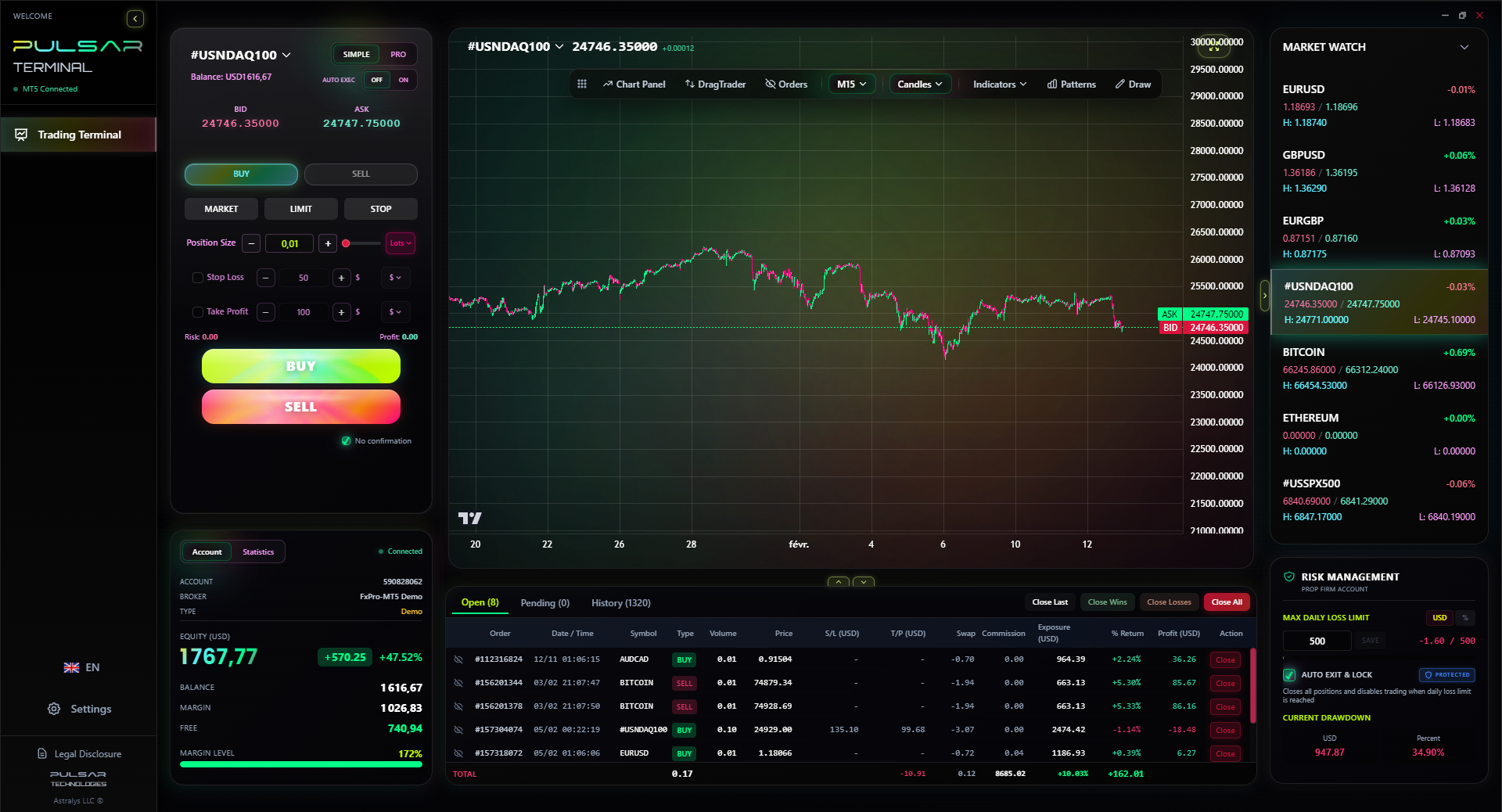
Okay, so how do you actually decide what to trade on forex today? Don't just scroll through charts randomly. Have a system. Here's mine.
Step 1: The Session Check (8:30 AM SAST) I open my platform and check which session is dominant.
- Asian Session (Our early morning): Low volatility. I might look at AUD/USD or USD/JPY, but I rarely take trades. It's a planning time.
- London Session (10 AM - 7 PM SAST): This is my main playground. All majors are liquid. I focus on EUR/USD, GBP/USD.
- London/NY Overlap (3 PM - 5 PM SAST): Highest volatility. Perfect if you're looking for a breakout trade. I'm also watching for news releases.
Step 2: The Market Condition Scan I quickly assess three pairs to gauge the overall market:
- EUR/USD: Is it trending or ranging? (I use the 200-period MA on H1).
- DXY (US Dollar Index): Is the USD broadly strong or weak?
- XAU/USD: What's the 'fear' or 'risk' sentiment? This tells me if I should be looking for trend-following or range-bound strategies.
Step 3: Apply Your Strategy to 2-3 Pairs Max Don't analyze 20 pairs. Pick your two favorites. For me, it's often EUR/USD and XAU/USD. Apply your specific entry rules. If you see a setup, trade it. If you don't, that's a successful day. Preserving capital is a win.
This framework stops the paralysis of choice. It turns 'what to trade on forex today' from an overwhelming question into a simple, repeatable checklist.
“The 30:1 use limit forces better discipline from day one. It saved me more money than it cost.”
Knowing what not to trade is half the battle. Here’s my personal avoid list for the average South African trader.
Exotic Pairs (USD/TRY, USD/MXN, etc.): The spreads are monstrous, sometimes 50-100 pips. You need the pair to move 200 pips just to break even. It's a broker's dream and a trader's nightmare. I lost R2,500 trading USD/TRY before I realized the spread was eating me alive.
Trading During Major SA or US News (If You're New): When SARB announces an interest rate decision, or the US releases Non-Farm Payrolls, spreads widen to absurd levels and price can spike 50 pips in a second. Until you're very experienced, just watch. It's not a missed opportunity; it's avoided recklessness.
The 'Revenge Trade': You just took a loss on GBP/USD. The instinct is to jump right back in to win it back. That's gambling. My rule is simple: after a losing trade, I close the platform for at least two hours. Go for a walk. The market will still be there tomorrow.
Overtrading in Low Volatility: The Asian session (our morning) is quiet. Forcing trades in a 20-pip range is a great way to get chopped up by spread definition costs and minor fluctuations. Patience isn't just a virtue; it's a profit center.
💡 Wskazówka Winstona
If you feel the urge to 'double down' on a losing trade to average your price, close your platform instead. Averaging down is a surefire path to a margin call.
So, what to trade on forex today? Start simple. For your first six months, your watchlist should be: EUR/USD, GBP/USD, and XAU/USD. Master the rhythm of these. Learn how they move during our South African day. Use the 30:1 use as a protective cage, not a limitation.
Choose a reputable, FSCA-regulated broker like those we've reviewed (Exness review, XM review) that offers tight spreads on your chosen pairs. Your number one job is not picking winners, it's managing losers. A tight stop-loss and a sensible position size calculator are more important than any fancy indicator.
Some days, the right answer to 'what to trade' is 'nothing'. That's a skill in itself. This isn't a get-rich-quick scheme. It's a craft. It's about consistent, disciplined decisions, day after day, within the rules of our market. Start with the majors, keep your size small, and focus on the process. The profits will follow the discipline, not the other way around.
FAQ
Q1Is forex trading legal in South Africa?
Yes, it's completely legal and regulated by the Financial Sector Conduct Authority (FSCA). You must trade with an FSCA-licensed broker (or a reputable foreign one) to ensure client fund protection and fair practices. Remember, use for retail traders is capped at 30:1.
Q2What is the best time of day to trade forex in South Africa?
The most active and liquid time is between 10:00 AM and 5:00 PM South African Standard Time. This covers the peak of the London session and the overlap with the New York open (3 PM SAST onwards). This is when spreads are tightest and trends are most likely to develop on pairs like EUR/USD and GBP/USD.
Q3Can I trade USD/ZAR to speculate on the Rand?
No, not legally through an online broker for pure speculative profit. South African exchange control regulations prohibit residents from speculating directly against the Rand. You can trade other ZAR crosses (like EUR/ZAR) and you can use USD/ZAR for legitimate hedging purposes if you have an underlying foreign exchange exposure (e.g., for business).
Q4How much money do I need to start trading forex in South Africa?
You can start with as little as R500-R1000 with some brokers. However, I strongly advise starting with at least R5,000-R10,000 in a live account. This allows for proper position sizing and risk management. With a small account, it's very easy to over-use and get wiped out by a single small move, even with the 30:1 cap.
Q5How are my forex trading profits taxed by SARS?
SARS generally views frequent forex trading as generating income, which is taxed at your marginal income tax rate (not capital gains). You must keep careful records of all trades, deposits, withdrawals, and profits/losses. It's highly recommended to consult with a tax professional who understands trading.
Q6What's the biggest mistake new South African traders make?
Two stand out: 1) Overtrading due to FOMO (Fear Of Missing Out), especially in low-volatility sessions, and 2) Incorrect position sizing. They use too large a lot size for their account, so a normal 30-pip stop-loss risks 10% of their capital. Use a position size calculator for every single trade.
Q7Should I trade exotic pairs for bigger moves?
Almost certainly not when you're starting. Exotic pairs (like USD/TRY, USD/ZAR) have very wide spreads, sometimes 20-50 pips. You need an enormous move just to break even. The costs and unpredictable volatility make them unsuitable for beginners. Stick to major pairs where the costs are low and the price action is cleaner.
Lekcja Prof. Winstona
:
- ✓Start with only EUR/USD & Gold (XAU/USD). Master 2 pairs.
- ✓Never risk more than 1.5% of your account on a single trade.
- ✓The London/NY overlap (3-5 PM SAST) is your prime trading window.
- ✓Wide stops on ZAR pairs (50+ pips) or avoid them initially.
- ✓A losing trade means a 2-hour break. No revenge trading.
Jak przydatny był ten artykuł?
Kliknij gwiazdkę, aby ocenić
Tygodniowe analizy tradingowe
Darmowe tygodniowe analizy i strategie. Bez spamu.
O autorze
David van der Merwe
Trader Rynków Wschodzących
Trader z Johannesburga z 11-letnim doświadczeniem w walutach rynków wschodzących. Specjalizuje się w parach ZAR, handlu regulowanym przez FSCA i analizie rynku południowoafrykańskiego.
Komentarze
Może Ci się też spodobać

Cara Trading Forex Sukses: 7 Prinsip dari Trader Profesional
Cara trading forex sukses dengan 7 prinsip trader pro: manajemen modal, disiplin, journal trading, backtest. Data nyata, bukan janji profit palsu.
Jam Trading Forex Terbaik untuk Trader Indonesia: Panduan Lengkap dengan Tabel Waktu
Panduan jam trading forex untuk trader Indonesia. Tabel 4 sesi dunia, jam emas 20:00-00:00, sesi mana yang harus dihindari. Data akurat + tips dari trader berpengalaman.
Top 5 Sàn Forex Uy Tín Nhất 2026: Review Jujur dari Trader Indonesia
Top 5 sàn forex uy tín 2026 untuk trader Indonesia. Review jujur: spread, deposit, withdraw, dukungan lokal. Exness, XM, IC Markets & lebih.
All these calculators are built into Pulsar Terminal with real-time data from your MT5 account. One-click position sizing, automatic risk management, and instant calculations.
