


Let's be brutally honest: the promise of 'free deposit funds' is the single most effective trap brokers use to get you trading with more money than you should.

David van der Merwe
Trader Rynków Wschodzących ·  South Africa
☕ 12 min czytania
Czego się nauczysz:
- 1What 'Free Deposit Funds' Really Mean (It's Not What You Think)
- 2The FSCA's Rules on Bonuses (Your Protection)
- 3Brokers Offering Deposit Bonuses in South Africa (2026 Data)
- 4The Fine Print: Terms and Traps That Wipe Accounts
- 5Should You Use a Deposit Bonus? (A Risk Manager's View)
- 6Safer Alternatives to 'Free Money' Promotions
- 7If You Proceed: How to Claim a Bonus Safely (A Checklist)
Let's be brutally honest: the promise of 'free deposit funds' is the single most effective trap brokers use to get you trading with more money than you should. I've watched traders chase these bonuses for 12 years, and 9 out of 10 blow the account before ever meeting the withdrawal conditions. It's not free money. It's a risk multiplier disguised as a gift. In this guide, I'll show you exactly which forex brokers give free deposit fund offers in South Africa, decode the FSCA's stance, and explain why you should probably ignore them entirely.
When a broker advertises 'free deposit funds' or a '100% deposit bonus,' they're talking about a credit bonus. This isn't cash deposited into your bank account. It's virtual margin added to your trading account, locked behind a wall of trading volume requirements called a turnover requirement.
Think of it like this: you deposit R10,000. The broker 'gives' you another R10,000 in bonus credit. Your platform shows R20,000 in equity. But here's the catch: you can't withdraw that bonus R10,000. You can only withdraw profits you make from trading with the entire R20,000 after you've traded a specific volume. That requirement is often something insane like trade 1 standard lot (100,000 units of currency) for every $1 of bonus. On a R10,000 bonus, that's 10 standard lots. For a new trader, that's a mountain.
The psychological effect is deadly. You see a bigger number, so you take bigger trades. Your position size calculator tells you to risk 1% of R10,000 (R100), but you're now looking at R20,000 and might unconsciously risk 2% (R200). You've just doubled your risk because of a number on a screen. I did this myself in 2015 with a broker's 50% bonus. I turned a R15,000 deposit into a R30,000 displayed balance, got overconfident on a GBP/USD scalping strategy, and blew through the entire bonus and half my real capital in a week trying to hit the volume target. The bonus didn't protect me. It made me reckless.

Warning: Bonus funds almost always come with a 'removal clause.' If you try to withdraw any of your own deposited funds before meeting the terms, the broker will claw back the entire bonus, often along with any profits generated from it. You're locked in.

💡 Wskazówka Winstona
A bonus is a line of credit, not an asset. You wouldn't max out a credit card to feel rich, so don't let bonus funds inflate your trading ego. Risk your deposit, ignore the credit.
“The bonus doesn't protect you. It makes you reckless.”
The Financial Sector Conduct Authority (FSCA) is why we can even have this conversation. They don't ban bonuses outright, but they've put up guardrails to prevent the worst abuses. Their main job is consumer protection, and they view misleading bonus promotions as a major threat.
Transparency is Non-Negotiable
An FSCA-regulated broker can't just say 'Get 100% FREE BONUS!' in big letters and hide the terms in microscopic print. They must clearly disclose:
- The exact trading volume (turnover) required to convert bonus funds to withdrawable funds.
- All conditions that would cause the bonus to be revoked.
- That the bonus is not 'real money' but a trading credit.
- The specific risks involved in trading with leveraged products like CFDs.
This is a big deal. Before the FSCA got tough, some offshore brokers had terms so opaque you needed a law degree to understand them. Now, if an FSCA broker isn't crystal clear, you can report them.
No Guaranteed Profit Promises
You'll never see an FSCA broker promise 'guaranteed profits' alongside a bonus. The regulator would shut that down immediately. Their promotions must emphasize that trading is high-risk and you can lose your deposit. This is why the most reputable FSCA-regulated brokers like IFX Brokers or VT Markets frame bonuses as 'additional trading credit' rather than 'free cash.'
The FSCA's stance is simple: bonuses are allowed, but they must not trick you into thinking you're getting something for nothing. They must not encourage you to trade more aggressively than you normally would. In practice, they still do, but at least the rules are on the table.
“They're betting on your failure to meet their terms.”
Here are specific brokers with offers in the South African market. I'm listing the numbers, but remember my warning: these are tools for experienced, disciplined traders only. New traders should avoid them like the plague.
| Broker | Regulatory Status (SA) | Bonus Offer (Typical) | Key Condition / Cap |
|---|---|---|---|
| IFX Brokers | FSCA Regulated | 100% Deposit Bonus | Max total bonus of $5,000. Bonus is tradeable margin, withdrawable after volume target. |
| VT Markets | FSCA Regulated (VT Markets Pty Ltd) | 100% Welcome Bonus (1st deposit), 20% on later deposits | Welcome bonus capped at $1,000. Total bonus cap of $10,000 per client. |
| InstaForex | International Entity (Common for bonus offers) | Tiered: 100% (up to $2k), 50% ($2k-$5k), 30% ($5k+) | Bonus cancelled upon any withdrawal from account. |
| XM | FSCA Regulated | Known for $30 no-deposit bonus, also has deposit match offers | Requires trading min. volume (e.g., 10 standard lots) to withdraw profits. |
A critical point: the most aggressive bonus offers often come from international entities of a broker brand, not necessarily their FSCA-regulated South African arm. Always check which entity you are signing up with. The FSCA-regulated entity might have more conservative bonuses but far greater protection if something goes wrong.
For example, you might see a broker's global site offering a 150% bonus. Their South African FSCA site might only offer 50%. That's the regulator doing its job. I always recommend sticking with the FSCA side, even if the bonus is smaller. Your capital safety is worth more than a bigger virtual number. You can compare the regulatory standing and overall offering of major players in our IC Markets review and Pepperstone review, though their SA offers may differ.

Example: You deposit $1,000 with a broker offering a 100% bonus. You get $1,000 bonus credit. Terms: trade 1 lot per $100 bonus. Volume required = $1,000 / $100 = 10 standard lots. That's 10,000,000 units of currency. At a typical spread of 1.0 pip on EUR/USD, just the spread cost to achieve this is $100 (10 lots * $10 per pip). You're already down 10% of your real capital just to 'unlock' the bonus.
“They're betting on your failure to meet their terms.”
This is where they get you. You must read every word. I've made the mistake of skimming, and it cost me.
1. The Turnover (Volume) Requirement: This is the big one. It's usually expressed as a multiple of the bonus. 'Trade 20 times the bonus amount.' Or 'Trade 1 lot per $50 of bonus.' They force you to generate massive trading volume. This pushes you to trade frequently, often outside your strategy, just to hit the target. It turns you into a compulsive, fee-paying machine for the broker.
2. The 'No Arbitrage' / 'No Hedging' Rule: This is a killer. Most bonus terms forbid opening opposite positions on the same instrument. Why does this matter? Let's say you get the bonus and want to be conservative. You think, 'I'll open a long and a short EUR/USD position to lock in the price, wait for the bonus to be credited, then close them.' This is called bonus arbitrage, and it's strictly prohibited. They'll cancel your bonus and likely your profits if they detect it. It removes your safest way of 'claiming' the bonus.
3. Time Limits & Inactivity: Some bonuses expire if not used within a certain period (e.g., 90 days). Others are revoked if the account is inactive for 30 days. Life gets busy, you go on holiday, and poof - your 'free funds' are gone.
4. Maximum use Caps: Your account might be restricted to lower use while the bonus is active (e.g., max 1:200 instead of 1:500). For some traders, this is actually a good thing, but if your strategy relies on higher use, it breaks your plan.
5. Profit Withdrawal Limits: Even after meeting volume targets, some older schemes capped how much profit you could withdraw per month. This is less common now under FSCA scrutiny, but still check.
The ultimate trap is psychological. The bonus creates a 'house money' effect. You risk more because it feels like you're playing with the broker's cash. I can tell you from the other side of the screen: it's not their cash. It's a liability on their books that they're 95% certain you'll never successfully withdraw. They're betting on your failure.
💡 Wskazówka Winstona
The most valuable broker promotion is the one you don't notice: consistent low spreads, instant execution, and no withdrawal fees. Chase that, not the bonus billboard.
“A 10% gain on your own capital is better than a 20% gain on phantom money you'll never withdraw.”
My professional advice for 95% of traders: No.
Here's my reasoning. A trading bonus is designed to alter your behavior. Good trading is about discipline, patience, and strict risk management. A bonus incentivizes the opposite: high volume, frequent trading, and increased position sizes. It directly conflicts with the core principles of survival.
Who might benefit? A very experienced, high-volume trader who was going to trade that much anyway. For them, it's a rebate on their trading costs. If you're planning to trade 100 lots this month as part of your normal swing trading strategy, and a bonus gives you extra margin cushion for that same plan, it can be a minor perk. But you must ignore the bonus's existence when making trading decisions. That's incredibly hard to do.
For everyone else, especially beginners, it's a distraction. Instead of focusing on learning price action, mastering the MACD indicator or RSI in context, and managing your real capital, you're distracted by a progress bar showing how much volume you have left. You start taking trades you wouldn't normally take.
A better use of your energy? Find a broker with low spreads, reliable execution, and solid FSCA regulation. Treat every Rand in your account as your own hard-earned money. Because it is. A 10% gain on your own R10,000 (R1,000 profit) is better than a 20% gain on a bonus-inflated R20,000 that you then lose trying to hit an impossible volume target.
If you absolutely must try a bonus, do this: open a separate, small account. Fund it with money you're willing to lose. Use the bonus there. Keep your main, serious trading account completely separate and bonus-free. This quarantines the psychological virus.
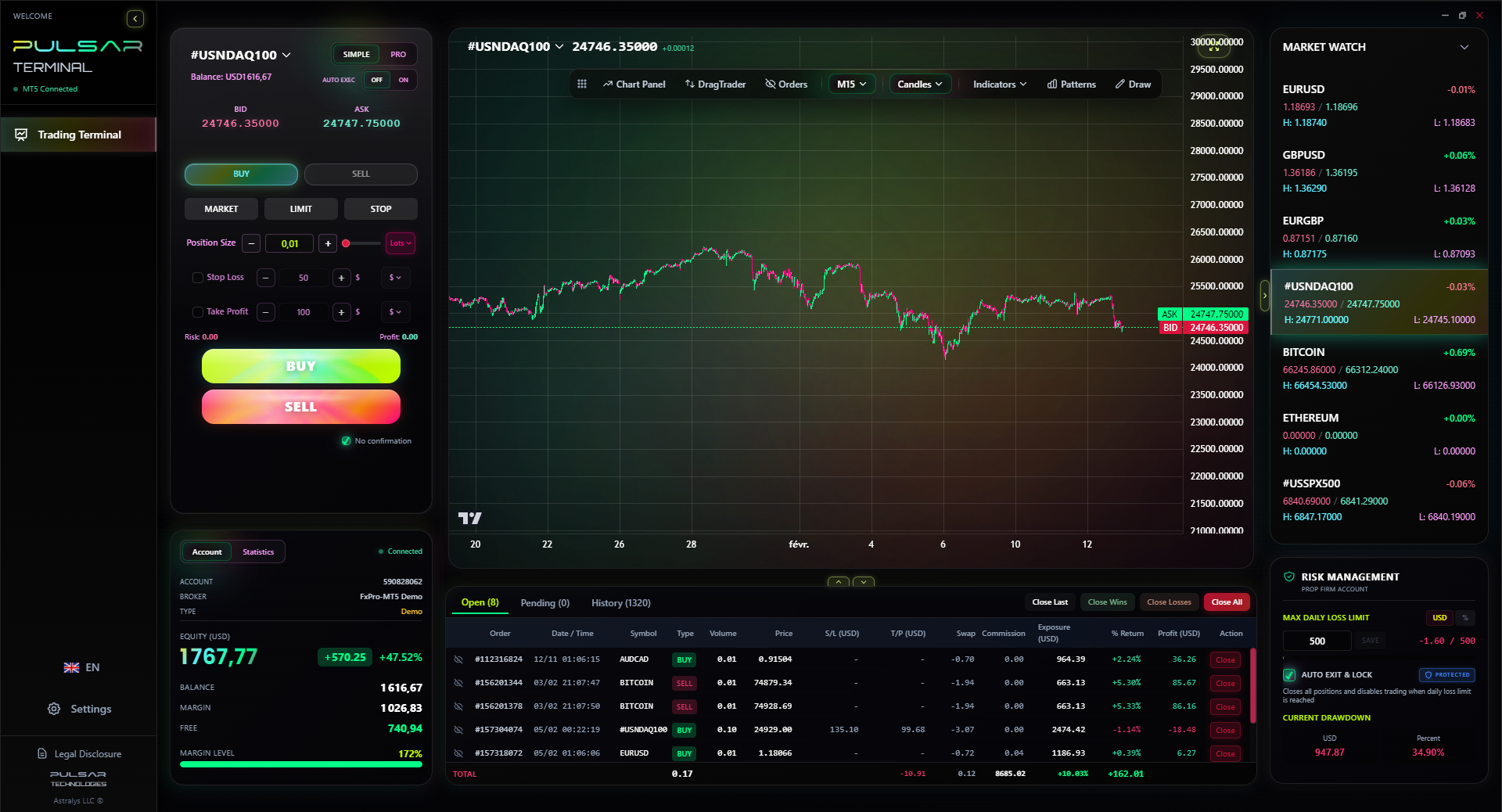
Sticking to your strategy while ignoring bonus pressure is hard, but tools like Pulsar Terminal help by automating your trade management on MT5, so you're not tempted to overtrade manually.
“A 10% gain on your own capital is better than a 20% gain on phantom money you'll never withdraw.”
Want real value from a broker? Look for these instead of flashy deposit matches:
1. Cashback or Rebate Programs: Some brokers offer a small rebate (e.g., $2 per lot) on your trading volume. This is real money paid into your account, usually with no withdrawal restrictions. It reduces your effective trading costs. This is far more honest and valuable than a bonus. You trade your strategy, and you get a small kickback. No behavior alteration required.
2. Reduced Spreads or Commission-Free Accounts: A lower spread on your favorite pair like EUR/USD or XAU/USD saves you money on every single trade. Over a year, this can add up to more than any bonus you'd likely successfully withdraw. Look for brokers with consistently tight spreads during your trading hours.
3. Fee-Free Deposits and Withdrawals: This is huge in South Africa. If a broker doesn't charge you for an EFT deposit or a withdrawal back to your FNB/Standard Bank account, that's real money saved. Some international brokers nickel-and-dime you on currency conversion and transfer fees.
4. Quality Education and Tools: A broker that provides genuine market analysis, quality webinars, and advanced trading tools is adding value to your skillset. This is an investment in your own ability, which pays dividends forever. A free VPS (Virtual Private Server) for algorithmic traders is another excellent, no-strings-attached perk.
5. Reliable Execution and No Requotes: This is priceless. A broker that executes your trades instantly at the price you see, especially during news events, saves you from slippage losses that can dwarf any bonus. This is where reading detailed reviews, like our XM review, focusing on execution quality, is crucial.
Focus on what lowers your costs and improves your trading environment, not what inflates your account balance with phantom money.
“Your goal isn't to outsmart them; it's to avoid letting their marketing outsmart you.”
Ignoring my advice? Okay. If you're determined to try, here's a survival checklist. Print this out.
- Read ALL Terms: Yes, all. Highlight the volume requirement, the time limit, the use cap, and the withdrawal conditions.
- Calculate the Real Cost: Use the example earlier. How much volume? What's the spread cost to achieve that? Is it even mathematically possible with your account size without taking insane risk?
- Adjust Your Position Size DOWN: If the bonus doubles your displayed equity, halve your normal position size. Use your position size calculator based on your real deposited capital only, not the bonus-inflated total. This is the most important step to counter the psychological effect.
- Stick to Your Strategy: Do not take extra trades. If your strategy says wait, you wait. Let the volume target be met slowly, over months, through normal trading. If you miss the time limit, let the bonus expire. Your capital preservation is more important.
- Document Everything: Take screenshots of the bonus terms, your acceptance, and your account balance before and after the bonus is applied. If there's a dispute, you have evidence.
- Plan for the Worst: Assume you will lose the bonus and any profits made from it. Be pleasantly surprised if you don't. This mental model keeps you grounded.
Remember, the broker's risk team is smarter than you about their own bonus terms. They've designed it to be profitable for them. Your goal isn't to outsmart them; it's to avoid letting their marketing outsmart you.
💡 Wskazówka Winstona
If you can't calculate the exact trading volume required and the spread cost to achieve it within 60 seconds, you have no business accepting the bonus. Ambiguity is the trap.
FAQ
Q1Are forex deposit bonuses legal in South Africa?
Yes, but with strict conditions. The FSCA allows them but mandates full transparency. Brokers must clearly state all terms, risks, and that the bonus is not 'free cash' but trading credit with withdrawal restrictions. Misleading promotions are illegal.
Q2Can I withdraw the free deposit bonus money immediately?
Almost never. The bonus credit itself is not withdrawable. You can typically only withdraw profits generated from trading with the bonus funds after meeting specific trading volume (turnover) requirements. Attempting to withdraw early usually results in the bonus and associated profits being revoked.
Q3What is the best FSCA-regulated broker with a deposit bonus?
'Best' is subjective and depends on your needs. IFX Brokers and VT Markets are examples of FSCA-regulated entities that offer structured deposit bonus programs with clear terms. However, the 'best' broker for you is likely one with low costs and reliable execution, not necessarily the biggest bonus.
Q4What happens if I get a margin call while using bonus funds?
Bonus funds often act as additional margin, so they can delay a margin call. However, if your equity (including bonus) falls below the required margin level, you will still get a margin call. If your positions are closed at a loss, you lose your real capital first, and the bonus is simply removed. The bonus does not protect you from losses.
Q5Do I pay tax on profits from a forex bonus in South Africa?
Yes. SARS views profits from trading, whether made with your own capital or bonus-funded capital, as taxable income (revenue in nature) or capital gains, depending on your trading frequency and intent. The bonus itself is not taxable income until it's converted into real, withdrawable profit. You must declare your net trading profits. Consult a tax professional.
Q6Are no-deposit bonuses safer than deposit match bonuses?
They're different, not necessarily safer. A no-deposit bonus (e.g., $30 free) lets you trade without risking your own money, which is good for testing a broker. However, the volume requirements to withdraw profits are often proportionally even higher. They still encourage excessive trading to unlock a small amount of money.
Lekcja Prof. Winstona
:
- ✓Bonus funds are margin loans, not cash gifts.
- ✓Turnover requirements force destructive trading behavior.
- ✓FSCA rules demand transparency, but the psychological trap remains.
- ✓Prioritize low costs & execution over bonus size.
- ✓Calculate the spread cost to unlock the bonus before accepting.
Jak przydatny był ten artykuł?
Kliknij gwiazdkę, aby ocenić
Tygodniowe analizy tradingowe
Darmowe tygodniowe analizy i strategie. Bez spamu.
O autorze
David van der Merwe
Trader Rynków Wschodzących
Trader z Johannesburga z 11-letnim doświadczeniem w walutach rynków wschodzących. Specjalizuje się w parach ZAR, handlu regulowanym przez FSCA i analizie rynku południowoafrykańskiego.
Komentarze
Może Ci się też spodobać

Cara Trading Forex Sukses: 7 Prinsip dari Trader Profesional
Cara trading forex sukses dengan 7 prinsip trader pro: manajemen modal, disiplin, journal trading, backtest. Data nyata, bukan janji profit palsu.
Jam Trading Forex Terbaik untuk Trader Indonesia: Panduan Lengkap dengan Tabel Waktu
Panduan jam trading forex untuk trader Indonesia. Tabel 4 sesi dunia, jam emas 20:00-00:00, sesi mana yang harus dihindari. Data akurat + tips dari trader berpengalaman.
Top 5 Sàn Forex Uy Tín Nhất 2026: Review Jujur dari Trader Indonesia
Top 5 sàn forex uy tín 2026 untuk trader Indonesia. Review jujur: spread, deposit, withdraw, dukungan lokal. Exness, XM, IC Markets & lebih.
All these calculators are built into Pulsar Terminal with real-time data from your MT5 account. One-click position sizing, automatic risk management, and instant calculations.
