


Let's get one thing straight: walking into an Absa Bank forex branch to trade the EUR/USD is like bringing a butter knife to a gunfight.

David van der Merwe
Trader de Mercados Emergentes ·  South Africa
☕ 10 min de leitura
O que você vai aprender:
Let's get one thing straight: walking into an Absa Bank forex branch to trade the EUR/USD is like bringing a butter knife to a gunfight. It's the wrong tool for the job, and you'll get slaughtered. But for moving real money internationally? That's where they shine. I've used them, I've cursed their fees, and I've learned exactly when they're useful and when you should run for the hills. This guide will cut through the corporate speak and show you exactly what those Absa bank forex branches can and cannot do for you as a South African trader or expat.
First, kill the misconception. Absa is not a forex broker. You can't open a MetaTrader account, place a limit order on the Yen, or scalp the news with 50:1 use through your local branch. What they are is an Authorised Dealer under South African Reserve Bank (SARB) rules. That's a fancy title meaning they're one of the few entities legally allowed to convert your Rands into foreign currency and send it out of the country.
Their core services are for real-world needs: sending money overseas for tuition, buying property abroad, paying for imports for your business, or getting travel cash. They handle the compliance, the paperwork, and the actual movement of funds through systems like SWIFT. Think of them as the bureaucratic gatekeepers of your hard-earned capital.
I learned this the hard way early on. After a decent run on XAU/USD, I wanted to withdraw profits to my South African account to pay off a chunk of my bond. My international broker's wire hit Absa, and it got stuck for a week. Why? Because any incoming transfer over a certain threshold triggers a review. I had to provide trade statements, bank statements, and a letter explaining the source of funds. It was a hassle, but it's the law. That's the environment these branches operate in.

Warning: Don't confuse banking forex services with trading. If you ask an Absa teller about the MACD indicator or your stop-loss, you'll get a blank stare. They're compliance and transfer specialists, not market analysts.
This is where they get you. The convenience of walking into a branch comes with a premium price tag. Let's break down the numbers so you know exactly what you're paying for.
Transfer Fees: Online vs. In-Branch
Absa themselves will tell you to do it online. Listen to them. As of their 2026 pricing, here's the damage for a SWIFT transfer:
| Method | Commission | Electronic Fee | Total Minimum Fee |
|---|---|---|---|
| Online/App | 0.55% (min R190, max R820) | R100 | R290 |
| In-Branch | 0.75% (min R260, max R920) | R190 | R450 |
That's a 55% higher minimum cost just for the privilege of talking to a human. On a R100,000 transfer, the online commission is R550, plus R100 fee = R650. In-branch, it's R750 + R190 = R940. You're paying R290 extra for paperwork.
The Hidden Killer: The Exchange Rate Margin
This is the silent fee most people miss. Absa doesn't give you the real mid-market rate (the one you see on Google). They add a margin. For major currencies like USD or EUR, this is typically around 1%. For less common ones, it can creep up to 4%.
Let's say you're converting R200,000 to USD when the real rate is 18.00 ZAR/USD.
- Real Value: R200,000 / 18 = $11,111
- With a 1% margin: Absa's rate might be ~18.18 ZAR/USD.
- What you get: R200,000 / 18.18 = $10,999
That's a $112 vanishing act, on top of the stated commission. You never see it as a line item, but it's there.

Example: Sending $10,000 overseas. At a rate of 18.00, that's R180,000. Online fee: R190 (min commission) + R100 = R290. Hidden margin (1%): ~R1,800. Total cost: ~R2,090 or about 1.16%. That's your real cost of doing business.
Other Services & Costs
- Receiving Money: They might charge 0.55% (min R190) on incoming SWIFT transfers. Sometimes it's free, but always ask.
- Correspondent Bank Fees: If your payment routes through an intermediary bank (common), add another R150-R1,500. It's a lottery.
- Travel Money: Ordering foreign cash or a Multi-currency Cash Passport card has its own margin. Delivery is free for orders over R30,000.

💡 Dica do Winston
Always do your Absa forex online. The branch fee premium is a tax on poor planning. Use the saved money for a better [position size calculator](/en/calculators).
“The convenience of walking into a branch comes with a 55% higher minimum cost. It's a tax on poor planning.”
You can't talk about Absa forex without understanding the SARB's handcuffs. These rules dictate everything. Ignorance isn't an excuse and will get your transaction rejected.
The Allowances: Your Legal Limits As a South African resident, you have two annual allowances:
- Discretionary Allowance: R2 million. You can use this for most things (travel, gifts, online subscriptions) without needing tax clearance from SARS. Just fill out the forms at Absa.
- Foreign Investment Allowance: R10 million. This is for investing offshore - buying shares, property, etc. This requires a Tax Compliance Status (TCS) PIN from SARS before Absa will touch it. They will check.
That's R11 million total per calendar year. Need more? You're applying for special approval from the SARB, and that's a whole other battle.
The Paperwork is Non-Negotiable For larger transfers, especially under the investment allowance, come prepared:
- Proof of Source: Where did the Rands come from? Salary slips, investment statements, property sale documents.
- Proof of Purpose: What's the money for abroad? Invoice from a foreign university, bond statement from a UK bank, contract for an overseas property purchase.
- SARS Tax Clearance: For the R10m allowance, this is key. No PIN, no transfer.
I once helped a client move funds to a broker like Pepperstone for a larger managed account. We used the investment allowance. The process took three weeks because SARS was backlogged on TCS pins. Plan for delays.

Pro Tip: Always use your Discretionary Allowance first. It's faster. If you're moving money to fund a trading account with an international FSCA-regulated broker, and it's under R2m, this is your path. Label it as 'investment' or 'trading capital' on the form. Be truthful but vague.
This is the critical decision tree. Getting it wrong costs you money and time.
Use Absa Bank Forex Branches For:
- Moving Large Sums Legally Out of SA: Funding an overseas bank account, buying property, paying for education. They are the compliant channel.
- Bringing Profits Home: When you withdraw from an international broker to your ZAR account. Absa will receive the SWIFT wire.
- Getting Physical Travel Cash: If you need dollars or euros in hand for a trip.
- Business Transactions: Paying foreign suppliers or invoices with proper documentation.
Use a Regulated Forex Broker (Like Exness or XM) For:
- Actually Trading Currency Pairs: Speculating on the movement of EUR/USD, GBP/JPY, etc.
- Using use: Absa gives you none. Brokers offer use (regulated by the FSCA), allowing you to control larger positions with less capital.
- Technical Analysis & Active Trading: Platforms like MT4/MT5 have charts, indicators like the RSI, and instant execution.
- Scalping or Day Trading: Impossible through a bank.
The Hybrid Approach (What I Do):
- Use Absa (online, cheaper) to send R1.9m of my annual discretionary allowance to my low-cost international brokerage account in my name. This is for swing trading capital.
- Trade actively on that platform, where spreads are tight (often under 1 pip on majors).
- When I take profits, I withdraw back to my Absa account via SWIFT. Absa handles the incoming compliance, and the money lands in Rands.
This keeps me legal, uses the right tool for each job, and minimizes costs. Trying to 'trade' through Absa's buy/sell rates for physical currency is a guaranteed way to lose with every transaction.
💡 Dica do Winston
That 1% exchange rate margin at Absa? That's your first loss. Never send money to trade without accounting for it. A trade must overcome that just to break even.
“That 1% exchange rate margin is your silent partner on every transfer, and it always takes its cut first.”
Alright, let's say you need to send money overseas for a legitimate reason. Here's how to navigate the Absa system without pulling your hair out.
Step 1: Gather Your Arsenal Before you log in or step into a branch, have this ready:
- Your Absa account details (must be in your name).
- Full beneficiary details: Name, address, bank name, SWIFT/BIC code, account number. One typo here can cause a nightmare and costly recall.
- Proof of source and purpose documents (scanned/ready).
- Your SARS TCS PIN if using the R10m investment allowance.
Step 2: Go Digital (Seriously, Do It Online) Log into Absa Online Banking or the app. Look for 'International Payments' or 'Forex'. The NovoFX app is also dedicated to this. The system will guide you through the forms. It's slower than a broker's trade ticket, but it's straightforward. You'll input all the details, upload your documents, and see the final rate and fees before you commit.
Step 3: The Waiting Game After submission, it goes to Absa's forex team for approval. This can take 24 to 72 hours. For large or complex transfers, it might be longer. They might call you for clarification. Don't ignore their call.
Step 4: In-Branch Last Resort If you must go in-branch, make an appointment with the forex desk. Don't just queue at the general tellers. Bring all your physical documents. Sign the forms they give you. Be prepared for the higher fees and accept them as the cost of your need for hand-holding.
Warning: Never, ever lie on the application form about the purpose of funds. If you say it's for 'travel' but buy crypto with it, and SARB audits the trail, you can be fined and lose your future allowances. The system is built on declared intent.
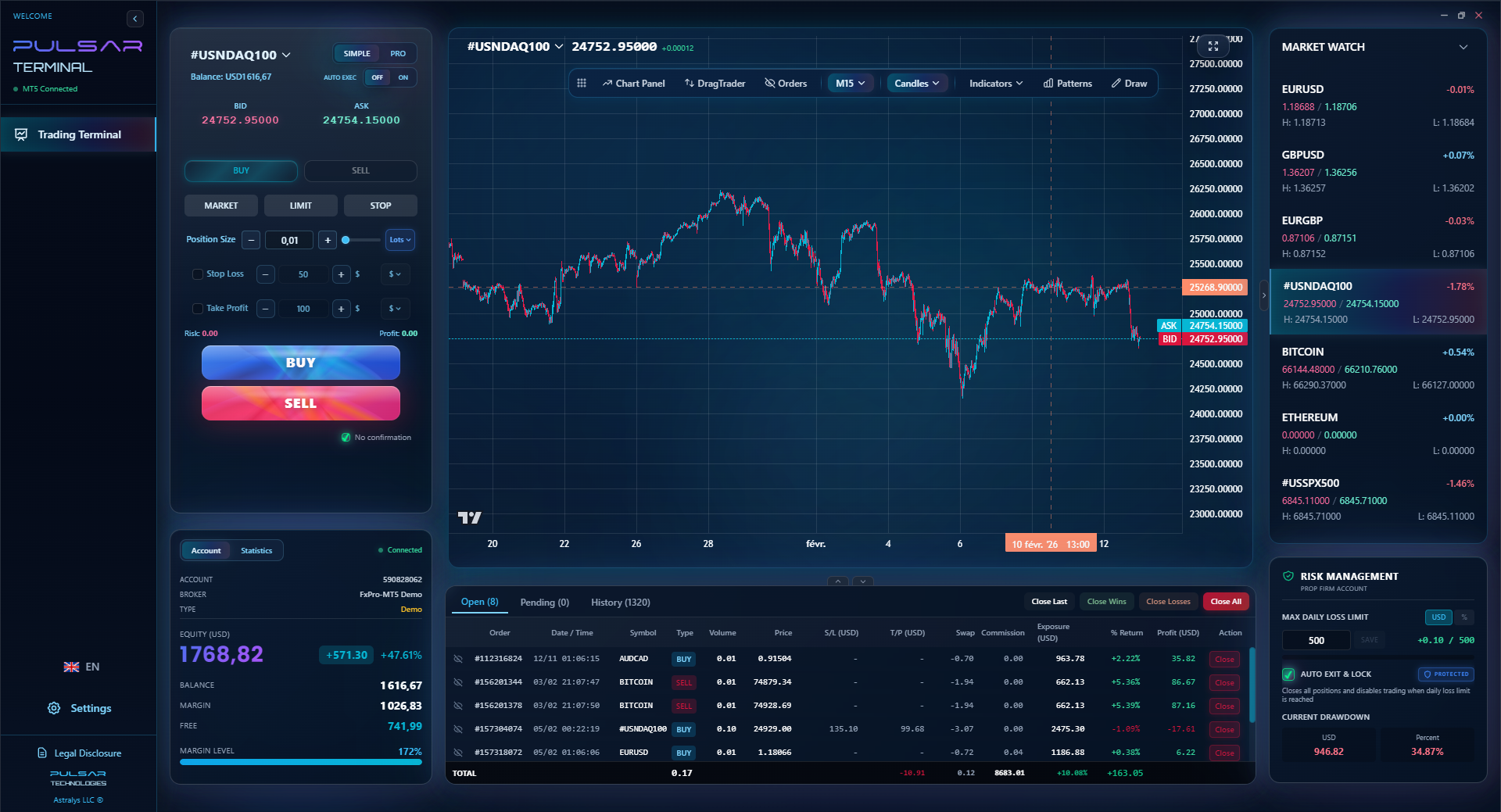
Managing the risk of your trading capital is key, especially when moving it through regulated channels. Pulsar Terminal's prop firm daily loss protection feature automates this safety net directly on your MT5 platform.
Pulsar Terminal
A ferramenta MT5 tudo-em-um: ordens drag-and-drop, multi-TP/SL, trailing stop, grid trading, Volume Profile e proteção prop firm. Usado diariamente por 1.000+ traders.
Are There Cheaper Alternatives? Yes, for certain transactions. Specialized international money transfer services (like Wise, formerly TransferWise) often have better exchange rates and lower fees for person-to-person transfers. However, they usually have lower limits per transaction and may not handle the full complexity or large amounts of SARB-compliant investment allowances. For moving trading capital, I've found the direct broker-to-bank (via Absa) method is still the most strong, even if not the cheapest on fees.
The Rand in 2025/2026: Keep an Eye Out Your timing matters. In 2024, we saw the Rand swing from R19/$ to R17/$ after the elections. For 2025, expect volatility. Global risk, China's economy, and US policy will whip it around. If you're converting a large lump sum, consider a forward contract through Absa. This locks in an exchange rate for a future date (up to 12 months). It costs a bit but removes the risk of the Rand weakening before your payment is due. It's a hedging tool, not a speculative one.
My Final Take Absa Bank forex branches are a necessary piece of infrastructure for the serious South African trader or investor with international ambitions. They are not competitive for trading, but they are essential for the legal movement of capital under SARB's strict regime.
Use them strategically: online for low-cost compliance, for receiving overseas profits, and for accessing your allowances. Pair them with a proper FSCA-regulated broker for the actual trading. Understand the fees, respect the regulations, and never underestimate the paperwork. They're a gatekeeper, not a genie. Use them as such, and you can build a legitimate, global trading operation right from South Africa.
Remember, the goal isn't to avoid the system, but to navigate it efficiently so you can focus on what actually makes money: your trading decisions. Now go check your position size calculator before your next trade, and leave the SWIFT transfers to the bankers.
FAQ
Q1Can I trade forex through an Absa Bank forex branch?
No, absolutely not. Absa provides foreign exchange services for international payments, travel money, and transfers under SARB regulations. They are not a forex broker. You cannot open a leveraged trading account, use MT4/MT5, or place speculative trades on currency pairs through them.
Q2What is the difference between Absa's online and in-branch forex fees?
The difference is significant. Online, the commission is 0.55% (min R190) plus a R100 fee. In-branch, it's 0.75% (min R260) plus a R190 fee. For a typical transfer, going to a branch can cost you over 50% more. Absa themselves advise customers to use online channels.
Q3How much money can I send overseas from South Africa through Absa?
As a resident, you have a combined annual limit of R11 million. This consists of a R2 million Discretionary Allowance (no SARS clearance needed) and a R10 million Foreign Investment Allowance (requires a SARS Tax Compliance PIN). Any transfer will count against these allowances.
Q4Why does my international transfer via Absa take so long?
Two reasons: Compliance and processing. First, Absa must verify your documents and ensure the transfer complies with SARB rules, which can take 1-3 days. Second, the actual SWIFT network payment can take another 2-5 business days depending on the destination, currencies, and correspondent banks involved.
Q5Can I use Absa to fund my international forex trading account?
Yes, but you must use your legal allowances. You would send the money via an international bank transfer (SWIFT) from your Absa account to your broker's client money account. You must declare the purpose as 'investment' or 'trading capital' on the application form. Use your Discretionary Allowance for amounts under R2m.
Q6What's the 'exchange rate margin' and how much is it?
It's the hidden fee. Absa doesn't give you the real market rate; they add a margin on top. For major currencies like USD and EUR, this is typically around 1%. For less common currencies, it can be 2-4%. This cost is built into the rate they offer you and is how they make a significant part of their profit.
Q7What happens if I exceed my annual forex allowance?
Absa will block the transaction. To move more money, you must apply for special approval directly from the South African Reserve Bank (SARB). This is a complex process requiring substantial motivation and documentation, and approval is not guaranteed. It's crucial to plan your large transfers within the annual cycle.
Lição do Prof. Winston
Pontos-chave:
- ✓Use Absa for compliance, not for trading.
- ✓Online transfers cost 55% less than in-branch.
- ✓The real exchange rate margin is a hidden 1-4% fee.
- ✓Your annual limit is R11m: R2m discretionary, R10m with SARS PIN.
- ✓Always have proof of source and purpose ready.
Quão útil foi este artigo?
Clique em uma estrela
Insights de Trading Semanal
Análises e estratégias semanais grátis. Sem spam.
Sobre o autor
David van der Merwe
Trader de Mercados Emergentes
Trader sediado em Joanesburgo com 11 anos em moedas de mercados emergentes. Especialista em pares ZAR, trading regulado pela FSCA e análise do mercado sul-africano.
Comentários
Aviso de risco
A negociação de instrumentos financeiros envolve riscos significativos e pode não ser adequada para todos os investidores. O desempenho passado não garante resultados futuros. Este conteúdo é apenas para fins educacionais e não deve ser considerado aconselhamento de investimento. Sempre conduza sua própria pesquisa antes de negociar.
Você também pode gostar

Cara Trading Forex Sukses: 7 Prinsip dari Trader Profesional
Cara trading forex sukses dengan 7 prinsip trader pro: manajemen modal, disiplin, journal trading, backtest. Data nyata, bukan janji profit palsu.
Jam Trading Forex Terbaik untuk Trader Indonesia: Panduan Lengkap dengan Tabel Waktu
Panduan jam trading forex untuk trader Indonesia. Tabel 4 sesi dunia, jam emas 20:00-00:00, sesi mana yang harus dihindari. Data akurat + tips dari trader berpengalaman.
Top 5 Sàn Forex Uy Tín Nhất 2026: Review Jujur dari Trader Indonesia
Top 5 sàn forex uy tín 2026 untuk trader Indonesia. Review jujur: spread, deposit, withdraw, dukungan lokal. Exness, XM, IC Markets & lebih.
Obter Pulsar Terminal
Todas essas calculadoras estão integradas ao Pulsar Terminal com dados em tempo real da sua conta MT5.
Obter Pulsar Terminal