


I was staring at my Absa online banking screen in late 2022, trying to move R50,000 into a USD trading account.

David van der Merwe
Trader de Mercados Emergentes ·  South Africa
☕ 12 min de leitura
O que você vai aprender:
- 1What You're Actually Looking At
- 2The Fee Structure: Where Your Money Disappears
- 3SARB Regulations: The Invisible Fence
- 4Trading? You're in the Wrong Place
- 5A Step-by-Step Guide for South African Traders
- 6Mistakes I've Seen (And Made)
- 7When Using Absa Forex Rates Actually Makes Sense
- 8The Bottom Line for Traders
I was staring at my Absa online banking screen in late 2022, trying to move R50,000 into a USD trading account. The quoted rate for USD/ZAR was 17.85. I pulled up the live interbank rate on my trading terminal: 17.62. That 23-cent difference wasn't just a spread; it was a 1.3% haircut before my trade even started, plus a R290 fee. That moment crystallized the real cost of using a retail bank for forex access. If you're looking at Absa forex rates for trading or transfers, you need to understand what you're really paying for and where the alternatives are.
When you check Absa forex rates, you're not looking at a trading price. You're looking at a retail buy/sell quote with a built-in profit margin for the bank. It's the financial equivalent of walking into a currency exchange booth at the airport. The rate is derived from the interbank market (the real wholesale price), but then Absa adds a margin, typically between 1.2% and 4%. For major pairs like USD/ZAR or EUR/ZAR, it's usually on the lower end, maybe 1-1.5%. For exotic currencies or smaller amounts, that margin balloons.
They update these rates throughout the day, but not tick-for-tick like a live market. There's a lag. If the ZAR is crashing, their system might be slower to adjust the sell rate (when you're buying USD), protecting their book. I've seen this delay cost clients hundreds of rands on a single transfer.

Warning: The rate you see online is often a 'indicative' rate. The final rate is applied at the time of transaction processing, which could be hours later. That's a hidden risk if the market is moving.
The service isn't designed for active trading. It's for necessity: sending money overseas, paying for imports, or getting travel cash. If you try to use it for speculative gains, the fees and margins will eat any potential profit. For actual trading, you need a different setup entirely, which we'll get to. First, let's break down the real cost structure.

💡 Dica do Winston
Your bank's forex desk is a shop, not a market. You buy retail, you sell retail. The spread is their rent.
This is where most people get blindsided. The exchange rate margin is just one part. The official fees are a maze of percentages and minimums. Let's use that R50,000 transfer to USD as an example, assuming a USD/ZAR rate of 18.00.
The Obvious Fees:
- Commission: 0.55% of the amount. That's R275.
- Electronic Fee: A flat R100.
- Total Direct Fees: R375.
The Hidden Cost (The Margin): If Absa's margin is 1.2% on the rate, and the real mid-market rate is 18.00, they might quote you 18.216 (18.00 * 1.012).
- Real Value of R50,000 at mid-market: R50,000 / 18.00 = $2,777.78
- What you actually get at Absa's rate: R50,000 / 18.216 = $2,744.80
- Loss from the margin: $32.98. At the 18.00 rate, that's R593.64.
📊 Example: Your total cost isn't R375. It's R375 + R593.64 = R968.64. You lost nearly 2% of your capital before it left South Africa. On a R1 million discretionary allowance transfer, that's R20,000 gone to fees and margin. That's a decent car deposit.

Pro Tip: Always calculate the total cost in percentage terms: (Fees + Loss from Margin) / Total Amount. If it's over 1.5% for a major currency, you're probably getting a bad deal. For smaller amounts under R10,000, the minimum fees make the percentage cost horrific, sometimes 5% or more. Consider alternatives like Wise (formerly TransferWise) for pure transfers.
And this is just for sending. Receiving international funds has its own fee schedule. If you're a freelancer getting paid in USD, those fees chip away at your income every single month. It adds up to a massive annual drag.


“Your first mission isn't beating the forex market; it's minimizing the structural drag of getting your capital there.”
You can't talk about Absa forex rates or any forex activity in South Africa without the Reserve Bank (SARB) and the Financial Sector Conduct Authority (FSCA) in the room. This isn't bureaucratic noise; it's the framework that dictates what you can and cannot do. Ignoring it is how you get your account frozen or face penalties.
The Allowances: Your Annual Limits
Every South African resident has a hard annual limit for moving money offshore. This is the single biggest constraint for traders and investors.
| Allowance Type | Amount | Requirement |
|---|---|---|
| Single Discretionary Allowance (SDA) | R1 million per calendar year | No tax clearance needed. Use it for travel, gifts, online shopping. |
| Foreign Investment Allowance (FIA) | R10 million per calendar year | Requires a Tax Compliance Status (TCS) PIN from SARS. This is for investments, including funding offshore trading accounts. |
| Total Potential | R11 million | If you're tax compliant. |
Absa, or any authorized dealer, will ask for your TCS PIN for anything over R1 million. I've had clients hit their SDA limit by October and then be stuck, unable to fund a trading opportunity in November. Plan your funding moves early in the year.
The Legal Grey Areas
Forex trading itself is legal and regulated by the FSCA. However, using your bank to constantly transfer small amounts to an offshore broker can raise red flags for "illegal capital flight." The system is designed for occasional large transfers, not frequent, trade-like movements. I made this mistake early on, moving R20,000 a month to a broker. By the third month, Absa's compliance department called asking for proof of the broker's license and the purpose of the transfers. It was a hassle.
Also, remember: It is illegal to use a credit card to fund a leveraged trading account. That's a fast track to a margin call and debt. Always use cleared, disposable capital.
💡 Dica do Winston
That R11 million annual allowance is your oxygen tank for offshore opportunity. Plan its use like a military campaign, not a weekend braai.
If you're reading this because you want to trade forex - speculate on currency movements for profit - then using Absa forex rates is like trying to win Formula 1 with a family sedan. The tools, costs, and purpose are completely mismatched.
Absa (and any retail bank) is for CONVERSION and TRANSFERS. An FSCA-licensed forex broker is for TRADING.
Let's compare the core mechanics:
- use: Absa offers none for speculative positions. You put down R100,000 to buy $5,555. A broker like IC Markets or Pepperstone might offer 1:30 use (under FSCA rules for retail clients). That means controlling a $166,650 position with the same $5,555 margin. (Risk warning: use magnifies losses equally).
- Spreads & Commissions: Absa's cost is the hidden margin (1%+). A broker's cost is the spread and sometimes a commission. On EUR/USD, Absa's effective spread could be 100-150 pips equivalent. A good broker's spread is 0.8 pips on a standard account, or even 0.0 pips + a $3.50 commission per lot on a raw account. That's a 99% reduction in transaction cost.
- Execution: Banks give you a quoted rate that they control. Brokers give you direct market access (DMA) or straight-through processing (STP) to liquidity pools. Your order is filled at the best available market price. The difference in speed and transparency is night and day.
- Platform: Absa's platform is for admin. A broker provides MetaTrader 4/5, cTrader, or proprietary platforms with charts, indicators like the RSI, and automated trading.
I learned this the hard way. In 2015, I tried to 'trade' by buying USD with ZAR via my bank, waiting for it to strengthen, and selling back. After two rounds, the fees had destroyed my 3% gain. I was just making money for Absa. The moment I switched to a proper broker, I could actually implement a scalping strategy or manage a swing trading plan.
Warning: Not all brokers are equal. You must use one licensed by the FSCA. This ensures client fund segregation, fair practice, and a local legal recourse. Never use an unregulated offshore broker, no matter how attractive their offers seem.

“The difference between a 2% total drag and a 5% drag over a year is the difference between being profitable and blowing up.”
So, you want to trade forex from South Africa. Here’s the efficient, compliant path, using Absa only where it makes sense.
Step 1: Get Your Tax Compliance Status (TCS) PIN. Go onto the SARS eFiling portal and apply for your Tax Compliance Status. Select "Financial Emigration" as the reason (even if you're not emigrating). This is the only category that generates the PIN needed for the Foreign Investment Allowance. Do this before you need it. It can take a few weeks.
Step 2: Choose an FSCA-Licensed Broker. Research is key. Look at XM, Exness, IC Markets, or Vantage. Compare their spreads on the pairs you care about, their deposit/withdrawal methods for SA, and their platform. Open a demo account first. Get a feel for their position size calculator and risk tools.
Step 3: Fund Your Broker Account. This is where Absa comes in. Use your online banking to make an international SWIFT transfer to your broker's client money account.
- Amount: Use part of your R1 million SDA first. For larger amounts, use your FIA and provide your TCS PIN to Absa.
- Purpose: Be truthful. "Investment in a leveraged foreign exchange trading account with [Broker Name], an FSCA-licensed entity." Have the broker's FSP number handy.
- Cost: Accept that you'll pay the Absa margin and fee (the ~2% cost). This is a one-time cost to get your capital into the efficient trading environment. It's worth it.
Step 4: Trade on the Broker Platform. Now you're in the real market. Your costs are the tight spreads. You can use use responsibly. You can set stop-losses and take-profits precisely. Analyze XAU/USD or EUR/USD with proper tools. This is where your skill as a trader matters, not your ability to absorb bank fees.
Step 5: Withdraw Profits. When you withdraw, the broker sends USD (or another currency) back to your Absa account. Absa will convert it to ZAR at their buy rate (again, with a margin). You'll pay a receiving fee. Factor this in when calculating your net profit. Some brokers offer local ZAR withdrawals via EFT, which can be simpler and cheaper.

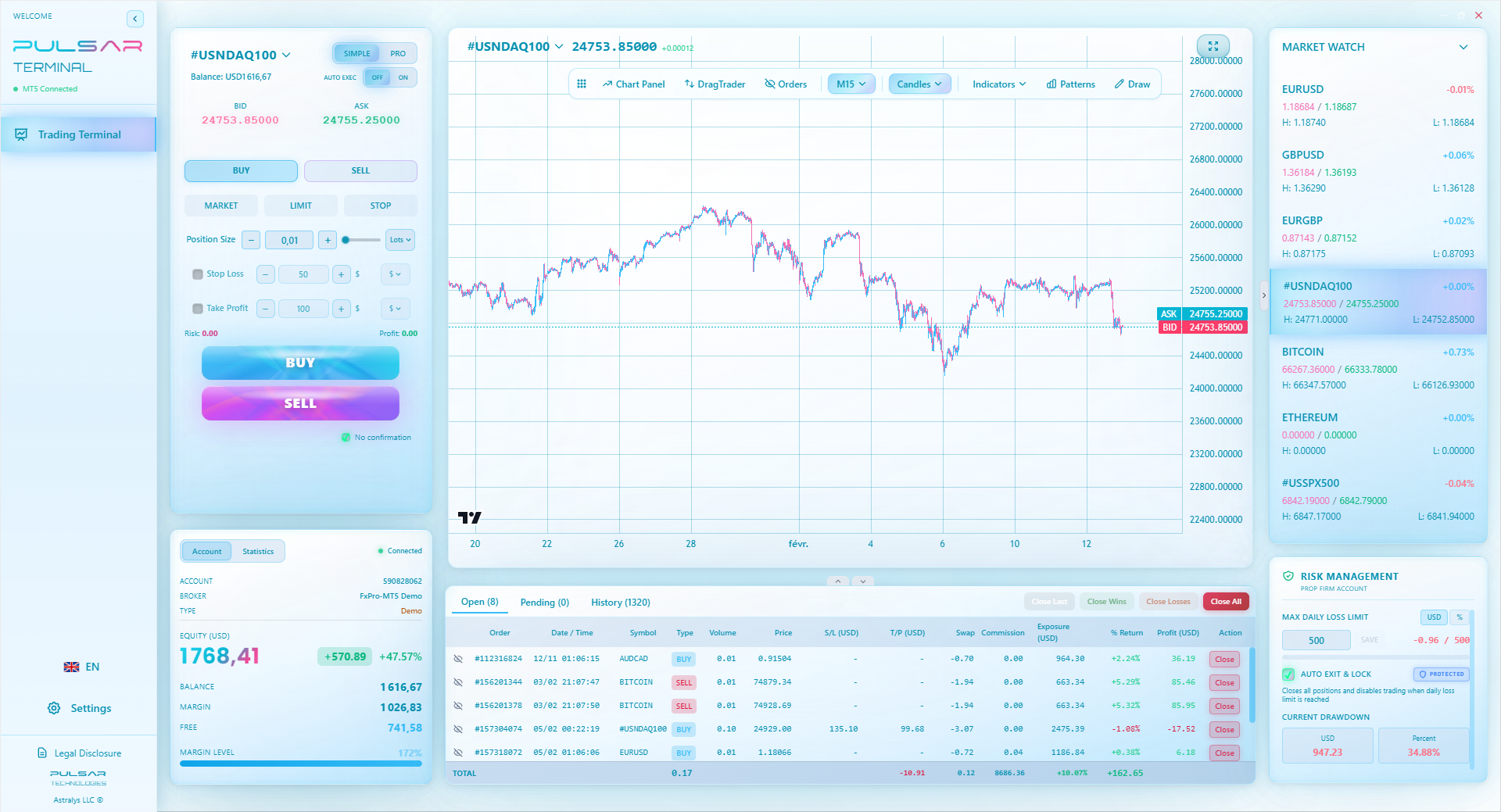
Once your capital is with a broker, managing risk with precise orders and stops is critical, which is where a tool like Pulsar Terminal for MT5 excels.
Pulsar Terminal
A ferramenta MT5 tudo-em-um: ordens drag-and-drop, multi-TP/SL, trailing stop, grid trading, Volume Profile e proteção prop firm. Usado diariamente por 1.000+ traders.
Let's talk about the concrete errors that blow up accounts or attract unwanted attention.
Pitfall 1: Chasing the 'Better' Bank Rate. You see Absa's USD/ZAR at 18.20 and FNB at 18.19. You spend days moving money between banks to save 0.01. It's a waste of energy. The difference is negligible compared to the overall margin. The real savings are in moving from a 1.5% bank margin to a 0.01% broker spread.
Pitfall 2: Ignoring the Annual Allowance. A client of mine aggressively funded his trading in Q1, using his entire R1 million SDA. In September, he had a major life opportunity requiring a USD deposit for an overseas education. He was blocked. He hadn't gotten his TCS PIN for the FIA. He missed out. Always keep a buffer in your SDA for life's unpredictability.
Pitfall 3: Using the Wrong Service for the Job. Trying to buy physical USD cash (at a terrible rate) to 'hold' as a trade. Using a travel card for online forex broker deposits (often blocked). Using a forward cover through Absa for a speculative view (expensive and complex). Keep it simple: Bank for transfers, Broker for trading.
Pitfall 4: Not Accounting for Total Cost. I once calculated a trade needed a 2% move to be profitable based on the broker's spread. I forgot the 1.8% cost of getting the money into the broker and the 1.5% cost of getting it out. The trade needed a 5.3% move just to break even. I lost. Now I use a simple rule: I add 3.5% to any profit target as a 'South African access cost' buffer for any short-term trade. It keeps me realistic.
These pitfalls stem from not having a clear system. A system that separates the currency access problem (solved by your bank, once) from the trading execution problem (solved by your broker, continuously).
💡 Dica do Winston
The first rule of South African trading: Add 3.5% to your break-even. That's the toll for getting to the battlefield.

“You're not paying for competitive market access at a bank. You're paying for the convenience, security, and regulatory compliance.”
I'm not saying never use Absa. I use them myself for specific, non-trading purposes. Here’s when their service is the right tool:
- Funding Your Initial Trading Account: As outlined, it's the compliant, documented path. Bite the bullet on the fee once.
- Receiving Large International Payments: If a client wires you $10,000, it's going to land in your Absa USD Nostro account. You'll pay a receiving fee, but it's straightforward.
- Forward Cover for a Known Business Expense: If you're an importer and know you need to pay $100,000 to a supplier in 90 days, you can book a forward contract with Absa at a fixed rate. This eliminates currency risk for a business transaction. This is hedging, not speculation.
- Physical Cash for Travel: Ordering USD or EUR notes for a trip. Their delivery service for orders over R30,000 is convenient. Just don't think of this as an investment.
- Regular Small Offshore Subscriptions: Paying for Netflix, a software SaaS, or a foreign magazine. The Visa/Mastercard conversion happens automatically at their rate, which is usually reasonable for tiny amounts.
The common thread? Certainty and necessity. You're paying for the convenience, security, and regulatory compliance of a major bank. You're not paying for competitive market access. Know which product you're buying.
Absa forex rates are a retail utility, not a trading instrument. The margin they add is the price of that utility: safe, regulated, easy currency conversion within the SARB framework.
For a South African trader, this creates a foundational cost of doing business. Your first mission isn't beating the forex market; it's minimizing this structural drag. That means:
- Getting your SARS tax affairs in perfect order for your TCS PIN.
- Choosing an efficient, FSCA-licensed broker with tight spreads.
- Making fewer, larger transfers to your broker to amortize the fixed bank fees.
- Factoring in a ~3.5% round-trip cost (in/out) when assessing potential trading returns.
If you try to trade around these realities, you'll lose. If you accept them as the cost of entry and then focus on executing flawlessly in the real market with proper tools, you have a fighting chance. The difference between a 2% total drag and a 5% drag over a year is the difference between being profitable and blowing up. It's that simple. Don't let the convenience of your online banking portal fool you into thinking you're in the trading game. You're not. You're just buying a ticket. The game is somewhere else entirely.
FAQ
Q1What is the difference between Absa's forex rate and the market rate?
Absa's rate is the interbank market rate plus a margin (typically 1.2%-4%). The market rate is the wholesale price banks trade at. The difference is Absa's profit on the conversion. For a USD/ZAR trade, this can mean you get 1-1.5% less currency than you would at the true market price.
Q2Can I trade forex through my Absa account?
Not in the speculative sense. You can convert currency, but there's no use, charts, or real-time execution. It's designed for transfers, not trading. For active trading, you must use an FSCA-licensed forex broker which provides proper trading platforms and leveraged products.
Q3How much can I send overseas from South Africa per year?
As a tax-compliant resident, you can send up to R1 million as a Single Discretionary Allowance (no clearance) and an additional R10 million as a Foreign Investment Allowance (requires a SARS Tax Compliance Status PIN). Total: R11 million per calendar year.
Q4Are there cheaper ways to send money abroad than using Absa?
Yes, for pure transfers (not trading), specialized services like Wise or CurrencyFair often offer rates much closer to the mid-market with lower transparent fees. Always compare the total amount of foreign currency received after all costs.
Q5What do I need to send more than R1 million offshore?
You need a valid Tax Compliance Status (TCS) PIN from SARS. You apply via eFiling, select 'Financial Emigration' as the reason, and provide this PIN to Absa when authorizing the transfer under your Foreign Investment Allowance.
Q6Is it legal to fund an international forex broker from South Africa?
Yes, but only with an FSCA-licensed broker. You must use your annual allowances (SDA or FIA). It is illegal to use a credit card or to use an unregulated broker. Always ensure your broker is properly licensed.
Q7Why are the fees so high for small transfers?
Banks have high minimum fees (e.g., R190) to cover fixed processing costs. On a R1,000 transfer, a R190 fee is 19%. This makes small transfers extremely expensive percentage-wise. Use alternative services or consolidate small amounts into larger transfers.
Lição do Prof. Winston
Pontos-chave:
- ✓Bank forex margins cost 1.2-4% per conversion.
- ✓Annual offshore limit: R1m (SDA) + R10m (FIA with TCS PIN).
- ✓Factor in a 3.5% round-trip cost for trading.
- ✓Use banks for transfers, brokers for trading.
- ✓FSCA license is non-negotiable for brokers.
Quão útil foi este artigo?
Clique em uma estrela
Insights de Trading Semanal
Análises e estratégias semanais grátis. Sem spam.
Sobre o autor
David van der Merwe
Trader de Mercados Emergentes
Trader sediado em Joanesburgo com 11 anos em moedas de mercados emergentes. Especialista em pares ZAR, trading regulado pela FSCA e análise do mercado sul-africano.
Comentários
Aviso de risco
A negociação de instrumentos financeiros envolve riscos significativos e pode não ser adequada para todos os investidores. O desempenho passado não garante resultados futuros. Este conteúdo é apenas para fins educacionais e não deve ser considerado aconselhamento de investimento. Sempre conduza sua própria pesquisa antes de negociar.
Você também pode gostar

Cara Trading Forex Sukses: 7 Prinsip dari Trader Profesional
Cara trading forex sukses dengan 7 prinsip trader pro: manajemen modal, disiplin, journal trading, backtest. Data nyata, bukan janji profit palsu.
Jam Trading Forex Terbaik untuk Trader Indonesia: Panduan Lengkap dengan Tabel Waktu
Panduan jam trading forex untuk trader Indonesia. Tabel 4 sesi dunia, jam emas 20:00-00:00, sesi mana yang harus dihindari. Data akurat + tips dari trader berpengalaman.
Top 5 Sàn Forex Uy Tín Nhất 2026: Review Jujur dari Trader Indonesia
Top 5 sàn forex uy tín 2026 untuk trader Indonesia. Review jujur: spread, deposit, withdraw, dukungan lokal. Exness, XM, IC Markets & lebih.
Obter Pulsar Terminal
Todas essas calculadoras estão integradas ao Pulsar Terminal com dados em tempo real da sua conta MT5.
Obter Pulsar Terminal