


Here's a fact that might surprise you: the South African forex market moves over R400 billion every single day.

David van der Merwe
Trader de Mercados Emergentes ·  South Africa
☕ 10 min de leitura
O que você vai aprender:
Here's a fact that might surprise you: the South African forex market moves over R400 billion every single day. Yet, most new traders here lose money chasing the wrong pairs at the wrong time. The 'best' market isn't just about popularity, it's about finding the right fit for your schedule, your capital, and your nerves. I've traded them all from my flat in Cape Town, and I can tell you, picking the right battlefield is half the fight won.
Choosing where to trade is more important than your strategy. Seriously. A perfect setup on a dead, illiquid pair is just a pretty picture. In South Africa, we have unique advantages and pitfalls. Our time zone (SAST) gives us a front-row seat to the London open and the US lunch hour, which are goldmines for activity. But if you're trading Asian pairs at 2 AM, you're basically gambling against robots with wider spreads.
The local regulator, the FSCA, caps use at 30:1 for retail traders. That's a good thing for your safety, but it also means you can't just throw a tiny account at a slow-moving pair and expect big returns. You need markets with enough natural movement to work with that sensible use. Your goal is to find the sweet spot: enough volatility to create opportunities, but enough liquidity so you can get in and out without the price slipping away from you. It's the difference between swimming in a calm ocean and trying to surf in a kiddie pool.

Warning: Don't confuse 'volatile' with 'good to trade'. USD/ZAR can move 500 pips in a day, which is fantastic if you're on the right side. It's a nightmare if your risk management is off. A volatile market will find and exploit every weakness in your plan.
“The 'best' market isn't about popularity, it's about the right fit for your schedule, your capital, and your nerves.”
Let's get specific. Based on liquidity, accessibility, and our local context, these are the markets you should have on your watchlist.
The Majors: Your Reliable Workhorses
These are the most traded pairs globally: EUR/USD, USD/JPY, GBP/USD, USD/CHF, AUD/USD, USD/CAD, NZD/USD. Their biggest advantage? Incredible liquidity. The spread on EUR/USD can be as low as 0.1 pips on a good ECN account. That means your trade starts in profit almost immediately. I built my first consistent account trading almost exclusively EUR/USD during the London-New York overlap. The moves are clean, the news is plentiful, and everyone is watching it. It's a great place to learn price action. For a deep dive on trading this pair, check out our EUR/USD guide.
The ZAR Pairs: Home Ground Advantage
This is where we have an edge. While the world sleeps, we're watching our own currency. USD/ZAR is the king here. It's liquid, volatile, and reacts strongly to local politics, commodity prices (like platinum and gold), and US dollar strength. I remember shorting USD/ZAR at 18.75 back in 2023 after a SARB rate decision, riding it down to 18.20. The 550-pip move was a thing of beauty, but it required staying up late for the US session. Other ZAR pairs like EUR/ZAR and GBP/ZAR are less liquid but can offer fantastic swing trading opportunities over days or weeks.
Commodity Currencies & Gold
Given our economy, pairs like AUD/USD (linked to mining) and USD/CAD (oil) often correlate with ZAR sentiment. But the real star for many South Africans is XAU/USD (Gold). It's not a forex pair technically, but it's traded the same way. Gold often moves inversely to the US dollar and is a classic safe-haven. When global panic hits, gold tends to rise. It's a fantastic diversifier for a forex portfolio. We have a dedicated guide on mastering XAU/USD.
Here’s a quick comparison of what you’re dealing with:
| Market | Typical Spread (SAST Day) | Key Trait | Best For |
|---|---|---|---|
| EUR/USD | 0.1 - 1.2 pips | High Liquidity | All traders, especially scalpers & beginners |
| USD/ZAR | 50 - 150 pips | High Volatility | Experienced traders, swing traders |
| XAU/USD | 20 - 50 cents | Safe-Haven | Portfolio diversification, trend followers |
| AUD/USD | 0.5 - 1.5 pips | Commodity-Linked | Traders watching Asian/Chinese data |

Pro Tip: Open a demo account with a broker like Pepperstone or IC Markets and track these pairs for a week. Don't trade. Just watch how they move at 10:00 SAST (London open) versus 22:00 SAST (Asian session). You'll learn more than from any book.

💡 Dica do Winston
A market's 'personality' is defined by its average daily range. Know it for your chosen pair. Trading EUR/USD expecting a 200-pip day is as foolish as trading USD/ZAR expecting a 50-pip day.
“Trading the right market at the wrong time is like trying to buy fresh bread at midnight.”
Your clock is a profit predictor. Trading the right market at the wrong time is like trying to buy fresh bread at midnight.
The magic hours are 10:00 to 19:00 SAST. This covers the entire London session and the first few hours of New York. Liquidity is high, spreads are tight, and real moves happen. The absolute peak is the 2-hour overlap between London and New York (roughly 15:00-17:00 SAST). This is when I place most of my intraday trades. The volume is insane.
From about 19:00 SAST, New York traders start going home, and the market slowly dies. The Asian session (from around 01:00 SAST) is quieter. It can be good for certain pairs like USD/JPY or AUD/USD, but the ranges are often smaller. As a beginner, focus your screen time and energy on the London and overlap sessions. It’s far more efficient.
I learned this the hard way. I used to sit up until 2 AM trying to scalp the Asian session, bleary-eyed and making rushed decisions. My profitability didn't improve until I restricted my active trading to a focused 4-hour window in the afternoon. The rest of the time is for analysis, planning, and living your life.
“Trading the right market at the wrong time is like trying to buy fresh bread at midnight.”
Let's talk about the silent profit killer: costs. That ‘zero spread’ ad isn't the whole story.
Spreads & Commissions: This is your direct trading cost. On a major like EUR/USD, a good Raw/ECN account might charge a 0.1 pip spread plus a commission of $7 per lot round-turn. On USD/ZAR, the spread is your main cost - it can be 100 pips (about R100 per standard lot). You need a much bigger price move just to break even. Always use a position size calculator that includes spread cost in your risk. It changes everything.
Swap Rates (Overnight Fees): If you hold a trade past 22:00 SAST (the broker's rollover time), you'll pay or receive a swap. It's based on interest rate differentials. Holding a ZAR short position (like in USD/ZAR) often means paying a negative swap because of South Africa's higher interest rates. This can eat into a long-term trade. Check your broker's swap sheet.
The Tax Man (SARS): This is non-negotiable. Profits from forex trading are viewed as income, not capital gains, if you're trading frequently. You must declare it. Keep careful records: every trade statement from your broker, all bank statements showing deposits and withdrawals. I use a simple spreadsheet logging date, pair, P/L, and a running total. When SARS asks, you need to be ready. I know traders who've had to pay back-taxes plus penalties because they thought offshore profits were invisible. They're not.
💡 Dica do Winston
Your most important tool isn't an indicator; it's your broker's economic calendar. Schedule your screen time around high-impact news events for your traded pair. Volatility is opportunity, but only if you see it coming.
“High volatility demands smaller position sizes, not bigger bets.”
Your broker and platform are your connection to these markets. A bad connection loses you money.
Regulation is Safety: Only use brokers regulated by the FSCA. It ensures client fund segregation and gives you a local recourse if things go wrong. Some international brokers like Exness and XM also have FSCA licenses, which is a good sign. Always verify the FSP number on the FSCA website.
Platform Choice: MetaTrader 5 (MT5) is becoming the new standard over MT4. It has more timeframes, a better economic calendar, and allows hedging. cTrader is fantastic for its clean execution and transparency. Your broker matters here - some like FP Markets offer great pricing on MT5, while others have their own platforms.
Minimum Deposits: You can start with as little as $5 (XM) or $10 (Exness), but be realistic. With R1,000 and 30:1 use, your room for error is tiny. I advise a starting capital of at least R5,000 to R10,000. This lets you trade sensible position sizes and survive the inevitable losing streaks without an immediate margin call.

Example: You have R10,000. You risk 1% (R100) per trade on USD/ZAR. With a typical stop-loss of 200 pips, your position size is R100 / 200 pips = R0.50 per pip. On USD/ZAR, 1 standard lot is roughly R1000 per pip. So you'd trade 0.05 lots. That's sensible. With R500, you'd be trading 0.0025 lots - most brokers don't even allow that size.
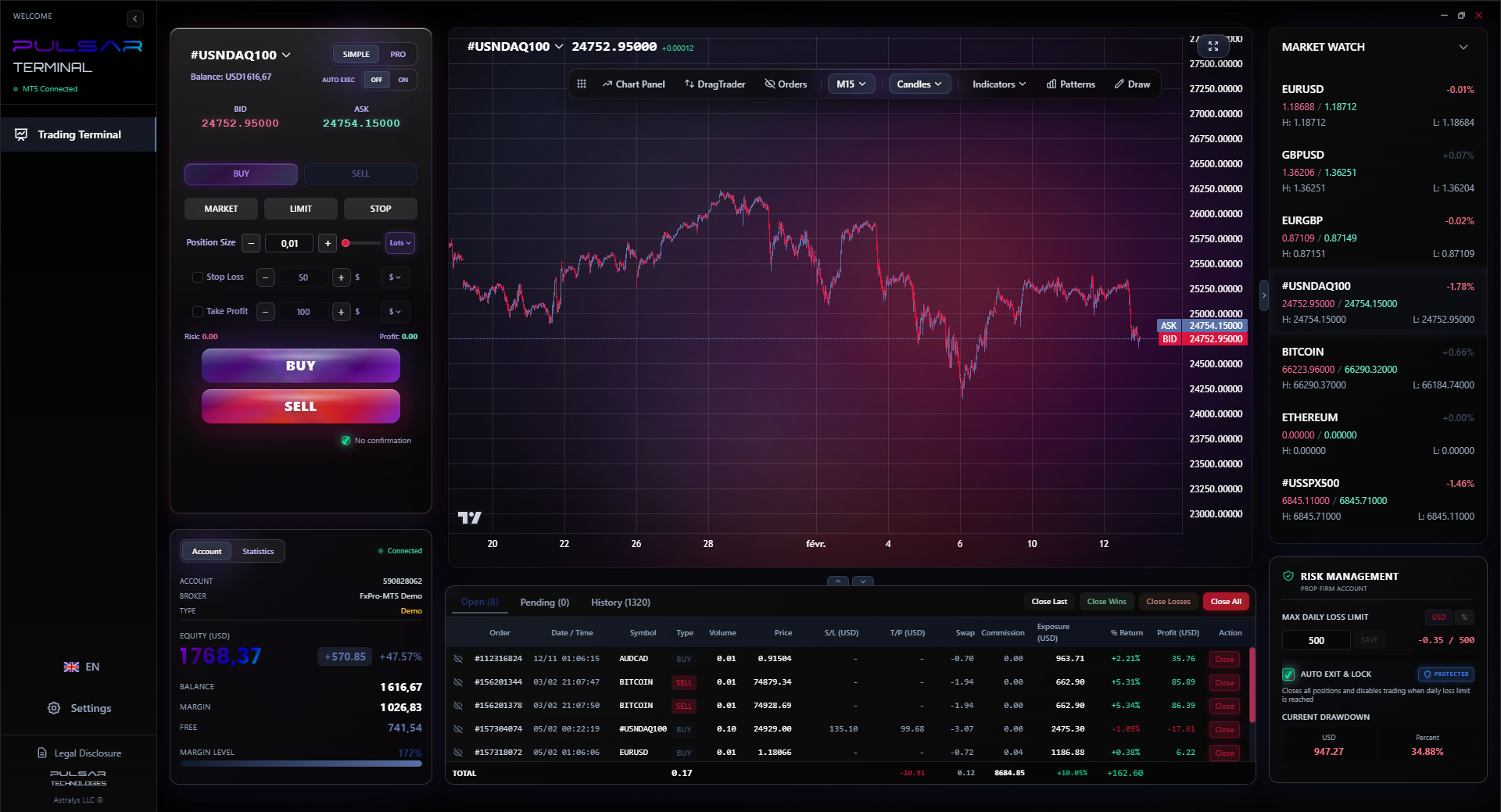
Managing multiple trades and setting precise stops on volatile pairs like USD/ZAR is critical, and Pulsar Terminal automates this with advanced order types directly on your MT5 platform.
Pulsar Terminal
A ferramenta MT5 tudo-em-um: ordens drag-and-drop, multi-TP/SL, trailing stop, grid trading, Volume Profile e proteção prop firm. Usado diariamente por 1.000+ traders.
“High volatility demands smaller position sizes, not bigger bets.”
Let me be the cautionary tale. We all make mistakes, but you can avoid these classics.
Chasing ZAR Volatility with a Tiny Account: My first big blow-up was in EUR/ZAR. I saw a 300-pip drop, threw my R2,000 account at it with max use, trying to catch the bounce. It dropped another 400 pips. I was wiped out before it even thought about reversing. High volatility demands smaller position sizes, not bigger bets.
Ignoring the Spread on Exotics: I once took a ‘cool’ trade on USD/TRY (Turkish Lira). I made 150 pips and was thrilled. Then I realized the spread was 120 pips. My ‘win’ was basically just covering costs. Know the typical spread of your chosen pair before you enter.
Overtrading the Quiet Hours: Boredom is not a trading signal. Just because the market is open doesn't mean you should be in a trade. The Asian session lull is for planning, not forcing low-probability setups.
Neglecting the Macro for South Africa: Trading USD/ZAR without an eye on SA politics, SARB statements, or commodity prices is like driving blindfolded. Local news at 14:00 SAST can cause a bigger move than US data at 16:00. Do your homework.
💡 Dica do Winston
The spread is the admission fee to the casino. If the fee is 20% of your expected profit, find a different game. Always calculate break-even including costs.
“Your psychology will point you to your best market.”
Here's a concrete plan to find your best market.
- Open Two Demos: One with a major-focused broker (like IC Markets) and one with a broker known for good ZAR pricing. Practice in both environments.
- Observe: For two weeks, just watch. Track EUR/USD and USD/ZAR from 09:30 to 18:00 SAST. Note the spread at different times, the speed of moves after news, and when it goes flat.
- Paper Trade: Pick ONE market. Maybe EUR/USD. Use your demo and pretend with real emotion. Risk your ‘virtual’ 1% per trade. Try a simple strategy based on RSI indicator divergence or MACD indicator crossovers. Do this for 50 trades. Log every single one.
- Analyze Your Log: Are you better at fast scalping or holding swings? Did you panic during USD/ZAR's wild moves but stay calm with EUR/USD? Your psychology will point you to your best market.
- Go Live Small: Fund a live account with an amount you can afford to lose. Take your best-performing setup from demo and trade it with one-tenth of your intended position size. The goal is to feel real money, not to get rich.
The best market to trade forex is the one that aligns with your personality, your schedule, and your risk tolerance. For many South Africans, that's a mix: the steady flow of EUR/USD for consistent practice, and the occasional, well-researched swing in USD/ZAR for bigger opportunities. Master one at a time. The market isn't going anywhere.
FAQ
Q1Is forex trading legal in South Africa?
Yes, it's completely legal. You must trade with a broker licensed by the Financial Sector Conduct Authority (FSCA) for proper protection. Trading with unregulated offshore brokers is risky and complicates tax matters with SARS.
Q2What is the best currency pair for beginners in South Africa?
Start with EUR/USD. It has the lowest spreads, massive liquidity, and tons of free educational material. It's the cleanest chart to learn price action. Avoid ZAR pairs like USD/ZAR as a beginner - the high volatility and wide spreads will amplify your mistakes.
Q3How much money do I need to start trading forex in South Africa?
You can technically start with $5. But to trade properly with sensible risk management, a minimum of R5,000 is a more realistic starting point. This allows you to risk 1% (R50) per trade and survive a series of losses without blowing your account.
Q4When is the most profitable time to trade forex in SA?
The most active and profitable window is between 10:00 and 19:00 SAST, covering the London session and the early New York session. The peak is the London-New York overlap from about 15:00 to 17:00 SAST.
Q5Do I pay tax on forex trading profits in South Africa?
Yes. SARS views frequent trading profits as ordinary income. You must declare your net profit (total profits minus total losses) on your annual tax return. Keep detailed records of all trades, deposits, and withdrawals.
Q6What use can I use in South Africa?
The FSCA caps use at 30:1 for retail traders. Some brokers may offer higher use to clients who qualify as 'professional traders' based on experience and financial knowledge, but 30:1 is the standard retail limit.
Q7Can I trade gold (XAU/USD) with a forex broker?
Absolutely. Most major forex brokers offer CFDs on Gold (XAU/USD). It's traded similarly to forex pairs and is a popular instrument for South African traders looking to diversify away from pure currencies.
Lição do Prof. Winston
Pontos-chave:
- ✓Master EUR/USD first; its liquidity forgives beginner errors.
- ✓Trade USD/ZAR only with a clear macro thesis, not on a whim.
- ✓Limit active trading to the 10:00-19:00 SAST window for efficiency.
- ✓Always include the spread cost in your initial risk calculation.
Quão útil foi este artigo?
Clique em uma estrela
Insights de Trading Semanal
Análises e estratégias semanais grátis. Sem spam.
Sobre o autor
David van der Merwe
Trader de Mercados Emergentes
Trader sediado em Joanesburgo com 11 anos em moedas de mercados emergentes. Especialista em pares ZAR, trading regulado pela FSCA e análise do mercado sul-africano.
Comentários
Aviso de risco
A negociação de instrumentos financeiros envolve riscos significativos e pode não ser adequada para todos os investidores. O desempenho passado não garante resultados futuros. Este conteúdo é apenas para fins educacionais e não deve ser considerado aconselhamento de investimento. Sempre conduza sua própria pesquisa antes de negociar.
Você também pode gostar

Cara Trading Forex Sukses: 7 Prinsip dari Trader Profesional
Cara trading forex sukses dengan 7 prinsip trader pro: manajemen modal, disiplin, journal trading, backtest. Data nyata, bukan janji profit palsu.
Jam Trading Forex Terbaik untuk Trader Indonesia: Panduan Lengkap dengan Tabel Waktu
Panduan jam trading forex untuk trader Indonesia. Tabel 4 sesi dunia, jam emas 20:00-00:00, sesi mana yang harus dihindari. Data akurat + tips dari trader berpengalaman.
Top 5 Sàn Forex Uy Tín Nhất 2026: Review Jujur dari Trader Indonesia
Top 5 sàn forex uy tín 2026 untuk trader Indonesia. Review jujur: spread, deposit, withdraw, dukungan lokal. Exness, XM, IC Markets & lebih.
Obter Pulsar Terminal
Todas essas calculadoras estão integradas ao Pulsar Terminal com dados em tempo real da sua conta MT5.
Obter Pulsar Terminal