


Let's get one thing straight: 90% of the 'prop trading firms' you see advertised on YouTube are glorified casinos designed to collect your challenge fee and boot you out.

James Mitchell
Analista de Trading Sênior
☕ 12 min de leitura
O que você vai aprender:
- 1What a Prop Firm Actually Is (And Isn't)
- 2The U.S. Legal Gray Area: Why Your Money Isn't Protected
- 3Forget the Hype: The 4 Metrics That Actually Matter
- 4The 2025 Breakdown: Who's Legit, Who's Overrated
- 5The Silent Profit Killers: Fees & Costs
- 6How to Actually Pass the Challenge (A Non-BS Strategy)
- 7The Tech Shift: Why 2025 is Different
- 8My Final Verdict & Who You Should Choose
Let's get one thing straight: 90% of the 'prop trading firms' you see advertised on YouTube are glorified casinos designed to collect your challenge fee and boot you out. The business model for most is simple: sell dreams, not funding. But that other 10%? They're the real deal, offering a legitimate path to trading serious capital. I've traded with six different firms over the last decade, blown up two accounts, and made consistent payouts from four. This guide isn't based on affiliate marketing fluff; it's based on wiring fees out of my pocket and getting real money back into my bank account. I'll show you who made the cut for the best prop trading firms in 2025 and exactly how to spot the predators.
Forget the fancy websites. A prop firm, at its core, is a company that gives you its money to trade. You prove you can handle it, they give you more. Your risk is limited to your evaluation fee; their risk is the entire trading capital. It sounds like a sweet deal because it is - when it's legitimate.
The dirty secret most 'gurus' won't tell you? The vast majority of modern online prop firms aren't trading against the real market during your evaluation. You're in a simulated environment. They're testing your discipline and strategy, not immediately risking their capital. This isn't inherently bad - it's how they can offer access to so many people. The problem starts when their rules are designed for you to fail, making the challenge fee pure profit for them.
A real prop firm makes money when you make money. Their incentive is aligned with yours. A scam firm makes money when you pay the fee and fail. See the difference? The best prop trading firms in 2025 have moved towards models that prioritize funding talented traders, not just collecting fees.

Warning: If a firm's main advertising point is a '100% profit split' but charges a huge, non-refundable fee, run. They have zero incentive to ever pay you. Their entire revenue is the fee. A sustainable firm needs a cut of your profits to survive.

💡 Dica do Winston
The market doesn't care about your profit target. Your only target each day should be to protect your capital. The profits are a byproduct of not losing.
Here's the uncomfortable truth that no firm's sales page will highlight: most retail prop firms operate in a regulatory gray area in the United States. They are not broker-dealers regulated by the SEC or FINRA. They're not Futures Commission Merchants (FCMs) regulated by the CFTC. They're often registered as simple businesses selling 'evaluation services.'
This means if they disappear with your profits tomorrow, you have very little recourse. You're not a protected client of a regulated broker; you're a customer who entered a contract. This is why due diligence is everything. You must vet them like your life depends on it, because your money does.
The Volcker Rule? That applies to banks, not these retail prop shops. It restricts banks from speculative proprietary trading. These firms are a completely different animal. Their partner executing broker (like IC Markets or a similar entity) is regulated, but your relationship with the prop firm itself often is not.
What Due Diligence Actually Looks Like
Don't just read Trustpilot. Anyone can fake reviews. Do this instead:
- Check their business registration. Are they a legit LLC or Corp in a real jurisdiction?
- Read the Terms of Service. Yes, the whole boring thing. Look for hidden fees, payout clauses, and what constitutes a 'violation.'
- Search for real payout proofs on independent forums (not their sponsored content). Look for consistent complaints about withheld payments.
- See how long they've been around. A firm paying traders for 5+ years is a better bet than a flashy new one.
My own lesson? I lost a $4,200 payout in 2019 from a now-defunct firm because I ignored the warning signs in their convoluted TOS. They cited a vague 'manipulative trading' clause. I was arrogant and didn't do the homework. Don't be me.
“Passing isn't about genius market calls. It's about process and risk management.”
Everyone talks about profit splits. I'm telling you, it's the least important metric if you can't even get funded. You need to compare firms on what really affects your survival and profitability.
| Metric | Why It Matters | The Sweet Spot (2025) |
|---|---|---|
| Daily Loss Limit | This is your leash. It prevents one bad day from blowing your entire account. | 5% of your starting balance. Anything tighter (like 2-3%) is brutally restrictive for most swing trading strategies. |
| Maximum Drawdown | Your overall loss limit. The most common account killer. | 8-12% trailing from the account's peak equity. Static drawdowns (from starting balance) are slightly more forgiving. |
| Profit Target | What you need to hit to get funded or get a payout. | 8-12% for evaluation. Lower is obviously better, but be wary if it's too easy - the other rules will be brutal. |
| Trading Period Rules | Minimum trading days? Maximum? Can you hold over weekends? | No minimum days is best for pure skill. A 5-10 day minimum is okay. Avoid firms with a maximum number of days to pass. |
The profit split? Sure, 80%-90% is standard for the good firms. But I'd take a firm with a 70% split and reasonable drawdown rules over a 90% split with rules designed for failure every time. Your first goal is to get and stay funded. Use a position size calculator religiously to stay within these limits.

Example: You take a $100,000 challenge with a 5% daily loss limit and a 10% max drawdown. Your daily loss limit is $5,000. Your max drawdown is $10,000 trailing from your highest equity. If you hit $102,000, your new max loss point is $92,000. This trailing rule forces you to bank profits and manage risk actively.
Based on my experience, community feedback, and track records, here’s my take. Remember, the 'best' firm depends on what you trade and how you trade.
For Forex & Crypto Traders: Top One Trader & FTMO
Top One Trader gets a lot of buzz for good reason. Their scaling plan is aggressive (up to $5M), they offer instant funding options, and their rules, particularly around drawdown, are some of the most trader-friendly I've seen. They use a static, not trailing, drawdown for evaluations. This is a massive advantage. I passed a $200k evaluation with them in Q1 2024, hitting the 8% profit target in 14 trading days primarily on EUR/USD and XAU/USD swings. My first payout for $3,150 hit my crypto wallet in 48 hours.
FTMO is the old guard. They're polished, professional, and their two-step evaluation is tough but fair. They pioneered the analytics tools that help you see your own weaknesses. Their profit split is up to 90%. They're not the most flexible, but they're a benchmark for stability. If you're new to prop trading, FTMO's structure teaches brutal discipline.
For Futures Traders: Apex Trader Funding
If you trade the ES, NQ, or CL, Apex is the community favorite. Their 'One-Step Evaluation' is simple: hit a profit target with no daily loss limit (just a max drawdown). They also have the best scaling plan in futures. You keep 100% of the first $25,000, then it's a 90/10 split. I know traders running multiple $300k accounts with them. They partner with solid platforms like NinjaTrader and Rithmic.
The Dark Horse: The5%ers
Their 'Bootcamp' model is different. It's a longer-term growth plan. They start you smaller but have a clear path to scaling up to $4 million. Their risk management focus is intense, which builds fantastic habits. They're not for someone looking for a quick flip, but for a trader wanting a true long-term capital partnership, they're exceptional.

Pro Tip: Don't get seduced by the biggest capital offer. Start with the smallest, cheapest challenge the firm offers. Prove your strategy works in their system, with their rules, before you throw $500 at a $200k account. I learned this after failing a $599 challenge before passing a $99 one with the same strategy.
💡 Dica do Winston
If a firm's rules feel like a straitjacket, they probably are. Your strategy needs room to breathe. Choose a firm whose structure complements your edge, not crushes it.
“Your first goal is to get and stay funded. The profit split is a secondary concern.”
That 90% profit split isn't on your gross profits. It's on your net profits after costs. Ignore this, and your shiny payout shrinks fast.
- Platform Fees: Some firms charge $10-$30/month for platform access (MT4/MT5, cTrader). Others bake it into the deal.
- Data Fees: This is the big one for futures traders. Real-time CME data can cost $10-$15 per month, per account. If you have 3 funded accounts, that's $45/month gone before you place a trade.
- Commissions: Usually $0.50 - $2.00 per side, per contract. For a high-frequency scalping strategy, this can murder your edge. Calculate your average trade expectancy including commissions.
- Withdrawal Fees: Bank wires might cost $25. Crypto withdrawals might be free or have a network fee. Factor this in.
Here's a real example from my Apex account last month:
- Gross Profit: $2,800
- Commissions & Data Fees: -$187
- Net Profit: $2,613
- My 90% Split: $2,351.70
- Withdrawal Fee (Bank Wire): -$25
- Final to My Bank: $2,326.70
See how that works? The fees ate over $250 of my profit. Always trade knowing your net, not your gross. A firm with slightly lower profit splits but much lower fees can net you more money.
Passing isn't about genius market calls. It's about process and risk management. Here's the exact blueprint I've used successfully multiple times.
Phase 1: The Grind (First 50% of Profit Target) Your only job here is survival. Do not get fancy. Use a risk-per-trade of 0.5% or less of the account's starting balance. Your goal is to grind out small, consistent wins. Avoid news events. Stick to your most reliable setup, even if it only comes twice a week. This phase is about building a buffer above your starting balance so the trailing drawdown isn't breathing down your neck.
Phase 2: The Push (Final 50% of Profit Target) You now have a small cushion. You can slightly increase risk to 0.75-1% to capture a good move, but the moment you hit a new equity high, recalculate your drawdown limit and mentally reset. The trailing drawdown is now your zero. Protect it at all costs. This is where tools for automation are crucial. Setting a trailing stop or a breakeven order manually is stressful and error-prone.
The Mental Trick: Don't look at the profit target. Obsess over the drawdown limit. Your primary goal is to not hit the max loss. Your secondary goal is to make money. If you frame it this way, you trade defensively, which is exactly what the firms want to see.
I failed my first two challenges because I was aiming for the profit target every single day. I was impatient. On my third attempt, I gave myself 60 days to pass a 30-day challenge. That psychological pressure valve changed everything. I passed with an 11% return, and my largest losing day was 1.2%. Consistency over brilliance, every single time.
“The fastest way to fail a challenge is to try to pass fast.”
The prop firm game is evolving from pure evaluation mills to tech-enabled trading partnerships. The best prop trading firms in 2025 are leveraging this.
AI & Analytics: Firms are using AI not just for their own risk management, but to give you feedback. They can flag overtrading, correlation risks, and poor time-of-day performance. This is valuable if you use it.
Platform Integration: Seamless integration with professional platforms is now expected. The ability to use TradingView for analysis and have orders routed directly is a game-changer for retail traders.
The Real Edge for You: Your edge comes from superior trade management. The firms with the best rules let you use tools that automate risk. Think about trailing stops that lock in profits, or automatic breakeven moves. Managing a trade manually while the trailing drawdown is creeping up is a nightmare. Automation removes emotion.
For example, a tool that lets you set a multi-level take-profit, automatically moving your stop to breakeven after the first target is hit, is useful. It protects you from a winner turning into a loser, which is a cardinal sin in a prop challenge. This kind of trade management is what separates the funded from the failed.
💡 Dica do Winston
Track your metrics religiously: win rate, average win vs. average loss, largest drawdown. If you don't know these numbers, you're gambling, not trading. A prop firm will find out for you - the hard way.
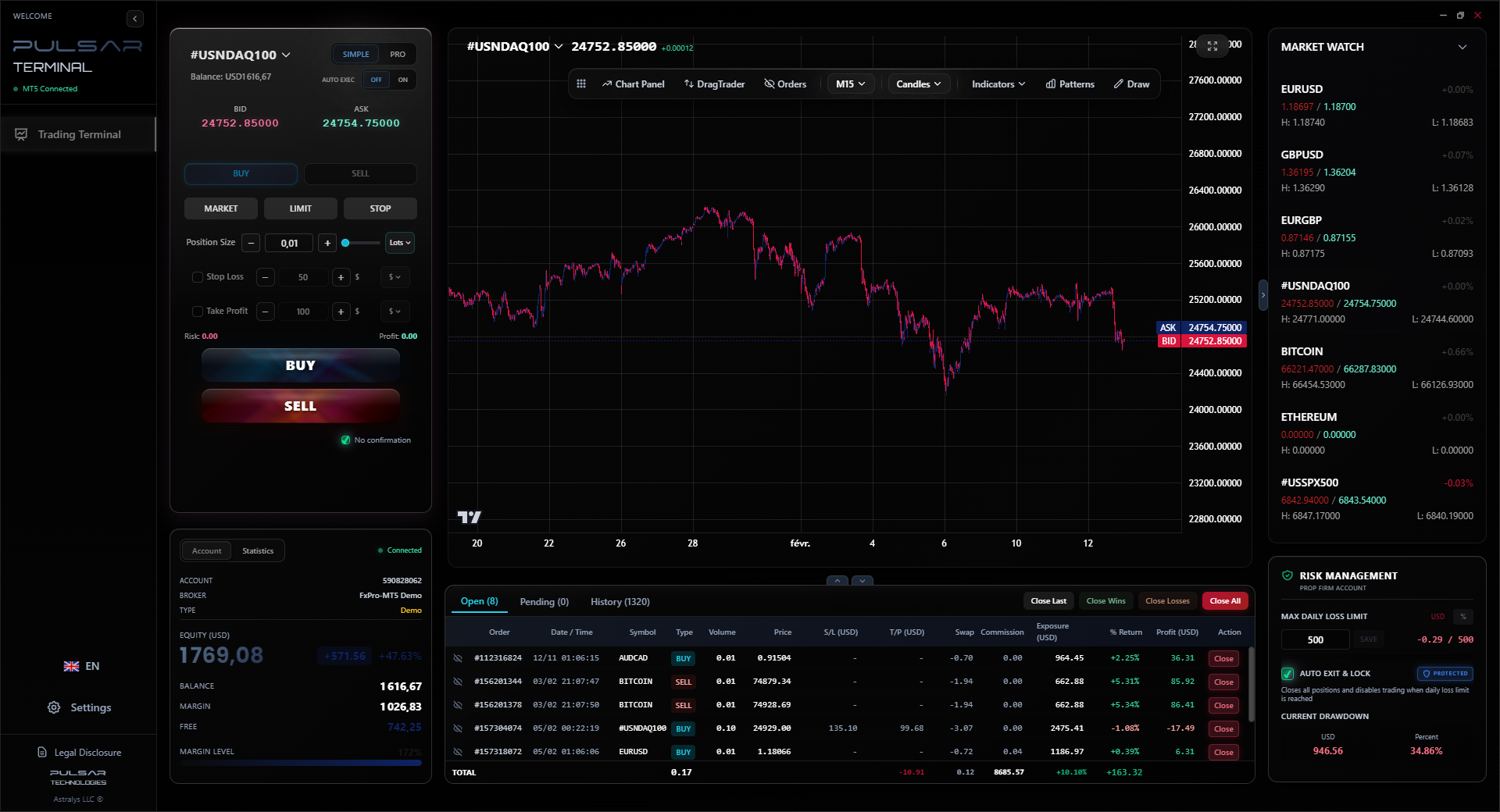
Managing a prop firm account's trailing drawdown manually is a high-stress recipe for error; Pulsar Terminal automates trailing stops, breakeven moves, and multi-level exits directly on your MT5 platform, turning complex rule compliance into a simple click.
Pulsar Terminal
A ferramenta MT5 tudo-em-um: ordens drag-and-drop, multi-TP/SL, trailing stop, grid trading, Volume Profile e proteção prop firm. Usado diariamente por 1.000+ traders.
So, after all this, who gets my money in 2025?
- For the brand-new prop trader: Start with FTMO or Apex Trader Funding (depending on your market). Their rules are standard, their reputations are solid, and the lessons you learn will apply everywhere. Buy their smallest challenge.
- For the experienced trader wanting flexible rules: Top One Trader is hard to beat right now. Their static drawdown model is a significant advantage for certain strategies.
- For the futures specialist: Apex is still the king. Their scaling plan and community support are top-tier.
- For the long-term builder: The5%ers offer a unique and potentially more sustainable partnership model.
Avoid any firm that:
- Has a maximum time limit to pass the challenge.
- Uses a 'consistency rule' that's impossibly vague.
- Has no visible track record or transparent leadership.
- Makes it difficult to find their actual terms and conditions.
Prop trading is a career path, not a lottery ticket. The best prop trading firms in 2025 are those that act as partners, not gatekeepers. Choose the one whose rules best fit your trading personality, start small, and focus on the process. The money will follow.
FAQ
Q1Can I really make a living from prop firm trading?
Yes, but it's a grind, not a jackpot. You need to be consistently profitable, manage multiple accounts to smooth out income, and treat it like a business. Your first $10k month feels amazing, but you need systems to replicate it. It's a living for the disciplined, not the desperate.
Q2What's the biggest mistake traders make in prop firm challenges?
Overtrading to hit the profit target quickly. They increase risk, trade during low-probability times, and blow the daily loss limit. The challenge is a test of patience and risk management, not raw profit generation. The fastest way to fail is to try to pass fast.
Q3Are instant funding accounts worth it?
They can be, but they're usually more expensive (higher fee) and have stricter drawdown rules. They're good for experienced traders who know their strategy is solid and want to skip the 1-2 month evaluation grind. For beginners, they're a more expensive way to fail.
Q4How do prop firms make money if they give traders 90% of profits?
From the 10% they keep, from the fees paid for challenges, resets, and platform/data subscriptions. A successful firm with many funded traders makes a ton from their 10% cut of all those profits. A shady firm makes all its money from the constant churn of failing challenge-takers.
Q5Is trading news allowed during a challenge?
Almost always, NO. Most firms prohibit trading during major economic news releases (like NFP, CPI, FOMC) due to the extreme volatility and potential for slippage. Violating this is an instant account fail. Always check the specific forbidden news list in the rules.
Q6What happens if I hit the profit target in one trade?
You pass! Congratulations. There's no rule against passing quickly. However, firms may review the trade for any rule violations (like holding over a major news event you shouldn't have). If it's clean, you're funded.
Q7Can I use expert advisors (EAs) or automated trading?
This is firm-specific. Many allow it, but the EA must not violate other rules (like hedging, latency arbitrage, etc.). Some firms explicitly forbid fully automated trading. You must read the TOS. Never assume it's allowed.
Lição do Prof. Winston
Pontos-chave:
- ✓Vet the firm's legal status and TOS before paying a single dollar.
- ✓Prioritize drawdown rules (5% daily, 10% max) over profit splits.
- ✓All fees are paid from gross profit; calculate your net edge.
- ✓Start with the smallest, cheapest challenge to prove your fit.
- ✓Automate trade management to protect against emotional errors.
Quão útil foi este artigo?
Clique em uma estrela
Insights de Trading Semanal
Análises e estratégias semanais grátis. Sem spam.
Sobre o autor
James Mitchell
Analista de Trading Sênior
Sediado em Nova York com mais de 9 anos de experiência em trading. Focado nos principais pares USD, desafios de prop firms e o cenário regulatório dos EUA.
Comentários
Aviso de risco
A negociação de instrumentos financeiros envolve riscos significativos e pode não ser adequada para todos os investidores. O desempenho passado não garante resultados futuros. Este conteúdo é apenas para fins educacionais e não deve ser considerado aconselhamento de investimento. Sempre conduza sua própria pesquisa antes de negociar.
Você também pode gostar

Cara Trading Forex Sukses: 7 Prinsip dari Trader Profesional
Cara trading forex sukses dengan 7 prinsip trader pro: manajemen modal, disiplin, journal trading, backtest. Data nyata, bukan janji profit palsu.
Jam Trading Forex Terbaik untuk Trader Indonesia: Panduan Lengkap dengan Tabel Waktu
Panduan jam trading forex untuk trader Indonesia. Tabel 4 sesi dunia, jam emas 20:00-00:00, sesi mana yang harus dihindari. Data akurat + tips dari trader berpengalaman.
Top 5 Sàn Forex Uy Tín Nhất 2026: Review Jujur dari Trader Indonesia
Top 5 sàn forex uy tín 2026 untuk trader Indonesia. Review jujur: spread, deposit, withdraw, dukungan lokal. Exness, XM, IC Markets & lebih.
Obter Pulsar Terminal
Todas essas calculadoras estão integradas ao Pulsar Terminal com dados em tempo real da sua conta MT5.
Obter Pulsar Terminal