


Most books for trading forex are a complete waste of your time.

Sarah Collins
Estrategista de Trading ·  United Kingdom
☕ 11 min de leitura
O que você vai aprender:
Most books for trading forex are a complete waste of your time. They're filled with theoretical nonsense, outdated strategies, and promises that fall apart the second you face a live market. I know because I've read hundreds of them, lost money following bad advice from a few, and found a handful that genuinely changed my career. Forget the hype. I'm going to show you the seven books that actually work for a UK trader, explain why they matter in our specific regulatory landscape, and tell you exactly how I applied them to make real profits.
Let's be brutally honest. The vast majority of trading books are written by people who make more money selling books than trading. They're designed to sound smart, not to be useful. They often ignore the single most important factor for us in the UK: the real-world, heavily-regulated environment we operate in.
A classic example is the endless promotion of 100:1 or 200:1 use in older texts. Following that advice today would be financial suicide. The FCA's retail use cap of 30:1 on majors like GBP/USD fundamentally changes how you manage risk and position size. A book that doesn't address modern risk constraints is teaching you to drive a Formula 1 car on public roads - thrilling in theory, disastrous in practice.
Another big issue is the "one-size-fits-all" strategy. A method built for the Japanese Yen during the 90s might be useless for trading GBP pairs now. The market's personality changes. I learned this the hard way early on. I religiously followed a famous book's pattern recognition system, entering every supposed "head and shoulders" I saw. I got stopped out constantly. The book didn't mention that in low-volatility, range-bound markets - common for EUR/GBP - those patterns fail more often than not. It was a costly lesson in context.

Warning: Be deeply skeptical of any book that promises a "secret formula" or guaranteed returns. If the strategy was that foolproof, the author wouldn't need to sell it for £20. Real trading is about probability and managing losses, not magic bullets.
The best books for trading forex don't give you a fish; they teach you how to fish in the specific pond you're in. They give you frameworks for thinking, not rigid rules. They focus on the timeless elements: psychology, risk management, and market structure. The specific entry trigger matters far less than whether you have the discipline to follow your plan when a trade goes against you.

💡 Dica do Winston
A library of a thousand books is worthless compared to a single, well-executed plan. Master one concept from one book before you even glance at the next.
Before you look at a single chart, you need to sort your head out. This isn't fluffy self-help; it's the bedrock of survival. More traders blow up their accounts from poor psychology than poor analysis.
1. Trading in the Zone by Mark Douglas This is the undisputed king. I re-read it every year. Douglas breaks down the fundamental truth: the market is a stream of probabilities, not certainties. Your job isn't to be right, it's to manage risk so you can be wrong and still be in the game tomorrow. He drills into the concept of accepting the risk before you enter the trade. This one mental shift saved me thousands.
Here’s a personal story. Early on, I’d enter a trade on EUR/USD, convinced it would rally. If it dipped 5 pips, I’d panic, move my stop loss wider "to give it room," and inevitably take a much larger loss. After internalising Douglas's lessons, I started writing my risk (e.g., "I risk £50 on this trade") on a sticky note next to my screen. Accepting that £50 as lost the moment I clicked buy removed the emotion. The trade could do what it wanted; my loss was defined.
2. The Mental Game of Trading by Jared Tendler If Douglas gives you the philosophy, Tendler gives you the playbook for fixing your specific leaks. He tackles tilt, fear, and overconfidence like a sports psychologist. His "mental dashboard" concept is brilliant. You track not just your P&L, but your mental state, energy levels, and decision quality.
I used his methods to cure my revenge trading. After a losing trade on Cable (GBP/USD), I’d feel stupid and angry. I’d immediately jump back in with double the size to "win my money back." Predictably, I’d dig a deeper hole. Tendler’s solution was a simple rule: after any loss exceeding 1% of my account, I had to walk away for one hour. No exceptions. It broke the emotional cycle and saved me from my worst impulses.
These books teach you that your biggest enemy is the person in the chair. Mastering them is more important than any indicator. You can have a mediocre strategy with elite psychology and do okay. You can have an elite strategy with mediocre psychology and you will blow up. It's that simple.
“Your money management system is 10x more important than your entry system.”
This is where UK-specific knowledge is critical. FCA rules like negative balance protection and the 50% margin close-out rule are safety nets, but they don't replace your own discipline. The best books here provide the mathematical framework for survival.
3. The Universal Principles of Successful Trading by Brent Penfold Penfold is relentless. He argues that your money management system is 10x more important than your entry system. His core premise is that you must know your long-term expectancy (average profit per trade) and then use a fixed fractional betting system - like risking 1% of your capital per trade.
I applied his methods directly. After a testing period, I calculated my strategy had a 40% win rate but a 2:1 reward-to-risk ratio. Using his formulas and a position size calculator, I determined my optimal risk per trade was 1.25% of my account. Sticking to this through losing streaks was agonizing but essential. In one brutal month, I had 11 losing trades in a row on the XAU/USD (gold). My old self would have doubled down and been wiped out. Using Penfold’s fixed fractional approach, I was down about 14% - a hit, but not a knockout. I recovered the next quarter.
4. Trade Your Way to Financial Freedom by Van K. Tharp Tharp introduces the concept of "R-multiples" - measuring every profit and loss as a multiple of your initial risk (R). This reframes everything. A trade that makes £200 when you risked £50 is a +4R win. A £30 loss is a -0.6R loss. It focuses you on the consistency of your process, not the pound amount.

Example: Let's say your system's average win is +2R and average loss is -1R. If you win 35% of the time, your expectancy is (0.35 * 2) + (0.65 * -1) = 0.7 - 0.65 = +0.05R. That's a tiny, but positive, edge. The goal is to execute that edge hundreds of times without deviating.
These books force you to think like a casino. The casino doesn't care if red or black hits on a single spin; they care about the statistical edge over thousands of spins. Your trading should be the same. This mindset is your primary defence against the high percentage of retail accounts that lose money, a statistic the FCA rightly forces brokers to warn you about.
💡 Dica do Winston
The margin close-out rule is the FCA's safety net. Your own 2% daily loss limit is your helmet. Wear it always, or the net will only save you from total ruin, not a serious injury.
Now we get to the charts. The goal here is to learn how to read the market's story, not to collect 50 confusing indicators. I prefer books that teach price action and context.
5. Technical Analysis of the Financial Markets by John J. Murphy This is the textbook. It's not a light read, but it's complete. Murphy covers everything from basic chart patterns to intermarket analysis (how bonds, commodities, and stocks affect currencies). Understanding this context is vital. For instance, if you're trading GBP/USD, you need to watch UK gilt yields and the FTSE 100, not just the chart.
His chapters on support/resistance and trend are foundational. I don't use most of the complex indicators he discusses, but his principles on trend identification are timeless. I combined his trend-following principles with a simple MACD indicator crossover as a filter for my swing trading on major pairs.
6. Naked Forex by Alex Nekritin & Walter Peters This is the antidote to indicator overload. The authors trade using only pure price action - clean charts. They focus on identifying "key levels" and reading price behaviour at those levels. Their "123" reversal pattern became a staple in my toolkit for spotting potential trend changes on the 4-hour chart.
My biggest takeaway was learning to distinguish between "noise" and "signal." On a 1-minute chart, every move looks important. On a daily chart, you see the real trend. I stopped trying to scalping the 1-minute EUR/USD and moved to higher timeframes. My stress levels dropped and my profitability increased because I was acting on more significant moves.
The UK Angle: Spread Betting & Tax
Many UK-focused books explore into spread betting as a tax-efficient wrapper. While the tax treatment is advantageous (no Capital Gains Tax on profits), the trading principles inside that wrapper remain the same. Don't get distracted by the wrapper; focus on the product. The analysis for a GBP/USD CFD and a GBP/USD spread bet is identical. The spread, commission, and margin call risks are what you need to compare between brokers like IG or CMC Markets.
“Books give you the map, but you have to walk the path.”
After you've read the above, there's one final step. You must synthesise the knowledge into a trading plan that fits your personality, schedule, and risk tolerance.
7. The Complete TurtleTrader by Michael W. Covel This isn't a how-to manual; it's a case study. It tells the true story of how trading legend Richard Dennis taught a group of ordinary people a simple trend-following system and turned them into millionaires. The magic isn't in the specific rules (which are revealed), but in the proof that discipline and systemisation trump genius.
The Turtles used a volatility-based position sizing formula (N). I adapted this for forex by using the Average True Range (ATR) indicator. If the ATR on GBP/JPY was 100 pips, I'd set my stop-loss wider than if it was 50 pips, and adjust my position size down accordingly to keep my monetary risk constant. This meant I wasn't taking outsized risk during volatile news events.
Your trading plan must be written down and include:
- Market Selection: Which pairs? I stick to majors like EUR/USD and GBP/USD for their liquidity and tighter spreads.
- Entry Conditions: What must happen for you to enter? (e.g., price retests a daily support level, and the 1-hour RSI is oversold).
- Exit Conditions: Your profit target and stop-loss rules. Will you use a trailing stop?
- Risk Rules: Your maximum risk per trade (I recommend 1% for beginners), maximum daily loss (e.g., 3%), and weekly loss limit (e.g., 5%).
- Journaling: A log of every trade, including the reason for entry and your emotional state.
This documented plan is your anchor. When you have a losing week, you review the plan, not your gut. You check if you followed it. If you did, the loss is just part of the game. If you didn't, you fix the behaviour.
💡 Dica do Winston
If a trading idea can't be explained in a paragraph, it's too complex to execute under pressure. Simplicity scales. Complexity fails.
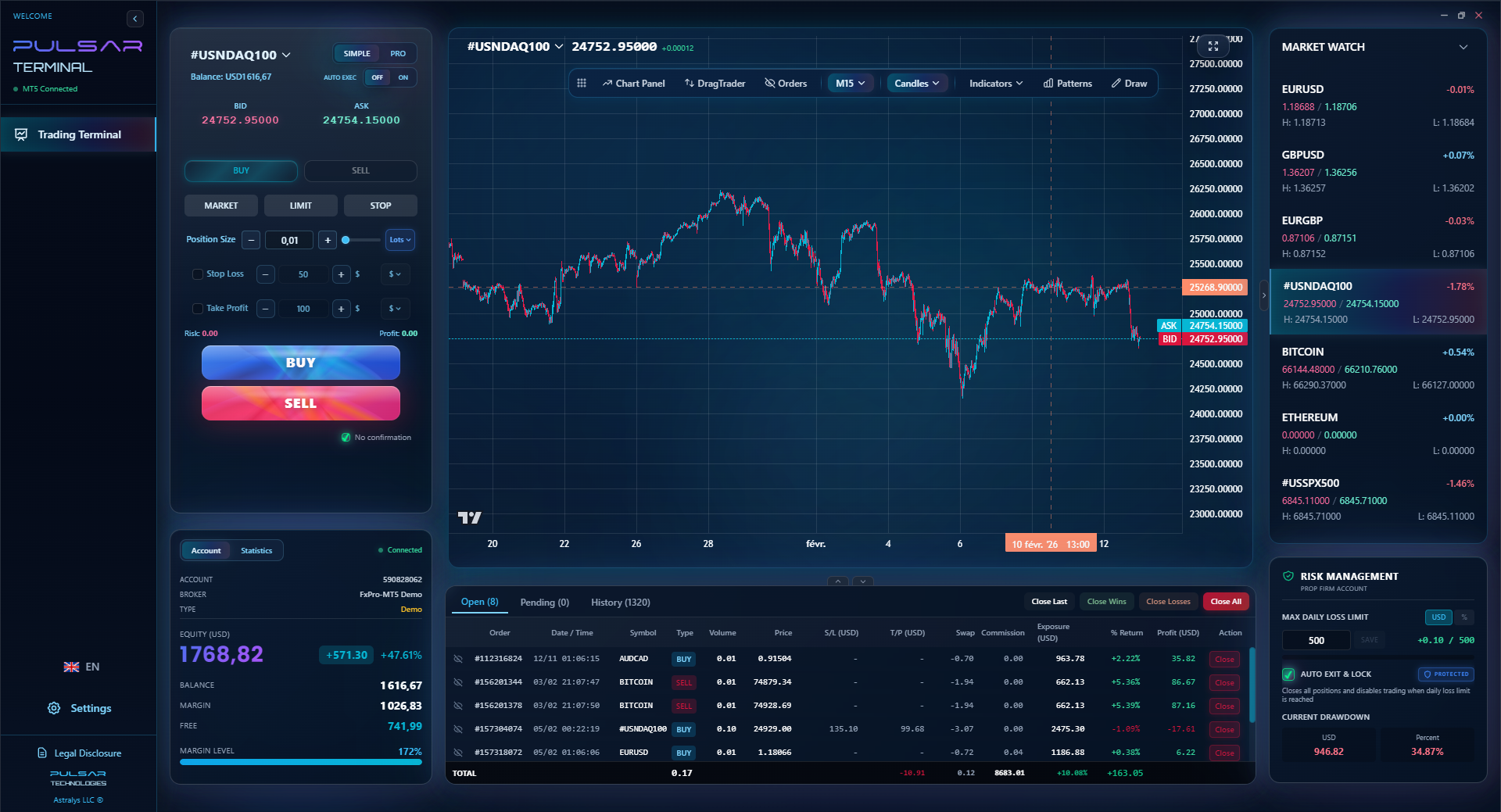
Building a disciplined system is one thing; executing it flawlessly is another. Tools like Pulsar Terminal automate your trade management rules—like partial closures and trailing stops—directly on MT5, so your psychology can't interfere with your plan.
Pulsar Terminal
A ferramenta MT5 tudo-em-um: ordens drag-and-drop, multi-TP/SL, trailing stop, grid trading, Volume Profile e proteção prop firm. Usado diariamente por 1.000+ traders.
Now you know what to read. Let me tell you what to run from.
Avoid books that:
- Focus on "harmonic patterns" or "Elliott Wave" as a primary strategy. They're highly subjective and I've never met a consistently profitable trader who relies solely on them.
- Promise "risk-free" strategies or guaranteed income.
- Are primarily about the author's luxurious lifestyle. It's marketing, not mentoring.
- Were written before 2010 and don't have updated editions addressing modern electronic markets and regulation.
Your action plan:
- Start with Psychology: Read Trading in the Zone. Internalise it.
- Learn Risk Math: Read Penfold or Tharp. Use a position size calculator for every single trade.
- Study the Market: Read Murphy for foundation, then Naked Forex for clarity.
- Paper Trade: Open a demo account with a reputable FCA broker like Pepperstone or Exness. Test the concepts for at least 3 months. Your goal is not to make fake money, but to build a habit of following your plan.
- Go Live Small: When you fund a live account, start with an amount you can afford to lose completely. Your first £10,000 is tuition fee, not capital. Expect to pay it.

Pro Tip: Don't buy all the books at once. Get one, read it twice - once for understanding, once for taking detailed notes - and practice its core message for a month before moving on. Depth beats breadth every time in this game.
Books give you the map, but you have to walk the path. It's a tough, lonely path at times. But with the right foundation from these seven books, you're giving yourself a fighting chance in the world's largest financial market.
FAQ
Q1I'm a complete beginner in the UK. Which single book should I read first?
Start with 'Trading in the Zone' by Mark Douglas. It has almost no charts or technical jargon. It's all about the mental framework you need to have before you even think about placing a trade. Getting your head right is the first and most important step. The technical stuff is easier to learn later.
Q2Are books about stock trading useful for forex?
Some are, but you have to be selective. Books on trading psychology and risk management (like those by Tharp or Douglas) are universally applicable. However, books focused on stock-specific analysis like earnings reports or P/E ratios are useless for forex. Stick to books that focus on technical analysis, price action, and general trading principles.
Q3How do FCA rules change what I learn from these books?
They massively impact risk management. Any book telling you to use 100:1 use is dangerously outdated for a UK retail trader. You must adapt the position sizing and risk concepts to work within the 30:1 use cap on majors. Also, always prioritise brokers with strong FCA regulation for the vital client money protection and negative balance protection.
Q4What's the biggest mistake people make after reading trading books?
They try to implement every idea from every book at once, creating a complex, contradictory mess of a system. Or, they find one simple strategy they like but then abandon it after 3 losing trades, jumping to the next book's strategy. The key is synthesis and patience. Take one core idea, test it thoroughly, and stick with it long enough to see its statistical edge (or lack thereof).
Q5Should I buy the latest edition of a trading book?
For psychology and core principles, older editions are often fine. For books on technical analysis or market mechanics, yes, get the latest edition. Markets evolve (more electronic, faster execution), and newer editions often address these changes. Check the publication date - anything pre-2008 is likely missing crucial context about modern market structure.
Q6Can I become a profitable trader just by reading books?
No. Books provide the knowledge, but trading is a skill. You wouldn't expect to become a surgeon just by reading textbooks. You need deliberate practice. That means months of demo trading, then trading very small live sizes, while carefully journaling your trades and emotions. Books are the instruction manual, but you have to build the thing yourself.
Q7Are there any good UK-specific trading books?
There are books focusing on spread betting and UK tax, which can be useful for understanding the wrapper. However, the actual trading knowledge inside is global. Don't limit yourself to only UK authors. The best minds in trading psychology, risk, and analysis come from all over the world. Focus on the universal principles they teach.
Lição do Prof. Winston
Pontos-chave:
- ✓Psychology dictates long-term success, not entry techniques.
- ✓Never risk more than 1-2% of your capital on a single trade.
- ✓The FCA's 30:1 use cap is a constraint you must design your system around.
- ✓Test any strategy for at least 100 trades before judging its edge.
Quão útil foi este artigo?
Clique em uma estrela
Insights de Trading Semanal
Análises e estratégias semanais grátis. Sem spam.
Sobre o autor
Sarah Collins
Estrategista de Trading
Estrategista de trading sediada em Londres com 12 anos em mercados financeiros. Ex-analista numa corretora na City de Londres. Cobre pares GBP, mercados europeus e trading regulado pela FCA.
Comentários
Aviso de risco
A negociação de instrumentos financeiros envolve riscos significativos e pode não ser adequada para todos os investidores. O desempenho passado não garante resultados futuros. Este conteúdo é apenas para fins educacionais e não deve ser considerado aconselhamento de investimento. Sempre conduza sua própria pesquisa antes de negociar.
Você também pode gostar

Cara Trading Forex Sukses: 7 Prinsip dari Trader Profesional
Cara trading forex sukses dengan 7 prinsip trader pro: manajemen modal, disiplin, journal trading, backtest. Data nyata, bukan janji profit palsu.
Jam Trading Forex Terbaik untuk Trader Indonesia: Panduan Lengkap dengan Tabel Waktu
Panduan jam trading forex untuk trader Indonesia. Tabel 4 sesi dunia, jam emas 20:00-00:00, sesi mana yang harus dihindari. Data akurat + tips dari trader berpengalaman.
Top 5 Sàn Forex Uy Tín Nhất 2026: Review Jujur dari Trader Indonesia
Top 5 sàn forex uy tín 2026 untuk trader Indonesia. Review jujur: spread, deposit, withdraw, dukungan lokal. Exness, XM, IC Markets & lebih.
Obter Pulsar Terminal
Todas essas calculadoras estão integradas ao Pulsar Terminal com dados em tempo real da sua conta MT5.
Obter Pulsar Terminal