


I remember staring at my screen in late 2020, watching GBP/NGN.

Olumide Adeyemi
Pioneiro do Trading na África Ocidental ·  Nigeria
☕ 8 min de leitura
O que você vai aprender:
I remember staring at my screen in late 2020, watching GBP/NGN. The pair was at 480, and everything in my analysis screamed it was going higher. The UK was sorting out Brexit, oil was shaky, and the Naira felt heavy. I clicked buy, my heart doing a little dance. That single decision, understanding what it truly means to buy in forex, turned a 50k position into over 120k in a few months. It wasn't just luck. It was knowing how to spot the right moment to go long and having the discipline to stick with it. Let's break down that skill, so your next buy order isn't a guess, but a calculated move.
When you buy in forex, you're not purchasing physical cash to stuff in a box. You're entering a contract. You're betting that the value of the first currency in the pair will go up relative to the second one. Think of it like this: you're buying the base currency and simultaneously selling the quote currency.
For a Nigerian trader, this is crucial. If you buy EUR/USD, you're saying, "I think the Euro will get stronger than the US Dollar." Your profit comes from that Euro appreciation. But here's where it gets local: if you're trading USD/NGN, buying means you believe the US Dollar will strengthen against the Naira. Given our history with the Naira, this is a trade many are familiar with, often for the wrong reasons (like panic buying during a crash).

Warning: Buying USD/NGN through your broker is a speculative CFD trade on the exchange rate. It is NOT a way to physically acquire dollars for your domiciliary account. The price you get is the broker's derived rate, not the official CBN or black-market rate.
The moment you click buy, you are 'long' the pair. Your broker fronts you the margin, and your P&L starts moving with every pip. If the price moves up, you're in profit. If it drops, you're facing a loss. It's that simple, and that dangerous, if you don't manage it right. I learned this the hard way early on, buying GBP/JPY because it 'felt low,' without a plan. A 200-pip move against me wiped out a week's gains. Always know your exit before you enter.
“Buying in forex isn't about optimism; it's about identifying a mathematical edge in a currency's appreciation.”
Knowing when to buy in forex is the art. It's not about buying every dip. It's about buying the right dip in a clear uptrend. You need a confluence of factors.
Reading the Trend
First, is the market even trending up? Don't try to buy in a raging downtrend; that's catching a falling knife. I use higher timeframes like the 4-hour or daily chart to establish the trend direction. If the price is making higher highs and higher lows, you have an uptrend. That's your green light to look for buy opportunities on lower timeframes.
Technical Confluence
I look for price to pull back to a key support level - maybe a previous swing high that's now acting as support, or a moving average like the 50 or 200 EMA. Then, I wait for a bullish price action signal. A pin bar rejecting the support, or a bullish engulfing candle. My favourite confirmation is watching the RSI indicator dip near 30 or 40 and then start curling back up. It shows selling pressure is exhausting.
The Fundamental Kick
For a trade to really run, it often needs a fundamental driver. As a Nigerian trading major pairs, this means watching economic calendars for USD, EUR, or GBP news. A better-than-expected US jobs report can sink USD pairs (bad for a USD buy), while a hawkish ECB comment can send EUR flying. I got caught once buying AUD/USD right before a huge Chinese data miss (China is Australia's biggest customer). The pair tanked. Now, I always check the calendar.

Pro Tip: For a classic buy setup, wait for the MACD indicator histogram to cross above the zero line on the 1-hour chart after a pullback in a daily uptrend. It's a reliable momentum confirmation I've used for years.

💡 Dica do Winston
A 'buy' signal is only valid if it appears in the direction of the higher timeframe trend. A 5-minute bullish candle in a 4-hour downtrend is a trap, not an opportunity.
“The spread is the toll you pay to enter the market. A tight spread from a good broker keeps that toll low.”
Let's make this real. You're on your MT4/MT5 platform with a broker like Exness or IC Markets. You've done your analysis on EUR/USD and decided to buy. Here's exactly what happens next.
You open the order ticket. The symbol is EUR/USD. You select 'Buy' (sometimes 'Buy Limit' or 'Buy Stop' for pending orders). Now, the critical parts:
Volume/Lots: This is your trade size. For a $500 account, risking 1% ($5), you might buy 0.05 lots. A 10-pip stop-loss would then risk about $5. Never guess this. Use a position size calculator.
Stop Loss (SL): You MUST set this. If you buy at 1.0850, you might place your SL at 1.0820 (30 pips below). This defines your maximum risk. Not having one is how accounts blow up.
Take Profit (TP): Your target. A common risk-reward is 1:2. So for a 30-pip SL, your TP would be at 1.0910 (60 pips above entry).
Click 'Buy', and you're in. Your terminal will show an open position in green if it's in profit, red if it's in a loss. The 'spread' - the difference between the buy and sell price - is your immediate cost. A tight spread from a good broker is key, especially for a scalping strategy.

Example: Buying USD/NGN at 1450.00 with a 0.1 lot (10,000 units). Each pip movement is worth ₦100. A move to 1460.00 is a 100-pip gain = ₦10,000 profit. A move to 1440.00 is a 100-pip loss = ₦10,000 loss. See how fast it moves? That's why the SL is non-negotiable.
“Your stop loss isn't a suggestion. It's the pre-written admission slip for when your analysis is wrong.”
Our market is volatile. Naira pairs can gap wildly on Monday mornings after a weekend of news. You buy USD/NGN on Friday, think you're safe with a 50-pip SL, and come Monday it's 200 pips against you before you can blink. I've been there. It hurts.
Your first defence is position size. Never risk more than 1-2% of your account on a single trade. On a ₦100,000 account, that's ₦1,000-₦2,000 max risk. Use that number to work backwards to your lot size.
Second, understand use. A broker like XM might offer 500:1. That means with ₦20,000, you can control a ₦10,000,000 position. Sounds great for profits, but it's a death trap for losses. A 0.2% move against you wipes your entire margin. I use use as a tool, not a weapon. For most trades, I never use more than 10:1 of the available use.
Finally, have a plan for when you're wrong. Your stop loss is that plan. Don't move it further away hoping the market will turn. That's called 'doubling down on stupid.' Take the small loss and live to trade another day. A margin call is a professional failure, not bad luck.
💡 Dica do Winston
Your first profit target should be where you move your stop loss to breakeven. Protecting your capital is always priority one. Profits come after survival.
“Your stop loss isn't a suggestion. It's the pre-written admission slip for when your analysis is wrong.”
Let's get honest. We've all messed up. Here are the classic errors when trying to buy in forex.
Buying the Top: This is the big one. FOMO (Fear Of Missing Out) kicks in. You see EUR/USD flying, you jump in late, and you buy right at the exhaustion point. The trend reverses, and you're stuck in a losing trade from the start. Wait for the pullback.
Averaging Down: You buy USD/NGN at 1400. It drops to 1380. Instead of admitting the trade is wrong, you buy more to 'lower your average cost.' This turns a small loss into a catastrophic one if the trend continues down. I turned a ₦15k loss into a ₦80k loss doing this in 2019. Never add to a losing position.
Ignoring Timeframes: You see a nice bullish candle on the 5-minute chart and buy, but you're selling against the dominant downtrend on the 1-hour chart. The lower timeframe noise swallows you. Always trade in the direction of the higher timeframe trend.
Trading Without a Catalyst: Buying a pair just because it's 'cheap' is not a strategy. There needs to be a reason for it to go up - a technical breakout, a fundamental shift, a change in market sentiment. Random buying is gambling.
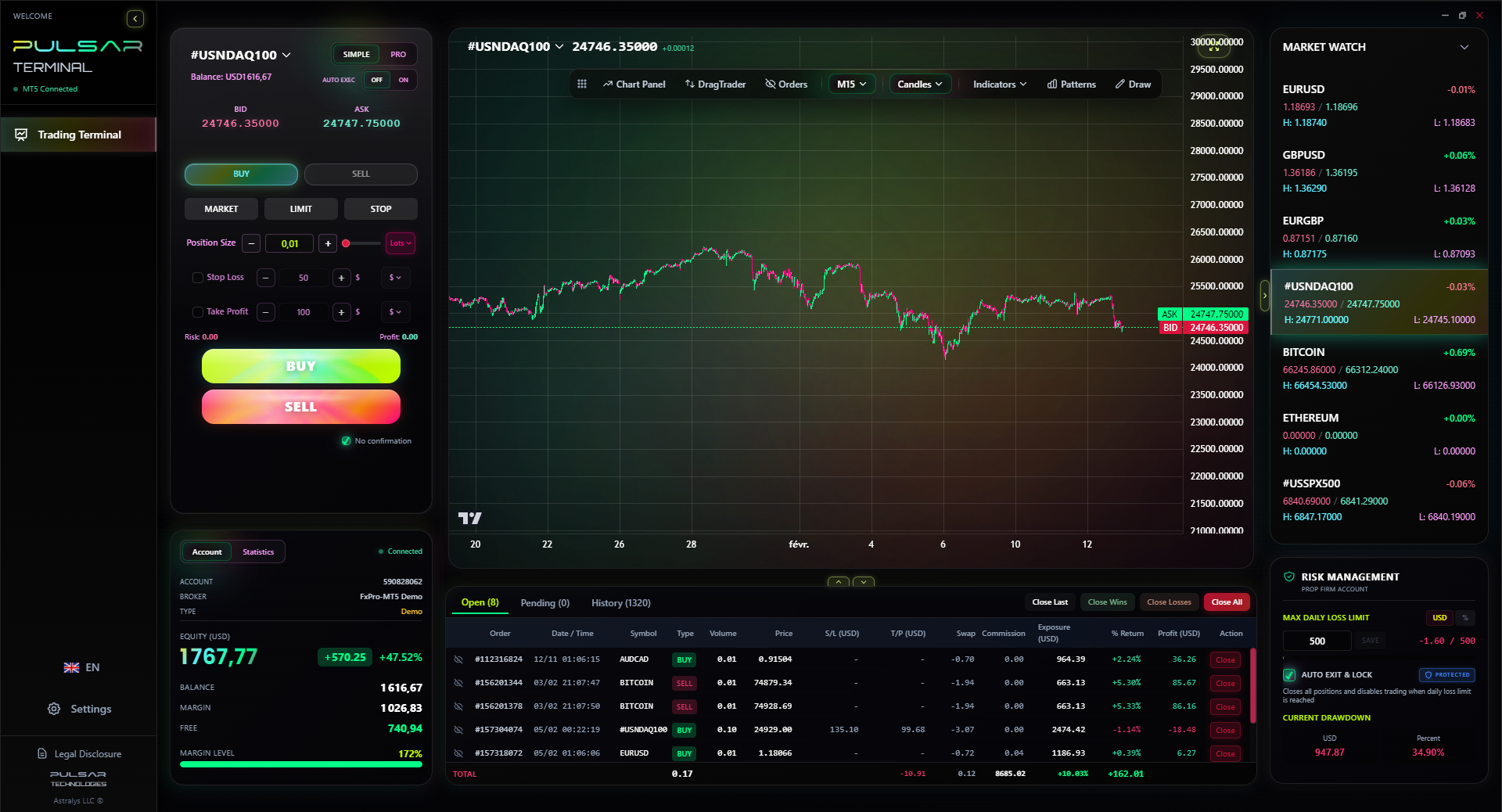
Managing the emotions of a buy trade is easier when your tools let you set multiple take-profit levels and a trailing stop from the start, which is exactly what Pulsar Terminal automates on your MT5.
Pulsar Terminal
A ferramenta MT5 tudo-em-um: ordens drag-and-drop, multi-TP/SL, trailing stop, grid trading, Volume Profile e proteção prop firm. Usado diariamente por 1.000+ traders.
“The psychology of holding a winning trade is often harder than picking the entry.”
Placing the order is easy. Holding it is the hard part. The moment you click buy, emotions flood in.
If it goes your way immediately, greed whispers, "Add more! It's a sure thing!" If it goes against you, fear screams, "Close it now before it gets worse!" Your job is to silence both voices and follow your plan.
I use a simple rule: once the trade is on, I don't touch the SL or TP unless I'm moving the SL to breakeven after a reasonable profit (like when price moves 1.5x my initial risk in my favour). This requires trusting your initial analysis. If you constantly tweak trades, you're not trading the market, you're trading your anxiety.
For longer-term swing trading buys, you have to ignore the intraday noise. That GBP/NGN trade I mentioned? It had several 300-pip pullbacks against me before continuing up. If I had been staring at it every minute, I would have panicked and exited. Set your alerts and walk away.
The best feeling isn't the winning trade; it's the one you managed perfectly according to your rules, win or lose. That's control. That's how you last in this game.
FAQ
Q1If I buy EUR/USD, am I buying Euros with my Naira?
No, not directly. You're trading a contract for difference (CFD) on the EUR/USD exchange rate. Your account is denominated in USD (or sometimes Naira with some brokers), and your profit/loss is calculated in that account currency based on the EUR/USD price movement. Your initial Naira deposit is converted to your account currency to provide margin.
Q2What's the difference between 'Buy' and 'Buy Limit'?
'Buy' is a market order - you buy at the current best available price. 'Buy Limit' is a pending order to buy at a specific price below the current market price. You use a Buy Limit when you want to buy on a pullback to a support level.
Q3How much money do I need to start buying in forex in Nigeria?
You can start with as little as $10 (about ₦15,000) with some micro-account brokers. However, to trade sensibly with proper risk management, I'd recommend a minimum of $100 (₦150,000) or more. This allows for meaningful position sizing without being forced to use extreme use.
Q4Is buying USD/NGN the same as betting against the Naira?
In terms of price direction, yes. If you buy USD/NGN, you profit if the Naira weakens (the rate goes up, e.g., from 1400 to 1500). It's a speculative trade on the exchange rate, not a political or patriotic statement. It's a tool, like any other pair.
Q5Can I lose more than I deposit when I buy in forex?
With most reputable brokers offering negative balance protection, you cannot lose more than your account balance. However, if your trade moves massively against you and your stop loss isn't executed (e.g., in a market gap), you could theoretically owe money. This is extremely rare with proper risk management. Always use a guaranteed stop loss if you're very concerned.
Q6What time is best to buy major pairs like EUR/USD from Nigeria?
The best volatility and liquidity overlap during the London session (8 AM - 5 PM GMT, which is 9 AM - 6 PM Nigerian time) and the overlap with the New York session (1 PM - 5 PM GMT, 2 PM - 6 PM Nigerian time). This is when most moves happen.
Lição do Prof. Winston
Pontos-chave:
- ✓Always define your risk (1-2% per trade) before calculating your potential reward.
- ✓Use higher timeframes (4H/Daily) to find the trend, then lower timeframes to fine-tune your buy entry.
- ✓A buy trade needs both technical setup (support, RSI bounce) and a fundamental catalyst to have high probability.
- ✓Never add to a losing 'buy' position. Averaging down is amplifying a mistake.
Quão útil foi este artigo?
Clique em uma estrela
Insights de Trading Semanal
Análises e estratégias semanais grátis. Sem spam.
Sobre o autor
Olumide Adeyemi
Pioneiro do Trading na África Ocidental
Um dos educadores de trading forex mais ativos da Nigéria. 8 anos de experiência operando a partir de Lagos. Especialista em estratégias de baixo capital e desafios de prop firms para traders africanos.
Comentários
Aviso de risco
A negociação de instrumentos financeiros envolve riscos significativos e pode não ser adequada para todos os investidores. O desempenho passado não garante resultados futuros. Este conteúdo é apenas para fins educacionais e não deve ser considerado aconselhamento de investimento. Sempre conduza sua própria pesquisa antes de negociar.
Você também pode gostar

Cara Trading Forex Sukses: 7 Prinsip dari Trader Profesional
Cara trading forex sukses dengan 7 prinsip trader pro: manajemen modal, disiplin, journal trading, backtest. Data nyata, bukan janji profit palsu.
Jam Trading Forex Terbaik untuk Trader Indonesia: Panduan Lengkap dengan Tabel Waktu
Panduan jam trading forex untuk trader Indonesia. Tabel 4 sesi dunia, jam emas 20:00-00:00, sesi mana yang harus dihindari. Data akurat + tips dari trader berpengalaman.
Top 5 Sàn Forex Uy Tín Nhất 2026: Review Jujur dari Trader Indonesia
Top 5 sàn forex uy tín 2026 untuk trader Indonesia. Review jujur: spread, deposit, withdraw, dukungan lokal. Exness, XM, IC Markets & lebih.
Obter Pulsar Terminal
Todas essas calculadoras estão integradas ao Pulsar Terminal com dados em tempo real da sua conta MT5.
Obter Pulsar Terminal