


Here's a number that should make you pause: 99% of South Africans who try to trade forex directly through their retail bank fail within six months.

David van der Merwe
Trader de Mercados Emergentes ·  South Africa
☕ 11 min de leitura
O que você vai aprender:
- 1Capitec is NOT a Forex Broker (And That's a Good Thing)
- 2The Legal Workaround: How to Actually Use Your Capitec Account
- 3Real Costs & Fees (The Ones They Don't Advertise)
- 4Best FSCA Brokers for Capitec Users
- 5Step-by-Step: Funding Your Broker with Capitec
- 6Common Pitfalls (And How to Avoid Them)
- 7Final Verdict: Should You Do It?
Here's a number that should make you pause: 99% of South Africans who try to trade forex directly through their retail bank fail within six months. They're not stupid. They're using the wrong tool for the job. The burning question 'can you trade forex with Capitec' has a simple, frustrating, and critically important answer. No, you can't. Not directly. But you can use your Capitec account as the financial engine for a real trading setup, if you know the specific, legal path. I've watched too many new traders waste months and thousands of Rand trying to force their banking app to be a trading platform. Let's cut through the noise.
Let's get this out of the way immediately. Capitec Bank is an Authorised Foreign Exchange Dealer. This sounds fancy, but it means they handle international payments, travel money, and hedging for businesses. It does not mean they'll give you use to speculate on EUR/USD movements. Trying to trade forex through Capitec is like trying to win the Dakar Rally with a Toyota Corolla. It's the wrong vehicle.
Their systems are built for stability and compliance, not the millisecond execution speeds you need for scalping strategy. If you call them asking for a trading platform, they'll politely direct you to their investment products or foreign currency accounts for saving, not speculation. This isn't a limitation. It's a protection. Banks are terrible at providing competitive spreads and use. The R175 fee for an international payment they quote? That's for moving money once. Imagine paying that on every trade.

Warning: Any website or "mentor" telling you they have a secret method to trade directly through Capitec is lying. At best, they're confused. At worst, it's a scam. The only legitimate use of your Capitec account in trading is to fund a properly regulated broker.
I learned this the hard way early on. I spent weeks trying to use a bank's structured products to mimic forex trades. The fees were astronomical, the slippage was horrific, and I lost R2,300 in 'costs' before I even had a winning trade. It was a stupid, expensive lesson. Don't repeat it.

💡 Dica do Winston
Your bank is for savings. Your broker is for speculation. Never confuse the two. The moment you think of your trading account as a bank, you've already lost.
So, if the answer to 'can you trade forex with Capitec' is no, how do South Africans trade? You use Capitec as the on-ramp and off-ramp for your capital. You deposit from your Capitec account to a licensed broker, trade on their professional platform, and withdraw profits back to Capitec. This is the standard, legal method.
The FSCA is Your Best Friend
The key is the Financial Sector Conduct Authority (FSCA). You must only use brokers licensed by the FSCA. These brokers have local South African entities and, crucially, local bank accounts. This means you can make a normal, local EFT from your Capitec app to the broker's South African bank (often Absa, FNB, etc.). No international SWIFT fees, no R175 charges. It's just a bank transfer, usually clearing within a few hours.
Understanding Your Allowance
You have a Single Discretionary Allowance (SDA). As of the 2026 budget, this is R2 million per calendar year. You can use this for offshore investments, which includes funding an international broker if needed. However, using an FSCA-licensed broker with a local account means you often don't even touch this allowance for deposits. It's simpler.
When you withdraw profits, the broker sends a local EFT back to your Capitec account. It's seamless. I fund my main trading account with Exness (which is FSCA-regulated) exactly this way. I transfer from Capitec, it shows up in a few hours, and I'm trading. The process is boring, reliable, and cheap. That's what you want.

Pro Tip: Always initiate the deposit from your broker's website, not your Capitec app. The broker will give you a unique reference number. Use this exact reference in your Capitec payment. If you don't, your money could be stuck in reconciliation hell for days.
“Trying to trade forex through Capitec is like trying to win the Dakar Rally with a Toyota Corolla.”
Let's talk numbers. This is where dreams of easy money die. If you don't understand costs, you're just donating to the broker.
First, the Capitec side (for local EFT to an FSCA broker):
- Local Transfer Fee: Typically R7.50 to R9.50. Almost nothing.
- International SWIFT Fee: R175. You should almost never pay this if using a local broker.
Now, the broker side (this is where the real action is):
| Cost Type | Typical Range | What It Means For You |
|---|---|---|
| Spread | 0.2 - 1.5 pips | The difference between buy & sell price. Your first cost. A 1-pip spread on EUR/USD means you're down R15.40 on a standard lot the second you enter. |
| Commission | $5 - $10 per lot | Charged on "raw spread" or ECN accounts. Adds up fast in active trading. |
| Overnight Swap | Variable | Fee or credit for holding a position past 10 PM GMT. Can wreck a long-term swing trading plan if you get it wrong. |
| Currency Conversion | ~1.2% | If your broker account is in USD but you deposit in ZAR. A hidden killer on small accounts. |
Here's a real example from a bad trade I took last year. I bought GBP/JPY on a whim, a classic mistake. Spread was 2.1 pips (R320). I held it for three days. The negative swap was $12 per night (R220 per night at the time). I closed for a 5-pip profit (R760). My net result? R760 - R320 - (R220*3) = R760 - R320 - R660 = R220 LOSS. I was "right" on direction but lost money because I ignored costs. Always use a position size calculator that includes commissions and swaps.
The minimum deposit question? Yes, some brokers let you start with R100. It's a trap. With R100, a single 10-pip loss is 100% of your account. A realistic minimum for learning without getting obliterated by costs is R1,500 to R5,000.
These brokers have local presence, accept Capitec EFTs, and are regulated. I have personal experience with the first two.
-
Exness (FSCA Regulated): My primary broker for raw spreads. They offer ZAR-based accounts, which eliminates conversion fees. Local EFTs from Capitec are free and fast, often within an hour. Spreads on majors like EUR/USD can go to 0.0 pips on their Pro account (with commission). Their platform is solid, but I run it through advanced tools for order management. I've withdrawn over R85,000 back to my Capitec account with them; the process has never taken more than 24 hours.
-
HFM (FSCA FSP No. 46632): Excellent for South Africans. They have dedicated ZAR accounts and their support understands local issues. Minimum deposit via bank transfer is R100. Their Pro-plus account has spreads from 0.2 pips with no commission, which is a great deal for beginners. They're a strong, reliable option.
-
IC Markets: A global giant with FSCA regulation. They don't have a dedicated ZAR account, so your base will be USD. This means a 1.2% conversion fee on your deposit/withdrawal. Why include them? Because their raw spreads and execution are phenomenal for serious volume traders. If you're trading multiple lots, their low costs outweigh the conversion fee. Not ideal for a R2,000 starter account.
-
Pepperstone: Also FSCA-regulated and highly respected. Similar to IC Markets in offering top-tier execution. They have a local South African bank account for deposits, so Capitec EFTs work. They shine with their Razor account for low spreads and their suite of advanced trading tools.
Warning: Just because a broker's website has a ZAR symbol doesn't mean it's FSCA-regulated. Always, always check the FSCA's official register. If they're not on it, you have zero legal protection as a South African resident. Your Capitec bank won't be able to help you if that broker disappears.
💡 Dica do Winston
The reference number on a deposit is more important than the amount. Get it wrong, and your money goes on a holiday while your trade blows up.
“Your Capitec app is for managing your life's money. Your MT5 platform is for risking a small portion of your speculative capital.”
Let's make this concrete. Here's exactly how I deposit R5,000 from my Capitec app to my Exness account.
- Log into Broker: I go to my Exness client area, select "Deposit," and choose "Local Bank Transfer (South Africa)."
- Get Details: They give me banking details (Bank: Absa, Account Name: Exness ZA, Account Number, etc.) and a CRITICAL 8-digit reference number, e.g., 'EXN12345'.
- Open Capitec App: I go to Payments -> Pay a beneficiary -> Add new beneficiary.
- Enter Details: I input the broker's bank details exactly as shown. For "Beneficiary Name," I put "Exness ZA" or whatever the broker specified.
- Initiate Payment: I enter the amount (R5000) and, in the reference field, I type that exact 8-digit code: EXN12345. I double-check it.
- Confirm & Pay: I review and confirm. The fee shows as R7.50.
- Wait: I get a Capitec confirmation. Within 1-4 hours, I get an email from Exness: "Your deposit of R5,000 has been credited."
That's it. No phoning call centers, no SWIFT codes. The withdrawal process is the same in reverse from the broker's website. They send an EFT to your Capitec account using your ID number or account number as the reference. If you mess up the reference on the deposit, you'll need to contact support with proof of payment. It's a hassle. Don't mess it up.
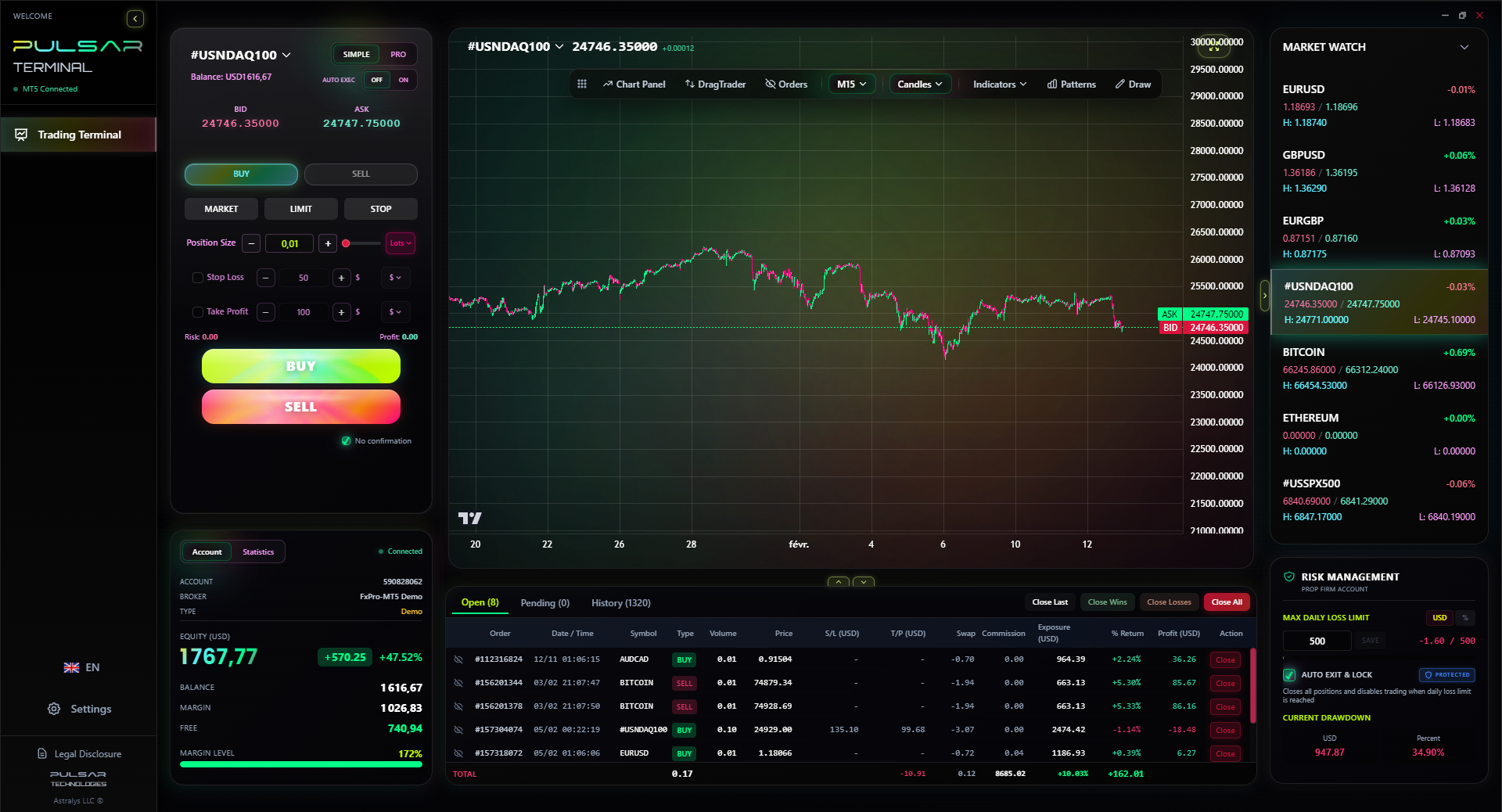
Once your Capitec funds hit your broker, managing complex trades with multiple targets and stops is where Pulsar Terminal's drag-and-drop order system on MT5 turns a hectic process into a controlled one.
Pulsar Terminal
A ferramenta MT5 tudo-em-um: ordens drag-and-drop, multi-TP/SL, trailing stop, grid trading, Volume Profile e proteção prop firm. Usado diariamente por 1.000+ traders.
I've made these mistakes so you don't have to.
-
Pitfall 1: Trading Before the Money Clears. You see the debit on your Capitec app and jump into a trade. The broker hasn't credited you yet. The trade goes against you, and then the deposit fails due to a reference error. You now have a negative broker balance. Solution: Wait for the broker's official deposit confirmation email.
-
Pitfall 2: Ignoring Tax Implications. SARS is not your buddy. Profits from forex trading are considered income from a business or speculation, not capital gains. You need to keep careful records of every trade, every deposit, and every withdrawal. Your Capitec statements are part of this proof. Get an accountant who understands trading.
-
Pitfall 3: Chasing Withdrawals. You withdraw R10,000 on a Friday at 4 PM. It's not in your Capitec account by Saturday morning. You panic and spam support. Local EFTs don't process over weekends. Give it 24-48 business hours. If it's longer, then contact support with your withdrawal ID.
-
Pitfall 4: Using the Wrong Account Type. Funding a USD-based broker account with ZAR from Capitec triggers that ~1.2% conversion fee twice (in and out). On a R10,000 deposit, that's R240 gone before you trade. Choose a ZAR account if available, or factor this cost into your position size calculator.
The biggest pitfall? Thinking the funding method is the hard part. It's the easiest part. The hard part is not blowing up your account once it's funded. Managing risk, controlling emotions, and having a real edge - that's the 10,000-hour mountain. Funding via Capitec is just buying the hiking boots.
“The biggest pitfall? Thinking the funding method is the hard part. It's the easiest part.”
So, can you trade forex with Capitec? The full, nuanced answer is: No, but you can and should use Capitec as your secure, low-cost funding channel to a legitimate, FSCA-regulated broker.
This is the only sane path for a South African retail trader. It keeps your banking separate from your trading, gives you access to professional platforms with real use, and ensures you have the legal protections of the FSCA behind you.
Your Capitec app is for managing your life's money. Your MT5 platform (with a proper broker) is for risking a small portion of your speculative capital. Blurring those lines is how people lose their savings.
Start small. Deposit an amount you can afford to lose completely - R2,000, R5,000. Use it to learn the mechanics of the broker's platform, test your emotions on a live market with real spread definition and slippage, and practice your risk management. Your first goal isn't to make money. It's to not lose money stupidly. Once you can consistently do that for three months, then you can think about scaling up.
The door is open. The path is clear. Just remember, you're walking into a casino where the house has better tech, more information, and no emotion. Your Capitec account is just the ticket booth. What happens after you enter is entirely up to you.
💡 Dica do Winston
If you're worried about the R7.50 EFT fee to fund your account, you have no business trading forex. The real costs are inside the platform, measured in pips and swaps.
FAQ
Q1Can I open a forex trading account directly with Capitec Bank?
No, absolutely not. Capitec Bank does not offer speculative forex trading platforms or accounts. They are a retail bank and authorised forex dealer for payments, not a leveraged trading broker.
Q2How do I get my trading profits from a broker back into my Capitec account?
You request a withdrawal from your FSCA-regulated broker's website to your nominated bank account. The broker will process a local EFT to your Capitec account. Use your Capitec account number as the reference. It typically takes 1-2 business days.
Q3Are there any limits on how much I can deposit to a broker from Capitec?
Your main limit is your Single Discretionary Allowance (SDA) of R2 million per year for offshore transfers. However, using an FSCA broker with a local South African bank account often bypasses this, as it's considered a local transfer. Your daily Capitec transfer limit (which you can adjust in the app) is your practical limit.
Q4What's the cheapest way to fund a forex broker from South Africa?
A local EFT (Electronic Funds Transfer) from your Capitec account to an FSCA-regulated broker's local South African bank account. The fee is usually under R10. Avoid any method labelled 'International Transfer' or 'SWIFT' which incurs a R175+ fee.
Q5Is forex trading through these brokers legal and safe in South Africa?
It is legal and regulated by the FSCA. It is 'safe' only in the sense that using a licensed broker protects you from outright fraud and ensures client funds are segregated. The trading itself is high-risk. You can still lose all your money through poor trading decisions.
Q6Can I use my Capitec Global One Card for forex trading?
No. The Global One Card is for spending foreign currency abroad or online. You cannot load a broker's trading account with it. Attempting to do so would be treated as a cash advance with high fees and interest.
Q7What happens if my broker is not FSCA regulated?
You lose all regulatory protection in South Africa. Depositing to them from Capitec may be blocked as an international transfer for investment purposes. If the broker collapses or scams you, the FSCA and Capitec Bank will not be able to assist you. It's an enormous risk.
Lição do Prof. Winston
Pontos-chave:
- ✓Capitec is a funding channel, not a broker.
- ✓Always use an FSCA-regulated broker with a local account.
- ✓Local EFT costs under R10; avoid SWIFT fees.
- ✓The R2 million SDA is your annual offshore limit.
- ✓Real costs are spreads, swaps, and commissions.
Quão útil foi este artigo?
Clique em uma estrela
Insights de Trading Semanal
Análises e estratégias semanais grátis. Sem spam.
Sobre o autor
David van der Merwe
Trader de Mercados Emergentes
Trader sediado em Joanesburgo com 11 anos em moedas de mercados emergentes. Especialista em pares ZAR, trading regulado pela FSCA e análise do mercado sul-africano.
Comentários
Aviso de risco
A negociação de instrumentos financeiros envolve riscos significativos e pode não ser adequada para todos os investidores. O desempenho passado não garante resultados futuros. Este conteúdo é apenas para fins educacionais e não deve ser considerado aconselhamento de investimento. Sempre conduza sua própria pesquisa antes de negociar.
Você também pode gostar

Cara Trading Forex Sukses: 7 Prinsip dari Trader Profesional
Cara trading forex sukses dengan 7 prinsip trader pro: manajemen modal, disiplin, journal trading, backtest. Data nyata, bukan janji profit palsu.
Jam Trading Forex Terbaik untuk Trader Indonesia: Panduan Lengkap dengan Tabel Waktu
Panduan jam trading forex untuk trader Indonesia. Tabel 4 sesi dunia, jam emas 20:00-00:00, sesi mana yang harus dihindari. Data akurat + tips dari trader berpengalaman.
Top 5 Sàn Forex Uy Tín Nhất 2026: Review Jujur dari Trader Indonesia
Top 5 sàn forex uy tín 2026 untuk trader Indonesia. Review jujur: spread, deposit, withdraw, dukungan lokal. Exness, XM, IC Markets & lebih.
Obter Pulsar Terminal
Todas essas calculadoras estão integradas ao Pulsar Terminal com dados em tempo real da sua conta MT5.
Obter Pulsar Terminal