


I remember staring at my screen in late 2022, my personal account down another $300.

James Mitchell
Analista de Trading Sênior
☕ 13 min de leitura
O que você vai aprender:
- 1What Does 'Cheap' Actually Mean Here?
- 2Realistic Options for the US Trader on a Budget
- 3The Hidden Fees That Aren't in the Headline Price
- 4A Real Trade: My $50, 30-Day Experiment
- 5A Strategy Built for Passing, Not Getting Rich Quick
- 6From $10k to $100k: The Real Scaling Path
- 7Red Flags: When 'Cheap' Means 'Scam'
- 8Your Action Plan: First Steps to a Funded Account
I remember staring at my screen in late 2022, my personal account down another $300. I was stuck. I had the ideas, but my $2,000 bankroll felt like trying to storm a castle with a slingshot. That's when I seriously looked at prop firms. Not the flashy $100k challenges, but the real, cheap prop firms that let you prove yourself without a massive upfront fee. It changed everything. Let's talk about how you can use them without getting burned.
When we say cheap prop firms, we're not talking about shady operations. We're talking about accessible entry points. A quality cheap firm has a low evaluation fee, clear rules you can actually follow, and a realistic path to scaling. The goal isn't to find the absolute cheapest $10 challenge (those are often traps), but to find the best value where your risk is minimized and your opportunity is real.
Think of it this way: you're paying for a test, not for capital. If the test costs $500, that's a big barrier. If it costs $50, you can afford to take it seriously, maybe even twice. The real cost isn't just the fee. It's the spread they charge, the profit split they keep, and the hidden rules that blow up your account. I learned this the hard way with a firm that had a great $89 challenge but required a 10% profit target in 30 days with a max daily loss of 3%. It was mathematically designed for failure. A better cheap prop firm will have rules that a human can actually trade with, like the 5% profit targets you see at more reputable outfits.

Warning: If the challenge fee seems too good to be true, check the profit target and time limit. A $25 challenge needing 20% profit in two weeks isn't a deal. It's a donation.
The best cheap prop firms understand they're a gateway. Their business model is to get good traders funded, not to collect endless challenge fees from failing ones. You can often spot this by their scaling plans and community reputation.
Alright, let's get specific. I can't name every firm, but I can tell you the types that have worked for me and traders I know. Remember, regulation is tricky for US traders, so many of these are offshore but service US clients. Do your own deep dive on each.
The 'One-Step' Evaluation Model: These are my favorite for cheap prop firms. You pay one fee for a one-phase challenge. No confusing second verification phase. You hit a single profit target (usually 5-10%) while respecting a daily and overall loss limit. Pass, and you get a funded account. Simple. Firms operating this model often have challenge fees between $50 and $200 for a $10,000 to $25,000 simulated account. The value is in the simplicity.
The Free-Retry or Discounted Retry Firms: This is huge for cost control. Some firms offer an 80% or even 100% discount on a retry if you fail near the profit target. Others give a free retry for a small admin fee. This effectively cuts your cost of trying in half. Always check the retry policy before you buy. It's the difference between a $200 learning experience and a $50 one.
The Mini/Micro Challenges: A few firms now offer $5,000 or $10,000 account challenges for under $50. These are perfect for testing your strategy in their environment with very low risk. The payout is smaller, but it's a real, cheap prop firm starting point. I used a $10k challenge for $39 to test a new scalping strategy before attempting a larger account. Made 6% in two weeks, passed, and the confidence boost was worth more than the first payout.
Here’s a quick comparison of what to look for:
| Feature | Good Value (Cheap) | Bad Value (Just Cheap) |
|---|---|---|
| Challenge Fee | $50 - $150 | Under $30 (often a trap) |
| Profit Target | 5% - 8% | 10%+ |
| Time Limit | 30+ Days | 14 Days or Less |
| Max Daily Loss | 3% - 5% | 2% or a fixed dollar amount that's too small |
| Retry Policy | Discounted (50-80% off) | No discount, full price |

Pro Tip: Always calculate your required risk per trade based on THEIR daily loss limit, not your own. If their max daily loss is 3%, your stop-loss on any single trade should use only a fraction of that. A good position size calculator is non-negotiable here.

💡 Dica do Winston
A professor once told me, 'The fee is tuition, not a ticket.' If you learn something that improves your trading, even a failed challenge is worth the money. Measure education, not just profit.
“The real cost isn't just the fee. It's the spread they charge, the profit split they keep, and the hidden rules that blow up your account.”
This is where they get you. The challenge fee is just the ticket to the carnival. The games inside cost extra.
The Spread Markup: This is the big one. Some cheap prop firms offer 'raw spreads' but then charge a hefty commission per lot. Others bake their profit into a wide, fixed spread. You need to know which it is. Trade a fast pair like EUR/USD during a quiet session? A 2-pip spread vs. a 0.5-pip spread kills a scalper. I once failed a challenge not because my analysis was wrong, but because the effective spread on Gold (XAU/USD) was over 50 cents, turning my break-even scalps into losers. Always check real spread examples on their demo.
The Profit Split: 80/20 is common. 90/10 is great. 70/30 starts to feel heavy, especially on smaller accounts. If a firm is taking 30%, you need to be that much better. Also, check the payout threshold. Needing to make $1,000 before you can withdraw a dime on a $10k account is a tough hill to climb.
The 'Platform Fee' or Data Fees: Less common now, but some firms still charge a monthly fee for using their platform or for real-time data. It might only be $10, but that comes out of your profits.
The Withdrawal Fee: This feels like a slap in the face. You pass the challenge, make a profit, and then they charge you $50 to wire your own money. Look for firms with free withdrawals (or at least one free per month) or those that cover fees above a certain amount.
The cheapest firm on paper can become the most expensive one in practice if their trading conditions are poor. Your first $100 profit might effectively be $60 after all costs. Do the math.
Let me walk you through an actual attempt with a cheap prop firm. This was last year. I chose a firm with a $50,000 one-step challenge for $149. Not the absolute cheapest, but the rules were solid: 8% profit target, 5% max loss, no time limit. Good deal.
My strategy was swing trading NAS100 (US100) using daily chart support and resistance. I used a demo for a week to get used to their platform (a version of MT5).
Trade 1: Entered long on US100 at 15280. Stop loss at 15150 (130 point risk). Target at 15500. My position size was 0.5 lots. This risked about $65, which was well under 1% of the account's $50k. The trade ran for four days and hit my target. Profit: $110.
Trade 2: This is where I almost blew it. Saw a setup on EUR/USD. Entered short at 1.0950. Got greedy. Instead of my usual 1% risk, I sized to 1.5 lots, risking about $150. The trade immediately went against me. I watched it, paralyzed. It hit my stop loss at 1.0970. Loss: $150.
I was furious with myself. I broke my own rule. That one loss wiped out my first win and then some. I was now down $40 for the challenge, with the 8% ($4,000) target looking miles away. This is the mental game. I had to step away for two days.
I came back, reduced my size to 0.25 lots max, and grinded. Used the MACD indicator and RSI indicator on the 4H chart for clearer entries. Took only A+ setups. Over the next three weeks, I took 9 more trades. Won 6, lost 3. My net profit was just over $700. Not enough to pass, but I saved the account from a margin call and learned a brutal lesson about discipline with someone else's (simulated) money. That $149 was some of the best education I ever bought.

Example: My failed math. Account: $50,000. Max Loss: 5% = $2,500. My stupid trade risked $150. That's 6% of my allowed total loss on ONE trade. I was one bad day away from blowing the whole thing. Never risk more than 0.5% of the challenge's max loss on a single trade.
💡 Dica do Winston
Your first goal in any challenge is to survive the first week without a major loss. Set a personal rule: no trade can risk more than 0.25% of the account's *starting* balance in the first five days. Be boring.
“Your goal in the challenge is not to maximize profits. Your goal is to pass. Those are different things.”
Your goal in the challenge is not to maximize profits. Your goal is to pass. Those are different things. You need a boring, repeatable, low-stress process.
The Mindset: Survival First
Forget the profit target for the first week. Your only goal is to not hit the daily loss limit. Trade tiny. I mean, embarrassingly small. On a $10k account, trade 0.01 lots. Get used to the platform, the order execution, the spreads. Prove to yourself you can be in the game without getting knocked out in the first round.
The Technical Approach: High Probability, Low Reward
You want trades with a high chance of a small win. Think 1:1 risk-to-reward or even 1:0.75. Why? Because consistency is king in challenges. String together five 0.5% wins, and you're at 2.5% without a single sweaty palm. One attempt at a 5% home run trade will likely end in a 2% loss and panic.
Use indicators that keep you out of trouble. The RSI is great for avoiding overbought/oversold entries. I set alerts at RSI 70 and 30 and just wait. Patience is your funded account.
The Rule You Must Write Down
Never, ever trade the day after a big loss. If you lose 2% in a day, you are emotionally compromised. The rule is: close the platform. Walk away. Your next mission is to protect the remaining 3% of your daily loss limit, not to win it back. Winning it back is how you fail.
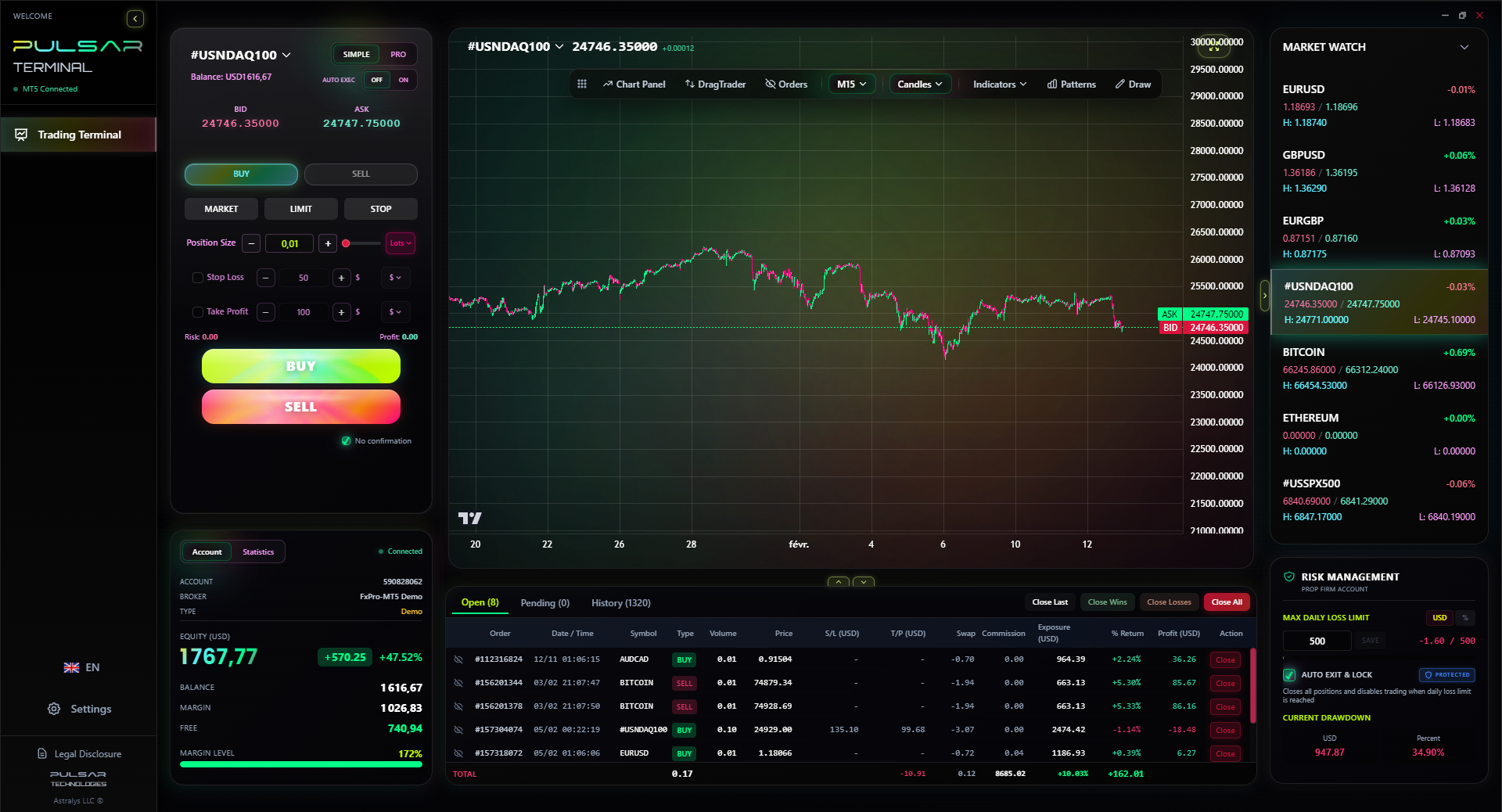
This is where tools can save you. If your prop firm uses MT5, a companion app that lets you set hard daily loss limits automatically is a lifesaver. Passing a prop firm challenge requires iron-clad discipline, and sometimes you need software to be your enforcer when your emotions won't.
Managing daily loss limits is the hardest part of a prop firm challenge, which is why tools like Pulsar Terminal that can automate this and protect your account are invaluable for serious candidates.
Pulsar Terminal
A ferramenta MT5 tudo-em-um: ordens drag-and-drop, multi-TP/SL, trailing stop, grid trading, Volume Profile e proteção prop firm. Usado diariamente por 1.000+ traders.
Let's say you pass a $10k challenge from a cheap prop firm. Congrats! Now you have a live, funded sim account. You make 5% in your first month, that's $500. Your 80% split is $400. Not life-changing, but it's real money from trading.
This is where the good cheap prop firms separate from the mediocre ones. Look for a clear, attainable scaling plan. For example: make 5% over three months, and your account increases by 25% or 50%. Do it again, another increase. The best firms automate this. You hit the target, you get an email, your account size grows. No extra fees, no new challenges.
The psychology here shifts. Now you're trading to grow an asset (your account size), not just to make a monthly payout. That $400 payout is nice, but the chance to turn your $10k account into a $50k account in a year is the real prize. Every trade decision should be filtered through: "Does this help my long-term consistency and my scaling goals?"
I know a trader who started with a $25k account from a budget firm. He treated it like a precious seedling. Took 2-3 trades a week, max. He focused on the EUR/USD guide patterns he knew best. He hit his scaling targets three times in 14 months. That $25k is now $85k. His monthly payouts have grown steadily. He started cheap, but he played the long game the firm's structure allowed. That's the dream.
💡 Dica do Winston
The firms that are easiest to pass are often the hardest to scale with. Read the scaling plan before you buy the challenge. A clear, automatic scaling path is worth a slightly higher entry fee.
“Start small, learn cheap, and scale with confidence.”
The prop space has some bad actors. Here’s how to spot them.
1. The 'No-Rules' Challenge. If they say there's no daily drawdown, or you can lose 50% of the account and still pass, run. This is a marketing gimmick. They'll fail you on "violation of trading principles" or some other vague clause when you're about to cash out.
2. Over-the-Top Payout Promises. "Earn 90% of profits forever!" Real firms have sustainable business models. An offer that seems too generous is paying for something else - like your inevitable failure.
3. No Verifiable Track Record or Community. A legit firm has a public track record. You can find user experiences on independent forums, YouTube reviews from credible sources (not just affiliate promoters), and a history of payouts. If you can't find anyone talking about them beyond their own website, be very skeptical.
4. Pressure to Upgrade Immediately. You fail a $50 challenge and get an email offering a $100k challenge for $999 as a "second chance." This is a classic upsell to a bigger sucker bet. Good cheap prop firms want you to pass the affordable challenge first.
5. Unclear or Opaque Profit Calculations. If you can't easily understand how your profit is calculated, or how the spread/commission affects it, assume it's affecting it a lot in their favor.
Stick with firms that have been reviewed by third-party sites you trust. Look for consistent complaints. One or two bad reviews is normal. A pattern of "they didn't pay me" is a deal-breaker.
- Audit Your Own Trading: Get a month of consistent, profitable results on a personal demo account. Use a journal. If you can't do it with fake money, you won't do it in a challenge.
- Pick Your Instrument: Choose ONE major pair or index to trade during the challenge. Don't jump around. Become a specialist. Your knowledge of its spread definition and behavior is your edge.
- Select Two Firms: Research and pick two potential cheap prop firms. Compare their rules side-by-side. Read the fine print on drawdowns, profit targets, and allowed trading styles (e.g., news trading, holding over weekends).
- Start with the Smaller Challenge: Buy the smaller challenge of the two. This is your low-cost reconnaissance mission. Your goal is to learn their platform and rule enforcement.
- Define Your Challenge Trading Plan: Write down, in detail: Your maximum position size (use a position size calculator). Your daily loss limit (half of theirs). Your only trading setup. The time of day you will trade. The day you will NOT trade (e.g., NFP day).
- Execute, Review, Adapt: Trade the plan. After the challenge - win or lose - review every trade. What did the firm's environment teach you? Then, and only then, consider your second attempt.
The path to a funded account isn't through one heroic challenge win. It's through systematic, disciplined preparation. A good cheap prop firm is simply the most cost-effective testing ground for that discipline. Start small, learn cheap, and scale with confidence.
FAQ
Q1What is the cheapest legit prop firm?
There's no single 'cheapest,' as prices change. Look for reputable firms offering one-step evaluations on $10k-$25k accounts for between $50 and $150. The key is 'legit.' A firm charging $25 with impossible rules is more expensive than a $150 firm with fair rules you can actually pass.
Q2Can you really make money with a cheap prop firm?
Yes, but manage expectations. A $10k funded account making a 5% monthly return is $500. Your 80% split is $400. It's real income, but it's not quit-your-job money. The value is in the track record and the scaling plan. The goal is to grow the account size over time, turning that $400/month into $2,000/month.
Q3What's the biggest mistake traders make with cheap challenges?
Overtrading and incorrect position sizing. They see a $50k account and trade 1-lot positions, blowing the daily drawdown in one or two bad trades. You must trade the challenge account as if it's only as large as your max risk allowance (e.g., 5% of $50k is $2,500). That's your real capital for the test.
Q4Are there any prop firms with free challenges?
Truly free challenges are extremely rare and often have near-impossible terms or are customer acquisition funnels for expensive upgrades. Some firms offer 'free retries' or heavily discounted retries after a failed attempt, which is a better value proposition than an upfront 'free' challenge with hidden traps.
Q5How do I know if a prop firm's rules are fair?
Simulate them. If the profit target is 10% in 30 days with a 5% max loss, ask yourself: "Can my strategy, with my win rate, reasonably hit that without taking excessive risk?" Fair rules allow for normal losing streaks. Unfair rules require almost perfect trading. Also, check if the daily loss is based on starting balance or trailing equity - trailing is stricter.
Q6Do I need a special strategy for prop firm challenges?
You need a strategy adapted to their rules. A high-frequency scalping strategy might violate a firm's minimum trade time rule. A long-term trend-following strategy might struggle with a short time limit. Tweak your existing, proven strategy to fit their specific constraints, especially the daily loss limit.
Lição do Prof. Winston
Pontos-chave:
- ✓Treat challenge fees as educational tuition, not lottery tickets.
- ✓Never risk more than 0.5% of the challenge's max loss on a single trade.
- ✓The best cheap firm has a clear, automatic scaling plan.
- ✓If the rules seem too good to be true, they are designed for you to fail.
Quão útil foi este artigo?
Clique em uma estrela
Insights de Trading Semanal
Análises e estratégias semanais grátis. Sem spam.
Sobre o autor
James Mitchell
Analista de Trading Sênior
Sediado em Nova York com mais de 9 anos de experiência em trading. Focado nos principais pares USD, desafios de prop firms e o cenário regulatório dos EUA.
Comentários
Aviso de risco
A negociação de instrumentos financeiros envolve riscos significativos e pode não ser adequada para todos os investidores. O desempenho passado não garante resultados futuros. Este conteúdo é apenas para fins educacionais e não deve ser considerado aconselhamento de investimento. Sempre conduza sua própria pesquisa antes de negociar.
Você também pode gostar

Cara Trading Forex Sukses: 7 Prinsip dari Trader Profesional
Cara trading forex sukses dengan 7 prinsip trader pro: manajemen modal, disiplin, journal trading, backtest. Data nyata, bukan janji profit palsu.
Jam Trading Forex Terbaik untuk Trader Indonesia: Panduan Lengkap dengan Tabel Waktu
Panduan jam trading forex untuk trader Indonesia. Tabel 4 sesi dunia, jam emas 20:00-00:00, sesi mana yang harus dihindari. Data akurat + tips dari trader berpengalaman.
Top 5 Sàn Forex Uy Tín Nhất 2026: Review Jujur dari Trader Indonesia
Top 5 sàn forex uy tín 2026 untuk trader Indonesia. Review jujur: spread, deposit, withdraw, dukungan lokal. Exness, XM, IC Markets & lebih.
Obter Pulsar Terminal
Todas essas calculadoras estão integradas ao Pulsar Terminal com dados em tempo real da sua conta MT5.
Obter Pulsar Terminal