


I remember staring at my screen in 2017, watching my USD/ZAR trade go against me.

David van der Merwe
Trader de Mercados Emergentes ·  South Africa
☕ 11 min de leitura
O que você vai aprender:
- 1What Margin Actually Is (It's Not Your Money)
- 2Free Margin: Your Real Trading Power (and Safety Net)
- 3Margin Level: The Critical Gauge on Your Dashboard
- 4The South African Context: Rules, Rand, and Real Numbers
- 5Mistakes I've Made (So You Don't Have To)
- 6A Practical Strategy for Managing Margin Daily
- 7Choosing a SA Broker: What to Look for on Margin
I remember staring at my screen in 2017, watching my USD/ZAR trade go against me. My account had R20,000. I was using 50:1 use on a R100,000 position, thinking I was being 'smart' with my capital. The margin required was only R2,000, so I figured I had plenty of buffer. What I didn't grasp was that my free margin - the money actually available to absorb losses - was disappearing faster than a cold drink on a Durban beach. When the rand suddenly strengthened after a SARB announcement, my floating loss hit R1,800. My free margin dropped to almost zero, and I got that dreaded pop-up: 'Margin Level: 105%'. I had to close at a loss or get liquidated. That R1,800 lesson taught me more about the difference between margin and free margin in forex than any textbook ever could.
Let's clear this up first, because most new traders get it wrong. Margin isn't a fee or a cost. It's not something the broker takes from you. Think of it like a security deposit.
When you rent a flat, you pay a deposit, right? The landlord holds it to make sure you don't trash the place. If you leave it clean, you get it back. Margin works the same way. Your broker sets aside a portion of your account balance as collateral to cover potential losses on your leveraged trade. That's your Used Margin.
In South Africa, thanks to FSCA rules, the maximum use for us retail traders on major pairs like EUR/USD is capped at 30:1. This is a good thing - it protects us from ourselves. So, if you want to open a $30,000 (roughly R540,000) position on EUR/USD, you don't need the full $30,000. At 30:1 use, your broker will require 1/30th of that as margin: $1,000 (about R18,000). That $1,000 gets locked up as Used Margin.

Warning: This is where the danger lies. Because you only put down R18,000, you feel like you're controlling R540,000. Your potential profit and loss are calculated on the full R540,000 position. A 1% move against you isn't a R180 loss; it's a R5,400 loss. That's why understanding your margin call level is non-negotiable.

💡 Dica do Winston
Your broker's margin call is their problem. Your stop-loss is your solution. Always trade with the latter.
If Used Margin is the money locked in your current trades, Free Margin is the money left in your pocket. It's your available balance to open new positions or, more importantly, to absorb the floating losses from your open trades.
The formula is simple, but it's everything: Free Margin = Equity – Used Margin
Your Equity is your current account value: your starting balance plus or minus your running profit/loss on open trades.
Let me give you a real example from last month. My account balance was R50,000. I opened two trades:
- A GBP/USD position requiring R8,000 in Used Margin.
- A Gold (XAU/USD) position requiring R12,000 in Used Margin.
My total Used Margin was R20,000. My Free Margin was R30,000 (R50,000 - R20,000). All good.
Then, my GBP/USD trade went south by R2,500. My Equity dropped to R47,500 (R50,000 - R2,500). My Used Margin was still R20,000. Instantly, my Free Margin was only R27,500 (R47,500 - R20,000).
That R2,500 loss came directly out of my Free Margin pool. If my Free Margin hits zero, I can't open any new trades. If it goes negative, I'm getting a margin call. This is why I always use a position size calculator before every trade - it tells me exactly how much margin I'll use and how much free margin I'll have left.

Pro Tip: Your Free Margin is your breathing room. I never let my Used Margin exceed 30% of my account equity. If my Free Margin drops below 70% of my account value, I know I'm overexposed and need to reassess.
“Margin is the deposit you give the broker. Free margin is the oxygen left in the room for you to breathe.”
Your trading platform shows a percentage called Margin Level. This is your most important real-time risk metric. Ignore it at your peril.
Margin Level = (Equity / Used Margin) x 100
This number tells you how much cushion you have left. Let's break down what the percentages mean:
| Margin Level | What It Means | What Happens |
|---|---|---|
| Above 200% | Healthy. You have ample Free Margin. | You're in control. |
| 100% | Danger Zone. Equity = Used Margin. | Free Margin is ZERO. You cannot open new trades. A margin call is imminent. |
| 50% (or broker's stop-out level) | Stop-Out. | Your broker will start automatically closing your losing positions, usually starting with the biggest loser, to prevent your account from going negative. |
South African brokers like Khwezi Trade or FP Markets have their specific stop-out levels (often between 20-50%). You must know yours. I learned this the hard way with a broker whose stop-out was 30%. My margin level dipped to 32%, I thought I was safe, but a quick spike in USD/ZAR volatility pushed it to 29% in seconds, and my largest position was closed instantly.
Keeping an eye on this level is more important than staring at your P&L. It's the fuel gauge for your trading account.
Trading from SA isn't the same as trading from the US or UK. Our rules, our currency, and our broker options shape everything.
The FSCA use Cap
Since 2021, the Financial Sector Conduct Authority (FSCA) caps use for retail clients at 30:1 for major pairs. For minors like USD/ZAR, it's often lower (20:1 or 10:1). This directly affects your margin. To control a $100,000 (R1.8m) lot, you need $3,333 (R60,000) margin. Compare that to an unregulated offshore broker offering 500:1, where you'd only need $200 (R3,600) margin. The FSCA cap forces you to put more skin in the game, which is frustrating when you want bigger positions, but it saves countless accounts from blow-ups.
Trading in ZAR vs USD
Many local brokers, like Khwezi Trade, offer ZAR-denominated accounts. This is a double-edged sword. The Good: No currency conversion fees. Your margin, profit, and loss are all in rands. It's simpler. The Catch: If the rand weakens dramatically, the relative cost of trading international instruments (funding your account in rands to trade USD-based pairs) can increase. I fund my account in USD for my main trading, as I'm primarily trading EUR/USD and XAU/USD. I use a ZAR account for smaller, experimental trades.
Broker Spreads & Margin
Your broker's spread affects your equity the moment you open a trade. A wider spread means a slightly larger initial loss. Here's a quick local comparison:
- IC Markets: Might show 0.0 pips on EUR/USD, but charge a commission. Your effective cost is low, preserving more Free Margin from the start.
- Standard "Commission-Free" Account: Might have a 1.3 pip spread. That's an immediate R130 cost on a R100,000 position, which comes straight off your Equity and reduces your Free Margin.
Always factor in the spread as an immediate cost against your Free Margin. A tool that helps you visualize this entry cost in the context of your account equity can be a game-saver.
💡 Dica do Winston
Free margin isn't 'extra' money. It's your account's immune system. Deplete it, and the first sniffle will put you in the ICU.
“The FSCA's 30:1 use cap isn't a restriction; it's a seatbelt for a market full of potholes.”
Mistake 1: Confusing Free Margin with "Available to Trade"
Early on, I saw R40,000 in Free Margin and thought, "Great, I can open another R40,000 worth of positions!" Wrong. That R40,000 needs to cover the margin for new trades AND potential losses from all trades. If I used all R40,000 as new Used Margin, my Free Margin would be zero, and the first tick against me would trigger a warning. Now, I never use more than 50% of my Free Margin for new position margin.
Mistake 2: Ignoring Margin on Pending Orders
This one stung. I set a bunch of limit orders on a swing trading setup. My current Free Margin was healthy. But I forgot that most brokers reserve margin for pending orders. When all my orders triggered in a volatile spike, my Used Margin ballooned instantly, my Free Margin plunged, and I got a margin call before I could even manage the trades. Now, I account for the total potential margin of all pending orders in my risk calculation.
Mistake 3: Over-leveraging in a "Small" Account
I funded an account with R5,000, wanting to "grow it quickly." With 30:1 use, I could control R150,000. I thought a 2% move would make me R3,000. What happened? A 0.67% move against me wiped out R1,000 of my equity - that's 20% of my account. My Margin Level crashed. The psychological pressure was immense. I closed for a loss. The lesson? use magnifies losses faster than profits. For small accounts, use lower use, not the maximum. Treat the FSCA's 30:1 as a limit, not a target.

Example: Account: R10,000. Trade: 1 mini lot (R100,000) on USD/ZAR at 20:1 use.
- Used Margin: R5,000 (R100,000 / 20)
- Free Margin: R5,000 (R10,000 - R5,000)
- A 50 pip loss (common in ZAR pairs) = R500 loss.
- New Equity: R9,500. New Free Margin: R4,500.
- Your account just lost 5%, and your available capital dropped 10%. See how fast it moves?
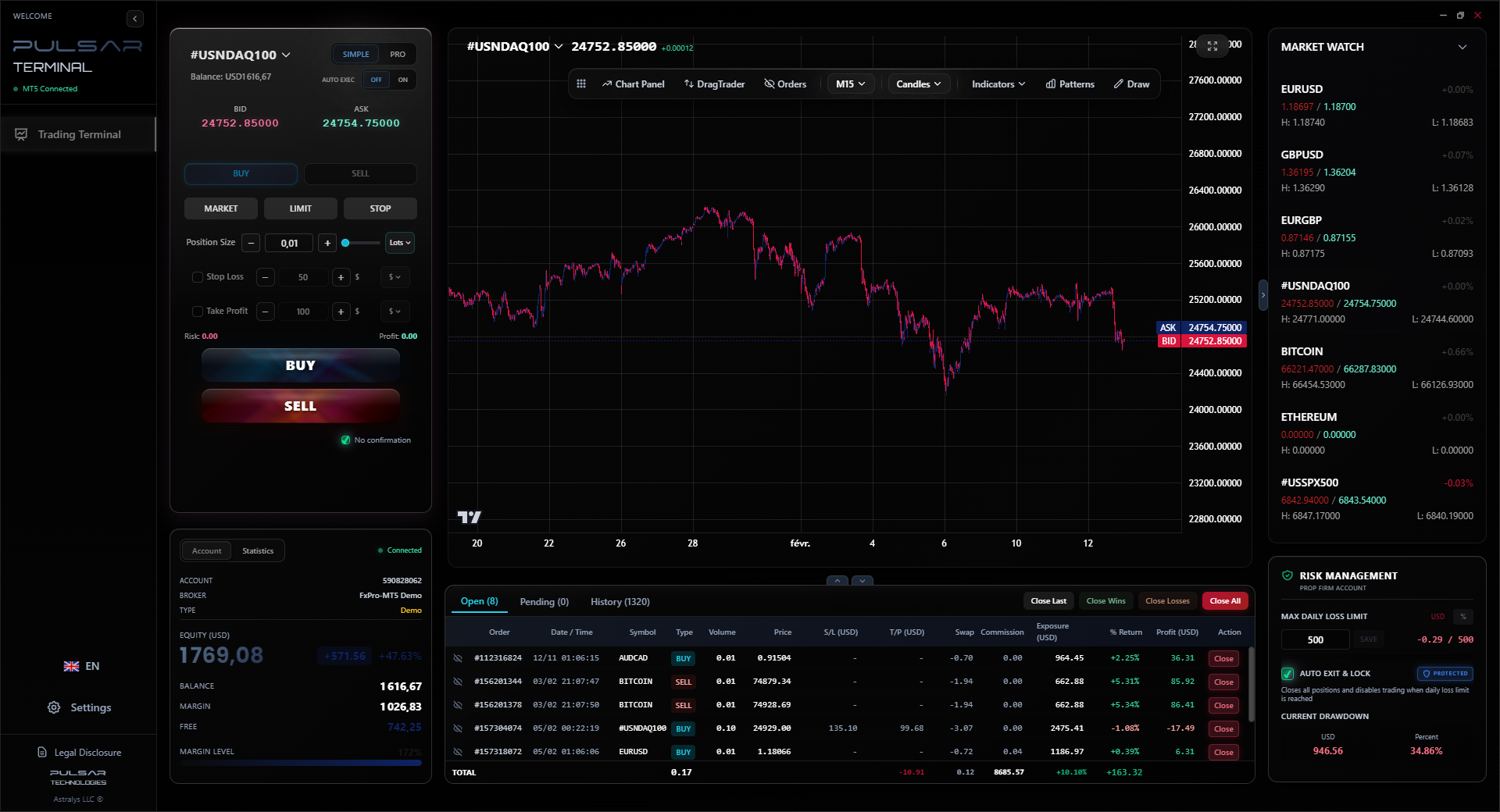
Manually calculating margin for multiple trades and pending orders is error-prone; Pulsar Terminal's drag-and-drop order panel shows your used and free margin in real-time as you set up your trades.
Pulsar Terminal
A ferramenta MT5 tudo-em-um: ordens drag-and-drop, multi-TP/SL, trailing stop, grid trading, Volume Profile e proteção prop firm. Usado diariamente por 1.000+ traders.
Here’s my simple routine. It takes 2 minutes and has saved me thousands.
-
The Pre-Trade Check: Before any trade, I calculate the worst-case scenario. I look at the recent Average True Range (ATR) for the pair. If USD/ZAR has a 100-pip ATR, I ask: "Can my account survive a 100-pip move against this position?" I use my position size calculator to input my stop-loss and see what that loss would be in rands. That loss amount must be less than 30% of my current Free Margin. If it isn't, my position is too big.
-
The Equity Watch: I don't just watch my P&L. I have my Margin Level percentage displayed prominently on my chart. If it drops below 300%, I'm on alert. Below 200%, I'm reviewing all open trades and considering reducing exposure.
-
The Withdrawal Rule: This is psychological. When my Equity grows by 20% from its baseline (excluding my initial deposit), I withdraw the profit. This does two things: it physically takes money off the table, and it resets my account size, forcing me to recalculate all my margin requirements based on a smaller, safer balance. It prevents me from letting winning streaks trick me into using dangerously high margin.
Managing margin isn't about complex math. It's about discipline. It's about knowing that the R10,000 you see as "available" isn't all for trading - it's your lifeboat. The best trade you'll ever make is the one you don't take because your Free Margin told you not to.
“Watching your Margin Level is more important than watching your profit. One tells you your score, the other tells you if you're still in the game.”
Not all brokers are equal when it comes to how they handle margin. Here’s your checklist:
- FSCA Regulation: Non-negotiable. It guarantees the 30:1 use cap, segregated funds, and a legal recourse. Check the FSP number on the FSCA website.
- Clear Stop-Out Policy: The broker must clearly state their margin call and stop-out levels. Is it 50%? 30%? 20%? Prefer a higher stop-out (like 50%) as it's a stricter safety net.
- ZAR Accounts & Local Deposits: Does the broker offer a ZAR account? Can you deposit via EFT from your FNB or Standard Bank account without crazy fees? Local deposits mean you can top up your margin quickly if needed (though this should be a last resort).
- Platform Stability: During high volatility (like SARB announcements), does their MT4/MT5 platform freeze? If you can't close positions when your Margin Level is falling, you're toast. I've had good stability with IC Markets and XM during local events.
- Negative Balance Protection: While common with regulated brokers, confirm it. This ensures you can never lose more than your account balance, even if a "flash crash" blows through your stop.
My personal preference is to use a larger, internationally regulated broker like IC Markets or Pepperstone for my primary trading due to their tight spreads and execution speed, which helps preserve Free Margin. I keep a smaller account with a pure South African FSCA broker like Khwezi Trade to stay compliant and support local. You need to find your own balance.
Remember, the broker is your partner in this. Their margin rules are the rules of the game. You need to know them better than they do.
FAQ
Q1If my Free Margin is R10,000, can I open a trade that uses R10,000 in margin?
Technically, yes, your platform might let you. But it's a terrible idea. The moment you open that trade, your Free Margin becomes R0. Any floating loss, even 1 pip, will push your Margin Level below 100%, triggering a margin call. Your Free Margin is for losses and new margin. Never use it all.
Q2What's the difference between a Margin Call and a Stop-Out?
A Margin Call is a WARNING. It's your broker saying, "Your Free Margin is zero or negative. Please deposit more funds or close positions to increase your Margin Level." A Stop-Out is ACTION. If you don't respond to the warning and your Margin Level falls to a pre-set level (e.g., 50%), the broker will automatically start closing your positions to protect themselves from further loss. The stop-out is the point of no return.
Q3Does my Free Margin go up if my open trades are in profit?
Yes, absolutely. Remember, Free Margin = Equity - Used Margin. If your trades are in profit, your Equity increases. Your Used Margin stays the same (it's fixed when you open the trade). So, a higher Equity means a higher Free Margin. Profitable trades literally free up more capital for you to use.
Q4Why did my Free Margin change when I didn't open or close any trades?
Because your Equity changed. Every tick of price movement changes the floating profit/loss on your open positions, which changes your Equity. If your trades are moving against you, your Equity drops, and so does your Free Margin. It's a live, breathing number.
Q5Is the FSCA's 30:1 use limit good for traders?
It's excellent for beginner and intermediate traders. It feels restrictive when you want big positions, but it forces proper position sizing. Before the cap, I saw too many people blow R50,000 accounts using 400:1 use in a single afternoon. The cap saves more accounts than it hinders. Professional traders can apply for higher use by proving experience and wealth.
Q6Can I lose more money than I have in my account?
With a reputable FSCA-regulated broker offering Negative Balance Protection, no. Your maximum loss is limited to the funds in your account. However, with unregulated brokers or in extreme market gaps, it is theoretically possible (though very rare with majors). Stick to regulated brokers.
Lição do Prof. Winston
Pontos-chave:
- ✓Used Margin is locked collateral. Free Margin is your survival fund.
- ✓Margin Level below 100% means a margin call is imminent.
- ✓FSCA caps retail use at 30:1 for major pairs.
- ✓A 50-pip loss on a standard lot can wipe out 25% of a small account's Free Margin.
- ✓Always calculate margin impact before opening a trade.
Quão útil foi este artigo?
Clique em uma estrela
Insights de Trading Semanal
Análises e estratégias semanais grátis. Sem spam.
Sobre o autor
David van der Merwe
Trader de Mercados Emergentes
Trader sediado em Joanesburgo com 11 anos em moedas de mercados emergentes. Especialista em pares ZAR, trading regulado pela FSCA e análise do mercado sul-africano.
Comentários
Aviso de risco
A negociação de instrumentos financeiros envolve riscos significativos e pode não ser adequada para todos os investidores. O desempenho passado não garante resultados futuros. Este conteúdo é apenas para fins educacionais e não deve ser considerado aconselhamento de investimento. Sempre conduza sua própria pesquisa antes de negociar.
Você também pode gostar

Cara Trading Forex Sukses: 7 Prinsip dari Trader Profesional
Cara trading forex sukses dengan 7 prinsip trader pro: manajemen modal, disiplin, journal trading, backtest. Data nyata, bukan janji profit palsu.
Jam Trading Forex Terbaik untuk Trader Indonesia: Panduan Lengkap dengan Tabel Waktu
Panduan jam trading forex untuk trader Indonesia. Tabel 4 sesi dunia, jam emas 20:00-00:00, sesi mana yang harus dihindari. Data akurat + tips dari trader berpengalaman.
Top 5 Sàn Forex Uy Tín Nhất 2026: Review Jujur dari Trader Indonesia
Top 5 sàn forex uy tín 2026 untuk trader Indonesia. Review jujur: spread, deposit, withdraw, dukungan lokal. Exness, XM, IC Markets & lebih.
Obter Pulsar Terminal
Todas essas calculadoras estão integradas ao Pulsar Terminal com dados em tempo real da sua conta MT5.
Obter Pulsar Terminal