


Thinking about trying binary options on forex pairs? You've probably seen the ads promising quick, easy money.

David van der Merwe
Trader de Mercados Emergentes ·  South Africa
☕ 9 min de leitura
O que você vai aprender:
- 1What Are Binary Options, Really?
- 2The Legal Lowdown: FSCA Rules and Offshore Risks
- 3Broker Comparison: Real Numbers on Deposits, Payouts & Fees
- 4Why Strategy & Psychology Are Everything
- 5Making It Real: Deposits, Withdrawals & ZAR
- 6Binary Options vs. Traditional Forex: A Side-by-Side Look
- 7The Final Verdict & How to Start (If You Still Want To)
Thinking about trying binary options on forex pairs? You've probably seen the ads promising quick, easy money. Before you deposit a single rand, you need to understand what you're really getting into. I've traded these instruments, and I can tell you it's a world apart from regular forex. This guide will walk you through the South African landscape, the real numbers behind the payouts, and why choosing the right broker is only half the battle.
Let's strip away the marketing. A binary option is a simple 'yes or no' bet on whether an asset's price will be above or below a certain level at a specific time. You're not buying the asset itself, like you would with a share or a forex lot. You're buying a contract with a fixed outcome: you either win a predetermined payout, or you lose your entire stake. That's the 'binary' part – all or nothing.
For example, you might bet R100 that the EUR/USD will be above 1.0850 in 15 minutes. If it is, you get a 75% payout (R175 total). If it's not, you lose the full R100. The appeal is obvious: simplicity and defined risk. You know your exact profit or loss before you even place the trade. But that defined risk is 100% of your stake on every losing trade. This structure makes it incredibly seductive and, frankly, dangerous for new traders. It encourages short-term gambling on price noise rather than long-term analysis. I learned this the hard way early on, blowing through a R2000 account in a week trying to predict 5-minute moves on gold.

Warning: The fixed payout structure is designed to be in the broker's favor over the long run. To be profitable, your win rate needs to be significantly higher than in traditional trading. A strategy that wins 55% of the time in forex might still lose you money in binaries.

💡 Dica do Winston
A 95% payout sounds generous until you do the math. You need a 51.3% win rate just to break even. The house edge is always there, cleverly disguised.
“Binary options are a derivative product on forex, not a direct substitute for it.”
Here's the crucial part for any South African trader. Binary options trading is legal here. The Financial Sector Conduct Authority (FSCA) is the main watchdog. In an ideal world, you'd only use an FSCA-authorized broker, often registered as an Over-the-counter Derivatives Provider (ODP). This gives you a path for complaint if something goes wrong.
The Offshore Reality
The reality? Most of the popular platforms you'll see advertised – Pocket Option, Quotex, IQ Option – are not regulated by the FSCA. They're based offshore, licensed in places like Vanuatu or St. Vincent. The FSCA has explicitly warned against dealing with unauthorized firms. In May 2025, they called out 'Binary Options Investment (BOI)' for soliciting funds without a license and making wild claims about '96% winning rates'.
When you trade with an offshore broker, you step outside the South African regulatory safety net. Your funds aren't protected under local laws. If the broker decides to freeze your account or makes withdrawal difficult, your options are very limited. I once had a R5000 withdrawal stuck 'in processing' with an unregulated platform for over a month. It eventually came, but the stress wasn't worth it.
Your first filter for any broker should be: are they FSCA-regulated? If not, you are accepting a much higher level of counterparty risk. Some international brokers like Deriv hold other reputable licenses (like CySEC in Europe), which is better than nothing, but it still doesn't give you FSCA recourse.
💡 Dica do Winston
The FSCA warning list is your friend. Checking it is the fastest, free due diligence you can do. If a broker is on it, your money is already at risk before you even trade.
“When you trade with an offshore broker, you step outside the South African regulatory safety net.”
Let's talk specifics. The numbers below are typical, but always check the broker's website directly as they change.
| Broker | Typical Min. Deposit | Min. Trade | Max. Payout | Key Regulation |
|---|---|---|---|---|
| Pocket Option | $50 (some say $1) | $1 | Up to 95%+ | Offshore (IFMRRC) |
| Quotex | ~$10 | $1 | Up to 95% | Offshore |
| IQ Option | $10 | $1 | Up to 90%+ | CySEC (EU), but unregulated for ZA clients. FSCA has warned about them. |
| Deriv | $5 (e-wallet) | ~$0.35 | Up to 95% | Multiple (MFSA, VFSC, BVI FSC) |
| Binomo | $1 | $1 | Up to 90% | Offshore |
Understanding the costs:
- Payouts: That '95% payout' sounds great. But it means you need to win roughly 51.3% of your trades just to break even (100/195). If the payout is 80%, you need a 55.6% win rate. This is the hidden house edge. You can use a position size calculator to work out the exact risk on each trade, but remember, the risk is always 100% of your stake.
- Fees: Spreads don't exist in the traditional sense. Instead, watch for deposit/withdrawal fees (e.g., CM Trading charges 2%), currency conversion fees if depositing in ZAR, and inactivity fees (e.g., $10-$15 per month after a year).
- Platforms: Most have their own slick, simple web platforms. Some, like Deriv, also offer MT5 access for a more familiar charting experience. IQ Option does not support MetaTrader.
“When you trade with an offshore broker, you step outside the South African regulatory safety net.”
You can have the best broker in the world and still lose everything. Binary options amplify every trading mistake. Here’s what I wish I knew sooner.
Strategy is Not Optional
You need a clear, tested edge. Guessing based on a 'feeling' is a recipe for ruin. Many traders adapt common indicators. For instance, using the RSI indicator to spot overbought/oversold conditions on a 5-minute chart, or the MACD indicator for momentum shifts. But be warned: these signals are noisy on very short timeframes. A strategy that might work for swing trading over days falls apart in 60-second binaries.
True scalping strategy discipline is required. You need strict entry rules, and you must avoid the temptation to 'double down' after a loss. My worst day saw me lose 12 trades in a row trying to recoup losses. It was a brutal, expensive lesson in emotional control.
The Psychology Trap
The fast pace and all-or-nothing outcomes trigger a casino mentality. A win gives a quick dopamine hit, a loss prompts an urgent desire to win it back immediately. You stop analyzing and start reacting. The only way to combat this is with robotic discipline: a fixed trade size (never more than 1-2% of your total capital per trade), a daily loss limit, and mandatory breaks after two consecutive losses.

Pro Tip: Keep a trading journal. Write down every trade: asset, time, expiry, reason for entry (e.g., '5-min RSI > 70, price at resistance'), and outcome. After 100 trades, you'll see if you actually have an edge or are just gambling. My first journal revealed my 'gut feeling' trades had a 42% win rate.
“The fast pace and all-or-nothing outcomes trigger a casino mentality.”
Getting money in and out is a practical headache you need to plan for.
Local Payment Methods: Most brokers catering to South Africans accept:
- Bank Cards: Visa/Mastercard are universal.
- E-Wallets: Skrill, Neteller, and SticPay are very common. They act as a middleman, which can sometimes speed up withdrawals.
- Crypto: Bitcoin, USDT. Often the fastest and cheapest for withdrawal, but introduces crypto volatility risk.
- Bank Transfer: Slow and can have high fees, especially for international wires.
The ZAR Problem: Few brokers hold ZAR accounts. Your deposit will be converted to USD or EUR. Your bank or card provider will add a foreign exchange fee (often 2-3%). When you withdraw, it's converted back again. These small percentages eat into your profits over time. Always check the broker's stated conversion rates and fees.
Withdrawal Red Flags: If a broker makes withdrawals difficult – demanding excessive verification you've already provided, charging huge fees, or delaying for 'manual processing' for weeks – it's a major warning sign. Stick to brokers with clear, published withdrawal policies and timelines (e.g., 1-3 business days for e-wallets). Reading independent reviews like our Exness review or Pepperstone review can give you a sense of a company's operational reliability, even if they don't offer binaries.
💡 Dica do Winston
Your first 100 trades should be on demo. Your second 100 trades live should be at 1/10th of your intended stake size. If you can't be patient through this, you lack the temperament for binaries.
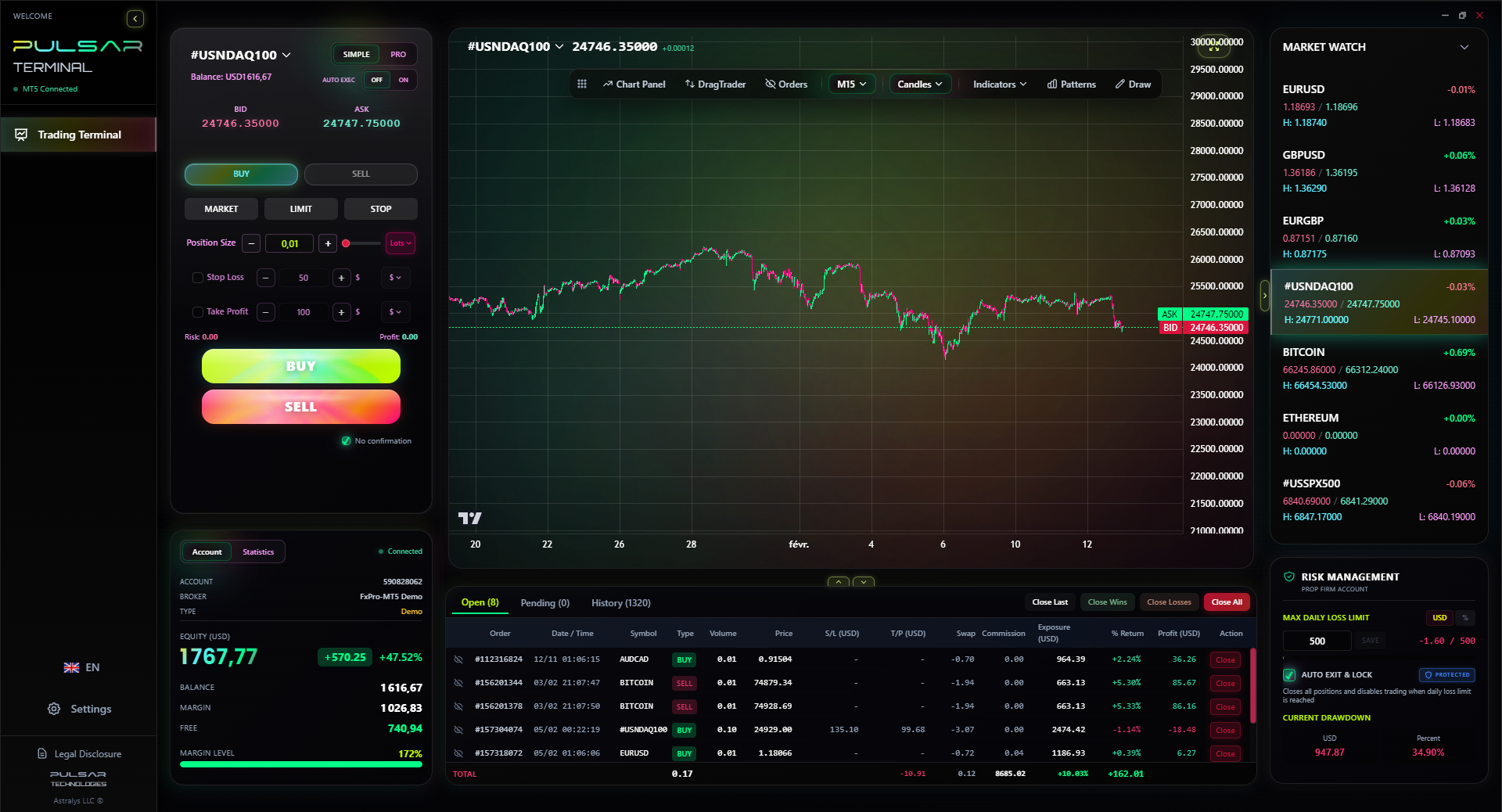
While binary options have fixed outcomes, managing your overall capital and journaling your trades is critical, and tools like Pulsar Terminal can help organize your trading data directly on your MT5 platform.
Pulsar Terminal
A ferramenta MT5 tudo-em-um: ordens drag-and-drop, multi-TP/SL, trailing stop, grid trading, Volume Profile e proteção prop firm. Usado diariamente por 1.000+ traders.
“The fast pace and all-or-nothing outcomes trigger a casino mentality.”
Should you trade binaries or stick to the standard forex market? Let's be clear about the differences.
Traditional Forex (on XM, IC Markets, etc.):
- Risk: You control it with stop-loss orders. You can lose a known, limited amount on a trade.
- Profit: Unlimited potential on a winning trade. You can ride a trend for days.
- Costs: You pay the spread definition and possibly a commission.
- Analysis: Focuses on fundamentals, long-term trends, and deeper technical analysis.
- Time Commitment: Can suit swing trading over hours or days.
Binary Options:
- Risk: Fixed. You lose 100% of your stake if wrong. No stop-loss needed.
- Profit: Fixed. Capped at the agreed payout, even if the price rockets past your target.
- Costs: The cost is the built-in house edge via the payout percentage.
- Analysis: Almost purely short-term technical analysis on very noisy charts.
- Time Commitment: Intense, focused on minutes or seconds.
Binary options are a derivative product on forex, not a direct substitute for it. They are a tool for speculating on very short-term volatility, not for investing in currency trends. Most successful forex traders I know avoid binaries entirely because the structure is stacked against you in the long run.
“View binary options as a form of skilled speculation, not investment.”
Here's my honest take. Forex binary options brokers offer a legal, accessible, but extremely high-risk way to trade. For most people, especially beginners, the odds are structurally unfavorable. The psychological pressures are immense, and the prevalence of unregulated brokers adds another layer of risk.
If you've read all this and still want to proceed, here is the safest path:
- Education First: Don't deposit real money. Use a broker's demo account exhaustively. Trade for a month as if it were real. Can you be consistently profitable? My demo success did not translate to live markets initially because the emotions were absent.
- Broker Due Diligence: Prioritize regulation. An FSCA-regulated entity is best. If going offshore, pick one with other strong licenses (like CySEC) and a long, verifiable track record.
- Start Microscopic: Your first live deposit should be money you are 100% prepared to lose. Not R10,000 'to make it worthwhile.' Start with R500 or R1000. Use a miniscule trade size (R10-R20). The goal is to learn the live environment, not get rich.
- Implement Military Discipline: Set a daily loss limit (e.g., 10% of account). Never breach it. Use a fixed trade size. Walk away after two consecutive losses.
- Know Your Assets: Stick to major, liquid pairs like EUR/USD or assets like XAU/USD (gold). Avoid exotic pairs with wider spreads that make short-term predictions even harder.
, view binary options as a form of skilled speculation, not investment. The market doesn't care about your hopes. It only responds to price. Trade the price, manage your risk like your financial life depends on it (because it does), and never forget that the easiest person to fool in this game is yourself.
FAQ
Q1Is binary options trading legal in South Africa?
Yes, it is legal. The Financial Sector Conduct Authority (FSCA) regulates the activity. However, many brokers accepting South African clients are based offshore and not regulated by the FSCA, which increases your risk.
Q2What is a typical payout percentage for binary options?
Payouts typically range from 65% to 95% of your stake. A 90% payout means you risk R100 to make R90 profit. This structure requires a win rate well above 50% to be profitable long-term.
Q3Can I trade binary options on the USD/ZAR pair?
Some international brokers offer USD/ZAR as a tradable asset. However, it's less common than major pairs like EUR/USD. Be aware that trading your local currency pair can still involve conversion fees if your account is in USD.
Q4What's the minimum deposit for binary options brokers?
Minimum deposits can be very low, often between $1 and $50. Brokers like Binomo and Quotex allow you to start with $1 or $10. This low barrier is part of the appeal but also the danger, as it encourages overtrading.
Q5How do I avoid a margin call in binary options?
Binary options don't use margin in the same way as forex. You can't lose more than your stake on a single trade. However, the equivalent risk is blowing your entire account. To avoid this, you must use strict position sizing (e.g., never risk more than 2% of your total capital on one trade) and a daily loss limit. The concept of a margin call is replaced by the risk of total account depletion.
Q6Are binary options easier than forex trading?
They are simpler to understand, but not easier to profit from. The all-or-nothing, short-term nature makes them psychologically harder and statistically stacked against the trader. Successful forex trading requires patience and trend-following; binary options require pinpoint accuracy on very short-term noise.
Q7Can I use MetaTrader 5 for binary options?
Most dedicated binary options brokers use their own proprietary platforms. A few, like Deriv, do offer MT5 access alongside their binary products. Major forex brokers like IC Markets or Pepperstone who use MT5 do not typically offer binary options.
Lição do Prof. Winston
Pontos-chave:
- ✓Payouts of 90% require a 52.6% win rate to break even.
- ✓FSCA regulation is your primary layer of protection.
- ✓Unregulated offshore brokers pose significant withdrawal risks.
- ✓Never risk more than 2% of your capital on a single binary trade.
- ✓Demo trade for one month minimum before going live.
Quão útil foi este artigo?
Clique em uma estrela
Insights de Trading Semanal
Análises e estratégias semanais grátis. Sem spam.
Sobre o autor
David van der Merwe
Trader de Mercados Emergentes
Trader sediado em Joanesburgo com 11 anos em moedas de mercados emergentes. Especialista em pares ZAR, trading regulado pela FSCA e análise do mercado sul-africano.
Comentários
Aviso de risco
A negociação de instrumentos financeiros envolve riscos significativos e pode não ser adequada para todos os investidores. O desempenho passado não garante resultados futuros. Este conteúdo é apenas para fins educacionais e não deve ser considerado aconselhamento de investimento. Sempre conduza sua própria pesquisa antes de negociar.
Você também pode gostar

Cara Trading Forex Sukses: 7 Prinsip dari Trader Profesional
Cara trading forex sukses dengan 7 prinsip trader pro: manajemen modal, disiplin, journal trading, backtest. Data nyata, bukan janji profit palsu.
Jam Trading Forex Terbaik untuk Trader Indonesia: Panduan Lengkap dengan Tabel Waktu
Panduan jam trading forex untuk trader Indonesia. Tabel 4 sesi dunia, jam emas 20:00-00:00, sesi mana yang harus dihindari. Data akurat + tips dari trader berpengalaman.
Top 5 Sàn Forex Uy Tín Nhất 2026: Review Jujur dari Trader Indonesia
Top 5 sàn forex uy tín 2026 untuk trader Indonesia. Review jujur: spread, deposit, withdraw, dukungan lokal. Exness, XM, IC Markets & lebih.
Obter Pulsar Terminal
Todas essas calculadoras estão integradas ao Pulsar Terminal com dados em tempo real da sua conta MT5.
Obter Pulsar Terminal