


Let's cut through the noise.

David van der Merwe
Trader de Mercados Emergentes ·  South Africa
☕ 11 min de leitura
O que você vai aprender:
- 1The Durban Forex Class Landscape: What You're Really Buying
- 2What a Good Course MUST Cover (Or It's Useless)
- 3Costs & Realistic Earnings: The Rand and Cents Truth
- 4Brokers & Platforms: Your Actual Trading Tools
- 5The Free Self-Education Roadmap (Save Your Money)
- 6Red Flags & Scams: Protecting Your Wallet
- 7Final Verdict & Your Next Steps
Let's cut through the noise. The biggest myth about forex classes in Durban is that they'll turn you into a profitable trader. They won't. Most are overpriced PowerPoint presentations that leave you more confused and R20,000 poorer. I've seen it a hundred times. This guide isn't about selling you a course; it's about showing you what you actually need to know, where to find real value, and how to avoid the predators circling the newbie trader. I'll give you the numbers, the local specifics, and the hard truths so you can make an informed choice.
Driving around Durban, you'll see flyers and social media ads promising financial freedom through forex. It's a minefield. The offerings generally fall into three camps, and only one is worth your time.
The Expensive "Academy" Trap
These are the big names, often with slick websites and promises of mentorship. They'll charge you anywhere from R2,500 to a staggering R20,000 for a "complete" course. I once sat in on one of these (posing as a clueless uncle) where the "guru" spent three hours explaining what a candlestick was. For R15,000. The material is almost always generic, freely available information repackaged with a premium price tag. The promised "one-on-one mentorship" often translates to a weekly group Zoom call with 50 other people.

Warning: Any course demanding a large, non-refundable deposit (like R1,500) before you've seen the content is a major red flag. That's a classic tactic to lock you in before you realize the value isn't there.
The Weekend Warrior Workshop
These are cheaper, one or two-day intensives, like the 1-day course offered by The Knowledge Academy. They cost R500 to R2,000. They're good for one thing only: absolute conceptual basics. You'll learn the very bare bones – what forex is, what a broker does, maybe how to place a trade. Think of it as Forex 101. The problem? You walk out thinking you're ready to trade, but you have zero clue about risk management, psychology, or developing a real strategy. It's like getting a driver's license after only learning what the pedals do.
The Real Value (It's Not What You Think)
The best "class" you can take is free and online. I'm talking about the educational sections from reputable, FSCA-regulated brokers. Brokers like IC Markets, Pepperstone, and XM have extensive libraries covering everything from basic terminology to advanced chart patterns. Why is this better? It's structured, it's accurate (they have a legal obligation not to mislead), and it's directly applicable to their trading platforms. Pair this with a demo account, and you have a practical, risk-free learning environment. This is where you should spend your first 100 hours, not R20,000.

💡 Dica do Winston
Your first R20,000 is better spent on 100 hours of demo trading and a stack of books on trading psychology than on any 'premium' course. The market doesn't care what certificate you have.
“The biggest cost isn't the course fee; it's the opportunity cost of your time and the inevitable learning losses.”
If you do decide to pay for a course in Durban, use this as a checklist. If it misses more than one of these points, walk away. Your money is better spent on a good position size calculator and screen time.
- South African Regulations, Front and Center. It must explain the FSCA, the 30:1 use cap for retail traders, and what client fund segregation means. Trading with an unregulated offshore broker offering 1000:1 use is a different (and far riskier) game. A proper course will drill into local specifics.
- Risk Management is King. This isn't a sidebar topic; it's the main event. They need to teach you how to calculate position size based on your account balance and risk tolerance. They must explain stop-losses, the concept of risk-reward ratios (I never enter a trade aiming for less than 1:1.5), and what a margin call feels like (it feels terrible, trust me).
- Psychology Over Indicators. Anyone can teach you how to draw a moving average. Will they teach you how to handle a 5-trade losing streak without blowing up your account? Will they make you confront your own greed and fear? The course should have dedicated modules on trading psychology - this is what separates break-even traders from profitable ones.
- Practical Platform Walkthrough. Not just theory. They need to show you, on MetaTrader 4 or 5, how to place a trade, set a stop-loss, take profit, and read the deal ticket. How does the spread affect your entry? What's the difference between a market and pending order?
- Strategy, Not Magic. They should teach you one or two complete strategies from top to bottom: how to find the trade, how to enter, where to place stops, how to manage the trade, and when to exit. It should be rules-based, not "I have a feeling." A good intro is a simple swing trading strategy based on support and resistance.

Pro Tip: Ask the course provider for a detailed syllabus before you pay. If it's vague ("Module 3: Making Profits") or obsessed with flashy cars and lifestyles, it's a marketing pitch, not an education.
“Trading with an unregulated entity is like handing your cash to a guy in a parking lot.”
Let's talk numbers, because this is where dreams get crushed by reality. I'll give it to you straight.
What You'll Pay:
- Beginner Basics: R500 - R2,500. Expect introductory concepts only.
- "Advanced" Courses: R2,500 - R20,000+. This is the danger zone. The value rarely matches the price.
- Ongoing Costs: Your real education cost is your trading capital. You should start with money you are 100% prepared to lose. Don't fund a live account with rent money.
What You'll (Probably) Earn as a Beginner: Forget the Lamborghini ads. Here's the real Durban story for the first 6-12 months:
- Daily: R50 to R300 on good days. More often, R0 or small losses as you learn. Your goal is survival, not income.
- Monthly: R1,000 to R10,000 is a realistic range for a beginner who's getting the hang of it. That's if you're disciplined. Most lose money initially.
I remember my first "successful" month. I turned a R10,000 account into R11,200. I was ecstatic. A R1,200 profit. Then I calculated the hours I'd spent staring at charts - it worked out to about R25 an hour. It was a humbling lesson that this is a marathon. The intermediate traders I know who are consistently profitable might pull in R10,000 to R50,000 monthly, but that's after years of screen time and blown accounts.
The biggest cost isn't the course fee; it's the opportunity cost of your time and the inevitable learning losses. Budget for both.
“Trading with an unregulated entity is like handing your cash to a guy in a parking lot.”
Your class might teach you theory, but you'll trade on a broker's platform. This choice is critical. In South Africa, you must prioritize FSCA regulation. It's your only safety net.
Why FSCA Regulation is Non-Negotiable: It means the broker must segregate your client funds, adhere to the 30:1 use limit, and follow local financial laws. If you have a dispute, you have a local authority to complain to. Trading with an unregulated entity is like handing your cash to a guy in a parking lot.
Top FSCA-Regulated Broker Considerations:
| Broker | Min. Deposit (ZAR Approx.) | Key Feature for Beginners |
|---|---|---|
| XM | ~R90 ( $5) | Very low barrier to entry, good educational content. |
| IC Markets | ~R3,600 ($200) | Excellent raw spreads, great for scalping. |
| Pepperstone | ~R3,600 ($200) | Top-tier execution, fantastic MetaTrader tools. |
| Exness | Varies | Popular locally, but always verify their specific FSCA license status. |
The Platform: MT4/MT5 is the Standard. Any decent forex class in Durban must teach you on MetaTrader 4 or 5. It's the universal language of retail trading. cTrader is also excellent but less common. Don't let a course try to teach you on their own proprietary, weird platform - you'll never use it in the real world. Learn the tools that matter, like the RSI indicator or MACD, on the platform you'll actually trade on.

Example: Let's say you deposit R2,000 with a broker. With 30:1 use (the SA max), your buying power is R60,000. But if you use all that on a single EUR/USD trade, a 3.3% move against you wipes out your entire deposit. This is why the course must teach position sizing, not just how to max out use.
💡 Dica do Winston
If a course doesn't make you calculate position size for every single example trade, it's teaching you to gamble, not to trade. Risk management isn't a module; it's the entire syllabus.
“Your first goal is not to be profitable. Your first goal is to follow your trading plan perfectly, even when it results in a loss.”
Here’s exactly what I would do if I were starting in Durban today with a tight budget. This roadmap beats 95% of paid courses.
Phase 1: Foundations (Weeks 1-4)
- Open a Demo Account with an FSCA broker like IC Markets or Pepperstone. This is your sandbox.
- Devour Free Broker Education. Complete every tutorial module on their site. Learn what a pip is, what affects currency prices.
- Learn the MT5 Platform. Don't just watch. On your demo, practice: buying, selling, setting stop-losses, placing limit orders. Make 100 fake trades.
Phase 2: Strategy & Risk (Weeks 5-12)
- Pick ONE Market. Don't jump between 28 pairs. Start with one major, like EUR/USD or XAU/USD (gold). Learn its personality.
- Learn ONE Strategy. Start with price action - support and resistance. Watch how price reacts at certain levels. There are thousands of free videos on this.
- Master Risk Management. This is your homework: Before every demo trade, write down your entry, stop-loss, and take-profit. Calculate your position size so you never risk more than 1% of your demo balance on a single trade. Use a position size calculator.
Phase 3: Psychology & Journaling (Ongoing)
- Keep a Trading Journal. For every trade, note: the setup, your emotion ("FOMO buy," "scared out"), the outcome, and what you learned. This is your most valuable tool. I still review mine.
- Accept the Losses. Your first goal is not to be profitable. Your first goal is to follow your trading plan perfectly, even when it results in a loss. If you can do that, you're ahead of 80% of beginners.
This process is hard, boring, and unsexy. But it builds real skill. A paid class might compress Phase 1, but it can't do the practice for you in Phases 2 and 3.
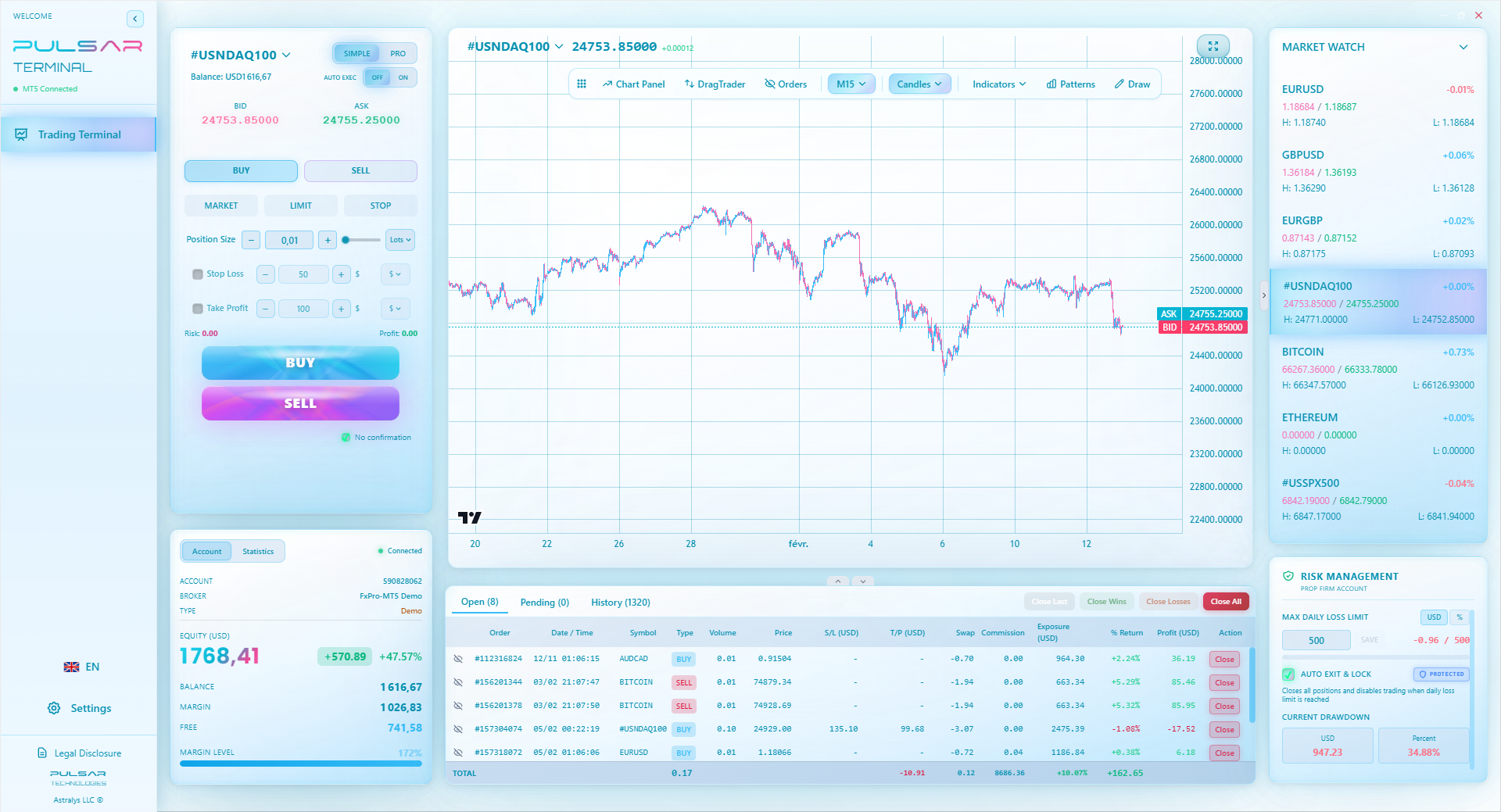
When you're ready to move from demo to live trading, managing multiple trades and risk becomes critical; a tool like Pulsar Terminal automates this directly on your MT5 platform with features like one-click multi-TP/SL orders and trailing stops.
Pulsar Terminal
A ferramenta MT5 tudo-em-um: ordens drag-and-drop, multi-TP/SL, trailing stop, grid trading, Volume Profile e proteção prop firm. Usado diariamente por 1.000+ traders.
“Your first goal is not to be profitable. Your first goal is to follow your trading plan perfectly, even when it results in a loss.”
Durban has its share of financial charlatans. Here’s how to spot them from a mile away.
- The Lifestyle Pitch: If the ad is all about luxury cars, watches, and beach houses, they're selling a dream, not an education. Profitable traders are typically quiet and boring.
- Guaranteed Profits: Anyone guaranteeing returns is lying. It's illegal for a reason. The market guarantees nothing.
- "Secret Indicator" or "Robot" Sales: After the class, they'll try to sell you a "winning" EA or indicator for thousands more. It's junk. If it worked, they'd be using it, not selling it.
- Pressure to Deposit: A "mentor" pushing you to quickly deposit large amounts into a specific broker (sometimes one they're affiliated with) is a massive conflict of interest. Your first live deposit should be small, and with a broker you've researched yourself.
- No Discussion of Losses: If the instructor only shows winning trades, run. Every real trader has a screenshot folder of embarrassing losses. I once misread a news event on GBP/USD and lost 8% of my account in 90 seconds. It happens. A teacher who doesn't show that side is a fraud.
My rule of thumb: The more someone talks about money, the less they probably know about trading. Seek out the educators who talk about process, discipline, and risk.
💡 Dica do Winston
The most valuable lesson you'll learn won't be in a class. It'll be the feeling in your gut when you move your stop-loss 'just this once' to avoid a loss, only to watch the trade crash through your original level and hit your new, worse one. That lesson is free, but expensive.
“The right 'forex class' is the one you teach yourself through focused, deliberate practice.”
So, should you take forex classes in Durban?
For most people, the answer is no, not the expensive ones. The R20,000 course is almost never worth it. The R1,500 weekend workshop might be okay for total basics if you need structure, but know its severe limitations.
Here’s your action plan:
- Allocate a Learning Budget: Decide you have, say, R2,000 total for your first year of education. Spend R500 on a basic workshop if you must see a human face. Save the other R1,500.
- Use 90% of that budget on DEMO TRADING. Not on more courses. Your learning happens when you press the button and manage the trade.
- Choose an FSCA Broker: Do your own research on XM, IC Markets, or Pepperstone. Open a demo account.
- Follow the Self-Education Roadmap. Give it six months of consistent, daily study and demo trading.
- Only then, consider a small live account. Start with an amount so small that losing it wouldn't affect your life. R1,000 or R2,000. Your goal is to translate your demo skill to live markets, not to get rich.
The path is free, but it's not easy. It requires discipline, patience, and a brutal honesty with yourself. The right "forex class" is the one you teach yourself through focused, deliberate practice. Now you know what to look for, and more importantly, what to avoid. Go learn, and trade safe.
FAQ
Q1What is the best forex trading course in Durban?
The 'best' course is highly subjective, but the most cost-effective one is free. I recommend the extensive education centres from FSCA-regulated brokers like IC Markets or Pepperstone, combined with a demo account. If you insist on a paid class, look for one that focuses intensely on risk management and trading psychology, not just indicators. Avoid any course costing over R5,000 unless it offers genuine, prolonged mentorship with a verifiable track record.
Q2How much do forex classes cost in Durban?
Prices vary wildly. Introductory workshops can cost R500 to R2,500. More complete (and often overpriced) 'academy' courses range from R2,500 to R20,000 or more. Remember, a higher price does not mean better quality or a faster path to profitability. Your biggest educational expense will be the capital you lose while learning on a live account, so always start with a demo.
Q3Is forex trading legal and regulated in South Africa?
Yes, absolutely. Forex trading is legal and regulated by the Financial Sector Conduct Authority (FSCA). It is crucial to only use brokers licensed by the FSCA. This ensures your funds are segregated, you're protected by local laws (including the 30:1 use cap for retail traders), and you have a local authority for dispute resolution. Never trade with an unregulated entity.
Q4Can I really make money from forex trading in Durban?
Yes, it's possible, but it's a skilled profession, not a get-rich-quick scheme. Realistic earnings for a disciplined beginner after 6-12 months might be R1,000 to R10,000 per month. Most beginners lose money initially. Consistent profitability requires years of dedication, strict risk management, and emotional control. Focus on learning the skill first, not the income.
Q5What should I look for in a forex trading mentor in Durban?
Look for transparency. A real mentor will show you their live trading statement (with losses included), will focus on your trading plan and psychology, and will never pressure you to deposit money or buy additional products. They should be able to clearly explain FSCA regulations and sane risk management. Be extremely wary of mentors who flaunt luxury lifestyles as their primary credential.
Q6What is the minimum amount I need to start forex trading in South Africa?
Technically, you can start a demo account with R0. For a live account, some FSCA-regulated brokers like XM allow minimum deposits as low as $5 (approx. R90). However, I strongly advise you to start with a demo account until you are consistently profitable on it. When you go live, start with an amount you can afford to lose completely - R1,000 to R2,000 is a sensible starting point to learn live market mechanics without devastating risk.
Q7Are there any free forex trading resources for beginners in Durban?
Yes, plenty. Start with the free educational sections on the websites of FSCA brokers (IC Markets, Pepperstone, XM). Use YouTube for tutorials on specific concepts like support/resistance or risk management (stick to channels that teach process over profit promises). Finally, open a free demo account to practice everything you learn without any financial risk.
Lição do Prof. Winston
Pontos-chave:
- ✓FSCA regulation is non-negotiable for South African traders.
- ✓Risk management is 90% of the game; strategy is the other 10%.
- ✓Start with a demo account and treat it like real money for at least 3 months.
- ✓Never risk more than 1% of your capital on a single trade.
- ✓Avoid any course promising guaranteed profits or selling a luxury lifestyle.
Quão útil foi este artigo?
Clique em uma estrela
Insights de Trading Semanal
Análises e estratégias semanais grátis. Sem spam.
Sobre o autor
David van der Merwe
Trader de Mercados Emergentes
Trader sediado em Joanesburgo com 11 anos em moedas de mercados emergentes. Especialista em pares ZAR, trading regulado pela FSCA e análise do mercado sul-africano.
Comentários
Aviso de risco
A negociação de instrumentos financeiros envolve riscos significativos e pode não ser adequada para todos os investidores. O desempenho passado não garante resultados futuros. Este conteúdo é apenas para fins educacionais e não deve ser considerado aconselhamento de investimento. Sempre conduza sua própria pesquisa antes de negociar.
Você também pode gostar

Cara Trading Forex Sukses: 7 Prinsip dari Trader Profesional
Cara trading forex sukses dengan 7 prinsip trader pro: manajemen modal, disiplin, journal trading, backtest. Data nyata, bukan janji profit palsu.
Jam Trading Forex Terbaik untuk Trader Indonesia: Panduan Lengkap dengan Tabel Waktu
Panduan jam trading forex untuk trader Indonesia. Tabel 4 sesi dunia, jam emas 20:00-00:00, sesi mana yang harus dihindari. Data akurat + tips dari trader berpengalaman.
Top 5 Sàn Forex Uy Tín Nhất 2026: Review Jujur dari Trader Indonesia
Top 5 sàn forex uy tín 2026 untuk trader Indonesia. Review jujur: spread, deposit, withdraw, dukungan lokal. Exness, XM, IC Markets & lebih.
Obter Pulsar Terminal
Todas essas calculadoras estão integradas ao Pulsar Terminal com dados em tempo real da sua conta MT5.
Obter Pulsar Terminal