


Thinking a deposit bonus is free money to boost your trading? You're not alone.

David van der Merwe
Trader de Mercados Emergentes ·  South Africa
☕ 9 min de leitura
O que você vai aprender:
- 1What Exactly Is a Forex Deposit Bonus?
- 2The Ugly Truth: Why Most Bonuses Are Bad for You
- 3The Exceptions: Bonus Types That Might Actually Help
- 4What South African Traders Need to Watch
- 5Forget the Bonus: How to Really Evaluate a Broker
- 6A Contrarian Plan: How to Use a Bonus (If You Insist)
- 7The Final Word for South African Traders

Thinking a deposit bonus is free money to boost your trading? You're not alone. Every new trader in South Africa gets tempted by those flashy "100% Bonus on Your First Deposit!" ads. I was too, back when I started. But here's the hard truth I learned the expensive way: most bonuses are cleverly designed traps, not gifts. This guide will cut through the marketing fluff. We'll look at which types of bonuses from forex deposit bonus brokers can actually help you, and which ones will lock your capital away until you've traded yourself into a corner.
At its core, a deposit bonus is extra trading credit a broker adds to your account when you fund it. You deposit R5,000, they might add another R5,000 as a bonus, showing a balance of R10,000. Sounds great, right? The catch is in the terms and conditions, which are often buried in fine print. This isn't free cash you can withdraw. It's use with strings attached, usually called "bonus credit" or "non-withdrawable funds."
The most common type you'll see here is the matched deposit bonus. Broker matches your deposit by a certain percentage, often 50% or 100%. There's also the no-deposit bonus, where they give you a tiny amount (like $10 or $30) just for signing up. This one is rare now due to abuse, but it still pops up.

Warning: That bonus money isn't yours. You can't withdraw it. Its primary function is to make you feel like you have a bigger account, which often leads to taking larger, riskier trades to meet the withdrawal conditions. I learned this after a bonus made me double my usual position size calculator input, leading to a nasty margin call.
The psychology is powerful. Seeing a bigger number on your screen affects your judgment. You stop thinking in terms of your actual risk capital (your own R5,000) and start thinking about the "total" balance. That's exactly what the broker wants.

“Most bonuses are cleverly designed traps, not gifts.”
Let's be brutally honest. For the retail trader, the typical deposit bonus is a liability, not an asset. The business model for many forex deposit bonus brokers relies on you not being able to withdraw the bonus or the profits generated from it.
The Volume Trap
This is the big one. To withdraw any profits linked to the bonus, you usually have to trade a certain volume. The formula is often something like: Bonus Amount x 30 (or more) = Required Trading Volume in lots. So a R5,000 bonus might require you to trade 150 standard lots (R5,000 x 30) before you can touch a cent of profit. That's R150,000,000 (one hundred and fifty million Rand) in notional value. You will almost certainly blow your account trying.
The Withdrawal Lock
Some bonuses lock your initial deposit for a period. You can't withdraw your own money until you've met the trading conditions. This is a major red flag. Your capital should always be accessible.
It Warps Your Risk Management
This is the silent killer. When I used a 50% bonus years ago, I felt invincible. I took a scalping strategy and applied it to longer timeframes because I had "more buffer." I ignored my stop-loss rules. The result? I turned a R2,000 drawdown into a R4,500 disaster because the bonus portion amplified my losses on my real capital. I was trading to chase volume, not to follow my strategy.
A good broker's value is in execution, spreads, and support, not in handing out tricky bonuses. I'd take a raw Pepperstone review showing tight spreads over a 100% bonus any day.

💡 Dica do Winston
A bonus that requires you to trade more is a tax on your discipline, not a reward for it. Your strategy dictates your volume, not a marketing department.
“The real 'bonus' in trading is the compound growth of your own disciplined capital.”
Not all bonus structures are predatory. Some can be useful if you understand them completely and they fit your style. Here’s what to look for.
The Rebate or Cashback Bonus: This is my preferred type. You get a small rebate (e.g., $5 back per lot traded) on your trading volume, paid as real, withdrawable cash. It effectively reduces your trading costs (spread definition). Some brokers like Exness review have offered these. It rewards actual trading activity without forcing you into insane volume targets.
The Real No-Deposit Bonus: A true free credit with reasonable conditions (e.g., trade 2 lots, keep any profit over $50). These are rare as hen's teeth now, but they exist for genuine trial purposes. Treat it as a demo-plus account.
The Limited-Time Deposit Boost: Some brokers run promotions where they add a small, fixed amount (like $50) to any deposit over $500, with minimal or clear conditions. The key is the conditions must be achievable without altering your normal trading plan.

Pro Tip: If you're considering a bonus, do this math first. Take the required trading volume and divide it by the lot size you actually trade. How many trades will it take? If it's more than 100, forget it. It's not a bonus; it's a full-time job with a high probability of no pay.
“The real 'bonus' in trading is the compound growth of your own disciplined capital.”
Our context matters. The Financial Sector Conduct Authority (FSCA) regulates financial services providers, but its reach over international forex brokers is complex. Many top-tier global brokers (like IC Markets or Pepperstone) have FSCA registration, which is a good sign. However, the bonus offers you see often come from the broker's international entity, not the local one.
Tax Implications: Here's something most don't consider. SARS views income from trading as revenue. If you successfully claim a cash bonus or profit from a bonus, it could be considered taxable income. Keep clear records. A R10,000 bonus-turned-profit is not just "free money" in the eyes of SARS.
Deposit Methods: Bonuses might be tied to specific deposit methods. If a bonus only works with a cryptocurrency deposit, be extra cautious. Crypto deposits can sometimes complicate withdrawal processes and fall into regulatory grey areas.
The Rand Factor: Many bonuses are advertised in USD or EUR. Remember the conversion. A "$100 bonus" sounds nice, but with the Rand at R18/$1, that's R1,800. Is that worth potentially locking up your R10,000 deposit? Probably not. Always think in your home currency. When I compared a XM review bonus to their standard account, the raw account's lower spreads saved me more money over time than the bonus ever offered.
💡 Dica do Winston
If you find yourself calculating 'how fast can I hit the volume target,' you've already lost. You're now a employee of the bonus, not a trader.
“Chasing bonuses is a rookie mistake. Choosing a broker should be about fundamentals.”
Chasing bonuses is a rookie mistake. Choosing a broker should be about fundamentals. Here’s your checklist, in order of importance.
- Regulation & Safety of Funds: Is the broker regulated by a reputable authority (FSCA, ASIC, FCA, CySEC)? Are client funds in segregated accounts? This is non-negotiable.
- Trading Costs: Look at the spreads on the pairs you trade, especially during your trading hours (South African market open, London open). Check for commissions. A low spread on EUR/USD guide of 0.1 pips with a $7 commission can be worse than a 1.2 pip spread with no commission. Use a position size calculator to work it out.
- Execution & Platform: Slippage, requotes, and platform stability matter more than a 50% bonus. Do they offer MT4/MT5? What are the deposit/withdrawal times and fees in ZAR?
- Customer Support: Test them. Call their SA number or use live chat. Ask a technical question about MACD indicator settings. See if they're helpful or just salespeople.
Let's compare two scenarios:
| Feature | Broker A (With 100% Bonus) | Broker B (No Bonus) |
|---|---|---|
| Avg. EUR/USD Spread | 1.8 pips | 0.6 pips |
| Deposit Fee | 2% on credit card | 0% |
| Withdrawal Time | 7-10 business days | 24 hours |
| Key Condition | Trade 30x bonus volume | None |
Broker B saves you money on every single trade. That saving is a real, risk-free "bonus" that compounds. Broker A's offer is a distraction from their inferior core service. I learned this after switching from a bonus-heavy broker to a raw IC Markets review style account. My profitability improved simply because my costs dropped.

“Chasing bonuses is a rookie mistake. Choosing a broker should be about fundamentals.”
Okay, you've read the warnings and you still want to try a bonus. Maybe it's a cashback offer that genuinely reduces costs. Here’s a damage-control plan. This is not advice, it's a survival guide.
Step 1: Document Everything. Screenshot the bonus terms before you deposit. Save the URL. Note the date. I've seen terms change after the fact.
Step 2: Treat the Bonus as Non-Existent. Mentally subtract the bonus amount from your platform balance. If you deposit R4,000 and get a R4,000 bonus, you have an R8,000 balance. In your mind and your journal, you have R4,000. Trade your normal strategy with your normal position size calculator settings based on R4,000.
Step 3: Never Adjust for Volume. Do not increase your trade size to meet volume requirements. If you happen to meet them through your normal, disciplined trading, consider it a lucky windfall. If not, you didn't compromise your account.
Step 4: Plan Your Exit. Decide in advance: "If my real capital (R4,000) draws down by 20%, I withdraw everything and close the account, forfeiting the bonus." The bonus is not a reason to stay in a losing situation.

Example: You deposit R2,000, get a R2,000 bonus. Your real capital is R2,000. You risk 1% per trade = R20. You trade a micro lot (0.01) on GBP/USD. Your stop-loss is 20 pips. 20 pips x R0.80 per pip (approx.) = R16 risk. That's within your plan. You do NOT think "I have R4,000, so I can risk R40 and trade 0.02 lots." That's the trap.
Using tools that enforce discipline is key here. If you're a swing trading, having a platform that lets you set and forget multiple take-profits and stop-losses removes emotion. This is where discipline tools matter more than bonus cash.
💡 Dica do Winston
The best bonus you'll ever get is the spread you didn't pay. Save 0.5 pips on 100 lots, and you've just given yourself a $500 cash bonus with no strings attached.
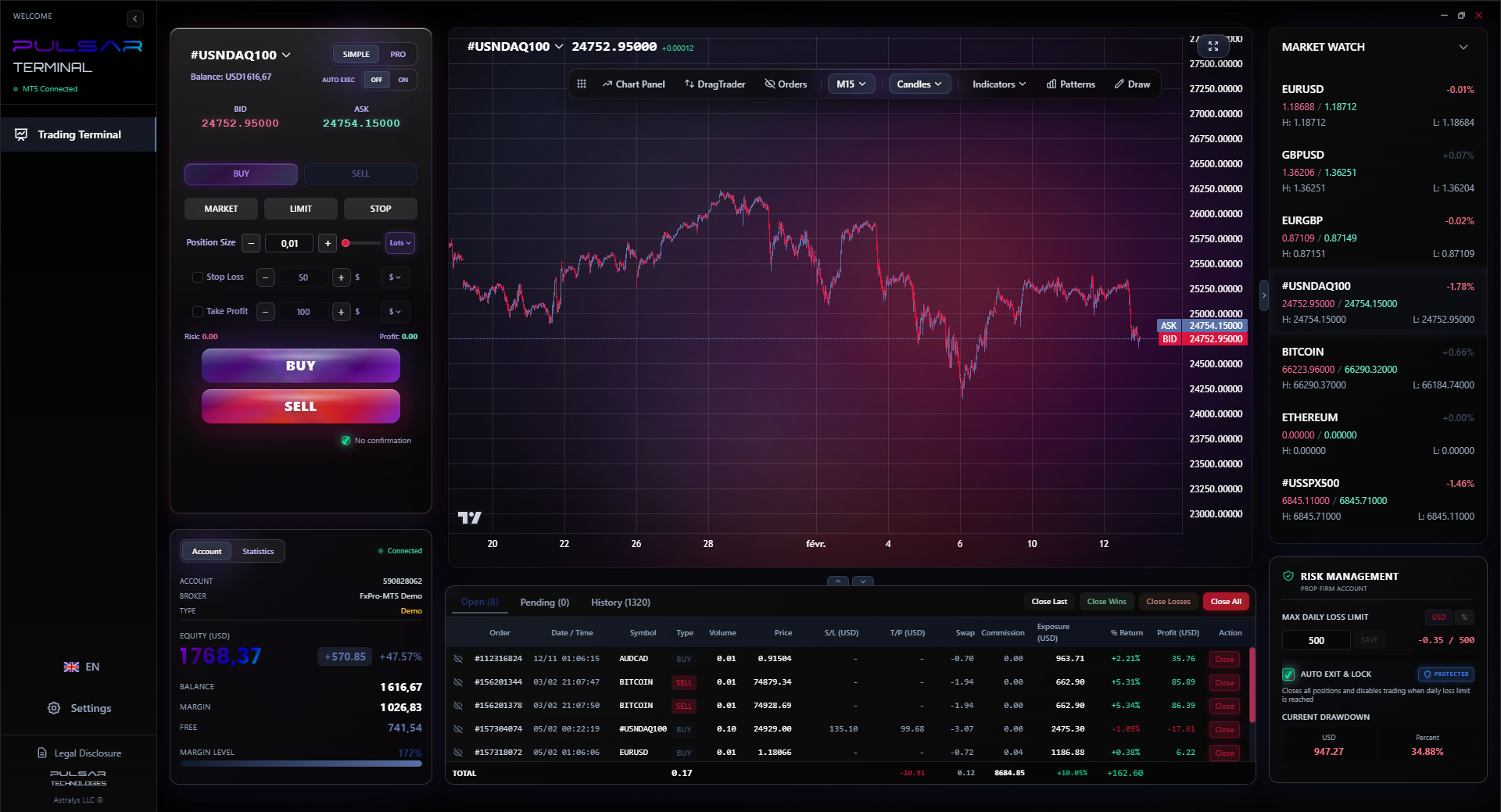
Sticking to a disciplined trading plan around bonuses is hard, but tools like Pulsar Terminal automate risk management with features like partial closures and trailing stops directly on MT5, keeping your focus on strategy, not bonus terms.
Pulsar Terminal
A ferramenta MT5 tudo-em-um: ordens drag-and-drop, multi-TP/SL, trailing stop, grid trading, Volume Profile e proteção prop firm. Usado diariamente por 1.000+ traders.
“A bonus that requires you to trade more is a tax on your discipline.”
After 12 years and seeing hundreds of these offers come and go, my stance is clear. A sign-up bonus should be the last factor you consider when choosing a broker, if you consider it at all. It's the glitter on the fishing lure.
Your energy is better spent mastering your strategy, understanding RSI indicator divergences on XAU/USD guide, or backtesting your ideas. The few hundred Rand in potential bonus value is meaningless compared to the thousands you can save or make with tight spreads, instant execution, and a stable platform.
Find a broker that is transparent, regulated, and competitive on costs. Build your skill and consistency there. The real "bonus" in trading isn't a marketing gimmick; it's the compound growth of your own disciplined capital over time. That's a bonus no broker can give you, and no broker can take away.
I started chasing the easy money of bonuses. I ended up learning that the only thing that matters is the hard work of consistent execution. Focus on that, and the rest, including whether a broker has a flashy deposit bonus, becomes irrelevant noise.
FAQ
Q1Can I actually make money from a forex deposit bonus?
Technically, yes, but it's designed to be very difficult. The trading volume requirements are usually so high that to meet them, you must take excessive risk, which typically leads to losing your deposit before you unlock the bonus profits. It's a statistical game, and the house (broker) always wins.
Q2Are forex deposit bonuses legal in South Africa?
Yes, but it depends on the broker's licensing. An internationally regulated broker offering bonuses from its global entity is common. However, the FSCA encourages transparency. The legality isn't the main issue; the fairness of the terms is. Always check which entity is offering the bonus and who regulates it.
Q3What's the single biggest red flag in bonus terms?
A high volume multiplier (like 30x or more) required to withdraw bonus profits. Also, any condition that locks your initial deposit. If you can't withdraw your own money, walk away immediately.
Q4Is a no-deposit bonus a good way to start?
It can be a harmless way to test a broker's platform and execution with real money (albeit not your own). Treat it strictly as a learning exercise. Assume you will not be able to withdraw anything, and focus on testing order execution, spreads, and platform features. If you make profit, see it as a bonus, not an expectation.
Q5Should I choose a broker just because it has the biggest bonus?
Absolutely not. This is the fastest way to pick a bad broker. The bonus is a marketing cost. Brokers with the biggest bonuses are often compensating for poorer execution, wider spreads, or inferior customer service. Choose on regulation, costs, and reputation first.
Q6How do I calculate if a bonus's volume requirement is achievable?
Use this formula: (Bonus Amount x Multiplier) / (Your Standard Lot Size). Example: $500 bonus x 30 multiplier = $15,000 required volume. If you trade 0.1 lots standard, that's 1,500 trades (15,000 / 10). If you take 3 trades a day, that's 500 trading days - about two years. It's not realistic for a retail trader.
Q7Can a bonus help with passing a prop firm challenge?
No, and don't try it. Prop firms have strict rules about external capital. Using a broker bonus to fund a challenge account would violate terms and result in instant failure. Fund prop challenges with your own, clear capital. Managing the challenge's daily loss limits is a discipline task better suited for dedicated tools than bonus hunting.
Lição do Prof. Winston
Pontos-chave:
- ✓Volume requirements of 30x+ are designed for you to fail.
- ✓Prioritize broker spreads & execution over any bonus.
- ✓Mentally subtract bonus funds from your trading balance.
- ✓A cashback rebate is often the only fair "bonus."
- ✓Your own capital's safety is the only non-negotiable.
Quão útil foi este artigo?
Clique em uma estrela
Insights de Trading Semanal
Análises e estratégias semanais grátis. Sem spam.
Sobre o autor
David van der Merwe
Trader de Mercados Emergentes
Trader sediado em Joanesburgo com 11 anos em moedas de mercados emergentes. Especialista em pares ZAR, trading regulado pela FSCA e análise do mercado sul-africano.
Comentários
Aviso de risco
A negociação de instrumentos financeiros envolve riscos significativos e pode não ser adequada para todos os investidores. O desempenho passado não garante resultados futuros. Este conteúdo é apenas para fins educacionais e não deve ser considerado aconselhamento de investimento. Sempre conduza sua própria pesquisa antes de negociar.
Você também pode gostar

Cara Trading Forex Sukses: 7 Prinsip dari Trader Profesional
Cara trading forex sukses dengan 7 prinsip trader pro: manajemen modal, disiplin, journal trading, backtest. Data nyata, bukan janji profit palsu.
Jam Trading Forex Terbaik untuk Trader Indonesia: Panduan Lengkap dengan Tabel Waktu
Panduan jam trading forex untuk trader Indonesia. Tabel 4 sesi dunia, jam emas 20:00-00:00, sesi mana yang harus dihindari. Data akurat + tips dari trader berpengalaman.
Top 5 Sàn Forex Uy Tín Nhất 2026: Review Jujur dari Trader Indonesia
Top 5 sàn forex uy tín 2026 untuk trader Indonesia. Review jujur: spread, deposit, withdraw, dukungan lokal. Exness, XM, IC Markets & lebih.
Obter Pulsar Terminal
Todas essas calculadoras estão integradas ao Pulsar Terminal com dados em tempo real da sua conta MT5.
Obter Pulsar Terminal