


I remember watching USD/ZAR hit 19.86 in October 2022.

David van der Merwe
Trader de Mercados Emergentes ·  South Africa
☕ 10 min de leitura
O que você vai aprender:
I remember watching USD/ZAR hit 19.86 in October 2022. My phone was buzzing with WhatsApp messages from other traders - everyone was either panicking or seeing dollar signs. I had a small short position from 19.50, and for a moment, I felt that rush. The 'forex dreamer' fantasy felt real. Then it reversed hard, taking my stop-loss and a chunk of my confidence with it. That's the thing about being a forex dreamer in South Africa: the market doesn't care about your dreams, only your decisions. Let's talk about how to make better ones.
In our local context, a 'forex dreamer' is that guy on Instagram showing off a rented BMW, talking about 'financial freedom' from his bedroom in Sandton or Cape Town. He's the promise of quitting your 9-to-5 after three trades. It's the fantasy sold in Telegram groups and flashy seminars. The dream is compelling: trade from your laptop, earn in dollars, and escape the Rand's volatility.
But here's the reality I learned the hard way. The true forex dreamer isn't the one who fails; it's the one who confuses the initial fantasy with the actual work. The market turns over nearly $21.39 billion a day here. You're not dreaming against a casino; you're competing in a vast, professional arena. The shift from dreamer to trader happens when you stop focusing on the Lamborghini and start obsessing over your spread definition on USD/ZAR, which can be 5 pips or more, and your daily risk limit.

Warning: That 'mentor' charging R5,000 for a 'secret strategy'? The FSCA fined someone over R1 million in 2024 for running unlicensed signal services. If it sounds too good to be true, it almost always is.

💡 Dica do Winston
A dream written down with a date becomes a goal. A goal broken down into steps becomes a plan. A plan backed by action becomes reality. Start with the plan, not the dream.
“The shift from dreamer to trader happens when you stop focusing on the Lamborghini and start obsessing over your spread on USD/ZAR.”
You can't play the game if you don't know the rules. In South Africa, the referee is the Financial Sector Conduct Authority (FSCA). Trading is legal, but it's a regulated space designed to protect you, even if it feels restrictive.
FSCA Licensing is Non-Negotiable
Your first check before depositing a single cent: is the broker FSCA licensed? You can look them up on the FSCA's public register. This means they must segregate client funds - your money is kept separate from the broker's operating capital. If a broker isn't on that list, walk away. I made the mistake of testing an unregulated 'offshore' broker years ago for their insane use; getting my withdrawal processed was a month-long nightmare.
The use Cap: Your Built-In Safety Net
Since 2021, the FSCA caps use at 30:1 for retail traders. Yes, you'll see brokers like XM review or Exness review advertising 1:1000+ on their global sites, but for their FSCA-licensed entity, it's 30:1. This isn't to ruin your fun. It's to stop you from blowing a R10,000 account in two trades. With 30:1, a 3.33% move against you wipes you out. It forces discipline.
SARS is Your Silent Trading Partner
Nobody likes this part, but here it is. The South African Revenue Service (SARS) views frequent trading as income, taxed at your marginal rate. That means if you're profitable, you need to declare it. I keep a simple spreadsheet: date, pair, profit/loss in ZAR. Your broker's statement is your proof. Remember, you're taxed on worldwide income. Profits from an international account? Declare them. A good accountant who understands trading is worth every rand.
“use is a tool, not a turbo button.”
Let's crush the biggest fantasy with real numbers. You won't make R100,000 a month starting with R5,000. It's mathematically impossible without suicidal risk. The surveys are brutal: most traders don't consistently profit. The successful ones aren't magicians; they're risk managers.
Here’s a more realistic ladder of progression, based on what I've seen and lived:
| Trader Level | Typical Account Size | Realistic Daily Focus | Monthly Expectation (Good Month) | Key Mindset Shift |
|---|---|---|---|---|
| Beginner | R1,000 - R5,000 | Don't blow up. Learn the platform. | R0 to -R500 (learning cost) | Surviving the first 100 trades. |
| Consistent Learner | R10,000 - R50,000 | Perfecting 1 strategy. Risking 1% per trade. | R2,000 - R10,000 profit | Consistency over home runs. |
| Intermediate | R50,000 - R200,000 | Scaling size, managing emotions. | R10,000 - R50,000 profit | Process is everything. P&L is a result. |
| Experienced | R200,000+ | Portfolio risk, multiple strategies. | R50,000+ profit | It's a business. |
My own journey: In my second year, I turned R20,000 into R35,000 in three months. I felt like a genius. Then I gave back R10,000 in two weeks because I broke my own rules and doubled my position size after a win. That loss taught me more than the profit. The goal isn't a huge win; it's a string of small, smart decisions. Using a position size calculator religiously is what separates a dreamer from a trader.

Example: You have a R25,000 account. You risk 1% per trade (R250). You trade USD/ZAR with a 50-pip stop-loss. Your position size is R250 / (50 pips * pip value for USD/ZAR). This math keeps you in the game.
“use is a tool, not a turbo button.”
As a South African, you have a home-field advantage: the Rand. But it's a volatile, emotional market. Pairs like USD/ZAR and EUR/ZAR are 'exotics,' which means wider spreads and bigger swings.
Understanding ZAR Pairs
USD/ZAR is the main event. It's driven by local politics, commodity prices (we're a mining country), and global risk sentiment. A 20-pip move on EUR/USD is noise; a 20-pip move on USD/ZAR is lunch money. I prefer trading it during the London/New York overlap (3-7 PM SAST) when liquidity is best. Remember, the spread is a cost. If your broker's spread on USD/ZAR is 8 pips, you're already down R80 on a standard lot before the trade even moves.
Broker Checklist for South Africans
Don't just pick the one with the shiniest ads. Look for:
- FSCA License: As discussed, non-negotiable.
- ZAR Accounts: Saves you from bank conversion fees. Brokers like Pepperstone review and IC Markets review offer this.
- Reasonable Spreads on ZAR Pairs: Compare. A 5-pip spread vs. a 10-pip spread makes a huge difference to your bottom line.
- Local Payment Methods: You want Instant EFT (Ozow, EFT Secure), not just international wire transfers. Funding should be easy and cheap.
- Platform: MT4/MT5 is the standard. It's what you'll learn on, and where all the tools are.
A personal note: I use an FSCA-regulated broker with ZAR accounts and Instant EFT. Depositing R5,000 and having it available to trade in 10 minutes, without fees, removes one huge headache. It lets me focus on the charts, not the banking.
💡 Dica do Winston
The market is a relentless teacher. It doesn't give you the test first and the lesson later. The loss IS the lesson. Pay attention.
“Some days, your best trade will be the one you don't take.”
Forget the 30-day challenge. Building skill takes six months of focused work. Here's a roadmap.
Months 1-2: The Demo Grind Open a demo account with an FSCA broker. Don't trade real money. Your job is to learn the MT4 platform inside out. Place 100 trades. Practice setting stop-losses and take-profits every single time. Get used to the feeling of losing on a demo. It should feel bad, even with fake money. That's the emotion you need to manage.
Months 3-4: Find One Strategy Pick one market setup. Maybe it's a simple RSI indicator divergence on the 4-hour chart, or a MACD indicator crossover. Don't collect 20 strategies. Master one. Back-test it on historical data for USD/ZAR. How did it perform in 2020 during the pandemic crash? Write down the rules. This is now your playbook.
Months 5-6: Live Micro-Account Fund a live account with the minimum amount - maybe R1,000. Your goal is not to make money. Your goal is to execute your strategy's rules for 50 trades, with perfect risk management (1% risk per trade). The psychological jump from demo to live is massive. You'll feel it. The goal here is to prove to yourself you can follow your plan when real money is on the line. This is where most forex dreamers quit. If you can complete this phase, you're no longer a dreamer. You're a novice trader, and that's something to be proud of.
From there, you can explore different styles, like scalping strategy for quick moves or swing trading for longer holds. But the foundation is non-negotiable.
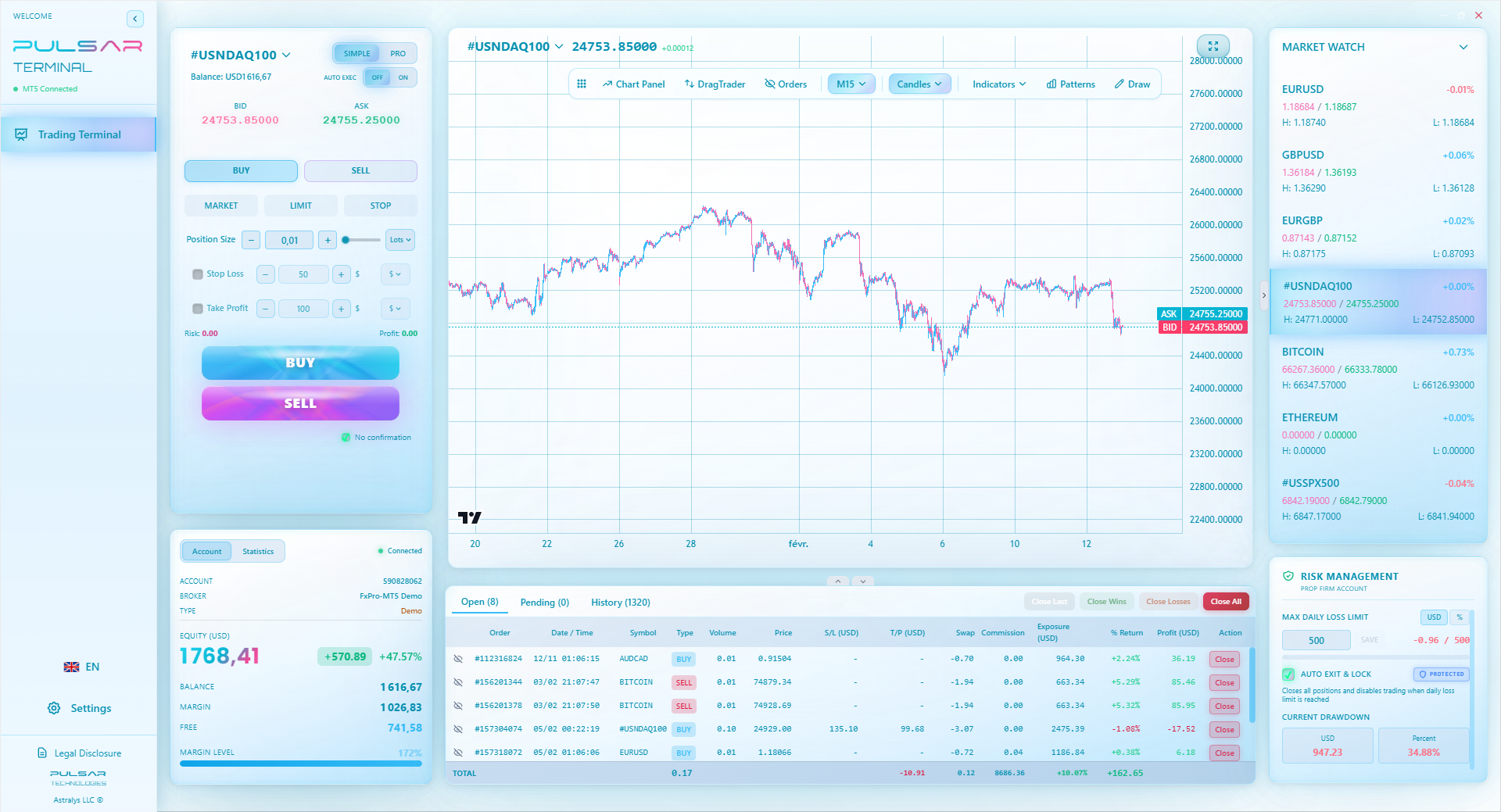
When you're ready to move from a demo to a live micro-account, managing multiple trades and strict risk rules manually becomes a huge burden.
Pulsar Terminal
A ferramenta MT5 tudo-em-um: ordens drag-and-drop, multi-TP/SL, trailing stop, grid trading, Volume Profile e proteção prop firm. Usado diariamente por 1.000+ traders.
“Some days, your best trade will be the one you don't take.”
Let me save you some money and heartache by listing my own expensive lessons.
1. Chasing Losses. This is the killer. You lose R500 on a USD/ZAR trade. Your ego kicks in. You immediately re-enter with a double-sized position to 'make it back fast.' This is how a R1,000 loss becomes a R3,000 loss in an hour. The rule now: After two losing trades in a day, I walk away. Close the platform. The market will be there tomorrow.
2. Ignoring the Economic Calendar. I once went long on GBP/ZAR right before a Bank of England announcement I'd forgotten about. It was a classic 'sell the news' event. I watched my position dive 80 pips in 90 seconds. Now, I check the calendar every Monday. High-impact news events are minefields for the unprepared.
3. Overleveraging on 'Sure Things.' Even with the 30:1 cap, you can still over-use your account. I once used 20:1 on a 'can't lose' EUR/USD setup I saw in a forum. It lost. That single trade wiped out 20% of my account. It took me six weeks of disciplined 1% trades to climb back. use is a tool, not a turbo button.
4. Not Understanding a Margin Call. Early on, I didn't grasp how my used margin worked with multiple positions. I had three trades open, thought I had plenty of buffer, and got a margin call when the market moved fast. The broker automatically closed my biggest position at the worst possible price. It was a brutal, but effective, teacher in position sizing.
💡 Dica do Winston
Your first R10,000 profit will feel like genius. Your first R10,000 loss will feel like disaster. They are the same thing: feedback. Don't let either one change your rules.
“The goal isn't a huge win; it's a string of small, smart decisions.”
The transition from forex dreamer to trader is a mental one. It's moving from 'get rich quick' to 'get good slowly.'
You have to fall in love with the process - the analysis, the planning, the discipline of the stop-loss. The profit becomes a byproduct of doing things right, not the sole goal. Some days, your best trade will be the one you don't take. On other days, it'll be closing a small winner according to plan, even though your gut screamed to let it run.
Surround yourself with realistic voices, not hype men. Find a community that talks about risk-reward ratios and journaling, not just screenshots of profits. Remember why you started. Maybe it was for more freedom, or a side income. Those are good goals. Anchor yourself to them, not to the distorted fantasy sold online.
South Africa has a vibrant, growing trading community. You can be part of it. But come in with your eyes open, your risk managed, and your expectations grounded. That's how a dreamer builds something real.

Pro Tip: Keep a trading journal. Not just 'bought EUR/USD.' Write your reasoning, your emotion ('felt FOMO after missing the first move'), and the outcome. Review it weekly. Your journal will tell you more about yourself than any indicator ever will.
FAQ
Q1What is the minimum amount I need to start forex trading in South Africa?
Technically, some FSCA brokers like XM let you start with about R90 ($5). But realistically, to trade properly with sensible risk management (risking 1% per trade), you need at least R2,000-R5,000. This lets you use micro lots and survive the inevitable learning-curve losses without blowing your account in a week. The industry standard minimum deposit is around R2,800.
Q2Can I trade with international brokers, and how do I get my money out?
Yes, you can, but it adds complexity. You'll deal with currency conversion and SARB exchange controls. For withdrawals back to your South African bank account, you'll need a formal invoice from the broker. Transfers over R1 million require a simple banking form, and over R10 million need more documentation. It's often easier to stick with an FSCA-regulated broker that offers a ZAR account for seamless deposits and withdrawals in Rands.
Q3How much tax will I pay on my forex profits?
SARS treats frequent trading as income, not capital gains. So your net profit (total profits minus total losses and allowable expenses) is added to your other income and taxed at your marginal tax rate. If you're in the 30% tax bracket, you'll pay 30% tax on your trading profits. Keep careful records of all trades, deposits, and withdrawals.
Q4Is forex trading a scam in South Africa?
The activity itself is not a scam; it's a legitimate, regulated financial market. The scams come from unlicensed 'signal sellers,' 'mentors' charging thousands for basic info, and fake brokers. Always verify your broker's FSCA license number on the official register. If someone guarantees profits or downplays risk, that's the red flag.
Q5What's the best time of day to trade from South Africa?
The most liquid and volatile times are during the London session (10 AM - 7 PM SAST) and especially the London-New York overlap from 3 PM to 7 PM SAST. This is when you'll see the best movement on major pairs like EUR/USD and GBP/USD. For USD/ZAR, liquidity is also good during these hours.
Q6Why is the spread on USD/ZAR so much higher than on EUR/USD?
USD/ZAR is an exotic currency pair. It has lower trading volume and higher volatility than major pairs like EUR/USD. The wider spread (often 5-10 pips vs. under 1 pip for EUR/USD) is the broker's compensation for taking on the higher risk of facilitating that trade. It's a key cost you must factor into your strategy.
Lição do Prof. Winston
Pontos-chave:
- ✓Verify FSCA license before any deposit.
- ✓Risk maximum 1% of capital per trade.
- ✓Master one strategy before trying ten.
- ✓Journal every trade, especially the losers.
- ✓Taxable income must be declared to SARS.
Quão útil foi este artigo?
Clique em uma estrela
Insights de Trading Semanal
Análises e estratégias semanais grátis. Sem spam.
Sobre o autor
David van der Merwe
Trader de Mercados Emergentes
Trader sediado em Joanesburgo com 11 anos em moedas de mercados emergentes. Especialista em pares ZAR, trading regulado pela FSCA e análise do mercado sul-africano.
Comentários
Aviso de risco
A negociação de instrumentos financeiros envolve riscos significativos e pode não ser adequada para todos os investidores. O desempenho passado não garante resultados futuros. Este conteúdo é apenas para fins educacionais e não deve ser considerado aconselhamento de investimento. Sempre conduza sua própria pesquisa antes de negociar.
Você também pode gostar

Cara Trading Forex Sukses: 7 Prinsip dari Trader Profesional
Cara trading forex sukses dengan 7 prinsip trader pro: manajemen modal, disiplin, journal trading, backtest. Data nyata, bukan janji profit palsu.
Jam Trading Forex Terbaik untuk Trader Indonesia: Panduan Lengkap dengan Tabel Waktu
Panduan jam trading forex untuk trader Indonesia. Tabel 4 sesi dunia, jam emas 20:00-00:00, sesi mana yang harus dihindari. Data akurat + tips dari trader berpengalaman.
Top 5 Sàn Forex Uy Tín Nhất 2026: Review Jujur dari Trader Indonesia
Top 5 sàn forex uy tín 2026 untuk trader Indonesia. Review jujur: spread, deposit, withdraw, dukungan lokal. Exness, XM, IC Markets & lebih.
Obter Pulsar Terminal
Todas essas calculadoras estão integradas ao Pulsar Terminal com dados em tempo real da sua conta MT5.
Obter Pulsar Terminal