


I lost $420 in about 90 seconds.

Olumide Adeyemi
Pioneiro do Trading na África Ocidental ·  Nigeria
☕ 9 min de leitura
O que você vai aprender:
- 1What Exactly Is a Forex Economic Calendar?
- 2Red, Orange, Yellow: Understanding Impact Levels
- 3Practical Strategies: How to Actually Trade the News
- 4The Nigerian Trader's Context: Naira, Oil, and Local Events
- 5Essential Tools and Classic Mistakes to Avoid
- 6Making the Calendar Part of Your Daily Trading Plan
I lost $420 in about 90 seconds. It was a Tuesday morning, and I was casually long on GBP/USD. The chart looked fine, trending gently. Then, out of nowhere, the pair dropped 80 pips like a stone. My stop-loss was vaporized, and my position was gone. I'd completely forgotten the UK inflation data was due. That was the day I stopped guessing and started living by the forex economic news calendar. It's not about predicting the news, it's about not being on the wrong side of the explosion.
Think of it as the market's diary. It's a schedule of all the major economic reports, speeches, and political events that can move currency prices. For us traders, it's our early warning system.
Every country releases data that acts as a health check on its economy. The big ones are things like the US Non-Farm Payrolls (jobs report), inflation data (CPI), interest rate decisions from central banks like the US Federal Reserve or the European Central Bank, and GDP growth figures. When these numbers come out, they tell a story. Is the economy strong? Is inflation too high? Will interest rates rise?
Markets hate uncertainty. So, in the minutes before a major release, trading often slows to a crawl. Everyone's waiting. Then the number hits, and volatility explodes. That's where you can make money, or more commonly, lose it very fast if you're unprepared. You can find free, reliable calendars on sites like Forex Factory or Investing.com. Your broker's platform probably has one built in too.

Warning: Never trade a major news event blindly. The initial spike can be a 'fakeout' that reverses violently within seconds. I've been caught in that trap more than once.

💡 Dica do Winston
The calendar isn't a crystal ball. It's a hazard map. Your first goal isn't to profit from every red event, it's to avoid getting wrecked by one.
Not all news is created equal. Calendars use a color-coded system (usually red, orange, yellow) to show an event's expected market impact. You need to know the difference.
High Impact (Red): These are the market movers. Treat them with respect. We're talking US Interest Rate decisions, Non-Farm Payrolls, and CPI inflation data from major economies. A surprise here can move a major pair like EUR/USD 100 pips or more in a heartbeat. Your entire trading plan for the day should be built around these events. I often just close all my positions 30 minutes before a red event and watch.
Medium Impact (Orange): These can cause decent moves, maybe 30-50 pips. Examples are retail sales data, manufacturing surveys (like PMIs), or mid-tier employment figures. You can trade around these, but you still need a tight plan. The spread can widen significantly just before the release, so your entry and exit costs go up.
Low Impact (Yellow): These are minor. A speech by a mid-level official, or low-tier sentiment data. They might cause a 10-15 pip wiggle, but rarely a trend change. I mostly ignore these unless I'm already in a trade, in which case I just note the time.
The "Actual vs. Forecast vs. Previous" Trinity
This is the core of news trading. The calendar shows three numbers:
- Previous: What the number was last time.
- Forecast: What economists are expecting this time.
- Actual: The real number just released.
The market's reaction depends on how the Actual compares to the Forecast. If the US CPI forecast is 3.1% and the actual comes out at 3.4%, that's hotter inflation than expected. The US Dollar will likely rally because it increases the chance of interest rate hikes. It's that simple. The "Previous" number is just for context.
“I don't try to catch the initial spike. I wait for the 5-10 minute frenzy to settle, then trade the new trend.”
There are two main schools of thought here: trading the volatility or avoiding it entirely. I've done both.
Strategy 1: The Fade & Wait (My Preferred Method) This is for survival. I don't try to catch the initial spike. Here's my routine:
- Identify the Red Events: The night before, I check the calendar for the next day.
- Clear the Decks: 30-60 minutes before the release, I close any open positions in the affected currency pairs. No exceptions. The peace of mind is worth it.
- Watch the Aftermath: After the news hits, I wait for the initial 5-10 minute frenzy to settle. The market often overreacts initially, then pulls back to find a new range.
- Trade the New Trend: Once a clear direction is established (look for a strong 15-minute or 1-hour candle closing in one direction), I look for an entry in that direction. This is much safer than trying to guess the headline.
Strategy 2: The Straddle/Strangle (High Risk, High Reward) This involves placing both a buy stop and a sell stop order just above and below the current price before the news. Whichever way the market breaks, you get in. The problem? You need a massive move to cover the spread on both orders and still make a profit. Slippage can be brutal. I tried this on an ECB rate decision once. The move was big, but my sell order filled 8 pips below my trigger price due to slippage, killing most of my profit.
Strategy 3: The Pre-News Position This is about anticipation. If the forecast is for a very strong US jobs number, you might go long USD/JPY an hour before. But this is pure gambling. I learned this the hard way with gold (XAU/USD). Everyone was expecting hawkish Fed comments, so I shorted gold. The comments were actually dovish, and gold ripped $30 higher against me instantly.

Pro Tip: Use a position size calculator religiously for news trades. If you're going to play with volatility, reduce your normal lot size by at least 50%. The swings are bigger, so your risk should be smaller.
Our reality is different. While the US and EU data dominate the global calendar, we have local factors that directly impact our trading, especially if you're trading USD/NGN pairs or commodities.
1. Oil Prices (Brent Crude): This is Nigeria's lifeblood. A major move in oil prices (often driven by OPEC news, US inventory data, or geopolitical tensions) can impact the Naira's perceived strength. A sharp drop in oil can put pressure on Nigeria's foreign reserves, which might lead to speculation about the Naira. If you're trading forex with a Nigerian broker, watch oil news.
2. Central Bank of Nigeria (CBN) Announcements: Monetary Policy Committee (MPC) meetings, interest rate decisions, and pronouncements on foreign exchange policy are high-impact red events for the Naira. The volatility in the parallel market can be extreme after these. If your broker offers USD/NGN, treat CBN news with the same caution as the US Fed.
3. Local Inflation & GDP Data: Nigeria's own CPI and GDP releases can cause short-term moves in African currency pairs. They also affect the overall sentiment for Nigerian assets.
Practical Advice: Keep two calendars open. One for the global majors (Forex Factory), and one that tracks Nigerian and key African economic events. Don't get so focused on the Fed that you miss a CBN bombshell that affects your entire local market outlook. Brokers like Exness or XM, which are popular here, often have tools that can help filter news.
💡 Dica do Winston
If you wouldn't walk into a room with a lion, don't hold a position into a high-impact news release. The potential reward is never worth the catastrophic risk.
“Your first goal isn't to profit from every red event, it's to avoid getting wrecked by one.”
Tools You Need:
- A Reliable Calendar: Forex Factory is the community standard. It's free, updates in real-time, and has a good comments section to gauge sentiment.
- An Economic Clock: Some platforms have a countdown timer to the next major event. This stops you from forgetting.
- A News Wire: Having a fast, textual news feed (like Reuters or Bloomberg headlines) on your screen helps you understand the context behind the number. Sometimes the devil is in the details of the report.
Mistakes I've Made (So You Don't Have To):
1. Trading Without a Stop-Loss: This is suicide during news. I once thought, "It'll come back." It didn't. A bad US retail sales report blew through my mental stop and kept going. I turned a $150 loss into a $500 loss out of sheer stubbornness. Always use a hard stop-loss.
2. Ignoring Revisions: Sometimes the market reacts more to the revision of the previous month's number than to the current actual figure. Check if "Previous: 200K" was revised to "185K." That changes everything.
3. Overleveraging: News volatility magnifies everything. A 50-pip move with 100:1 use is a much bigger deal than a 50-pip move in a quiet market. This is the fastest path to a margin call.
4. Chasing the News: You see EUR/USD rally 60 pips on a report. You FOMO buy at the top. Then it reverses and gives back 40 pips. You're now stuck in a losing trade. If you miss the initial move, let it go. There will be another opportunity tomorrow.

Example: Let's say you have a $1,000 account. Your normal risk is 1% ($10). For a high-impact news trade, you should cut that to 0.5% ($5). If you're trading a pair where a news move could be 80 pips, your position size needs to be small enough that an 80-pip loss against you only costs $5. That keeps you in the game.
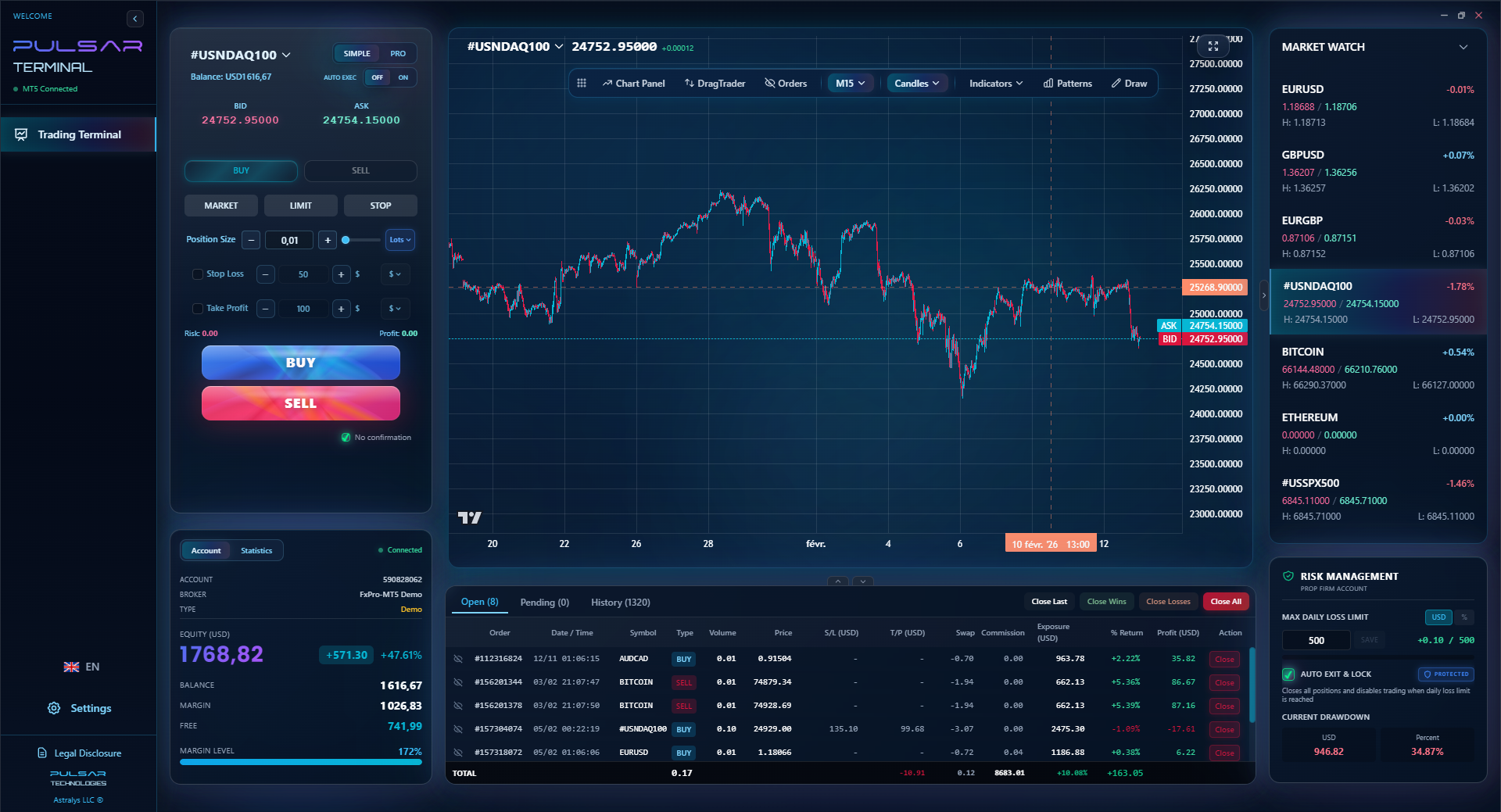
Managing risk during volatile news events requires precise order tools, which is where a platform like Pulsar Terminal excels for MT5 users.
Pulsar Terminal
A ferramenta MT5 tudo-em-um: ordens drag-and-drop, multi-TP/SL, trailing stop, grid trading, Volume Profile e proteção prop firm. Usado diariamente por 1.000+ traders.
This isn't a sometimes thing. It should be as routine as checking your charts.
Your Morning Routine:
- Open the Calendar: Before you even look at a chart, check the day's schedule. Mark the high and medium-impact events in your trading journal.
- Plan Your Sessions: If there's a red event at 2:30 PM GMT, maybe you trade in the morning session and then step away. Or you plan to only trade after the event, using the new established trend.
- Set Alarms: Use phone alarms or calendar alerts 30 minutes before major events. This is your "stand clear" warning.
How It Fits With Your Strategy:
- For Scalpers: You should absolutely avoid trading during high-impact news. The spread widens, execution slows, and your tight stops are meaningless. Your strategy relies on small, consistent moves, not explosions.
- For Swing Traders: News events can be the catalysts that start or end your swings. A swing low that forms right after a major news sell-off can be a high-probability entry point. The news provides the fundamental reason for the move your charts are showing.
, the forex economic news calendar is about managing risk, not just finding opportunities. It tells you when the market's mood is likely to change abruptly. Your job is to either get out of the way, or prepare carefully to navigate the storm. The traders who last are the ones who know when to sit on their hands.
FAQ
Q1What is the most important news event for forex?
The US Non-Farm Payrolls (NFP) jobs report, released on the first Friday of every month, is often considered the king. It causes massive volatility in USD pairs. Close second is the US Federal Reserve's Interest Rate Decision and press conference.
Q2What time does the forex news come out?
It varies by country. US data typically drops between 1:30 PM and 3:00 PM GMT (which is 2:30 PM to 4:00 PM Nigerian time). European data is earlier, around 8:00 AM to 10:00 AM GMT. Always check your calendar and convert to your local time.
Q3Should I trade before or after news?
For most retail traders, especially beginners, trading after the news is far safer. Let the initial panic and volatility settle, then assess the new price direction. Trading before is speculation; trading after is reaction.
Q4Can I make money just trading news?
Some prop firms and very disciplined traders do. But it's incredibly stressful and risky. Slippage and whipsaws are common. For most people, it's better to use the calendar to avoid losses than to chase news-specific profits.
Q5Why did the price go down on good news?
This is called 'buy the rumor, sell the news.' Sometimes the market prices in a good number before it's released. When the good news finally comes, traders who bought earlier take their profits, causing a sell-off. It's all about expectations.
Q6Is the forecast on the calendar always accurate?
No. Economists' forecasts are often wrong. That's why the market moves - the surprise factor. Never bet your entire account on a forecast being correct.
Q7How do I handle news when trading with a prop firm?
Extreme caution. Prop firm challenges often have strict daily loss limits. A single bad news trade can blow your daily limit and fail the challenge. Many savvy prop traders simply avoid trading during major high-impact events altogether to protect their capital.
Lição do Prof. Winston
Pontos-chave:
- ✓Always check the calendar before opening any trade.
- ✓Close positions 30 mins before high-impact (red) news.
- ✓Reduce position size by 50% for news-based trades.
- ✓The market reacts to Actual vs. Forecast, not the number itself.
Quão útil foi este artigo?
Clique em uma estrela
Insights de Trading Semanal
Análises e estratégias semanais grátis. Sem spam.
Sobre o autor
Olumide Adeyemi
Pioneiro do Trading na África Ocidental
Um dos educadores de trading forex mais ativos da Nigéria. 8 anos de experiência operando a partir de Lagos. Especialista em estratégias de baixo capital e desafios de prop firms para traders africanos.
Comentários
Aviso de risco
A negociação de instrumentos financeiros envolve riscos significativos e pode não ser adequada para todos os investidores. O desempenho passado não garante resultados futuros. Este conteúdo é apenas para fins educacionais e não deve ser considerado aconselhamento de investimento. Sempre conduza sua própria pesquisa antes de negociar.
Você também pode gostar

Cara Trading Forex Sukses: 7 Prinsip dari Trader Profesional
Cara trading forex sukses dengan 7 prinsip trader pro: manajemen modal, disiplin, journal trading, backtest. Data nyata, bukan janji profit palsu.
Jam Trading Forex Terbaik untuk Trader Indonesia: Panduan Lengkap dengan Tabel Waktu
Panduan jam trading forex untuk trader Indonesia. Tabel 4 sesi dunia, jam emas 20:00-00:00, sesi mana yang harus dihindari. Data akurat + tips dari trader berpengalaman.
Top 5 Sàn Forex Uy Tín Nhất 2026: Review Jujur dari Trader Indonesia
Top 5 sàn forex uy tín 2026 untuk trader Indonesia. Review jujur: spread, deposit, withdraw, dukungan lokal. Exness, XM, IC Markets & lebih.
Obter Pulsar Terminal
Todas essas calculadoras estão integradas ao Pulsar Terminal com dados em tempo real da sua conta MT5.
Obter Pulsar Terminal