


I once lost nearly 80,000 Naira on a single USD/NGN trade because I trusted the 'official' rate I saw on a news site.

Olumide Adeyemi
Pioneiro do Trading na África Ocidental ·  Nigeria
☕ 8 min de leitura
O que você vai aprender:
I once lost nearly 80,000 Naira on a single USD/NGN trade because I trusted the 'official' rate I saw on a news site. I bought at what I thought was a dip, only to watch my position bleed out as the real market rate - the one people actually trade at - moved completely against me. That painful lesson taught me that in Nigeria, knowing the 'forex exchange rate in Nigeria today' isn't about one number. It's about understanding a fractured system with multiple prices, each telling a different story. If you're trading from Nigeria, you need to know which rate matters for your broker, your bank, and your profit.
Forget what you see on the CBN website or most mainstream news headlines. The first rule of trading FX from Nigeria is accepting there is no single 'forex exchange rate in Nigeria today.' There's a menu, and your profit depends on which one you're looking at.
You've got the Official CBN Rate. This is the government's preferred number, used for certain official transactions. Then there's the NAFEX (I&E Window) Rate. This is the closest thing to an official market-determined rate for investors and exporters. It's the one international platforms like Bloomberg might quote.
But for you and me, the most critical one is the Parallel Market Rate (what we call the 'black market' or 'Aboki FX' rate). This is the street price for dollars. When your bureau de change guy quotes you a rate, this is it. The spread between NAFEX and the parallel rate can be 100 Naira or more. I learned this the hard way when I tried to fund my international broker using a bank transfer at the NAFEX rate, only to realize the effective cost, after bank charges and the real market valuation of my Naira, was much closer to the parallel rate. I was down before I even placed a trade.

Warning: Never base a trading decision solely on the CBN's official rate. It's often a lagging indicator and doesn't reflect the liquidity or price you can actually access as a retail trader.
Your broker's rate for currency pairs involving the Naira (if they offer it) will typically be pegged to an international benchmark, not the local street price. This disconnect is the core challenge.

💡 Dica do Winston
The market's 'official' story and its real price are often two different things. Your P&L only cares about the real one. Always know which one you're looking at.
So, you're not trading USD/NGN on MetaTrader. How does this rate chaos impact you? In two massive ways: funding and psychology.
Funding Your Trading Account
This is the biggest practical hurdle. Most reputable international brokers (like the ones we review, such as Exness or IC Markets) don't accept Naira deposits. You must send dollars, euros, or pounds.
Your bank will convert your Naira at their rate (often a blended rate that still costs you). The real cost per dollar you pay includes their spread and fees. Let's say the NAFEX rate is ₦1,450/$, but your bank charges you an effective rate of ₦1,480/$ after everything. That's an instant 2% loss you have to make back just to break even on the deposit. I once calculated that over a year, these funding costs ate up nearly 30% of my smaller, profitable trades. It forced me to move to a scalping strategy with higher frequency to overcome this drag.
Market Sentiment and Correlations
Secondly, severe pressure on the Naira creates broad market sentiment. When there's a sharp devaluation or liquidity crunch, it can trigger risk-off sentiment locally. Nigerian traders might pull out of riskier assets. More importantly, pairs like USD/ZAR or even USD/JPY can see indirect flows. If Nigerians are desperate for dollars, they sell other assets (like stocks or crypto) to get them, which can create unexpected volatility. You need to be aware of this local news cycle, even when trading global pairs.
“In Nigeria, knowing the 'forex exchange rate today' isn't about one number. It's about understanding a fractured system with multiple prices, each telling a different story.”
Some CFD brokers offer USD/NGN, GBP/NGN, or EUR/NGN pairs. Tread carefully here. The liquidity is often thin, and the spreads can be monstrous - I've seen 50-100 pips on a bad day. Remember, a pip on USD/NGN is worth a lot in Naira terms because of the high nominal rate.
These pairs are less about technical analysis and more about political and central bank policy speculation. A rumor of a CBN meeting can cause a 5% move. It's incredibly volatile. I dabbled in it during a period of stability, using a basic swing trading approach on the 4H chart. I made a 15% return in two weeks, then gave half of it back in one afternoon when a news headline hit. The emotional toll wasn't worth it.

Pro Tip: If you must trade a Naira pair, use a tiny position size - much smaller than you would for EUR/USD. The volatility demands it. Always use a stop-loss, and consider it speculative gambling money, not core trading capital. A position size calculator is non-negotiable here.
💡 Dica do Winston
Your first trade isn't when you click 'buy.' It's when you convert your local currency to fund your account. Calculate that entry price honestly.
Here's my actionable advice, born from years of frustration and adaptation.
- Separate Funding Rate from Trading Rate: Mentally accept the cost of acquiring foreign currency. Calculate your true 'deposit rate' and add it to your trading costs. This will make you a more disciplined trader.
- Choose Your Broker Wisely: You need a broker with multiple, low-cost deposit options. Look for ones that accept stablecoins (USDT, USDC) via crypto. This has been a game-changer for me and many traders I know. The transfer is faster and often at a better effective exchange rate than banks. Check our reviews for brokers like XM or Pepperstone to see their deposit policies.
- Focus on Liquid Global Pairs: Build your strategy around the majors and crosses where you have a fair chance. EUR/USD, GBP/USD, XAU/USD (gold). The spreads are tight, and the markets are deep. You can find a solid EUR/USD guide to start. Your edge should come from your analysis, not from navigating illiquid markets.
- Use a VPN Judiciously: While I can't advise breaking any laws, many Nigerian traders use reliable VPNs to access international trading resources, economic calendars, and sometimes broker websites during periods of local restriction. Do your own research on the legality and risks.
- Hedge Your Earnings: If you're profitable in dollars, think about how you'll bring profits back. Sometimes converting in chunks during periods of relative Naira strength can improve your final yield.
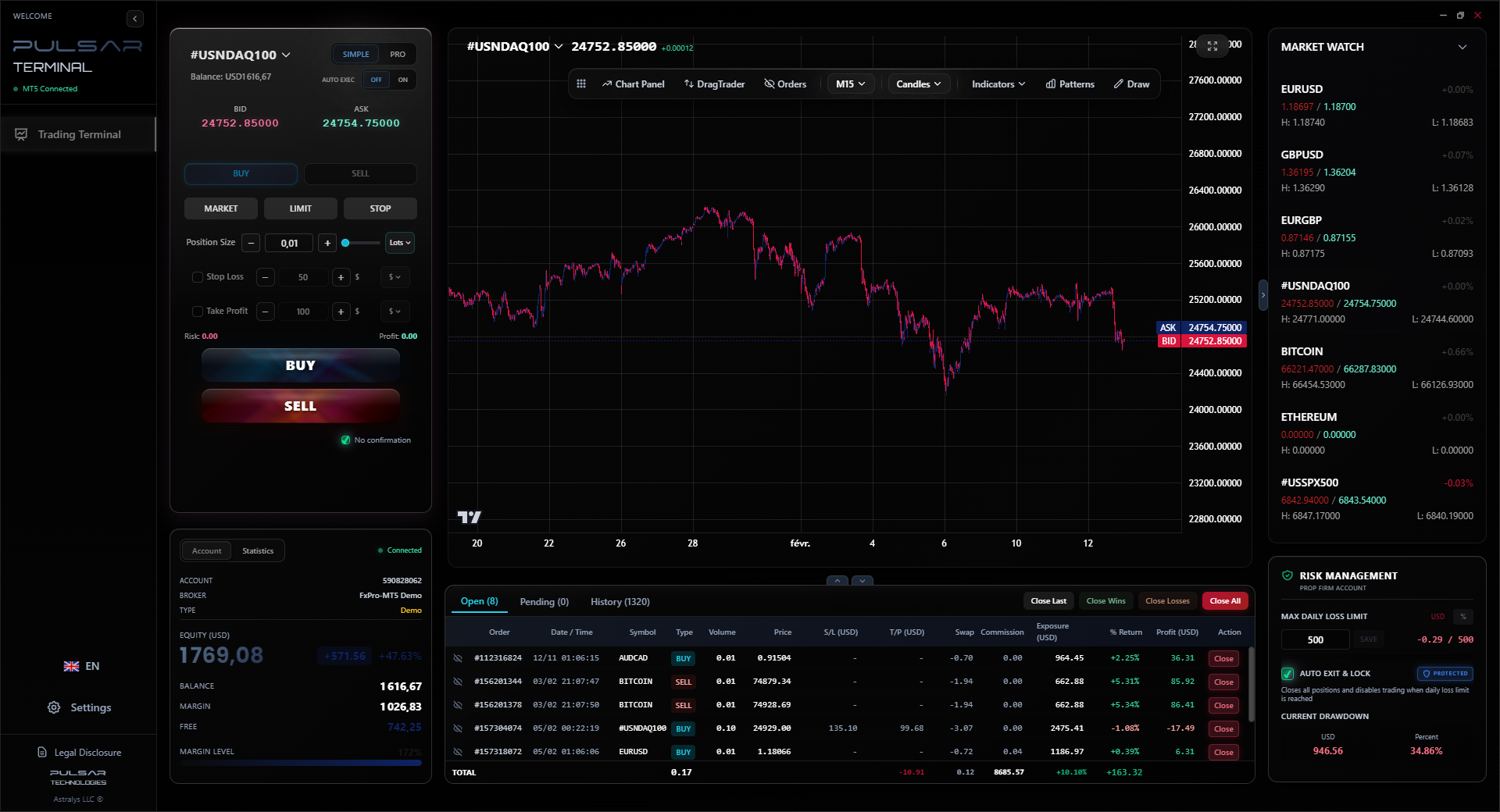
When trading in a volatile market, managing your risk with precise order tools is non-negotiable, which is where a platform like Pulsar Terminal excels for MT5 users.
Pulsar Terminal
A ferramenta MT5 tudo-em-um: ordens drag-and-drop, multi-TP/SL, trailing stop, grid trading, Volume Profile e proteção prop firm. Usado diariamente por 1.000+ traders.
“Your goal is to be so consistently profitable in your core trading that these local inefficiencies become a manageable overhead, not a barrier.”
You need real-time info. Don't rely on evening news.
- For the NAFEX/I&E Rate: Check the FMDQ website (the official financial market quotes hub) or reputable business news sites like Nairametrics or BusinessDay. They usually publish closing rates.
- For the Parallel Market Rate: This is trickier. Some websites and social media channels provide daily averages from bureau de change surveys. Remember, this rate varies by location (Lagos, Abuja, Kano) and by trader. Use it as a guide, not gospel.
- For Your Trading: Your broker's platform is your source of truth for the pairs you trade. For global sentiment, a good economic calendar is key. I also keep an eye on the MACD indicator and RSI on the DXY (US Dollar Index) to gauge broad dollar strength, which pressures the Naira.

Example: Let's say you want to deposit $500. NAFEX is ₦1,460/$. Your bank's effective rate is ₦1,490/$. Parallel market is ₦1,520/$. You'd pay ₦745,000 through your bank. If you could use an alternative method near the parallel rate, you might pay ₦760,000. The bank seems cheaper, but if you factor in the potential speed and certainty of the alternative, the choice isn't always simple.
I've fallen into most of these. Learn from my losses.
- Chasing Parallel Market Profits: Don't try to 'trade' the difference between NAFEX and parallel by timing currency conversions for profit. It's a full-time job with huge risks. Focus on trading.
- Ignoring Funding Costs: That 'small' 2% fee on deposit? Compound it over 20 deposits a year. It's a massive leak. Optimize your funding pipeline.
- Overtrading Due to Frustration: The FX market stress can make you feel you need to 'make up' for the bad exchange rate by trading more. This leads to revenge trading and blown accounts. Stick to your plan.
- Using Unregulated Platforms: The desperation for dollars leads some to shady platforms promising 'CBN rates.' If it sounds too good to be true, it's a scam. You could lose everything. Only use well-known, internationally regulated brokers.
- Neglecting Risk Management: Volatility is high. A wider stop-loss is often needed for Naira pairs, but that means a smaller position. Never risk more than 1-2% of your capital. A margin call in a volatile Naira trade can wipe you out in minutes.
💡 Dica do Winston
In inefficient markets, simplicity wins. A clean chart on a liquid pair with a clear strategy will beat a complex gamble on an unstable local rate every time.
“The discipline you learn from trading in a challenging environment like Nigeria's can make you an exceptionally resilient trader globally.”
The Nigerian FX market will likely remain complex. As a trader, your job isn't to fix it but to navigate it with clear eyes.
Accept the friction as a cost of doing business. Your goal is to be so consistently profitable in your core trading (on the major pairs) that these local inefficiencies become a manageable overhead, not a barrier. It's a hurdle, not a wall.
Build your skills on stable ground. Master price action on XAU/USD. Understand correlations. Develop a strong strategy. The discipline you learn from trading in a challenging environment like Nigeria's can make you an exceptionally resilient trader globally. The trader who can make it work here can trade anywhere.
FAQ
Q1What is the most accurate forex exchange rate in Nigeria today for traders?
For funding your international trading account, the most accurate rate is the effective rate you personally get after all bank fees and charges. For trading sentiment, monitor the NAFEX (I&E) rate from FMDQ and be aware of the parallel market rate, but base your actual CFD trades on the quotes from your regulated international broker.
Q2Can I trade the Nigerian Naira (NGN) on Forex platforms like MetaTrader?
Yes, but with caution. Some CFD brokers offer pairs like USD/NGN. However, they often have very wide spreads, low liquidity, and are extremely volatile due to local policy news. It's considered a high-risk, speculative market more than a technical trading one.
Q3How can I fund my forex trading account from Nigeria with the best rate?
The landscape changes, but methods often include international bank transfers (expensive), credit/debit cards (with limits), and increasingly, cryptocurrency deposits (e.g., USDT). Crypto transfers can offer a faster, sometimes more cost-effective route. Always check your broker's specific deposit options and policies first.
Q4Why is there a big difference between the official and black market exchange rate?
The difference (spread) stems from limited supply of FX at the official windows, high demand, and market inefficiencies. The parallel market fills the gap for those who can't access dollars through official channels, but at a premium price that reflects the higher risk and scarcity.
Q5Does the CBN rate affect my forex trading on EUR/USD?
Not directly, as EUR/USD pricing is set by the global interbank market. However, a major Naira devaluation or FX crisis can influence broader risk sentiment among Nigerian market participants, which could indirectly affect liquidity or your personal psychology as a trader.
Q6What is the safest way for a Nigerian to start forex trading?
Start by trading major global currency pairs (like EUR/USD) with a reputable, internationally regulated broker. Use a demo account to test strategies. Begin with very small real money positions to understand the practicalities of funding and withdrawal. Prioritize learning risk management above everything else.
Lição do Prof. Winston
Pontos-chave:
- ✓There are multiple 'Naira rates'; the tradable one is rarely the official one.
- ✓Funding costs can eat 2-5% of your capital before you even trade.
- ✓Trade liquid global pairs (EUR/USD, Gold) for fairness.
- ✓Volatility in Naira pairs demands tiny position sizes.
- ✓Your mindset must accept friction as a business cost.
Quão útil foi este artigo?
Clique em uma estrela
Insights de Trading Semanal
Análises e estratégias semanais grátis. Sem spam.
Sobre o autor
Olumide Adeyemi
Pioneiro do Trading na África Ocidental
Um dos educadores de trading forex mais ativos da Nigéria. 8 anos de experiência operando a partir de Lagos. Especialista em estratégias de baixo capital e desafios de prop firms para traders africanos.
Comentários
Aviso de risco
A negociação de instrumentos financeiros envolve riscos significativos e pode não ser adequada para todos os investidores. O desempenho passado não garante resultados futuros. Este conteúdo é apenas para fins educacionais e não deve ser considerado aconselhamento de investimento. Sempre conduza sua própria pesquisa antes de negociar.
Você também pode gostar

Cara Trading Forex Sukses: 7 Prinsip dari Trader Profesional
Cara trading forex sukses dengan 7 prinsip trader pro: manajemen modal, disiplin, journal trading, backtest. Data nyata, bukan janji profit palsu.
Jam Trading Forex Terbaik untuk Trader Indonesia: Panduan Lengkap dengan Tabel Waktu
Panduan jam trading forex untuk trader Indonesia. Tabel 4 sesi dunia, jam emas 20:00-00:00, sesi mana yang harus dihindari. Data akurat + tips dari trader berpengalaman.
Top 5 Sàn Forex Uy Tín Nhất 2026: Review Jujur dari Trader Indonesia
Top 5 sàn forex uy tín 2026 untuk trader Indonesia. Review jujur: spread, deposit, withdraw, dukungan lokal. Exness, XM, IC Markets & lebih.
Obter Pulsar Terminal
Todas essas calculadoras estão integradas ao Pulsar Terminal com dados em tempo real da sua conta MT5.
Obter Pulsar Terminal