


I lost R4,200 in 47 seconds.

David van der Merwe
Trader de Mercados Emergentes ·  South Africa
☕ 12 min de leitura
O que você vai aprender:
- 1What is Forex Factory (And Why It's Not Just a Website)
- 2Decoding the Impact Meter: Red, Orange, and Yellow
- 3How South African Traders Blow Up on News (I Did This)
- 4Practical Strategies: What Actually Works
- 5Risk Management When the World Goes Red
- 6Setting Up Your Trading Desk for News Days
- 7The ZAR Wildcard: Trading Local News and Events
- 8Building Your Long-Term News Trading Plan

I lost R4,200 in 47 seconds. It was a Thursday afternoon in Johannesburg, and the US Core PCE Price Index data hit. My EUR/USD position, which I'd held for two days of careful analysis, vaporized before my stop-loss could even trigger. The spread on my broker's platform ballooned from 0.8 pips to over 28 pips instantly. That's the raw, unedited power of high-impact news. I was staring at the Forex Factory calendar, but I had no real plan for it. Most South African traders treat the news calendar like a weather report - they glance at it, then ignore the coming storm. This guide is about building a bunker.
Forex Factory is the town square for economic data. It's where all the major announcements - US Non-Farm Payrolls, SARB interest rate decisions, CPI prints from Europe - get listed with their scheduled times, previous values, and forecasts. For a South African trader, it's your primary source for knowing when the market's normal rhythm is about to get a shock.
Think of the market like a dam. Price action builds up pressure behind it. A high-impact news event is the moment they open the floodgates. All that pent-up energy gets released in a chaotic, high-volume surge. Your job isn't to predict which way the water will go. Your job is to not be standing directly in the spillway when it opens.

Warning: Many local "gurus" teach trading the news by predicting the outcome. "If the number is higher than forecast, buy the dollar!" This is a fantastic way to lose money consistently. The market's reaction is what matters, not the textbook theory. I've seen the Rand strengthen on what looked like bad local data because the market had already priced in something worse.
The real value of Forex Factory news isn't in the speculation. It's in the schedule. It tells you when to reduce your position size, when to widen your stops, and most critically, when to step aside completely. Knowing that the US Federal Reserve announcement is at 20:00 SAST is more valuable than any guess about what Jerome Powell will say.

💡 Dica do Winston
The market's first move on news is often a false one, designed to trigger the most stops. The real money is made in the calm after the storm, not in the storm itself.
Forex Factory uses a simple color-coded system: Red (high impact), Orange (medium impact), and Yellow (low impact). Most traders get this part right. Where they fail is in the application.
Red Events: The Account Killers These are the major economic releases: Central Bank Interest Rate Decisions (SARB, Fed, ECB), US Non-Farm Payrolls (NFP), CPI inflation data, and GDP figures. For ZAR pairs like USD/ZAR, the SARB's Monetary Policy Committee (MPC) meetings are solid red. During these events:
- Liquidity dries up. The big banks pull their orders.
- Spreads widen dramatically. That 5-pip spread on USD/ZAR can easily hit 50+ pips.
- Slippage is guaranteed. Your market order might fill 20 pips away from where you clicked.
- Price moves in spikes, not trends. It's pure volatility, not technical analysis.
Orange & Yellow Events: The Silent Assassins This is where the subtle damage happens. Medium-impact events like Retail Sales or PMI data can still cause 30-50 pip moves in major pairs. For a trader using tight stops on a scalping strategy, that's enough for a string of losses. Low-impact events are generally noise, but they can amplify existing trends.
The South African Context
You need to monitor two calendars: the global one (Fed, ECB) and the local one (SARB). A red event from the SARB will cause havoc in USD/ZAR, but might barely ripple EUR/USD. Conversely, a red Fed event will shake every pair, including your ZAR crosses. Your position size calculator settings must change based on which calendar is active.
“Trading the headline is a guessing game. Trading the market's reaction to the headline is a skill.”
Let's talk about the classic failures. I've committed every one of these sins.
Mistake 1: Trading the Announcement Itself You put on a trade 30 seconds before the data drops, hoping to catch a 100-pip rocket. This is gambling, not trading. The initial spike is often a false move (a "whipsaw") that takes out stops on both sides before settling into a real direction. I once tried this with the UK CPI print, lost 2% of my account in a minute, and spent the next week trying to earn it back slowly.
Mistake 2: Ignoring Spread Widening This was my R4,200 lesson. You have a stop-loss 20 pips away. You think you're risking 0.5% of your capital. But when the news hits, the spread expands to 25 pips. Your trade is stopped out the moment it opens, at a loss nearly double what you calculated. This is especially brutal on exotic pairs like EUR/ZAR. Always assume spreads will multiply during red news.
Mistake 3: Leaving Trades Open Over Major News This is the lazy man's mistake. You have a swing trading position on EUR/USD from Tuesday. Thursday's ECB announcement rolls around, and you think, "I'll just ride it out." The resulting volatility can easily hit your stop, turning a winning trade into a loser, or cause a margin call if you're over-leveraged. If you don't have a specific plan for the news, close the position.
Mistake 4: Misreading ZAR-Specific News South African data like load-shedding schedules, political announcements, or mining production numbers aren't always on Forex Factory, but they massively affect USD/ZAR. Traders get caught looking only at the formal calendar while the real driver is a local headline.

Okay, so what can you do? Here are two evidence-based approaches. I use the first one exclusively now.
Strategy 1: The Bunker Approach (My Preferred Method) This is pure risk management. For any red event on the calendar:
- One hour before: Close all open positions that will be affected. No exceptions.
- 30 minutes before: Remove all pending orders.
- During the event: Do not trade. Watch the chaos unfold. Observe how price reacts, where it finds support/resistance, and how the spread behaves.
- 15-30 minutes after: Once the spread has normalized and price has established a new, volatile range, you can begin to analyze. Look for a retest of the initial spike high or low. That's where you plan a trade, with a stop beyond the extreme.
This approach turns news from a threat into a free research session. You learn market behavior without risking a cent.
Strategy 2: The Volatility Breakout (Advanced) This requires patience and discipline. Don't trade the initial spike. Wait for the first 5-15 minutes of madness to pass. Then, place a buy stop order 5 pips above the high of that initial range, and a sell stop order 5 pips below the low. Whichever order triggers first, you cancel the other. Your stop-loss goes on the opposite side of the range. This strategy tries to catch the first meaningful follow-through move after the initial panic.

Example: SARB hikes rates by 50bps. USD/ZAR spikes down to 18.2000, then rallies to 18.3500, and chops between 18.2500 and 18.4000 for 10 minutes. You place a buy stop at 18.4050 and a sell stop at 18.2450. Price breaks up, triggering your buy. You cancel the sell order and place your stop at 18.2450, risking about 160 pips. You're not guessing the direction; you're letting the market show you.
Both strategies have one thing in common: they avoid the initial, unpredictable explosion. Your broker's technology, your internet speed, and sheer luck dominate that first minute. I'd rather not compete with investment banks' algorithms on my 10 Mbps line in Cape Town.
💡 Dica do Winston
If you wouldn't walk into a lion's den for a R100 note, don't enter a trade just before red news for a potential 20-pip gain. The risk/reward is insane, and not in your favor.
“Your job isn't to predict which way the water will go. Your job is to not be standing directly in the spillway when it opens.”
If you absolutely must have exposure during news (maybe you're a long-term holder), your risk parameters must change.
1. Halve Your Position Size (At Least) If your standard risk is 1% per trade, make it 0.5% or 0.25% for a trade held over a red news event. The increased volatility means your stop needs to be wider, so a smaller position size keeps the monetary risk the same.
2. Triple Your Normal Stop Distance Your technical analysis stop based on a swing low is meaningless during news. Price will blow straight through it. Place your stop based on volatility. Use the Average True Range (ATR) indicator. If the 1-day ATR for EUR/USD is 70 pips, your stop should be at least 100-140 pips away from entry. This gives the trade room to breathe.
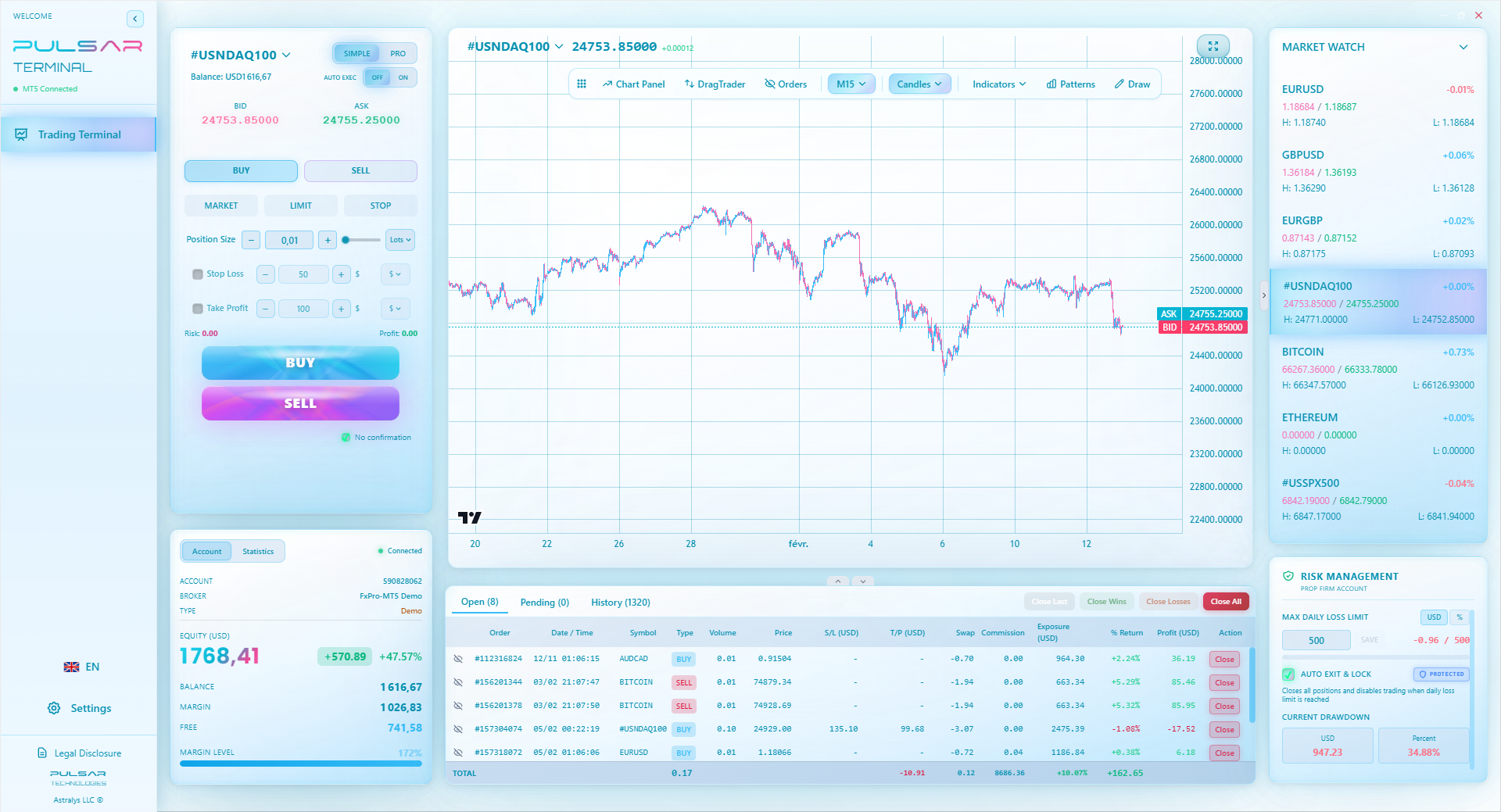
3. Expect and Accept Slippage Your fill price will be worse than you expect. If you're using a market order, you will get slippage. If you're using a limit order, it might not get filled at all. Factor this into your risk calculation. A tool that can help manage complex orders in these fast markets is crucial. For instance, setting multi-level take-profits with partial closures directly on the chart, a feature found in tools like Pulsar Terminal, can help you secure profits quickly if the move goes your way, without frantic clicking.
4. Watch for the Margin Call High volatility increases your floating loss rapidly. If you're using high use (even the FSCA's 30:1 limit), a sharp 100-pip move against you can wipe out a huge chunk of your margin. Ensure your account equity is well above the margin requirement before the event.
Managing complex orders and securing profits during volatile news spikes is nearly impossible with manual clicking. A tool like Pulsar Terminal lets you set multi-level take-profits and trailing stops directly on your MT5 chart, so you can execute a planned strategy the moment the news chaos subsides.
Pulsar Terminal
A ferramenta MT5 tudo-em-um: ordens drag-and-drop, multi-TP/SL, trailing stop, grid trading, Volume Profile e proteção prop firm. Usado diariamente por 1.000+ traders.
Preparation is everything. Here’s my checklist for a day with a red SARB or Fed event:
- The Night Before: I mark the exact event time (in SAST) on my trading platform chart with a vertical line. I use 20:00 SAST for the Fed, or 15:00 SAST for the SARB.
- Broker Choice: I check which of my accounts has the best historical spread stability during news. Not all FSCA-regulated brokers are equal. Some have much worse slippage and widening than others. Your IC Markets review or Pepperstone review should include notes on news handling.
- One Hour Before: I close relevant positions. I remove pending orders. I set an alarm for 5 minutes before the event.
- Five Minutes Before: I open a 1-minute or 5-minute chart. I note the current spread on my watchlist. I do nothing else.
- During: I watch. I might note key price levels that get tagged. I observe the MACD indicator or RSI indicator on the 1-minute chart for extreme readings, but I don't act on them.
- After: I wait for the spread to return to normal. Only then do I open my analysis on a 15-minute or 1-hour chart to see if a new trade setup has formed.
This routine removes emotion. It turns a chaotic event into a procedural checklist.

“The spread on USD/ZAR is your fear gauge. A quiet widening is the market whispering a warning.”
USD/ZAR and EUR/ZAR are a different beast. They're exotic pairs, which means lower liquidity and more dramatic reactions to both global and local news.
Local Red Events:
- SARB MPC Meetings: The big one. The statement tone (hawkish/dovish) is often more important than the rate change itself.
- National Budget Speech: Tax announcements and fiscal policy directly impact the Rand.
- Eskom Load-Shedding Stages: A move to Stage 6 is negative for ZAR. This isn't on Forex Factory, but it's a red event for your ZAR trades.
- Political Stability: Major cabinet reshuffles or policy announcements cause immediate volatility.
The Global/Local Mix: Often, USD/ZAR will be pulled in two directions. A hawkish Fed (strengthening USD) might coincide with strong local commodity export data (strengthening ZAR). The pair can go into a state of chaotic compression before exploding. During these times, it's often wiser to trade a major pair like EUR/USD or XAU/USD where the drivers are clearer, rather than trying to untangle the ZAR crosswinds.

Pro Tip: The spread on USD/ZAR is your fear gauge. If the normal 5-pip spread quietly widens to 8-10 pips on a quiet day, it means the interbank market is anticipating something. There's hidden news or a large order flow. It's a signal to reduce risk, even if your calendar is clear.
💡 Dica do Winston
Your trading journal should have a column for 'News Impact During Trade.' If you see a pattern of losses next to 'High' or 'Medium,' you have your answer. The calendar is telling you to stop.
Your goal isn't to make a fortune on one NFP report. Your goal is to survive all of them, year after year, so your capital compound growth isn't wiped out by random events.
- Define Your Rule: Write it down. "I will not have any open positions 1 hour before any red news event on my traded pairs." Or, "I will reduce position size by 75% for any trade held over orange news."
- Backtest with News in Mind: When you review your past trades, note how many were stopped out by sudden volatility spikes that coincided with a news event. I did this and found 40% of my losses came from trades open during medium or high-impact news. That was a system flaw, not bad luck.
- Respect the Session Overlap: The most volatile time for ZAR pairs is often the London/SA morning overlap (09:00-12:00 SAST). Major European data drops here. Schedule your analysis and entries outside this window if you're sensitive to noise.
- Use the Calendar Proactively: Don't just look at today. Look at the week ahead every Sunday night. Plan your trading activity around the news landscape. A week packed with red events is a week for smaller size, wider stops, or observation.
Forex Factory news is the most predictable source of unpredictability in the market. The time is known. The volatility is guaranteed. Your survival depends on having a plan for that certainty. Mine cost me R4,200 to learn. Yours can cost you just the time it takes to read this and decide to act differently.

FAQ
Q1Is it illegal for South Africans to trade news on USD/ZAR?
No, it's not illegal to trade forex news. However, South African exchange control regulations make it illegal to speculate against the Rand with the specific intent of harming the currency. Normal trading for profit through an FSCA-licensed broker is legal. The key is using an authorised dealer (your broker) and declaring your taxable income to SARS.
Q2What's the single biggest mistake with Forex Factory news?
Assuming you know how the market will react to the data. The actual number vs. forecast is less important than the market's interpretation. Often, a 'good' number sells off because it was already priced in, or a 'bad' number rallies because it wasn't as bad as the worst fears. Trading the headline is a guessing game.
Q3How do I know if my broker is good for news trading?
Look for two things: 1) FSCA regulation for client protection. 2) A reputation for stable spreads. Check reviews that mention 'slippage' and 'news trading'. Brokers with deep liquidity pools and true ECN/STP models (like some reviewed in our XM review or others) typically handle volatility better than market makers who are taking the other side of your trade.
Q4Should I use a wider stop-loss or just close my trade before news?
Closing the trade is always the safest option. A wider stop-loss still exposes you to spread widening and slippage, which can cause a much larger loss than your wider stop intended. If you must hold, use a wider stop AND a smaller position size to keep the monetary risk identical to your normal trade.
Q5Can I make money scalping the news?
Consistently? Almost certainly not. The combination of spread widening, slippage, and random price spikes makes it statistically unfavorable for retail traders. The institutions you're competing with have co-located servers and direct liquidity feeds. What looks like a scalping opportunity is often a trap set for retail orders.
Q6Does the FSCA's 30:1 use limit protect me during news?
It helps, but it's not a shield. Even at 30:1, a 200-pip move against you on a standard lot is a 60% loss on your margin. The use limit prevents 500:1 blowouts in seconds, but you can still lose your entire account quickly during high-impact news if your position size is too large.
Q7Where can I find news that affects the Rand but isn't on Forex Factory?
Follow local financial news (Business Day, Moneyweb), Eskom's load-shedding schedule, National Treasury announcements, and major commodity price moves (platinum, gold). These are fundamental drivers for ZAR that won't appear on a global economic calendar.
Lição do Prof. Winston
Pontos-chave:
- ✓Close all positions 1 hour before red news events. No exceptions.
- ✓During news, spreads can widen 5-10x, making your stop-loss useless.
- ✓The market's reaction matters more than the data itself.
- ✓For ZAR pairs, local events (Eskom, politics) are often red news.
- ✓Use the news calendar to plan your inaction, not your action.
Quão útil foi este artigo?
Clique em uma estrela
Insights de Trading Semanal
Análises e estratégias semanais grátis. Sem spam.
Sobre o autor
David van der Merwe
Trader de Mercados Emergentes
Trader sediado em Joanesburgo com 11 anos em moedas de mercados emergentes. Especialista em pares ZAR, trading regulado pela FSCA e análise do mercado sul-africano.
Comentários
Aviso de risco
A negociação de instrumentos financeiros envolve riscos significativos e pode não ser adequada para todos os investidores. O desempenho passado não garante resultados futuros. Este conteúdo é apenas para fins educacionais e não deve ser considerado aconselhamento de investimento. Sempre conduza sua própria pesquisa antes de negociar.
Você também pode gostar

Cara Trading Forex Sukses: 7 Prinsip dari Trader Profesional
Cara trading forex sukses dengan 7 prinsip trader pro: manajemen modal, disiplin, journal trading, backtest. Data nyata, bukan janji profit palsu.
Jam Trading Forex Terbaik untuk Trader Indonesia: Panduan Lengkap dengan Tabel Waktu
Panduan jam trading forex untuk trader Indonesia. Tabel 4 sesi dunia, jam emas 20:00-00:00, sesi mana yang harus dihindari. Data akurat + tips dari trader berpengalaman.
Top 5 Sàn Forex Uy Tín Nhất 2026: Review Jujur dari Trader Indonesia
Top 5 sàn forex uy tín 2026 untuk trader Indonesia. Review jujur: spread, deposit, withdraw, dukungan lokal. Exness, XM, IC Markets & lebih.
Obter Pulsar Terminal
Todas essas calculadoras estão integradas ao Pulsar Terminal com dados em tempo real da sua conta MT5.
Obter Pulsar Terminal