


Thinking about trading with a broker that's 'regulated in South Africa'? Wondering what that FSCA license sticker on their website actually means for your money? I've traded through three different regulatory regimes in my career, and let me tell you, not all licenses are created equal.

David van der Merwe
Trader de Mercados Emergentes ·  South Africa
☕ 13 min de leitura
O que você vai aprender:
- 1What Exactly is an FSCA License?
- 2The Real Costs and Requirements to Get Licensed
- 3What This License Actually Means For You, The Trader
- 4The South African Broker Landscape: Who's Playing by the Rules?
- 5Recent Changes You Can't Ignore (2024-2026)
- 6Red Flags: Spotting Unlicensed or Shady Operators
- 7How to Verify a License Yourself (Step-by-Step)
- 8The Future: Is South Africa a Forex Hub?
Thinking about trading with a broker that's 'regulated in South Africa'? Wondering what that FSCA license sticker on their website actually means for your money? I've traded through three different regulatory regimes in my career, and let me tell you, not all licenses are created equal. The South African market is unique - it's growing fast, the rules are shifting, and understanding who's really watching the shop can save you from a world of hurt. This isn't about dry legal jargon; it's about knowing who you can trust with your capital.
Right, let's cut through the broker marketing fluff. When a broker says they're 'FSCA regulated,' they mean they have a Financial Services Provider (FSP) license from the Financial Sector Conduct Authority. This isn't some rubber-stamp operation. The FSCA is the main cop on the beat for all financial services in South Africa, born from the Financial Sector Regulation Act of 2018.
For a forex broker, this usually means a Category I or II Discretionary FSP license, plus specific ODP (Over-the-Counter Derivative Provider) authorization. That ODP bit is crucial - it's what lets them legally offer you CFDs and forex pairs. I learned this the hard way years ago with a broker that had a generic license but wasn't properly authorized for derivatives; when a trade dispute arose, I had zero recourse. The FSCA told me, politely, that they couldn't help.
The license forces the broker to play by a local rulebook. They need a real, bricks-and-mortar office in South Africa. They must keep your money in a segregated account at a proper South African bank (so it's not mixed with their operating funds). They have to have a local Key Individual and Compliance Officer who've passed regulatory exams. This structure is designed to stop fly-by-night operations. It's not perfect, but it's a hell of a lot better than dealing with an unregulated offshore entity where your only guarantee is a fancy website.

Warning: An 'FSP number' alone doesn't cut it. You must check the FSCA's official register to confirm the license includes ODP authorization for derivatives trading. If it doesn't, they're not legally allowed to offer you forex CFDs.
So, how much does it cost a broker to get this golden ticket? And what do they have to do? The numbers might surprise you. It's not just about paying a fee.
The Upfront Price Tag
The application fees are the easy part. A Category I license runs about $850 USD. Category II is closer to $1,900. Then there are exam fees for their key staff - around R1,300 a pop. But that's just the entry fee to the casino.
The real barrier is the capital. You'll hear different numbers thrown around - R5 million, R10 million (that's roughly $350k to $700k USD). The truth is, the FSCA doesn't have a single fixed number. They look at the broker's business plan and say, 'Prove you have enough capital to cover your liabilities and run this business without going bust next Tuesday.' It's a judgment call based on expected client volume and risk. They also need professional indemnity insurance of at least R5 million.
The Operational Headaches
This is where it gets interesting for international brokers wanting a slice of the South African pie. The FSCA license is non-transferable. A big global brand like Pepperstone or IC Markets can't just extend their UK or Australian license here. They have to set up a whole new South African subsidiary, with a local office, local staff, and local bank accounts. This is why you'll see 'Pepperstone (SA) (Pty) Ltd' as the regulated entity. It's a separate company.
They need a local auditor. They need strong AML and KYC systems that meet South African standards. They have to report to the FSCA regularly. This structure creates a ring-fenced operation. If the global parent company has issues elsewhere, in theory, the South African client funds and operations should be protected. It's a major commitment, which is why only serious brokers bother. When you're choosing a broker, this level of commitment is a good filter. I'd always pick a broker with this local setup over one that just accepts South African clients via an offshore entity.

💡 Dica do Winston
A license is a snapshot of past compliance. Check the FSCA register for any recent ' Enforcement Actions' or fines against the broker. A clean record matters more than a fancy logo.
“The FSCA license forces a broker to have skin in the game: a real office, local staff, and your money in a separate bank account.”
Okay, enough about them. What does this FSCA license do for YOU when you're sitting there at 3 AM watching the USD/ZAR chart? Several concrete things.
First, segregated accounts. By law, your deposit must be held in a separate trust account at a major South African bank. If the broker goes under, your money isn't part of their bankruptcy estate. It should be returned to you. I've never had to test this, thank goodness, but it's the cornerstone of client protection.
Second, use limits. For retail traders like you and me, the FSCA caps use at 1:30 on major forex pairs. You'll see some brokers advertising 1:500 or more - that's either for professional clients (who have to jump through hoops to qualify) or it's being offered by their offshore, non-FSCA entity. The 1:30 limit is a pain if you're a reckless gambler, but it's a lifesaver if you're prone to over-leveraging. It forces a bit of discipline. You can learn more about managing this with a good position size calculator.
Third, a complaints channel. If you have a legitimate dispute about a trade execution, a withdrawal, or fees, you can escalate it to the FSCA. They won't get your losing trades back, but they will investigate if the broker broke their own rules or the law. It's a last resort, but it's there. This is far more than you get with an unregulated broker, where your complaint disappears into a black hole.
Finally, it means the broker is subject to local market rules. They have to understand South African payment methods, tax implications, and the unique volatility of the Rand. When there's a major local news event, they can't just blame 'liquidity providers' for wild spreads; they're accountable to a local regulator.

Pro Tip: The biggest practical benefit? Banking. Depositing and withdrawing in ZAR to a local bank account is instant and often fee-free with an FSCA-licensed broker. No international wire fees, no currency conversion delays. It makes managing your trading capital infinitely easier.
Let's look at who's actually on the field. The market is split between global giants with local subsidiaries and homegrown South African brokers.
The Global Players (with FSCA local subsidiaries): These are your heavyweights. Pepperstone, IC Markets, XM, AvaTrade, and FP Markets all have dedicated FSCA-licensed entities. They bring their international technology (MT4, MT5, cTrader) and deep liquidity to the local market. Their spreads are usually super competitive because they're plugged into global pools. For example, I've seen EUR/USD spreads as low as 0.0 pips (plus commission) on IC Markets' raw account. Their strength is execution and platform choice.
The Local & Regional Specialists: Brokers like IFX Brokers are built for the South African market from the ground up. They might offer higher use options (like 1:500) through a separate, non-FSCA entity for those who want it, while also providing an FSCA-regulated option. They often have better integration with local banks and might offer unique ZAR-based pairs.
Here’s a quick comparison of what you might see:
| Broker Type | Typical Strength | Watch Out For |
|---|---|---|
| Global (FSCA Sub) | Tighter spreads, better tech (MT5), proven platforms. | Customer service might not be 24/7 local time. |
| Local Specialist | Deep local knowledge, easier ZAR payments, maybe higher use. | Spreads on exotic pairs (like USD/ZAR) might be wider. |
My advice? If you're a technical trader who lives on charts and wants the best possible execution on major pairs like EUR/USD or XAU/USD, go with a top-tier global broker's FSCA entity. If you primarily trade ZAR crosses and value speaking to someone in Johannesburg during business hours, a strong local broker is a fine choice. I use both types for different strategies.
“Verifying a license takes 3 minutes. Not doing it can cost you your entire account.”
The regulatory sand is shifting. If you're trading here, you need to know about two huge changes that affect how money moves.
1. The Tax Clampdown (October 2025): The South African Reserve Bank (SARB) dropped a bombshell with new exchange control rules. Now, if you're a non-resident (say, a foreign prop firm or an offshore broker) trying to send South African-source income OUT of the country, the bank needs a SARS Tax Compliance PIN before they can wire the money. This is a big deal for international businesses operating here. For you, it means any broker moving money around needs to be ultra-compliant with SARS. It adds a layer of security but also potential delays.
2. Crypto is Coming Under Control (February 2026 Announcement): The Finance Minister just announced that crypto assets will be formally added to exchange controls. Soon, moving crypto across borders will need SARB approval. This is huge if you're dabbling in crypto CFDs or if you use crypto to fund your trading account. That 'instant Bitcoin deposit' might soon require paperwork. Brokers offering crypto will need to adjust fast.
What's the takeaway? Regulation in South Africa is getting tighter, not looser. The FSCA is expanding its reach (they now license crypto asset providers too). For you, this means the licensed brokers you use are under more scrutiny than ever. Their compliance costs are going up, but so should your protection. It also means that if a 'broker' is ignoring these rules, they're playing with fire - and your money is the fuel.
💡 Dica do Winston
The most common lie? 'We're regulated.' The most common truth? They're regulated *somewhere*, for *something*. Your job is to match the 'something' to 'forex derivatives' in South Africa.
After 12 years, I've seen every trick in the book. Here’s how to spot a problem before you deposit a cent.
The 'Registered' vs. 'Licensed' Trick: A company can be registered with the FSCA as a financial services provider (they have an FSP number) but not be licensed to provide forex derivatives. It's like having a driver's license but not a license to drive a truck. They'll show you the FSP number proudly. You must go to the FSCA website, type in that number, and check the 'Categories' and 'Authorised Financial Services'. If 'ODP' or 'Derivatives' isn't listed, run.
The Offshore Bait-and-Switch: This is common. A broker's main website is FSCA-licensed. You sign up. But then you notice your client agreement is with 'XYZ Ltd, registered in Vanuatu.' They've quietly onboarded you to their unregulated offshore entity. Always, always check the legal entity name on your sign-up contract and your MT4/5 server. It must match the FSCA-licensed name.
Too-Good-To-Be-True Offers: use of 1:1000. 'Guanteed' profits. Sign-up bonuses that match 200% of your deposit. These are hallmarks of unregulated shops. The FSCA has rules against certain types of bonus promotions. If it sounds like a casino promotion, it probably is one - and the house always wins.
Pressure to Deposit: A 'personal account manager' calls you immediately after you download a platform, pushing you to fund your account with a large sum to 'catch a move.' Licensed brokers don't need to do this. They provide a service; they don't act like used car salesmen.
I got caught early in my career by a slick operation offering 'managed accounts' with a Swiss license (that was fake). Lost $2,000 before I realized the website had a PO Box in Cyprus and the phone number was a VoIP line. The pain of that loss taught me more about due diligence than any winning trade ever did.
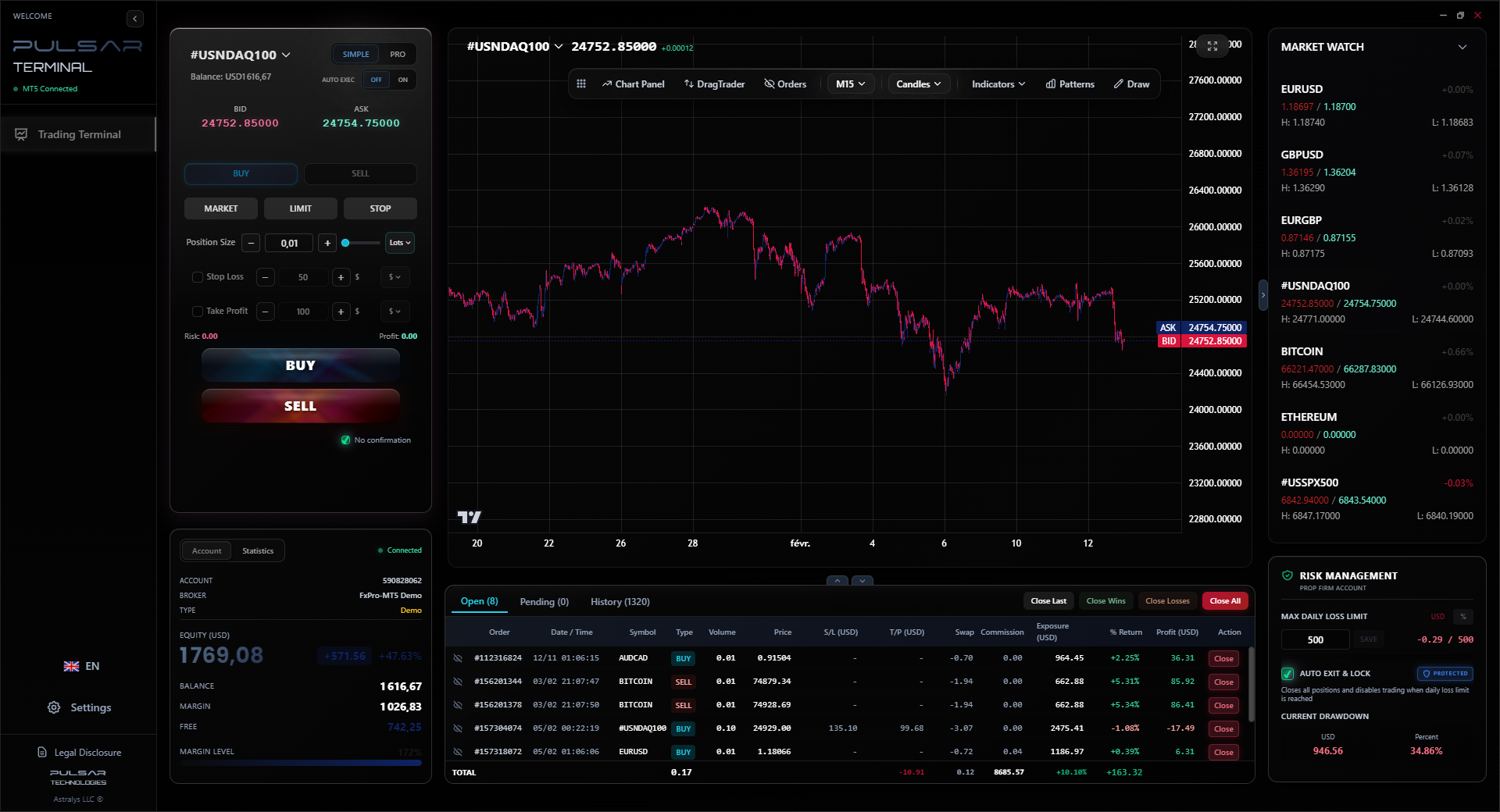
Managing risk is the core of professional trading, and tools like Pulsar Terminal automate critical protections like trailing stops and daily loss limits directly on your MT5 charts.
Pulsar Terminal
A ferramenta MT5 tudo-em-um: ordens drag-and-drop, multi-TP/SL, trailing stop, grid trading, Volume Profile e proteção prop firm. Usado diariamente por 1.000+ traders.
“South Africa's forex rules are getting tighter, not looser. That's bad news for cowboys, but good news for your capital.”
Don't take my word for it. Don't take the broker's word for it. Verify it yourself. It takes 3 minutes.
- Get the Details: Go to the broker's 'Regulation' or 'About Us' page. Find their FSP number (e.g., FSP No. 12345) and the exact legal name of the licensed entity (e.g., 'IG South Africa (Pty) Ltd').
- Go to the Source: Open the official FSCA Public Register: https://www.fsca.co.za/Fais/Search_FSP.htm.
- Search: Enter the FSP number or the company name. Hit search.
- Scrutinize the Results:
- Status: Must be 'Authorised'. 'Pending' or 'Deregistered' is a no-go.
- Authorised Financial Services: Look for the line that says what they can do. You need to see 'Discretionary FSP' and 'ODP (Over-the-Counter Derivative Provider)' or similar derivative-related terms.
- Key Individuals: These should be real people. The register often lists them.
- Cross-Check: Ensure the company name and address match what's on the broker's website and your contract.
If anything is off, or the page looks sparse, email the FSCA at info@fsca.co.za with the details. They typically respond. This simple check has saved me from two potentially disastrous broker choices in the last five years. Consider it the most important trade you'll ever make - the one that protects all the others.
So, where's this all going? South Africa is positioning itself as a major forex hub for the continent, and for good reason.
Compared to Europe's ESMA (with its strict use limits and ban on bonuses) or the UK's FCA, the FSCA has been seen as more pragmatic. The capital requirements, while substantial, can be lower than in some Tier-1 jurisdictions. There's no hard ban on incentives. This has attracted a flood of international brokers setting up shop here over the last five years.
The market is booming. We're looking at over 190,000 active traders and daily volumes hitting $16 billion. The USD/ZAR is a legitimately liquid and volatile pair, perfect for swing trading strategies. The growth potential is massive.
But with growth comes scrutiny. The recent AML law tightening and the crypto regulations show the authorities are watching. The FSCA won't let this become a wild west. I think we'll see a consolidation. The smaller, dodgy operators will get squeezed out or forced to comply. The big, well-capitalized brokers with proper licenses will get stronger.
For you, this is good news. It means more choice from reputable firms, better technology, and continued protection. The key is to stay informed. Regulation isn't static. The rules that protect you today might evolve tomorrow. Keep one eye on the charts, and the other on the FSCA's announcements. Your financial safety depends on both.

Example: Let's say Broker XYZ has an FSCA license with ODP authorization. They offer 1:30 use to you, a retail client. You deposit R10,000. They must hold that in a segregated account at, say, Nedbank. They can't use it for their office rent. If they offer you a 1:500 account, you are almost certainly being onboarded to their offshore entity, outside the FSCA's protection. That's the choice you're making.
FAQ
Q1Is it illegal to use an offshore broker if I live in South Africa?
No, it's not illegal for you as a trader. Many South Africans use offshore brokers. However, it means you have zero protection from the FSCA. Your funds aren't in segregated accounts in SA, you have no local complaints channel, and you're subject to the (often weaker) laws of whatever island nation the broker is based in. It's a higher-risk choice.
Q2What's the difference between an FSP number and being 'licensed'?
An FSP number means the company is registered on the FSCA's database. Being 'licensed' means they have been authorised to provide specific financial services. For forex trading, you need a license that explicitly includes ODP (Over-the-Counter Derivative Provider) authorisation. A company can have an FSP number but only be licensed to give advice, not to trade derivatives. Always check the authorised services on the FSCA register.
Q3Why do some FSCA-licensed brokers still offer 1:500 use?
They do this by offering you an account with a different, offshore legal entity within their group. When you sign up for the 'high use' account, your contract is with 'XYZ Ltd (Seychelles)', not with their FSCA-licensed South African company. Your money goes offshore, and you lose FSCA protection. It's a way for them to cater to demand while keeping their local entity compliant.
Q4How long does it take for a broker to get an FSCA license?
The process is rigorous and can take 6 to 12 months, sometimes longer. It involves submitting detailed business plans, financial projections, compliance manuals, and having key staff pass exams. The FSCA conducts thorough checks. This lengthy process is another reason why a genuine license signals a committed broker.
Q5If my FSCA-licensed broker goes bankrupt, am I guaranteed my money back?
There is no government-backed compensation scheme (like the UK's FSCS) for forex brokers in South Africa. Your primary protection is the segregated client account rule. Your money should be held separately and, in theory, returned to you. However, in a complex bankruptcy, there could be delays or legal costs. It's not a 100% guarantee, but it's vastly safer than having your funds mixed with the broker's operating capital.
Q6Can I trade with a prop firm that isn't FSCA licensed?
Yes, most proprietary trading firms are based offshore and aren't licensed by the FSCA. You're not depositing real money with them; you're trading their simulated capital. However, when you pass their challenge and get a 'funded account', your profit splits are real income. Be aware of the new 2025 SARB rules - getting those profits out of South Africa if the prop firm is foreign may now require a SARS Tax Compliance PIN, which could be a hassle.
Lição do Prof. Winston
Pontos-chave:
- ✓Always verify the ODP authorization on the FSCA register.
- ✓Segregated accounts are your #1 protection - insist on them.
- ✓use over 1:30 likely means you're with an offshore entity.
- ✓Local ZAR payments are a key benefit of FSCA brokers.
Quão útil foi este artigo?
Clique em uma estrela
Insights de Trading Semanal
Análises e estratégias semanais grátis. Sem spam.
Sobre o autor
David van der Merwe
Trader de Mercados Emergentes
Trader sediado em Joanesburgo com 11 anos em moedas de mercados emergentes. Especialista em pares ZAR, trading regulado pela FSCA e análise do mercado sul-africano.
Comentários
Aviso de risco
A negociação de instrumentos financeiros envolve riscos significativos e pode não ser adequada para todos os investidores. O desempenho passado não garante resultados futuros. Este conteúdo é apenas para fins educacionais e não deve ser considerado aconselhamento de investimento. Sempre conduza sua própria pesquisa antes de negociar.
Você também pode gostar

Cara Trading Forex Sukses: 7 Prinsip dari Trader Profesional
Cara trading forex sukses dengan 7 prinsip trader pro: manajemen modal, disiplin, journal trading, backtest. Data nyata, bukan janji profit palsu.
Jam Trading Forex Terbaik untuk Trader Indonesia: Panduan Lengkap dengan Tabel Waktu
Panduan jam trading forex untuk trader Indonesia. Tabel 4 sesi dunia, jam emas 20:00-00:00, sesi mana yang harus dihindari. Data akurat + tips dari trader berpengalaman.
Top 5 Sàn Forex Uy Tín Nhất 2026: Review Jujur dari Trader Indonesia
Top 5 sàn forex uy tín 2026 untuk trader Indonesia. Review jujur: spread, deposit, withdraw, dukungan lokal. Exness, XM, IC Markets & lebih.
Obter Pulsar Terminal
Todas essas calculadoras estão integradas ao Pulsar Terminal com dados em tempo real da sua conta MT5.
Obter Pulsar Terminal