


Here's a hard truth most new traders in South Africa ignore: you're not trading against other guys in their bedrooms.

David van der Merwe
Trader de Mercados Emergentes ·  South Africa
☕ 9 min de leitura
O que você vai aprender:
- 1The Biggest Whale: SARB and the Commercial Banks
- 2Institutional Giants: Funds and Corporates
- 3The Broker-Dealer Layer: Your Gateway (and Sometimes Your Opponent)
- 4The South African Retail Army: You and Me
- 5How These Participants Directly Affect Your ZAR Trades
- 6Using This Knowledge to Trade Smarter, Not Harder
- 7Common Retail Mistakes (I've Made Them All)
Here's a hard truth most new traders in South Africa ignore: you're not trading against other guys in their bedrooms. You're a minnow swimming with whales. The daily forex volume here hit nearly $21.4 billion in 2025. Your R10,000 trade is a rounding error to the real players. If you don't know who's on the other side of your USD/ZAR trade, you're just gambling. This guide breaks down every major forex market participant in our local context, so you can finally see the whole board.
Let's start with the 800-pound gorilla in the room: the South African Reserve Bank (SARB). They aren't a forex market participant; they're the architect of the entire pool. Their actions don't just move prices, they redefine the playing field.
When SARB adjusts interest rates, they're directly manipulating the carry trade appeal of the Rand. A hike can send the ZAR soaring as international money flows in for better yield. I got caught on the wrong side of this in 2022. I was short USD/ZAR, thinking the pair was overextended. Then SARB hiked by 75 basis points. The pair dropped 300 pips in a session, and my stop-loss got vaporized. Lesson learned: never trade ZAR pairs the day before a Monetary Policy Committee announcement.
Then you have the commercial banks: Absa, Standard Bank, Nedbank, FNB. This is where the real interbank market lives. They help massive currency flows for corporations, handle government transactions, and provide liquidity to each other. The spreads they see? A fraction of what you get. Their trading desks aren't guessing; they have order flow intelligence you'll never see.

Warning: When you see a sudden, news-less spike in USD/ZAR, it's often a large bank executing a corporate order (like a mining company converting USD profits to ZAR). Don't assume it's a new trend. Wait for the dust to settle.
Your broker, even an international one like Exness or IC Markets, connects to this bank liquidity. The tighter their bank relationships, the better your execution and spreads.

💡 Dica do Winston
The market's job is to take your money. The big players know where you put your stops. Stop placing them at obvious round numbers.
“You're not trading against other guys in their bedrooms. You're a minnow swimming with whales.”
This is where the real money sloshes around. Think of the Government Employees Pension Fund (GEPF) or large asset managers like Allan Gray. When they adjust their global portfolios, they generate forex transactions in the hundreds of millions of dollars. They're not speculating on a 50-pip move; they're hedging years of exposure.
The Corporate Flow
South African corporates are constant forex market participants. Sasol buying oil in USD? That's a USD/ZAR buy order. Anglo American selling platinum overseas? That's a USD/ZAR sell order. This creates predictable, recurring flows that savvy traders can sometimes anticipate. I once tracked the quarterly dividend season for JSE-listed dual-listed companies. Many convert USD dividends to ZAR around the same time, creating temporary ZAR strength. It's not a sure thing, but it stacks the odds.
Hedge Funds and Prop Shops
While less prevalent than in London or New York, there are local and international hedge funds taking directional bets on the ZAR. They use complex algorithms and have access to credit lines you can't imagine. Their scalping strategy can make the market look jumpy and irrational in the short term.
The key takeaway? These players move on fundamentals and long-term horizons. If you're trying to swing trade USD/ZAR based on a chart pattern, but a major pension fund is rebalancing, your pattern will break. Every. Single. Time.
“Never trade ZAR pairs the day before a Monetary Policy Committee announcement.”
This is the participant you interact with directly. FSCA-regulated brokers like XM or Pepperstone are your conduit to the market. But it's critical to understand their role.
Most brokers operate on a 'Market Maker' or 'Straight Through Processing' (STP) model. As a market maker, the broker may take the other side of your trade internally, especially for smaller lots. This creates a potential conflict of interest. Your loss is their direct profit. STP brokers route your order directly to their liquidity providers (those big banks), earning a commission instead.

Example: You buy 1 standard lot (100,000 units) of EUR/USD. A market maker might fill that from their own book. An STP broker sends it to, say, Citibank, adds a 0.6 pip markup, and gives you a 1.1 pip spread instead of the bank's 0.5 pip spread.
Why does this matter? In volatile conditions (like a SARB announcement), market makers might widen spreads dramatically or require slippage. STP/ECN brokers might just have slower fills. I've had trades on ZAR pairs rejected during news events with one broker, while another simply gave me a terrible price. Know your broker's model. Check their FSCA license details; it often hints at their operational structure.
They also provide the use that defines retail trading. That 1:500 use from some brokers? It's a double-edged sword that makes you a more significant, albeit riskier, forex market participant in terms of volume, but it can also lead to a swift margin call.
“Never trade ZAR pairs the day before a Monetary Policy Committee announcement.”
Here we are. Estimates say there are 200,000 to 500,000 of us. We're the smallest fish by individual size, but collectively, brokers pool our orders to become a meaningful force. Our psychology is the most predictable, and the big players know it.
We tend to pile into obvious support levels, place stops at round numbers, and panic-sell on bad news. I've seen it in my own trading logs. I'd place a stop-loss at a clean number like 18.5000 on USD/ZAR, only to get taken out by a wick that touched it exactly before reversing. That wasn't luck; that was the market hunting for easy liquidity - our liquidity.
Our biggest weakness is treating forex like the JSE. We want to buy the 'undervalued' Rand based on patriotism or news headlines, ignoring the monstrous momentum of institutional flows. I lost R15,000 in 2020 trying to 'buy South Africa's recovery' while global funds were fleeing emerging markets. The charts told me to sell, my heart told me to buy. My heart was wrong.
We also have unique local constraints: Exchange Controls. That R1 million single discretionary allowance limit? It shapes how we fund accounts and repatriate profits. It's a friction the guy trading from the UK doesn't have. Always use your position size calculator with your actual, accessible capital, not your theoretical 'if I-could-get-it-out' capital.
💡 Dica do Winston
If you can't explain which participant's action is likely causing the price move you see, you shouldn't be in the trade. You're guessing.
“Your loss is their direct profit. Know your broker's model.”
Theory is useless without application. Let's map these participants onto your screen.
London Open (10:00 SAST): The institutional flow hits. European banks and funds are active. Expect increased volume and potential trends on EUR/ZAR and GBP/ZAR. This is often a good time for a swing trading entry if your analysis aligns.
SA Market Hours (09:00-17:00 SAST): Local banks and corporates are active. This is when you might get cleaner reactions to local data (CPI, mining production). USD/ZAR can see direction based on actual South African economics.
US Open (16:30 SAST): The liquidity tsunami. All participants are active. This is when global risk sentiment (driven by US indices) overwhelms local ZAR factors. If the S&P drops, ZAR (as an EM currency) will likely weaken, regardless of local news. I've stopped holding sensitive ZAR positions over the US open unless I'm intentionally trading that global risk dynamic.
The 'Quiet' Period (01:00-08:00 SAST): Mostly Asian banks and retail traders. Liquidity is thin. Spreads on ZAR pairs can widen, and odd spikes are common. It's the worst time to enter a trade unless you're specifically scalping that low-volume environment.

Pro Tip: Watch the USD/ZAR volume profile. If price is rising on low volume, it's likely retail or algorithmic buying. If it's rising on surging volume, it's probably institutional accumulation. The latter has more staying power. Tools that visualize this, like Volume Profile, are useful.
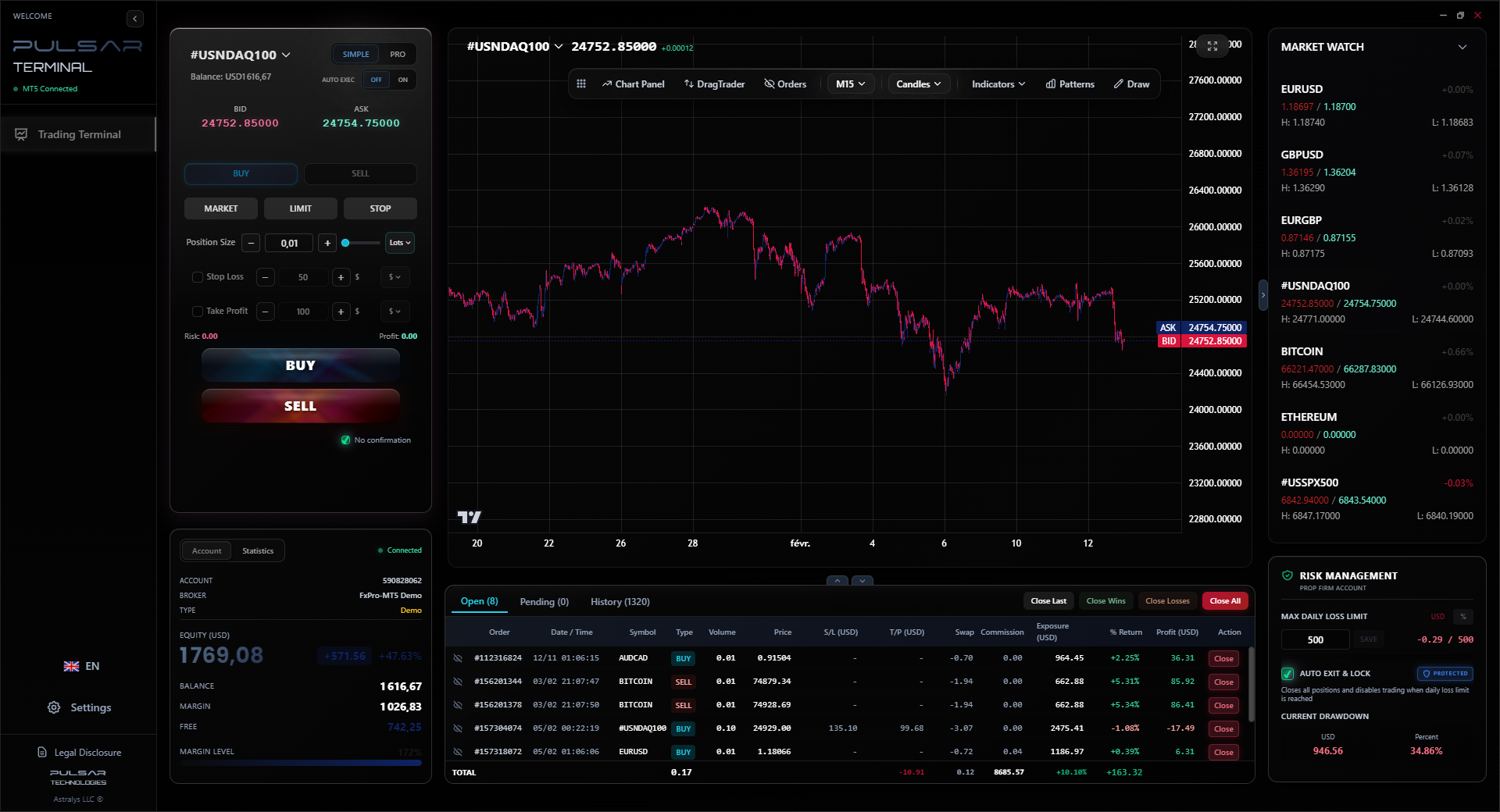
Spotting institutional footprints requires seeing beyond basic candles; Pulsar Terminal's Volume Profile and advanced drawing tools help you visualize the market's true structure directly on your MT5 charts.
Pulsar Terminal
A ferramenta MT5 tudo-em-um: ordens drag-and-drop, multi-TP/SL, trailing stop, grid trading, Volume Profile e proteção prop firm. Usado diariamente por 1.000+ traders.
“Your loss is their direct profit. Know your broker's model.”
So how do you, a retail trader with a day job, use this? You don't beat them; you learn to spot their footprints and avoid their traps.
- Respect the Clock: Align your trading style with the active participants. Don't try to scalp EUR/USD during the dead Asian session. Don't enter a new swing trade on USD/ZAR right before the US open if you're not prepared for volatility.
- Hide Your Liquidity: Use mental stops, or place stops away from obvious round numbers. If USD/ZAR is at 18.47, don't put your stop at 18.50. Put it at 18.53 or 18.45. It costs a few extra pips but saves you from the predictable hunt.
- Follow the Volume: Price movement without volume is a trick. A breakout on the highest volume of the day is likely real institutional participation. Most charting platforms have a volume indicator. Use it. Confirm your MACD indicator or RSI indicator signals with volume.
- Trade the Middle, Not the News: The big players have already positioned themselves before the CPI print or SARB announcement. The initial knee-jerk spike is often retail panic and algorithmic reactions. The move that happens 15-30 minutes after the news, once the institutions have digested it, is usually the real one. I wait.
, this knowledge should humble you. That winning trade? You probably rode a wave created by a pension fund. That losing trade? You probably got run over by a bank's order. Your edge comes from risk management and patience, not outsmarting the forex market participants with more money and information.
💡 Dica do Winston
Volume confirms price. A breakout on low volume is a liar. A small retracement on high volume is a warning sign.
“We tend to pile into obvious support levels, place stops at round numbers, and panic-sell on bad news. The big players know it.”
Let's get blunt. Here's where we screw up because we forget who's in the market.
Mistake 1: Trading Against the Flow. You see USD/ZAR has gone up for three days, so you short it, thinking it's 'overbought.' But if the flow is institutional buying (due to, say, a looming US rate hike), it can stay 'overbought' for weeks. Your RSI indicator will be pegged at 80 the whole time. I've blown accounts doing this.
Mistake 2: Chasing News Headlines. 'Rand strengthens as load-shedding declines!' That's a retail headline. The institutions are trading the forward curve of electricity, political stability, and global commodity prices. The headline is old news to them.
Mistake 3: Over-leveraging on Thin Logic. Because our capital is small, we're tempted to use crazy use to make it meaningful. But a 50-pip move against you on a highly leveraged ZAR trade can wipe you out, while to a bank, it's noise. They can hold and wait. You can't. Always know your exact risk per pip definition.
Mistake 4: Ignoring the True Cost. You focus on the spread definition but forget about swap fees on ZAR pairs, which can be massive. Holding a USD/ZAR short (earning ZAR interest) might pay you a positive swap. Holding a long might cost you. Over time, this eats profits or adds loss. Check the swap rates before you hold a trade for days.
FAQ
Q1Is forex trading legal in South Africa, and who regulates it?
Yes, it's legal, but you must use a broker authorized by the Financial Sector Conduct Authority (FSCA). They're the main regulator for derivatives like CFDs and forex. The South African Reserve Bank (SARB) oversees exchange controls, which limit how much money you can move in and out of the country.
Q2Who are the most important forex market participants for the ZAR?
For the Rand, the SARB is number one - their interest rate decisions are the biggest driver. Next are the major local commercial banks (Standard, Absa, etc.) handling corporate flows, and large international asset managers and hedge funds who trade emerging market currencies like the ZAR in bulk.
Q3As a retail trader, am I trading against my broker?
It depends on your broker's model. Some are market makers and may take the other side of your trade, especially on smaller lots. Others are STP/ECN brokers who simply pass your order to larger banks. Always check your broker's FSCA license and their stated execution policy.
Q4What's the single biggest mistake SA retail traders make?
Trading with their heart instead of following the money flow. We get sentimental about the Rand, trying to 'buy South Africa's recovery,' while institutional money is flowing out based on hard data. We also use far too much use, mistaking it for real opportunity.
Q5How do exchange controls affect me as a trader?
They limit your funding and withdrawal options. You have a R1 million single discretionary allowance per calendar year to move funds offshore. Transfers over that require tax clearance. This means you must be extra careful with risk management - you can't just easily top up a blown account with more offshore cash.
Q6When is the best time to trade USD/ZAR?
The most liquid and predictable times are during overlapping sessions when multiple major participants are active: the SA morning overlap with Europe (10:00-12:00 SAST) and the SA afternoon overlap with the US open (16:30-18:00 SAST). Avoid the early Asian session (01:00-08:00 SAST) when spreads are wide and moves can be erratic.
Q7Do prop trading firms count as major market participants?
In South Africa, they're a growing force among retail-level players. Firms like Khwezi Trade or international prop firms with local challenges pool retail trader capital. While their individual trades might be small, their aggregated volume through a few prime brokers can create noticeable short-term flows, especially in less liquid crosses.
Lição do Prof. Winston
Pontos-chave:
- ✓SARB rate decisions can move USD/ZAR 300+ pips in a session.
- ✓Institutional flows define trends; retail flows create temporary noise.
- ✓Over 200,000 retail traders in SA compete against billion-dollar banks.
- ✓Trade during London (10:00 SAST) or US (16:30 SAST) opens for real liquidity.
- ✓Hide stop-losses away from obvious round numbers (e.g., 18.5000).
Quão útil foi este artigo?
Clique em uma estrela
Insights de Trading Semanal
Análises e estratégias semanais grátis. Sem spam.
Sobre o autor
David van der Merwe
Trader de Mercados Emergentes
Trader sediado em Joanesburgo com 11 anos em moedas de mercados emergentes. Especialista em pares ZAR, trading regulado pela FSCA e análise do mercado sul-africano.
Comentários
Aviso de risco
A negociação de instrumentos financeiros envolve riscos significativos e pode não ser adequada para todos os investidores. O desempenho passado não garante resultados futuros. Este conteúdo é apenas para fins educacionais e não deve ser considerado aconselhamento de investimento. Sempre conduza sua própria pesquisa antes de negociar.
Você também pode gostar

Cara Trading Forex Sukses: 7 Prinsip dari Trader Profesional
Cara trading forex sukses dengan 7 prinsip trader pro: manajemen modal, disiplin, journal trading, backtest. Data nyata, bukan janji profit palsu.
Jam Trading Forex Terbaik untuk Trader Indonesia: Panduan Lengkap dengan Tabel Waktu
Panduan jam trading forex untuk trader Indonesia. Tabel 4 sesi dunia, jam emas 20:00-00:00, sesi mana yang harus dihindari. Data akurat + tips dari trader berpengalaman.
Top 5 Sàn Forex Uy Tín Nhất 2026: Review Jujur dari Trader Indonesia
Top 5 sàn forex uy tín 2026 untuk trader Indonesia. Review jujur: spread, deposit, withdraw, dukungan lokal. Exness, XM, IC Markets & lebih.
Obter Pulsar Terminal
Todas essas calculadoras estão integradas ao Pulsar Terminal com dados em tempo real da sua conta MT5.
Obter Pulsar Terminal