


Most new traders think the 24-hour forex market means you can trade whenever you want and make money.
Sarah Collins
Estrategista de Trading ·  United Kingdom
☕ 11 min de leitura
O que você vai aprender:
- 1The 24/5 Market Myth (And Why It's Dangerous)
- 2The Major Sessions in UK Time (Forget GMT, This is Your Clock)
- 3The Golden Overlap: Your Most Important 3 Hours
- 4How UK Regulations Should Shape Your Trading Time
- 5Building Your UK Trading Schedule (The Realistic Way)
- 6Session-Specific Strategies & What to Avoid
- 7Essential Tools for Perfect Timing
- 8The Top 3 Timing Mistakes UK Traders Make
Most new traders think the 24-hour forex market means you can trade whenever you want and make money. That's a fast track to blowing your account. The truth is, timing isn't just everything, it's the only thing that separates consistent profit from random gambling. I've watched too many traders in the UK burn out trying to catch moves in the dead of Tokyo night when they should be sleeping. Let's set the record straight on when the real money moves happen and how you, sitting in London or Manchester, can be there to catch them.
Yes, the forex market is open 24 hours a day from Monday morning in Sydney until Friday night in New York. Telling a new trader that is like giving a teenager the keys to a Ferrari and saying 'have fun.' It's technically true but practically irresponsible.
The danger is in the implication. It makes you think liquidity and opportunity are constant. They're not. They pulse with the opening and closing of the world's major financial centres. Trading during the Sydney session's low liquidity with the same position size calculator settings you use for London is a classic amateur mistake. The spreads widen, the moves can be erratic, and you're paying the broker extra for the privilege of gambling in a quiet casino.
I learned this the hard way early on. I was determined to be a 'full-time' trader, so I forced myself to sit through the Asian session (11 PM to 8 AM UK time). In February 2019, I took a short on AUD/JPY during this time. The spread was nearly 3 pips, double the usual. A tiny, random piece of Chinese data hit the wires, spiked the pair 15 pips against me, triggered my stop-loss, and then it instantly reversed to go in my original direction. I lost £120 on a trade that would have been a winner just two hours later. I was trading a ghost market.

Warning: Just because you can trade at 3 AM doesn't mean you should. Low liquidity often means higher costs (wider spreads) and more unpredictable price action. Your strategy might only work when the big players are awake.

💡 Dica do Winston
Your first trade of the day shouldn't be before 8:05 AM UK time. Let the initial London open volatility spike settle. The amateurs are getting stopped out in those first five minutes.
All times are in UK local time (GMT in winter, BST in summer). This is the clock on your wall, not a theoretical reference. Memorise these.
The Asian Sessions (Your Late Night / Early Morning)
- Sydney Open: 10:00 PM (22:00)
- Tokyo Open: 12:00 AM (00:00)
This is the 'setup' period. The moves are often smaller and more range-bound. Major pairs like EUR/USD might do very little. It's a time for the scalping strategy crowd on Asian pairs (AUD, JPY, NZD) or for swing trading analysis. For most UK traders, this is research or sleep time.
The London Session (Your Main Event)
- London Open: 8:00 AM
- London Close: 5:00 PM
This is where you earn your keep. London is the world's largest forex trading hub, handling over 40% of global volume. Liquidity floods the market at 8 AM. This is when European economic data drops, and big institutional orders get filled. Volatility and volume spike. If you have a day job, the London open is your first major check-in. The first hour (8-9 AM) is often chaotic but full of opportunity.
The New York Session (The Overlap Power Hour)
- New York Open: 1:00 PM
- New York Close: 10:00 PM
The New York session is important, but its real power for the UK trader comes in the first few hours when it overlaps with London.

Example: A classic London session trade. On March 12th, 2024, I was watching GBP/USD ahead of the UK budget announcement at 12:30 PM. Price was consolidating. I entered a long at 1.2785 at 12:25 PM, just before the news, with a tight 20-pip stop. The budget was perceived as mildly positive, the pair spiked 45 pips in 15 minutes. I took half profit at 1.2820 and let the rest run with a trailing stop, eventually exiting at 1.2835. The London session provided the volatility for the move.
“The London-New York overlap isn't just a good time to trade; it's the only time you need to be fully in the game.”
If you only trade one block of time all week, make it this one.
London-New York Overlap: 1:00 PM to 4:00 PM UK Time.
For three hours, the two biggest financial markets in the world are open simultaneously. This is peak forex. What does this mean for you?
- Liquidity is Maximum: Spreads on majors like EUR/USD are often at their tightest. You get the best prices.
- Volatility is High: Big moves happen as transatlantic flows collide. Breakouts from the London session ranges are common.
- News Galore: US economic data (like NFP, CPI, Retail Sales) is typically released at 1:30 PM UK time. This guarantees a market-moving event right in the middle of the overlap.
I structure my entire trading day around this window. My morning (London open) is for analysis and setting alerts. The overlap is for execution. I treat it like a surgeon's operating hours: focused, precise, and over by 4 PM. After that, the market often enters a lull as London traders log off.
Here’s a comparison of average hourly ranges (in pips) for EUR/USD:
| Session Window (UK Time) | Avg. Hourly Range (Pips) | Character |
|---|---|---|
| 2:00 AM - 7:00 AM (Late Asia) | 10-15 | Sleepy, Range-bound |
| 8:00 AM - 9:00 AM (London Open) | 20-30 | Volatile, Directional |
| 1:00 PM - 2:00 PM (Overlap Start) | 25-40 | Peak Liquidity & News |
| 5:00 PM - 10:00 PM (NY Only) | 15-25 | Slowing, Often Corrective |
The FCA isn't just about protecting your money, its rules should directly influence your schedule. The 30:1 use limit on majors is a blessing in disguise - it forces you to be more selective. You can't just throw huge use at every tiny move and hope for the best.
This means you need to trade when the quality moves happen, i.e., during high-volatility, high-liquidity windows where your controlled risk has the best chance of a good reward. Trading a 10-pip range on GBP/USD with 30:1 use at 4 AM is a mug's game. Trading a 50-pip breakout during the London-New York overlap with the same use is a calculated strategy.
Also, remember the margin call and Negative Balance Protection. While the FCA protects you from going into debt, a margin call during a thin session can still wipe you out. A fast move in XAU/USD (gold) during low liquidity can gap through your stop. Trading during peak hours gives your orders the best chance of being filled at the price you want.
Your choice of broker matters here too. An Exness review or IC Markets review will show they offer different conditions, but all FCA-regulated ones must adhere to these session-agnostic rules. The safety is there, but it's up to you to trade when the market is most orderly.
💡 Dica do Winston
If you find yourself placing a trade after 4:30 PM UK time, ask yourself: 'Is this a planned swing trade, or am I just bored?' The answer is usually the latter. Close the platform.
“Trading at 3 AM from your sofa isn't dedication, it's a lack of strategy.”
Let's be practical. You're not a hedge fund manager with a 24-hour desk. You have a life. Here are sample schedules based on common UK trader profiles.
The Full-Time Trader
- 7:30 AM - 8:00 AM: Prep. Scan news, check overnight levels, plan trades.
- 8:00 AM - 9:30 AM: Active trading. Capitalise on London open volatility.
- 9:30 AM - 12:30 PM: Monitor, manage positions, analyse for afternoon.
- 12:30 PM - 4:00 PM: Primary Trading Window. Focus entirely on the overlap. This is where you aim to place your main trades of the day.
- After 4:00 PM: Review, journal, shut down. The market's character changes.
The 9-5 Job Trader
- Before Work: Quick 10-minute check at 7:45 AM. Set price alerts for key levels ahead of London open.
- Lunch Break (1:00 PM - 1:30 PM): Your golden moment. US news is out, overlap is hot. Have pre-defined setups ready. Execute quickly, set stops and limits. This is a focused, 30-minute mission.
- After Work: Check positions at 5:30 PM. Manage or close trades. No new entries unless you're a night owl targeting late NY moves.
The Weekender / Swing Trader
- Sunday Evening (10:00 PM): Watch the Sydney open for any gap reactions to weekend news.
- Weekday Evenings (After 8:00 PM): Do your analysis for the next day. Place entry orders with stops and limits for the London or NY open. Then walk away. Let the market come to you.

Pro Tip: Use a broker with reliable mobile execution like XM or Pepperstone if you're trading around a job. Your lunch break trade needs to be executed flawlessly in under a minute. Test your mobile platform's order entry speed on a demo first.
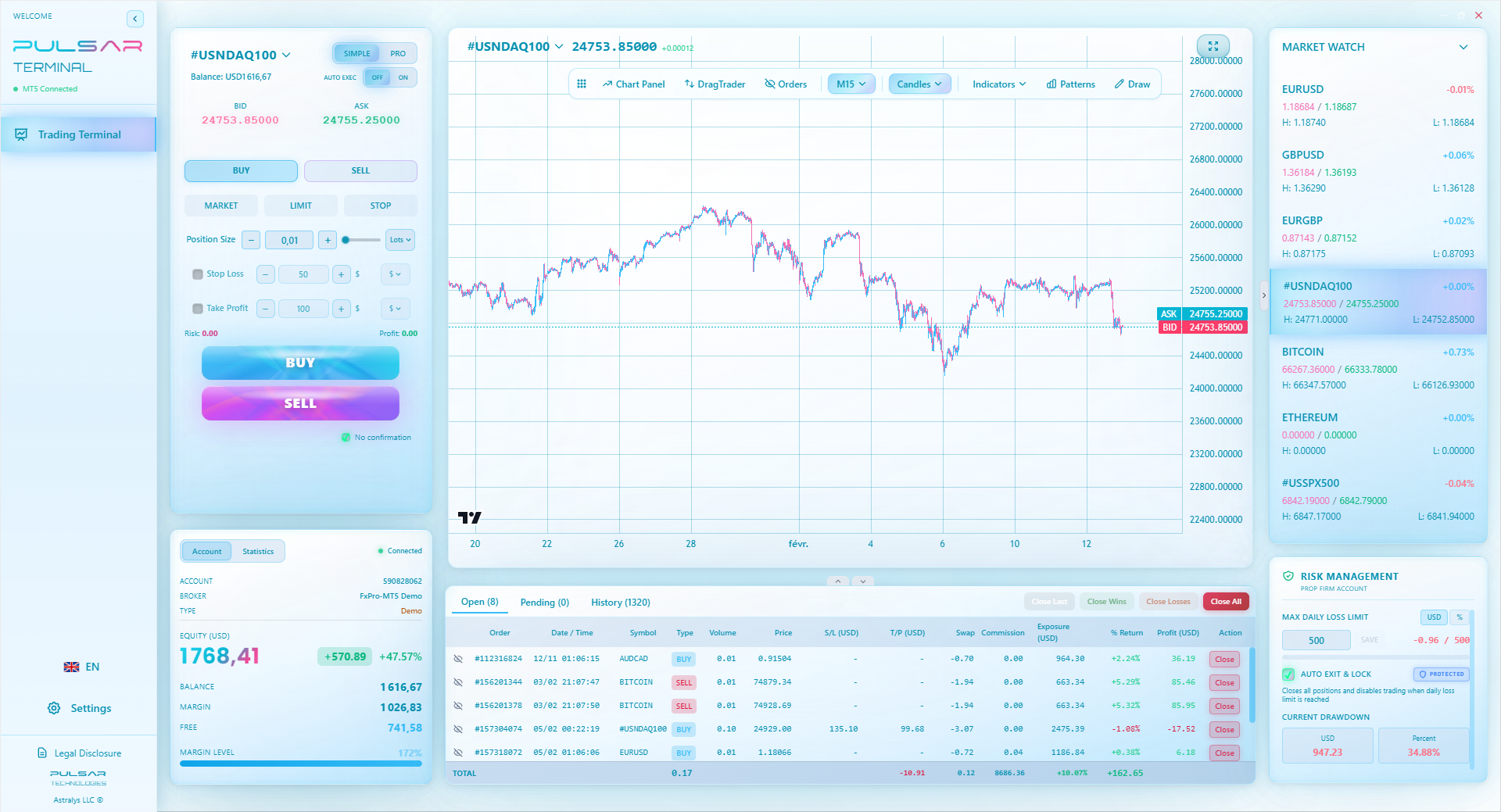
Sticking to a disciplined trading schedule is one thing, but managing multiple trades across sessions is another. Pulsar Terminal's drag-and-drop order management and multi-TP/SL features let you set complex trade plans during your analysis time and execute them flawlessly when your scheduled window opens.
Pulsar Terminal
A ferramenta MT5 tudo-em-um: ordens drag-and-drop, multi-TP/SL, trailing stop, grid trading, Volume Profile e proteção prop firm. Usado diariamente por 1.000+ traders.
Different sessions have different personalities. Your strategy should adapt.
London Session (8 AM - 5 PM):
- Do: Trade breakouts from the Asian range. Fade false early spikes (the 8:05 AM fakeout). Trade GBP and EUR pairs.
- Don't: Chase a move after 10 AM without a fresh catalyst. The initial energy often fades.
London-NY Overlap (1 PM - 4 PM):
- Do: Trade news releases (have a plan!). Look for continuation of the London trend or a reversal if US data contradicts. Use indicators like the MACD indicator on a 15-minute chart to confirm momentum.
- Don't: Trade blindly into major news (like NFP) without understanding the potential for slippage. And don't start a new, complex trade at 3:45 PM.
New York Solo (After 5 PM):
- Do: Manage existing positions. Look for retracements to key levels set earlier in the day. Sometimes the late NY session (after 8 PM) sees a second wind.
- Don't: Expect big, fresh directional moves. This is often a consolidation or correction period.
Asian Session (10 PM - 8 AM):
- Do: Use it for analysis. Set limit orders at key support/resistance. If you must trade, focus on AUD/USD, USD/JPY with range strategies.
- Don't: Use tight stop-losses. Low liquidity can cause wicked spikes. Don't trade EUR/GBP - it'll bore you to tears.
I once tried to apply my London breakout strategy to USD/JPY at 2 AM. The 'breakout' was a 7-pip move that immediately reversed. The lack of volume meant my 10-pip stop was meaningless; the spread and a single large order took me out. The strategy was sound, the timing was idiotic.
“The FCA's use limits are a forced lesson in patience: you have to wait for the right moment, not create it with margin.”
You can't just guess the session. You need data.
- Economic Calendar: Non-negotiable. Filter for 'High Impact' events. Know what's scheduled for 8:30 AM UK (EU data), 1:30 PM UK (US data).
- Market Hours Indicator: Most platforms have them. Get one that visually shades the different sessions on your chart. It's a constant reminder.
- Volume Indicator: While forex has no central volume, tools like the Volume Profile can show you where price was accepted with high activity. You'll see volume nodes often form during London and the Overlap.
- VWAP (Volume Weighted Average Price): A fantastic benchmark for the day's fair value. During active sessions, price tends to mean-revert to the VWAP. During dead sessions, it wanders away.
- Session-specific Alarms: Set an alarm for 7:45 AM (pre-London) and 12:55 PM (pre-Overlap). Discipline is built on routine.
Using these tools, you can objectively see when the market is 'alive.' For instance, when the RSI indicator gives a signal during the Asian session, I largely ignore it. The same signal at 1:15 PM UK time? I'm all over it.
💡 Dica do Winston
Mark the 1:00 PM - 4:00 PM overlap block in your calendar as a recurring 'Meeting.' It's the most important meeting of your day. Treat it with that level of respect.
I see these every week in my mentoring group.
- FOMO Trading the Sydney Open: You see a 20-pip move on AUD/USD at 10:05 PM and jump in, only for it to reverse by 11 PM. You're trading the last of the NY close liquidity, not a new trend. Go to bed.
- Ignoring the 'Dead Zone' (4 PM - 5 PM UK): London is packing up, New York is at lunch. Price often chops aimlessly. This is when impatient traders lose money trying to force a trade that isn't there. It's okay to have zero trades between 4 and 5 PM.
- Mis-timing News: A 'High Impact' news event for Australia at 2:30 AM UK time is NOT high impact for EUR/USD. You need to know which currency the news affects and if its counterparty market is even open. Trading EUR/USD on Australian employment data is pointless.
The biggest lesson? The market doesn't care about your convenience. It operates on its own global clock. Your job is to align your activity with its periods of maximum opportunity, not the other way around. Get this right, and you've solved more than half the battle before you even place a trade.
FAQ
Q1What are the exact forex market trading times for the London session?
In UK local time, the core London session runs from 8:00 AM to 5:00 PM, year-round. The most volatile and liquid period is typically the first two hours (8:00-10:00 AM) and the overlap with New York (1:00-4:00 PM).
Q2As a UK trader with a day job, what is the single best hour to trade?
Your lunch break, specifically 1:00 PM to 1:30 PM UK time. This captures the immediate reaction to US economic data releases (which drop at 1:30 PM) at the very start of the high-liquidity London-New York overlap. Be prepared, execute fast, and manage the trade remotely later.
Q3Do forex market trading times change with British Summer Time (BST)?
The clock on your wall changes, but the global sessions don't. When the UK is on BST (GMT+1), the New York open shifts to 2:00 PM your time, and the London-New York overlap becomes 2:00 PM to 5:00 PM UK time. Always think in your local time, not GMT.
Q4Is it profitable to trade the Asian session from the UK?
For most retail traders, no. The liquidity is lower, spreads are often wider, and moves are generally smaller and less directional. It requires a specific, patient range-trading strategy focused on AUD or JPY pairs. For most, it's better used for analysis and planning for the London open.
Q5When does the forex week technically start and end for a UK trader?
The new trading week begins with the Sydney Open at 10:00 PM on Sunday evening (UK time). The week closes with the New York session finish at 10:00 PM on Friday night (UK time). The most volatile weekly open is often the London open on Monday at 8:00 AM.
Q6How do FCA use limits affect my choice of trading time?
They make timing more critical. With use capped at 30:1 for majors, you need good, clean moves to make meaningful profits. These moves are most likely during high-volume sessions (London & the Overlap). Trading in thin sessions with limited use often yields poor risk/reward ratios.
Lição do Prof. Winston
Pontos-chave:
- ✓The 3-hour London-NY overlap is your primary profit window.
- ✓Never trade major EUR/GBP pairs during the Asian session.
- ✓Set alarms for 7:45 AM and 12:55 PM daily.
- ✓Your lunch break (1-1:30 PM) is a strategic weapon.
- ✓Low liquidity = wider spreads + erratic moves.
Quão útil foi este artigo?
Clique em uma estrela
Insights de Trading Semanal
Análises e estratégias semanais grátis. Sem spam.
Sobre o autor
Sarah Collins
Estrategista de Trading
Estrategista de trading sediada em Londres com 12 anos em mercados financeiros. Ex-analista numa corretora na City de Londres. Cobre pares GBP, mercados europeus e trading regulado pela FCA.
Comentários
Aviso de risco
A negociação de instrumentos financeiros envolve riscos significativos e pode não ser adequada para todos os investidores. O desempenho passado não garante resultados futuros. Este conteúdo é apenas para fins educacionais e não deve ser considerado aconselhamento de investimento. Sempre conduza sua própria pesquisa antes de negociar.
Você também pode gostar

Cara Trading Forex Sukses: 7 Prinsip dari Trader Profesional
Cara trading forex sukses dengan 7 prinsip trader pro: manajemen modal, disiplin, journal trading, backtest. Data nyata, bukan janji profit palsu.
Jam Trading Forex Terbaik untuk Trader Indonesia: Panduan Lengkap dengan Tabel Waktu
Panduan jam trading forex untuk trader Indonesia. Tabel 4 sesi dunia, jam emas 20:00-00:00, sesi mana yang harus dihindari. Data akurat + tips dari trader berpengalaman.
Top 5 Sàn Forex Uy Tín Nhất 2026: Review Jujur dari Trader Indonesia
Top 5 sàn forex uy tín 2026 untuk trader Indonesia. Review jujur: spread, deposit, withdraw, dukungan lokal. Exness, XM, IC Markets & lebih.
Obter Pulsar Terminal
Todas essas calculadoras estão integradas ao Pulsar Terminal com dados em tempo real da sua conta MT5.
Obter Pulsar Terminal