


You've seen the ads, right? 'Forex Mentor Pro' promises to turn you into a profitable trader.

Olumide Adeyemi
Pioneiro do Trading na África Ocidental ·  Nigeria
☕ 8 min de leitura
O que você vai aprender:
- 1What Exactly Is Forex Mentor Pro?
- 2The Nigerian Reality Check: Rules Before Tools
- 3Breaking Down the Costs: Course vs. Actual Trading
- 4What Does The Course Actually Teach? (The Good & The Missing)
- 5Free & Local Alternatives: Building Knowledge Your Way
- 6Should You Buy It? A Framework for Decision
- 7Your Action Plan: First Steps Today
You've seen the ads, right? 'Forex Mentor Pro' promises to turn you into a profitable trader. But here in Nigeria, with our unique rules and payment hurdles, does a foreign course make sense? I paid for it myself years ago. Let's cut through the hype. I'll break down what it actually offers, how much it costs in Naira, and - more importantly - what you really need to know about trading legally and profitably from Lagos or Abuja.
Forex Mentor Pro isn't a magic signal service or a robot. It's a structured online education platform. Think of it like a university course for trading, but delivered through videos, PDFs, and sometimes live sessions. The core promise is to teach you a complete trading methodology, from reading charts to managing your psychology.
When I joined back in 2019, the main draw was the mentor, a trader named Walter Peters. His approach was very systematic, focusing on price action and clear rules. The course walked you through everything: how to spot trends, where to place stops, how to manage a trade once it's running. It was complete, I'll give it that.
But here's the thing they don't shout about: it's generic. The lessons are built for a global audience. They'll teach you about the EUR/USD guide or the XAU/USD guide, but they won't teach you how to fund your account with a Nigerian bank facing CBN restrictions. That gap between global theory and local reality is where many Nigerian traders get stuck.
Before you spend one kobo on any course, you have to understand the lay of the land here. Trading itself isn't illegal, but how you go about it is tightly controlled.
The Central Bank of Nigeria (CBN) is the big boss. They don't ban you from trading, but they make it tricky to move money. Using your Naira debit card for large international broker deposits? That's often blocked. Their goal is to stop Naira from fleeing the country for speculation. So, you need workarounds like local bank transfers to a broker's Nigerian entity or using P2P services.
Then there's the Securities and Exchange Commission (SEC). Here's a critical point: the SEC Nigeria does not license retail forex brokers for spot trading. That means there's no 'SEC-approved' local broker for what you and I want to do. Zero. All the brokers we use - like Exness review, IC Markets review, or Pepperstone review - are regulated overseas (think Cyprus, Seychelles, Australia).

Warning: Anybody claiming to be a 'SEC-licensed forex broker' in Nigeria for spot trading is likely running a scam. Always verify a broker's international license.
This regulatory gap is why your education must include broker due diligence. A course like Forex Mentor Pro won't teach you this. You have to learn it yourself, or from local communities that understand these specific hurdles.

💡 Dica do Winston
The most expensive lesson is the one you learn with money you couldn't afford to lose. Master the demo with the intensity of a live account first.
“The gap between global trading theory and Nigerian reality is where most accounts get blown.”
Let's talk numbers, because this is where dreams meet budgets.
The Course Fee
Forex Mentor Pro typically operates on a subscription. When I last checked, it was around $97 per month, or a lump sum of nearly $1,000 for 'lifetime' access. At an exchange rate of say ₦1,450/$, that's roughly ₦140,650 monthly or over ₦1.45 million upfront. That's a serious chunk of change. You could start a small business with that.
The Real Trading Costs
Now, the costs of actually trading. This is where you need a position size calculator.
| Cost Type | What It Is | Typical Amount for Nigerian Traders |
|---|---|---|
| Spread | Difference between buy/sell price | 0.5 - 1.5 pips on standard accounts |
| Commission | Fee per trade (on raw accounts) | $3 - $7 per lot round turn |
| Swap/Overnight | Fee for holding past 5 PM EST | Varies by pair & direction |
| Payment Fees | Bank/P2P transfer costs | 1% - 3% of deposit amount |
A real example from my journal: On a standard account with XM review, I entered a GBP/USD trade. The spread was 1.3 pips. On a 0.1 lot position, that's a $1.30 cost just to enter. If the trade went against me by 20 pips, my loss would be $20 plus that initial spread. These micro-costs eat you alive if you're not careful.

Pro Tip: Before buying any expensive course, open a demo account. Practice until you consistently understand what a pip definition costs you and how a spread definition works. This basic knowledge is free.
So, what do you get for your money? The curriculum is solid for foundation. They cover technical analysis in depth - support/resistance, candlestick patterns, basic indicators like the RSI indicator and MACD indicator. The risk management modules are valuable; they hammer home the 1-2% risk-per-trade rule, which saved my account more times than I can count.
They also teach specific strategies. Some are geared towards swing trading, holding for days, others for quicker moves. I tried their version of a scalping strategy early on. It required lightning-fast execution and a broker with razor-thin spreads. On a bad connection in Lagos, with slightly higher latency, I was often a pip behind. I lost $150 over a week before admitting it wasn't for me. The strategy wasn't bad, but my local conditions (internet, broker choice) made it unfit.
The Critical Gap for Nigerians
This is the big miss. The course assumes:
- You can easily deposit/withdraw.
- You have stable, low-latency internet.
- You're trading in a vacuum, not during Nigerian market hours when liquidity might differ.
- Tax implications are your problem to figure out.
It doesn't address the psychological stress of trying to execute a perfect trade during a random NEPA outage. That's a uniquely Nigerian trading challenge no global course will cover.
💡 Dica do Winston
A strategy that works in London at 9 AM might behave differently during Lagos lunch hours. Always consider liquidity and who's in the market.
“That ₦1.4 million course fee could be your entire trading capital. Which teacher do you think is more effective: a video or a real, risk-managed trade?”
You don't need to spend ₦1.4 million to learn. The internet is overflowing with free, high-quality information. Start with Babypips' 'School of Pipsology'. It's completely free and will give you 90% of the foundational knowledge any paid course offers.
Then, move to YouTube - but be selective. Look for channels that focus on pure chart analysis, not 'get rich quick' nonsense. Practice drawing trendlines and identifying patterns every single day on your demo account.
The most valuable resource? Other Nigerian traders. Find serious communities on Telegram or forums (not the ones pumping signals). Discuss which brokers actually process withdrawals smoothly. Share notes on which P2P agents give the best rates. This localized, practical knowledge is worth more than any generic course module.
Build your own curriculum:
- Free Basics (Babypips).
- Platform Mastery (Learn MT4/MT5 inside out).
- Risk Management (Use a position size calculator religiously).
- Local Broker Research (Read real broker reviews).
- Psychology (Journal every trade, wins and losses). This path is slower, but it's tailored to you and costs almost nothing.
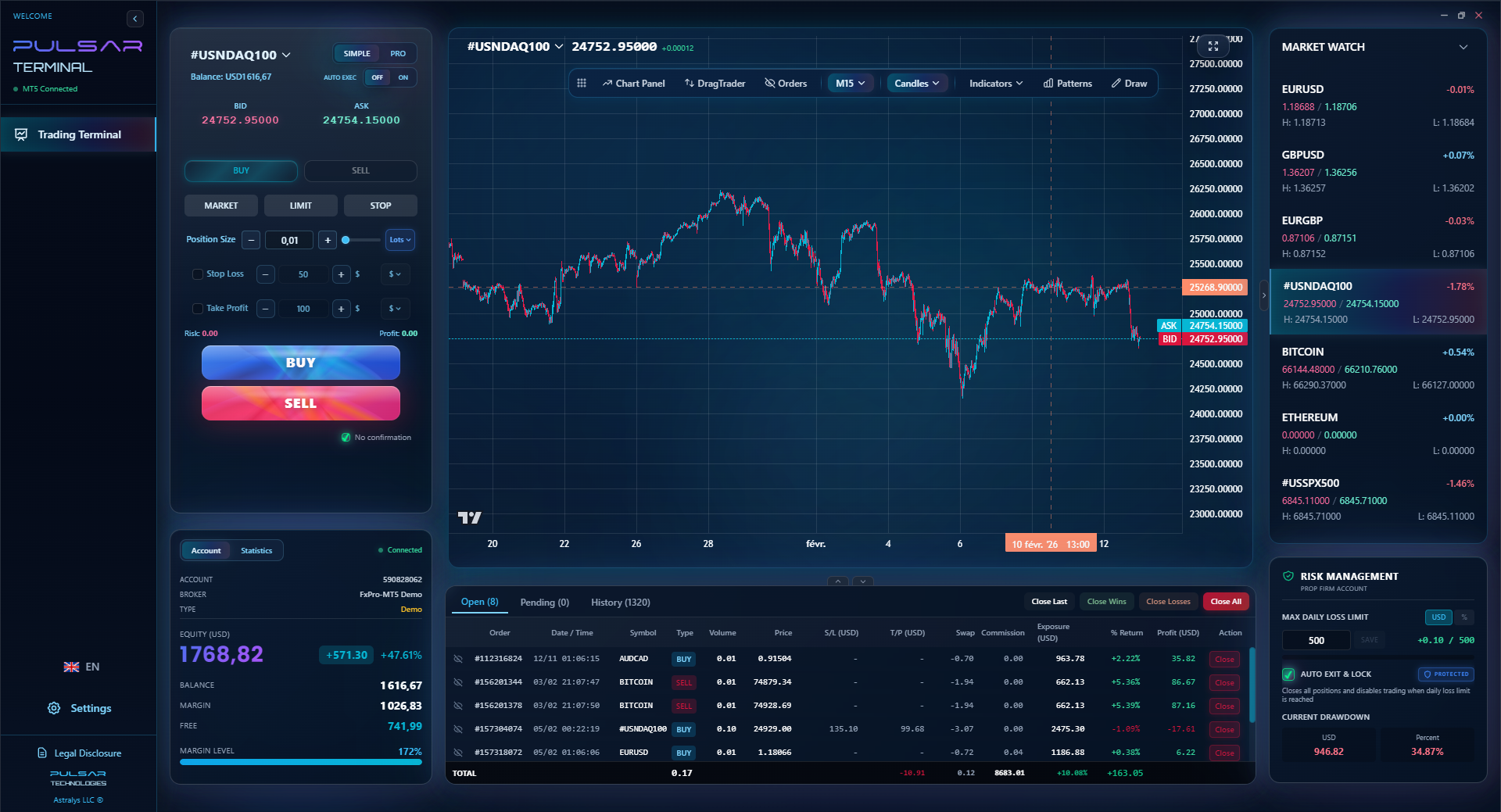
When you're ready to move from demo to live, managing multiple trades and strict risk rules becomes critical, which is where a tool like Pulsar Terminal for MT5 can automate those protections.
Pulsar Terminal
A ferramenta MT5 tudo-em-um: ordens drag-and-drop, multi-TP/SL, trailing stop, grid trading, Volume Profile e proteção prop firm. Usado diariamente por 1.000+ traders.
Let's be blunt. Forex Mentor Pro is a well-structured product. If you have the spare ₦1.4 million, learn best from a single, organized source, and can overlook the lack of Nigeria-specific advice, it can accelerate your learning.
But for most Nigerian starters, I can't recommend it. That money is better used as your trading capital. Imagine starting with a $500 account (about ₦725,000). Your education budget becomes the $20 you lose on a carefully risk-managed trade that teaches you a visceral lesson. That's real learning.
Ask yourself these questions:
- Have I exhausted all free resources yet?
- Do I have a proven, stable method to fund an international broker account?
- Is my primary need strategy, or is it discipline and psychology? (Courses are better for the former).
- Could this money instead serve as a 6-month emergency fund, securing my peace of mind while I trade?
My personal take? I benefited from the structure early on, but the real breakthroughs came from screen time, journaling, and learning from my own mistakes - like ignoring a margin call warning because I was over-leveraged on a USD/NGN speculation. No course could have drilled that lesson in like losing real money did.
💡 Dica do Winston
Your first investment shouldn't be in a course. It should be in a reliable UPS and a decent mobile data plan. Protect your ability to trade.
“No foreign course will teach you how to handle a trade during a NEPA outage. That's a uniquely Nigerian trading skill.”
Forget about Forex Mentor Pro for now. Here's what you do this week:
- Open a Demo Account: Do it right now. Use IC Markets review or Pepperstone - they offer solid demo platforms. Don't trade yet.
- Learn the Platform: Learn how to place a limit order, set a stop-loss, and modify a trade. This is 80% of the battle.
- Paper Trade One Pair: Pick the EUR/USD guide. Follow it on the 1-hour chart. Make 20 paper trades, writing down your reason for each entry and exit.
- Research One Broker: Deep dive into one broker's terms. How do they accept deposits from Nigeria? What are their withdrawal times? Read the fine print.
- Calculate Your Risk: If you had a $200 account, using the 1% rule, what is your maximum risk per trade in dollars? (Answer: $2). Use the position size calculator to see what lot size that allows.
This process will teach you more about being a trader in Nigeria than any initial course purchase. It builds the discipline you need. After 3 months of consistent demo trading and research, then re-evaluate if a paid course fills a specific gap in your knowledge. By then, you'll be a much smarter consumer.
FAQ
Q1Is Forex Mentor Pro a scam?
No, it's not a scam in the sense of being fake. It's a legitimate educational product. The question is whether its value justifies the high cost for a Nigerian trader, especially when you must also navigate local funding and regulatory issues it doesn't address.
Q2Can I use Forex Mentor Pro with a Nigerian broker?
There are no true 'Nigerian brokers' for spot forex due to SEC licensing rules. You'll use an international broker like Exness or IC Markets. The strategies taught can be applied on any MT4/MT5 platform, so yes, you can use the knowledge with brokers that accept Nigerian clients.
Q3How do I pay for Forex Mentor Pro from Nigeria?
You'd likely need an international debit/credit card (like a Visa Dollar card) or use a cryptocurrency payment if they accept it. Standard Naira cards often fail due to CBN restrictions on international transactions for speculative purposes.
Q4Are there any Nigerian-specific forex trading courses?
There are local mentors and communities, but be extremely wary. Many are unqualified. Focus on learning the universal principles of trading from reputable global free sources first, then seek local communities for practical advice on payments and broker experiences.
Q5What's the biggest risk for a Nigerian using a course like this?
The biggest risk is conflating 'knowledge' with 'profitability.' You can know every strategy in the course but still blow your account because you didn't manage your risk, couldn't handle withdrawal delays, or traded emotionally during a local market crisis. The course teaches trading; you must learn trading in Nigeria separately.
Q6Is the 'proprietary trading firm' path taught in such courses feasible from Nigeria?
Yes, many Nigerians pass prop firm challenges. However, it adds another layer of complexity. You must ensure the prop firm accepts traders from Nigeria and has a clear withdrawal method for you. Your internet reliability and ability to manage strict drawdown rules become even more critical.
Lição do Prof. Winston
Pontos-chave:
- ✓Free knowledge builds the same foundation as paid courses.
- ✓Always verify a broker's international license, not local claims.
- ✓Risk no more than 1-2% of your capital on any single trade.
- ✓Your first ₦500k is better used as capital than tuition.
Quão útil foi este artigo?
Clique em uma estrela
Insights de Trading Semanal
Análises e estratégias semanais grátis. Sem spam.
Sobre o autor
Olumide Adeyemi
Pioneiro do Trading na África Ocidental
Um dos educadores de trading forex mais ativos da Nigéria. 8 anos de experiência operando a partir de Lagos. Especialista em estratégias de baixo capital e desafios de prop firms para traders africanos.
Comentários
Aviso de risco
A negociação de instrumentos financeiros envolve riscos significativos e pode não ser adequada para todos os investidores. O desempenho passado não garante resultados futuros. Este conteúdo é apenas para fins educacionais e não deve ser considerado aconselhamento de investimento. Sempre conduza sua própria pesquisa antes de negociar.
Você também pode gostar

Cara Trading Forex Sukses: 7 Prinsip dari Trader Profesional
Cara trading forex sukses dengan 7 prinsip trader pro: manajemen modal, disiplin, journal trading, backtest. Data nyata, bukan janji profit palsu.
Jam Trading Forex Terbaik untuk Trader Indonesia: Panduan Lengkap dengan Tabel Waktu
Panduan jam trading forex untuk trader Indonesia. Tabel 4 sesi dunia, jam emas 20:00-00:00, sesi mana yang harus dihindari. Data akurat + tips dari trader berpengalaman.
Top 5 Sàn Forex Uy Tín Nhất 2026: Review Jujur dari Trader Indonesia
Top 5 sàn forex uy tín 2026 untuk trader Indonesia. Review jujur: spread, deposit, withdraw, dukungan lokal. Exness, XM, IC Markets & lebih.
Obter Pulsar Terminal
Todas essas calculadoras estão integradas ao Pulsar Terminal com dados em tempo real da sua conta MT5.
Obter Pulsar Terminal