


Let's start with a number that will sober you up: 90%.

Olumide Adeyemi
Pioneiro do Trading na África Ocidental ·  Nigeria
☕ 9 min de leitura
O que você vai aprender:
Let's start with a number that will sober you up: 90%. That's the percentage of retail traders who lose money. In Nigeria, where the dream of forex millionaires is sold harder than recharge cards, that number might be even higher. I've been in this game for over a decade, and I've seen more fortunes evaporate than I've seen built. The path isn't glamorous. It's a grind of discipline, brutal honesty, and surviving long enough for your edge to work. This isn't a motivational speech. It's a journal from the trenches.
Walk through any major market in Lagos or Abuja, and you'll hear it. 'Forex trading, bros. Quick money.' Social media is flooded with Lamborghini pictures and screenshots of massive profits, all promising to make you one of the next forex millionaires. It's a powerful narrative, especially when the Naira is struggling and traditional paths feel blocked.
The reality is a different movie entirely. Most of those screenshots are from demo accounts or prop firm challenges, not real, sustained capital. The real work happens in silence. It's the 3 AM analysis when a trade goes against you. It's the discipline to not revenge trade after a loss. I learned this the hard way in 2017. I had a good run, turned $2,000 into about $8,500 in three months trading GBP/USD. I started believing the hype. I thought I was invincible. I broke every rule in my plan, over-leveraged on a 'sure thing,' and gave back every single gain, plus my initial capital, in two weeks. That was my tuition fee for understanding that this isn't a sprint; it's a marathon of survival.

Warning: If your primary motivation for trading is escaping financial pressure, you will almost certainly fail. The market smells desperation and exploits it. You need a clear head, which means trading with capital you can truly afford to lose.

💡 Dica do Winston
A 'forex millionaire' is just a consistent trader who didn't quit. The title comes last, after years of unsexy, disciplined work.
“The real work happens in silence. It's the 3 AM analysis when a trade goes against you.”
Let's talk numbers, because dreams don't pay bills. Becoming a forex millionaire (in Naira or Dollars) isn't about one magical trade. It's a function of consistent returns, compounding, and, most critically, not blowing up your account.
Starting Capital is Everything
You can't compound from zero. The popular narrative of turning $100 into $1,000,000 is a fantasy that ignores statistics and the reality of position size calculator. If you start with $1,000 and aim for a (very ambitious) 20% return per month, it would still take you over 4 years of perfect execution to reach $1 million. One bad month, one emotional lapse, resets the clock. Most Nigerian traders start under-capitalized, which forces them to use excessive use to chase meaningful profits, which is the fastest route to a margin call.
The Power of Not Losing
My most profitable year wasn't the one with my biggest winning trade. It was the year I had the smallest drawdown. Protecting your capital is job number one. A 50% loss requires a 100% gain just to get back to breakeven. If you lose 30% of your account, the psychological pressure to 'make it back' often leads to even worse decisions.

Example: Let's say you have a ₦1,000,000 account. A conservative, realistic target might be 3-5% per month. That's ₦30,000 - ₦50,000. Not flashy, right? But compound that at 4% monthly for 5 years, without any major drawdowns, and that account grows to over ₦8.5 million. The slow, boring path is the only one that's real.
“Protecting your capital is job number one. A 50% loss requires a 100% gain just to get back to breakeven.”
You will not buy your way to success with signal groups. Your edge has to be yours. It has to fit your personality, your schedule, and your risk tolerance.
For the 9-to-5er: Swing trading is likely your friend. You're not glued to the screen. You can analyze in the evenings, set trades with stop losses and take profits, and manage them over days or weeks. Focus on higher timeframes like the 4-hour or daily chart. I know a trader in Port Harcourt who is a full-time engineer. He only trades USD/CAD and AUD/USD on the daily chart, using basic support/resistance and the MACD indicator for confluence. He's been consistently profitable for 5 years. Not a millionaire, but he funds his life and grows his account steadily.
For the Screen Junkie: If you have the time and temperament, scalping strategy or day trading might work. But understand the costs. Tight spreads and low commissions are non-negotiable. You need a broker like IC Markets review or Pepperstone review with raw spreads. Your edge here is often pure execution and speed. It's exhausting and statistically harder for most.
Your strategy must answer three questions: 1) When do I enter? 2) Where is my stop loss? 3) Where do I take profit? If you can't write these rules down on paper before you trade, you don't have a strategy, you have a hope.
“Protecting your capital is job number one. A 50% loss requires a 100% gain just to get back to breakeven.”
This is where forex millionaires are truly separated from the losers. Your mindset will be tested every single day.
Ego is the Enemy: My 2017 blow-up was pure ego. I stopped following my plan because I thought I was smarter than the market. The market is always right. You have to be humble enough to take small losses gracefully. A stop loss isn't a failure; it's a pre-paid insurance premium that keeps you in the game.
Fear & Greed Cycle: After a few wins, greed whispers, 'Increase your lot size!' After a loss, fear screams, 'Don't take the next setup!' You must neutralize these emotions with mechanical rules. Use a position size calculator for every single trade, so your lot size is determined by math, not emotion.
The Vulnerability Part: I once held a losing EUR/USD trade for 3 days, moving my stop loss further away because I couldn't admit I was wrong. I was waiting for it to 'come back.' It didn't. That one trade wiped out 2 months of profits. The lesson was painful but simple: my trading plan is my boss. If it says exit, I exit. No debate.

Pro Tip: Keep a trading journal. Not just 'bought EUR/USD, made 50 pips.' Write down how you felt. 'Felt anxious before news, almost didn't take the trade.' 'Felt overconfident after win, nearly doubled position size.' Reviewing your emotional patterns is more valuable than reviewing your charts.
💡 Dica do Winston
Your profit target should be boring. Aim for 3-5% monthly growth. The flashy 50% months are usually followed by catastrophic 40% drawdowns.
“Your trading plan is your boss. If it says exit, you exit. No debate.”
Let's get local. What does this path actually look like from Lagos, Abuja, or Ibadan?
1. Broker Choice is Critical: You need a reputable, internationally regulated broker. Your funds need to be safe. Look for brokers with a strong local presence and good deposit/withdrawal channels for Nigeria. Exness review and XM review have been popular choices for years due to their local payment processing. Always verify their international regulation (like CySEC or FCA).
2. Understand the Costs: The spread definition is your direct cost. Trading exotic pairs or during low-liquidity times (like Asian session for EUR/USD) means wider spreads. Factor in swap fees if you hold trades overnight. These costs eat into profits, so your edge needs to be wide enough to cover them.
3. Start in Naira, Think in Pips: Fund your account in Naira if it helps you psychologically connect to the value. But once trading, think in percentages of your account and in pip definition, not in Naira amounts. A 50 pip stop loss on a standard lot is a disaster. A 50 pip stop loss on a micro lot is a manageable risk. It's the same market move, but your position size makes it survivable.
4. The Naira Reality: The devaluation makes acquiring foreign currency for trading more expensive. This means the capital you start with is even more precious. It reinforces the rule: protect what you have. Don't rush to 'beat the devaluation' by taking reckless trades.
“Your trading plan is your boss. If it says exit, you exit. No debate.”
You don't need expensive software, but you need the right tools.
MT4/MT5 is Your Foundation: Learn it inside out. Use its built-in indicators like the RSI indicator to spot overbought/oversold conditions, but don't overload your chart. I use 3 things: price action (support/resistance), volume, and one oscillator.
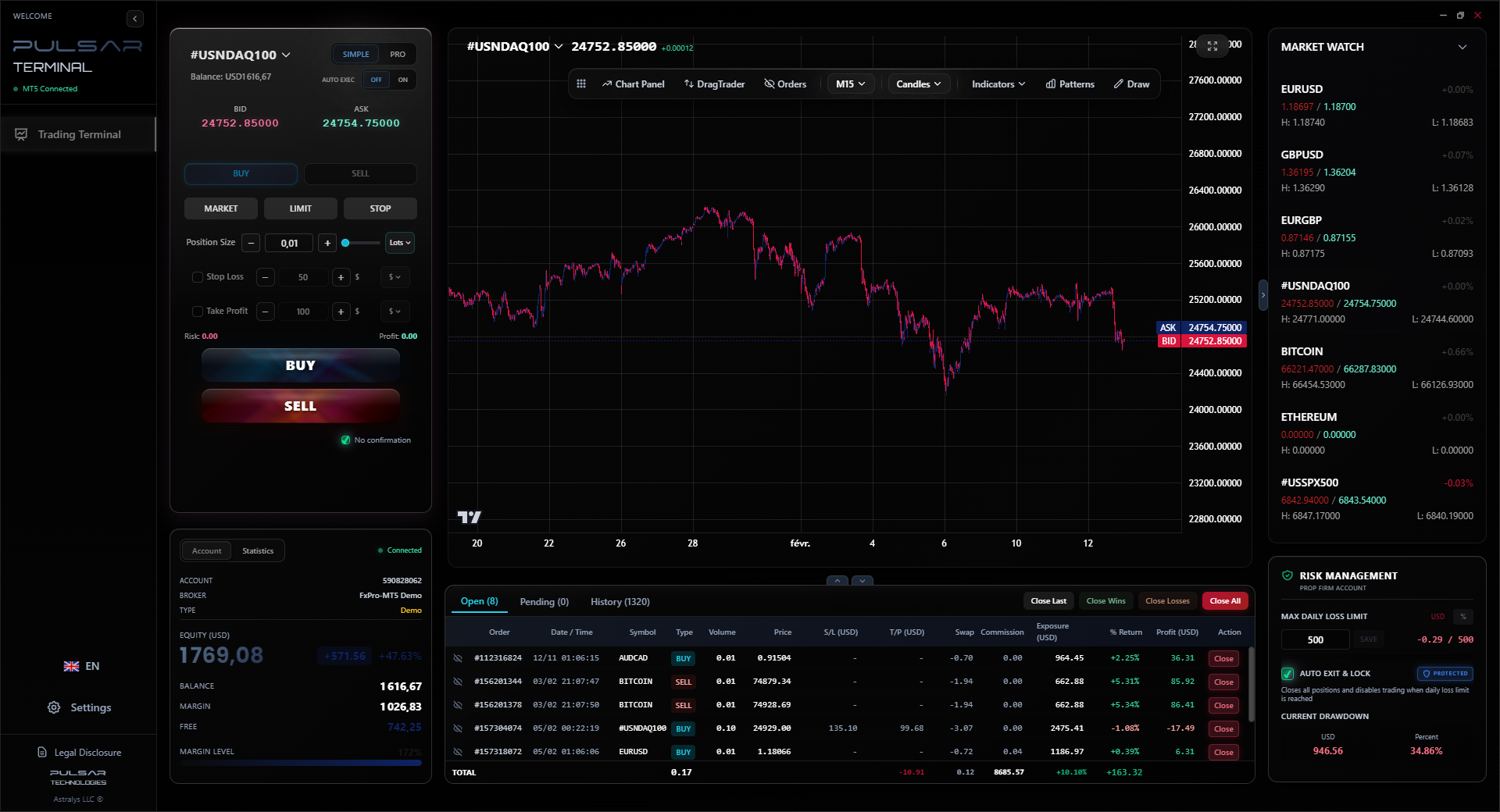
The Game Changer (Automation): The single biggest upgrade to my trading after my psychology was using a tool to automate my rules. Managing multiple trades, moving stops to breakeven, scaling out partial profits - doing this manually while emotional is nearly impossible. I now use a terminal that plugs into MT5 and lets me set all my rules (like a 3-step take profit or a trailing stop) before I even enter the trade. It executes them without me having to click a thing. This removed 90% of my emotional interference. For example, I can set a rule to close half my position at a 1:1 risk-reward ratio and trail the rest. The tool does it, and I can walk away. This is non-negotiable for managing the complex trade plans required for consistent growth.
Backtesting: Don't trust a strategy with your money until you've tested it on historical data. MT5 has a decent strategy tester. It's boring work, but it separates guesswork from a quantified edge.
💡 Dica do Winston
The most important tool isn't an indicator; it's your trading journal. Your past self holds the keys to fixing your future mistakes.
Managing complex trade plans and prop firm rules manually is a recipe for emotional failure; Pulsar Terminal automates partial closures, trailing stops, and daily loss limits directly on your MT5 chart.
Pulsar Terminal
A ferramenta MT5 tudo-em-um: ordens drag-and-drop, multi-TP/SL, trailing stop, grid trading, Volume Profile e proteção prop firm. Usado diariamente por 1.000+ traders.
“The money is a byproduct of getting the process right, day after boring day.”
So, how do the real forex millionaires get there?
Phase 1: Survival (Months 0-24): Your only goal is to not blow up your account. Aim for small, consistent returns. Prove you can follow your plan. This is where 90% drop out.
Phase 2: Consistency (Years 2-5): You have a proven, documented edge. Your equity curve is slowly drifting upward with controlled drawdowns. You're emotionally detached. Now you can start to think about scaling your capital.
Phase 3: Scaling: This is the fork in the road. You can scale by:
- Adding Personal Capital: As you profit, you compound your earnings back into your account.
- Prop Firm Challenges: This has become a popular path for Nigerians. You pass a challenge by a proprietary trading firm, and they give you a larger account to trade (e.g., $100,000). You keep a large share of the profits. The key here is their rules are strict - daily loss limits, maximum drawdowns. This is where automated trade management is absolutely critical, as one emotional mistake can blow the entire challenge. The discipline required is extreme.
- Managing Investor Money: This comes much later, with a multi-year track record. It's a whole other level of responsibility.
The common thread? They all passed through Phase 1 and 2 without quitting. They mastered risk long before they chased reward. They understood that a margin call isn't bad luck; it's a failure of planning. Focus on the process - the careful entry, the disciplined stop loss, the patient exit. The money is a byproduct of getting the process right, day after boring day.
FAQ
Q1Is forex trading illegal in Nigeria?
No, it's not illegal for individuals to trade forex with international brokers. However, it operates in a regulatory grey area without specific local oversight from the CBN for retail trading on offshore platforms. Your protection comes from the broker's international regulation (like FCA or CySEC).
Q2What is the minimum amount I need to start trading forex in Nigeria?
You can technically start with as little as $10 on a micro account. But realistically, to trade properly with sane risk management, a minimum of $200-$500 is more practical. Remember, your goal with a small account is to learn and survive, not to get rich.
Q3How do I fund my forex trading account from Nigeria?
Most international brokers accept bank transfers, debit/credit cards (Visa/Mastercard), and e-wallets like Skrill, Neteller, and Perfect Money. Some brokers like Exness and XM have integrated local payment channels that make depositing in Naira easier.
Q4Can I trade the Nigerian Naira (NGN) on forex platforms?
Generally, no. The Naira is not freely convertible on the international retail forex market. Nigerian traders primarily trade major pairs like EUR/USD guide, GBP/USD, and commodities like XAU/USD guide (Gold).
Q5Are prop firm challenges a good way to become a forex millionaire?
They are a potential path to trade larger capital without risking your own savings. However, they are extremely difficult. The rules (daily loss limits, max drawdown) are designed to test discipline. Most people fail the challenges repeatedly. It's only viable once you have a rock-solid, proven strategy from trading your own account.
Q6What's the biggest mistake Nigerian forex traders make?
Two tied for first: 1) Using excessive use because they started with too little capital, and 2) Trading based on emotion (greed after a win, fear after a loss) instead of a written plan. They focus on the potential profit and ignore the mathematical certainty of risk.
Lição do Prof. Winston
Pontos-chave:
- ✓90% lose because they manage profits, not risk.
- ✓A 50% loss needs a 100% gain to recover.
- ✓Start with at least $200 for sane risk management.
- ✓Your edge must be documented, backtested, and boring.
- ✓Ego is a bigger enemy than any central bank.
Quão útil foi este artigo?
Clique em uma estrela
Insights de Trading Semanal
Análises e estratégias semanais grátis. Sem spam.
Sobre o autor
Olumide Adeyemi
Pioneiro do Trading na África Ocidental
Um dos educadores de trading forex mais ativos da Nigéria. 8 anos de experiência operando a partir de Lagos. Especialista em estratégias de baixo capital e desafios de prop firms para traders africanos.
Comentários
Aviso de risco
A negociação de instrumentos financeiros envolve riscos significativos e pode não ser adequada para todos os investidores. O desempenho passado não garante resultados futuros. Este conteúdo é apenas para fins educacionais e não deve ser considerado aconselhamento de investimento. Sempre conduza sua própria pesquisa antes de negociar.
Você também pode gostar

Cara Trading Forex Sukses: 7 Prinsip dari Trader Profesional
Cara trading forex sukses dengan 7 prinsip trader pro: manajemen modal, disiplin, journal trading, backtest. Data nyata, bukan janji profit palsu.
Jam Trading Forex Terbaik untuk Trader Indonesia: Panduan Lengkap dengan Tabel Waktu
Panduan jam trading forex untuk trader Indonesia. Tabel 4 sesi dunia, jam emas 20:00-00:00, sesi mana yang harus dihindari. Data akurat + tips dari trader berpengalaman.
Top 5 Sàn Forex Uy Tín Nhất 2026: Review Jujur dari Trader Indonesia
Top 5 sàn forex uy tín 2026 untuk trader Indonesia. Review jujur: spread, deposit, withdraw, dukungan lokal. Exness, XM, IC Markets & lebih.
Obter Pulsar Terminal
Todas essas calculadoras estão integradas ao Pulsar Terminal com dados em tempo real da sua conta MT5.
Obter Pulsar Terminal