


For years, the 'forex premium' was the single biggest profit opportunity for Nigerian traders who weren't actually trading.

Olumide Adeyemi
Pioneiro do Trading na África Ocidental ·  Nigeria
☕ 9 min de leitura
O que você vai aprender:
For years, the 'forex premium' was the single biggest profit opportunity for Nigerian traders who weren't actually trading. It was the gap between the Central Bank's official rate and what you'd pay at the black market. That gap, sometimes over 100%, was pure arbitrage. But here's the brutal truth for traders today: that easy money is being systematically dismantled. The CBN's reforms from 2023 to 2026 are designed to kill the premium for good. If your trading plan was built on exploiting that disparity, you're already out of business. This guide isn't about chasing a ghost. It's about understanding the new, unified market and finding real trading edges that won't disappear with the next policy circular.
Let's get this straight, because most explanations overcomplicate it. The forex premium wasn't some complex derivative. It was simply the difference between two prices for the same thing: the US Dollar.
On one side, you had the official rate set by the Central Bank of Nigeria (CBN) for eligible transactions. On the other, you had the parallel market rate (what everyone calls the black market), where the law of supply and demand ran wild. The premium was the percentage markup on the parallel market.
Here’s a crude example from the bad old days:
- CBN Official Rate: ₦450/$
- Parallel Market Rate: ₦750/$
- Forex Premium: ((750 - 450) / 450) * 100 = 66.7%
That gap created a whole shadow economy. Businesses that could access dollars at the official rate could theoretically sell them at a massive profit. It distorted everything. For the average person trying to buy dollars for travel or school fees, it was a tax on necessity. For traders, it presented a tempting, but often illegal, arbitrage play that had nothing to do with chart patterns or fundamentals.
The critical point now? The CBN's entire reform agenda, especially the October 2023 unification, is a direct attack on this premium. The goal is one market, one price. No more easy arbitrage.

💡 Dica do Winston
A disappearing market edge is nature's way of telling you to evolve. The traders who mourned the death of the premium are already broke. The ones learning the new rules are placing their first trades.
“The forex premium was the single biggest profit opportunity for Nigerian traders who weren't actually trading.”
The government isn't just hoping the premium goes away. They're passing laws and changing structures to ensure it does. If you're trading anything Naira-related, you need to know this framework. Ignoring it is like trading a stock without reading its earnings reports.
The Unification Hammer (Oct 2023)
This was the big one. The CBN collapsed multiple exchange rate windows (like the old Investors' & Exporters window) into a single official market: the Nigerian Foreign Exchange Market (NFEM). The new model? 'Willing buyer, willing seller.' That's code for letting the market price discover itself, rather than having it dictated. This immediately narrowed the gap, as the official rate floated closer to reality.
The NFEM Guidelines (Nov 2024) & FX Code (2025)
These documents are the rulebook. They consolidate everything, demand transparency from banks, and aim for international standards. The Nigerian Foreign Exchange (FX) Code that took effect in late 2024 is all about ethics and best practices. It’s designed to make the official market credible, so people stop fleeing to the parallel market.
Bringing Back the BDCs (Feb 2026)
This is a masterstroke for liquidity. After kicking them out in 2021, the CBN re-admitted licensed Bureau de Change operators. Now, they can buy up to $150,000 weekly from banks at the market rate and sell to end-users. Why does this matter? It floods the retail market with a legal supply of dollars. When your aunt can walk into a licensed BDC and get dollars at a fair rate, she stops fueling the black market. Increased legal supply = lower parallel market pressure = a shrinking premium.

Warning: Don't confuse these official market reforms with your retail forex broker. Trading EUR/NGN or USD/NGN CFDs with an international broker like Exness or IC Markets is a different universe. Those prices are derived from interbank rates and have their own spreads. They don't directly mirror the local Nigerian street rate.
“If your trading plan was built on exploiting that disparity, you're already out of business.”
Your strategy needs a hard reset. The old game of betting on a widening premium is a sucker's bet now. The regulatory momentum is overwhelmingly in one direction: unification and stability.
For Naira-based Trading: If you're trading USD/NGN pairs, expect volatility to be policy-driven, not technically driven. A tweet from the CBN Governor will move the price more than a perfect MACD indicator crossover. Your edge shifts from speculation to information. You need to follow monetary policy announcements, liquidity injections, and BDC sales data. It becomes more of a macro-economic play.
For International Forex Trading (USD pairs): For most Nigerian traders using brokers like XM or Pepperstone, the direct impact is different. Your main risk is funding and withdrawal. A stable, unified FX market means the rate you get when converting your Naira to fund your account should be more predictable and fair. You're less likely to get murdered by a hidden premium during deposit. This is a huge win for capital preservation.
I learned this the hard way in 2021. I funded a trading account when the premium was sky-high. I deposited ₦500,000. By the time it converted through my bank's 'official' channel, I lost over 25% of its value compared to the real market rate. That trade was doomed before I even placed an order. A unified market protects you from that silent killer.
The New Opportunity: Stability attracts foreign investment. The CBN's March 2024 sale of ₦1.053 trillion in government securities, with 79% of bids from foreigners, proves that. A stable Naira makes Nigeria's assets more attractive. This doesn't mean trade the Naira long. It means watch for correlated moves in Nigerian stocks or bonds that might present indirect opportunities.
💡 Dica do Winston
Your biggest risk isn't a trade going 50 pips against you. It's your funding method silently stealing 20% of your capital before you even click 'buy'. Solve for that first.
“A stable Naira makes Nigeria's assets more attractive. This doesn't mean trade the Naira long.”
This transition period is a minefield. Here’s where traders blow up.
- Chasing the Ghost Premium: The biggest mistake is assuming the premium will bounce back to its old highs. You'll see a 10% gap and think it's a sure bet to widen. You're betting against the full force of the CBN, the IMF, and economic sanity. Don't do it.
- Using the Wrong Price Source: Your trading platform's USD/NGN quote is not the Lagos street rate. It's a derivative. Basing trades on WhatsApp group rumours about the black-market rate is a direct path to a margin call. Use a reliable, delayed source for the official NAFEM rate for context, but don't trade off it directly unless your broker specifically offers that spot contract.
- Ignoring Liquidity Crunches: Unification doesn't magically create dollars. There will still be periods of shortage, especially when oil prices drop. These will cause volatility. A good swing trading approach that waits for these panic spikes (or dips) might work better than frantic scalping.
- Underestimating Transaction Costs: In the official market, the minimum tradable amount for spot FX is $100,000. This isn't for retail traders. Your costs are the spreads and commissions from your international broker. Always run your trades through a position size calculator to ensure a 50-pip move against you doesn't wipe out a week's profits.

Example: Let's say you ignore the new rules and short USD/NGN, expecting the premium to collapse and the Naira to strengthen massively. You risk 2% of your account, which is $200 on a $10,000 account. But if a policy delay causes a temporary spike and the trade moves 500 pips against you (easily possible in this market), you could be looking at a loss far exceeding that 2% if your position size was reckless. The volatility hasn't disappeared; it's just changed drivers.
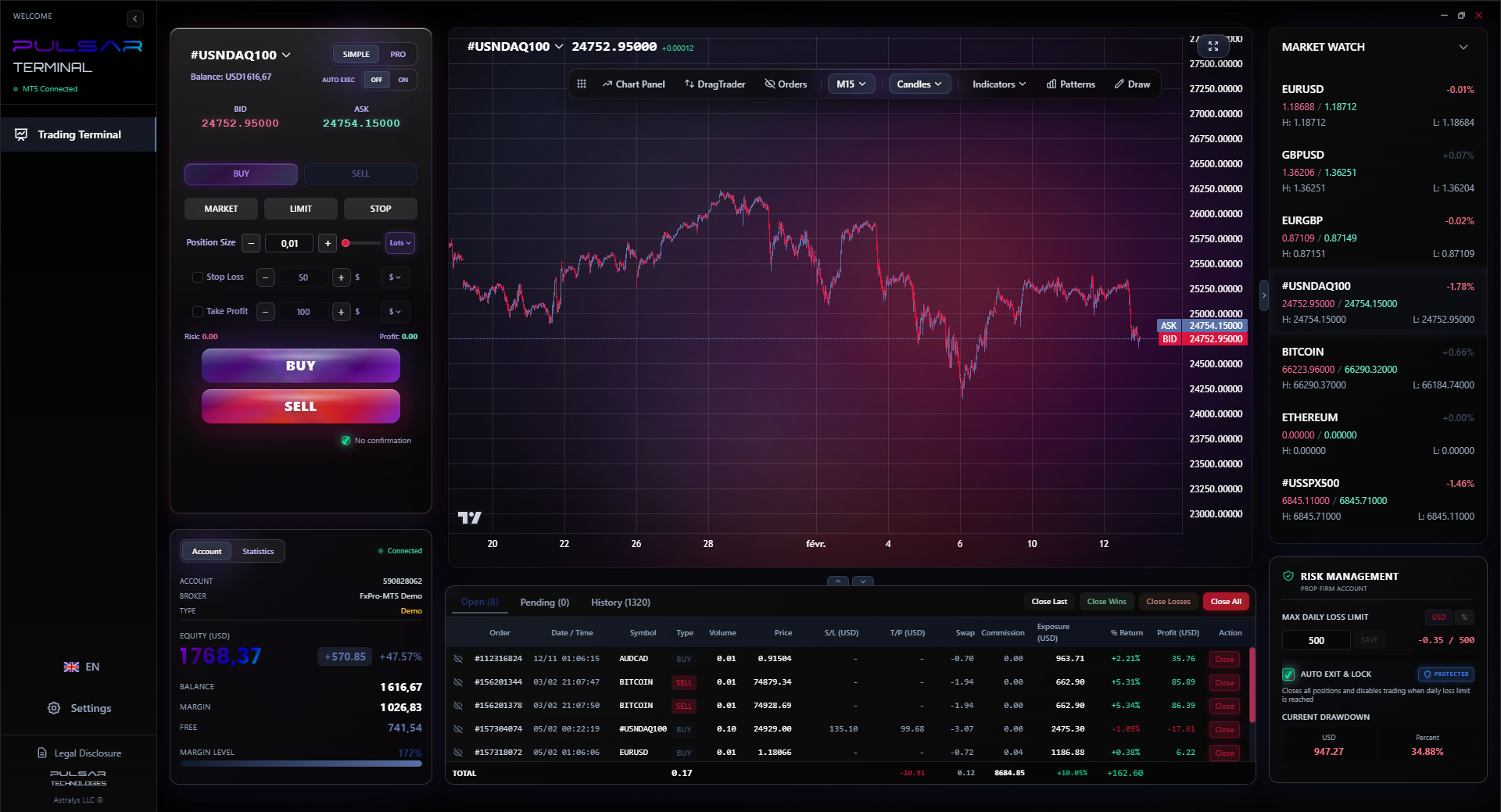
When trading volatile, policy-driven pairs like USD/NGN, managing your risk with precision is non-negotiable. Pulsar Terminal's drag-and-drop order tools and multi-take-profit system let you set complex risk-reward ratios instantly on your MT5 chart, so you can react to news without losing your discipline.
Pulsar Terminal
A ferramenta MT5 tudo-em-um: ordens drag-and-drop, multi-TP/SL, trailing stop, grid trading, Volume Profile e proteção prop firm. Usado diariamente por 1.000+ traders.
“A stable Naira makes Nigeria's assets more attractive. This doesn't mean trade the Naira long.”
So, how do you actually trade in this new environment? You adapt.
Step 1: Separate Your Worlds Keep your local Naira economics and your international forex trading mentally separate.
- World 1 (Local): Follow CBN press releases, NAFEM fixing rates, and BDC announcements. This is for your funding strategy and macroeconomic understanding.
- World 2 (Trading): Focus on the major pairs like EUR/USD or XAU/USD. Analyze their charts, use your RSI indicator, follow Fed policy. The Naira's unification is a background factor, not your primary chart.
Step 2: Fund Your Account Strategically With BDCs back in the game, explore legal channels to source dollars for brokerage funding. Compare the rate you get from your bank's transfer (at the NAFEM rate) versus a licensed BDC. Sometimes, the BDC rate with a small fee is still better than a bank's hidden charges. This is where saving 2-3% on funding is a guaranteed profit on your entire trading capital.
Step 3: Adjust Your Risk Parameters Naira-related volatility is now event-driven (policy). This means long periods of chop followed by explosive spikes. Use wider stop-losses if you choose to trade these pairs. Better yet, avoid them unless you have a proven macro edge. Stick to the more liquid, predictable majors where the rules don't change every quarter.
I made more consistent money trading Gold (XAU/USD) in the last year than I ever did trying to outsmart the Naira market. The rules are global, the liquidity is massive, and a pip definition means the same thing in Lagos as it does in London. That consistency is priceless.
💡 Dica do Winston
Volatility from policy changes is the most dangerous kind. It's fast, it's news-driven, and it doesn't respect your technical support levels. If you trade it, size tiny.
“The end of the forex premium isn't the end of opportunity. It's the beginning of real trading.”
Short answer? Not in its old, grotesque form. The CBN has burned the bridges.
The structural reforms - unification, the FX Code, bringing BDCs into the fold - are not temporary measures. They are a permanent rewiring of the system. The premium might fluctuate, creating a small spread between the official NAFEM rate and the street rate (there will always be a slight difference due to friction), but a 40%+ premium would signal a catastrophic failure of these policies.
The future is about managing the spread, not the premium. It's about transaction efficiency. For traders, the opportunity shifts from arbitraging a broken system to analyzing a functioning one. Volatility will come from global oil prices, domestic inflation, and interest rate differentials - normal market stuff.
Your job is to stop looking backwards at the easy money that's gone. Start looking forward at the new patterns forming in a market that's finally growing up. The discipline you'll learn trading a 'normal' market will make you a better trader everywhere else. The end of the forex premium isn't the end of opportunity. It's the beginning of real trading.
FAQ
Q1Is it illegal to trade based on the black-market forex rate in Nigeria?
Trading on the black market itself is illegal. Using black-market rates as analysis for trading USD/NGN pairs on a regulated international broker is a grey area, but highly risky. Your broker's price won't match the black-market rate, so your analysis will be fundamentally flawed. More importantly, the CBN's reforms aim to make the black market irrelevant, so building a strategy on illegal data is a dead end.
Q2How do the new CBN rules affect my funding with brokers like Exness or IC Markets?
Positively, if the reforms hold. A unified, stable FX market means the exchange rate you get when your bank converts Naira to USD for an international transfer should be closer to a true market rate, with less hidden premium. You lose less value on deposit. Always check your bank's final rate (amount of USD credited vs. Naira debited) against the day's NAFEM closing rate to see the true cost.
Q3Can I still make money trading USD/NGN?
Yes, but it's a different game. It's now a macro/event-driven currency pair. You need to trade based on CBN policy, oil prices, and liquidity announcements, not just technical charts. The volatility can be huge, so risk management is even more critical. Many traders find it cleaner to focus on major pairs like EUR/USD where the fundamentals are more transparent.
Q4What is the minimum amount to trade forex in the official Nigerian market?
For the actual spot FX market (NAFEM), the minimum tradable amount is $100,000. This is for institutional players, banks, and large corporations. As a retail trader, you are not participating in this market directly. You trade CFDs or derivatives through international brokers, where minimum deposits can be as low as $10-$100.
Q5Will Bureau de Change (BDC) rates now be the same as the official rate?
Not exactly the same, but they should be very close. BDCs buy dollars from banks at the official wholesale rate and add a small margin for their operational costs and profit. The CBN's rule allowing them to buy $150k/week aims to ensure this margin is competitive. The gap should be a small spread (a few Naira), not a massive premium.
Q6If the premium is gone, why does the parallel market still exist?
It exists due to friction and residual distrust. Some people need cash dollars immediately or for transactions they don't want to document. The BDC reintroduction is meant to serve these legitimate needs legally. Over time, as the official system proves reliable, the parallel market should shrink to a niche, not a dominant force.
Lição do Prof. Winston
Pontos-chave:
- ✓The 40%+ forex premium is a relic of the past. Betting on its return is foolish.
- ✓Trade majors like EUR/USD for clarity; trade USD/NGN only with a macro edge.
- ✓Use licensed BDCs for funding to avoid hidden bank premiums.
- ✓Policy tweets now move Naira more than chart patterns. Adjust your analysis.
Quão útil foi este artigo?
Clique em uma estrela
Insights de Trading Semanal
Análises e estratégias semanais grátis. Sem spam.
Sobre o autor
Olumide Adeyemi
Pioneiro do Trading na África Ocidental
Um dos educadores de trading forex mais ativos da Nigéria. 8 anos de experiência operando a partir de Lagos. Especialista em estratégias de baixo capital e desafios de prop firms para traders africanos.
Comentários
Aviso de risco
A negociação de instrumentos financeiros envolve riscos significativos e pode não ser adequada para todos os investidores. O desempenho passado não garante resultados futuros. Este conteúdo é apenas para fins educacionais e não deve ser considerado aconselhamento de investimento. Sempre conduza sua própria pesquisa antes de negociar.
Você também pode gostar

Cara Trading Forex Sukses: 7 Prinsip dari Trader Profesional
Cara trading forex sukses dengan 7 prinsip trader pro: manajemen modal, disiplin, journal trading, backtest. Data nyata, bukan janji profit palsu.
Jam Trading Forex Terbaik untuk Trader Indonesia: Panduan Lengkap dengan Tabel Waktu
Panduan jam trading forex untuk trader Indonesia. Tabel 4 sesi dunia, jam emas 20:00-00:00, sesi mana yang harus dihindari. Data akurat + tips dari trader berpengalaman.
Top 5 Sàn Forex Uy Tín Nhất 2026: Review Jujur dari Trader Indonesia
Top 5 sàn forex uy tín 2026 untuk trader Indonesia. Review jujur: spread, deposit, withdraw, dukungan lokal. Exness, XM, IC Markets & lebih.
Obter Pulsar Terminal
Todas essas calculadoras estão integradas ao Pulsar Terminal com dados em tempo real da sua conta MT5.
Obter Pulsar Terminal