


You want to trade the dollar to naira rate.

Olumide Adeyemi
Pioneiro do Trading na África Ocidental ·  Nigeria
☕ 9 min de leitura
O que você vai aprender:

You want to trade the dollar to naira rate. I get it. The spreads are wild, the news is constant, and the potential seems huge. But are you about to walk into a trap? I did, more than once. Trading Nigeria's most talked-about currency pair isn't just about charts; it's about understanding a market with two very different prices, navigating impossible liquidity, and keeping your head when everyone else is losing theirs. Let me walk you through what I've learned the hard way.
The first thing you must burn into your brain: there is no single 'forex rate dollar to naira'. There are two completely different economies operating side-by-side. The official rate, set by the Central Bank of Nigeria (CBN), is for government transactions, certain imports, and a lucky few. Then there's the parallel market rate - what you find with the Bureau de Change (BDC) on the street or on peer-to-peer platforms. This is the real price for most Nigerians.
The gap between these two can be staggering. I've seen it swing from a 20% difference to over 80%. Trading based on the official rate is a fantasy for retail traders. Your broker's quote, if they even offer NGN pairs, will never match the rate your cousin in Lagos is getting to buy dollars for school fees. This duality is the core reality. It creates massive arbitrage opportunities for those with the right access (not us) and pure chaos for everyone else trying to make sense of it on a chart.
When news hits about 'CBN closing the gap', the volatility is insane. I once tried to scalping strategy a USD/NGN move on a broker platform after a CBN announcement. The spread widened to over 500 pips in seconds, and my tiny profit target was swallowed before the order filled. Lesson learned: the liquidity for the real Naira rate isn't in the standard forex market. It's in a different place entirely.

This is the mistake I made for too long. You look at USD/NGN on your MT4 platform from an international broker and think, 'It's just another pair.' It's not. Here's the brutal truth.
The Liquidity Ghost
Major brokers like Exness or IC Markets might list USD/NGN, but the trading volume is a ghost town compared to majors. This means spreads are often enormous - 50 pips or more is normal. A 10-pip move in EUR/USD is noise; a 10-pip move in USD/NGN might be your entire profit margin gone to fees. Trying to use a tight stop-loss is like giving your money away.
The News Is Everything
Forget pure technical analysis. A tweet from a government official, a rumour about dollar allocations to BDCs, or a change in central bank policy will obliterate any chart pattern. The technicals are slave to the fundamentals here. I had a beautiful bearish setup on USD/NGN in 2021, shorting on a key resistance level. Then a CBN policy circular hit the wires, and the pair ripped 15% higher in a day. My stop-loss was a joke. The market didn't care about my trendline.

Warning: Trading USD/NGN with a standard retail broker often means you're trading a derivative of a derivative. The price is derived from the interbank rate, which is already disconnected from the parallel rate you hear about. You're several steps removed from the actual market.

💡 Dica do Winston
The market's job is to transfer wealth from the impatient to the patient. In illiquid markets like USD/NGN, it does this job with remarkable speed. Your patience is your primary capital.
“Trading Nigeria's most talked-about currency pair isn't just about charts; it's about understanding a market with two very different prices.”
So where is the real action? If you're in Nigeria, you're probably not trading a USD/NGN CFD. You're navigating other channels.
Peer-to-Peer (P2P) Platforms: This is where millions go. Platforms like Binance P2P, Paxful, and others. Here, you're directly buying or selling USDT (crypto) for Naira at the parallel market rate. The 'trade' is the exchange itself. The risk isn't market volatility alone; it's counterparty risk. Will the other person actually release the crypto after you send the bank transfer? I've had two successful transactions and one where I had to dispute for hours. The rate you get is the real, street rate.
Bureau de Change (BDC): The physical version of P2P. The rate is negotiated, cash is king, and it's all off the books. Not a trading vehicle, but a reflection of pure supply and demand.
Black Market (Aboki): The purest, riskiest form. No records, no recourse. The rate here is often the leading indicator for where the parallel market is heading. I don't recommend this for anything other than understanding sentiment.
The point is, the 'forex rate dollar to naira' that affects daily life is set in these arenas, not on the charts from your XM account. Your trading strategy must acknowledge which price you're actually trying to predict.

Given all this, how do you build a strategy that doesn't rely on luck? You focus on the macro tide, not the waves.
1. Trade the Proxy Pair. This was my breakthrough. Instead of fighting the illiquid USD/NGN, I trade major pairs that correlate with dollar strength when I have a strong view on the Naira. If I believe the Naira will weaken (dollar up), I might go long on a clean, liquid pair like EUR/USD (betting on dollar strength) or XAU/USD (gold in USD often rises when emerging market currencies falter). This way, I'm exposed to the same macro theme - Dollar strength vs. EM fragility - but with tight spreads and real liquidity. I'm trading the cause, not the broken effect.
2. Use Naira News as a Sentiment Gauge. Let the chaos of the Naira market inform your other trades. When headlines scream about a crashing Naira and CBN emergency meetings, it often signals broad risk-off sentiment for emerging markets. That could be a signal to avoid long positions on other risky assets.
3. Position Size is Your Lifeline. The volatility is extreme. If you must trade a Naira-linked instrument (like a crypto P2P spread), your position size calculator is your best friend. I'd risk no more than 0.5% of my capital on any single 'trade' here, compared to my usual 1-2% for majors. The uncertainty is just too high.

Pro Tip: Set up a simple watchlist: the official CBN rate, a reliable parallel rate tracker (like Naira Rates on Twitter), and the USD/NGN CFD on your broker. Watch the divergence. When the gap starts to narrow rapidly on big news, that's when the CFD might see its most predictable (though still wild) moves.
💡 Dica do Winston
A wide spread is the market telling you a story. It's saying, 'I am uncertain, costly to navigate, and dangerous.' Learn to listen. Sometimes the most profitable action is to not enter at all.
“The biggest opportunities with the forex rate dollar to naira aren't in directly trading the pair. They're in understanding the immense pressure it represents.”
Let's get specific. Theory is cheap. Here's where real money was made and lost.
The Burn: Chasing the Parallel Rate on a Broker Platform (2022)
- The Setup: Parallel rate was soaring. USD/NGN CFD on my broker was lagging, up only 5%. I thought, 'It has to catch up.'
- The Trade: Went long at 590. Stop loss at 585 (a laughable 5-pip stop in this pair).
- The Reality: The spread was 55 pips. I was in the red from the second I entered. A minor retracement hit my stop loss before any real move began. Loss: 1.5% of account. The spread definition wasn't a footnote; it was the main event.
The Win: Trading the Proxy (2023 CBN Unification Announcement)
- The Setup: CBN announced moves to 'unify' exchange rates. Chaos ensued. The parallel rate spiked, but the true implication was massive dollar demand and uncertainty.
- The Trade: I ignored USD/NGN. I bought USDT on a P2P platform at a rate of 740 NGN, holding it as a dollar hedge. Simultaneously, I went long on the US Dollar Index (DXY) on my futures account, a far more liquid market.
- The Reality: The Naira continued to weaken. My USDT holding gained value in Naira terms. The DXY trade also gained. Combined gain: ~8% on the capital allocated. I traded the macro story with liquid instruments.
The Lesson: The biggest opportunities with the forex rate dollar to naira aren't in directly trading the pair. They're in understanding the immense pressure it represents and finding a clean, liquid market that reflects that pressure.

In this market, survival isn't a strategy, it's the only goal. Here’s how to not blow up.
Forget Tight Stops: A 20-pip stop loss in EUR/USD is normal. In USD/NGN, it's suicide. You need to give the trade room to breathe, which means your position size must be tiny to accommodate a 200-300 pip stop. This drastically changes your risk-reward math.
Beware of Gap Risk: News breaks when the illiquid CFD market is closed. It can open 1000 pips away from where you closed. If you're leveraged, that's a margin call waiting to happen. Consider this pair only for very short-term, intraday positions you can monitor constantly, or don't trade it at all.
Hedging is Key: If you have Naira assets (like a business), your 'trade' might be using stablecoins or physical dollars as a hedge against depreciation. This isn't for profit, but for capital preservation. It's the most important trade many Nigerians will ever make.

Example: You have 10,000,000 Naira in business capital. You convert 2,000,000 Naira to USDT via P2P at 1000/$1. If the Naira weakens to 1200/$1, your 2M Naira in USDT is now worth 2.4M Naira. You've preserved value, even if you didn't 'trade' a single thing on a chart.
💡 Dica do Winston
Your edge is never the news itself. It's your preparation for the volatility the news will cause, measured in precise position size and predefined exits. Plan the riot before it starts.

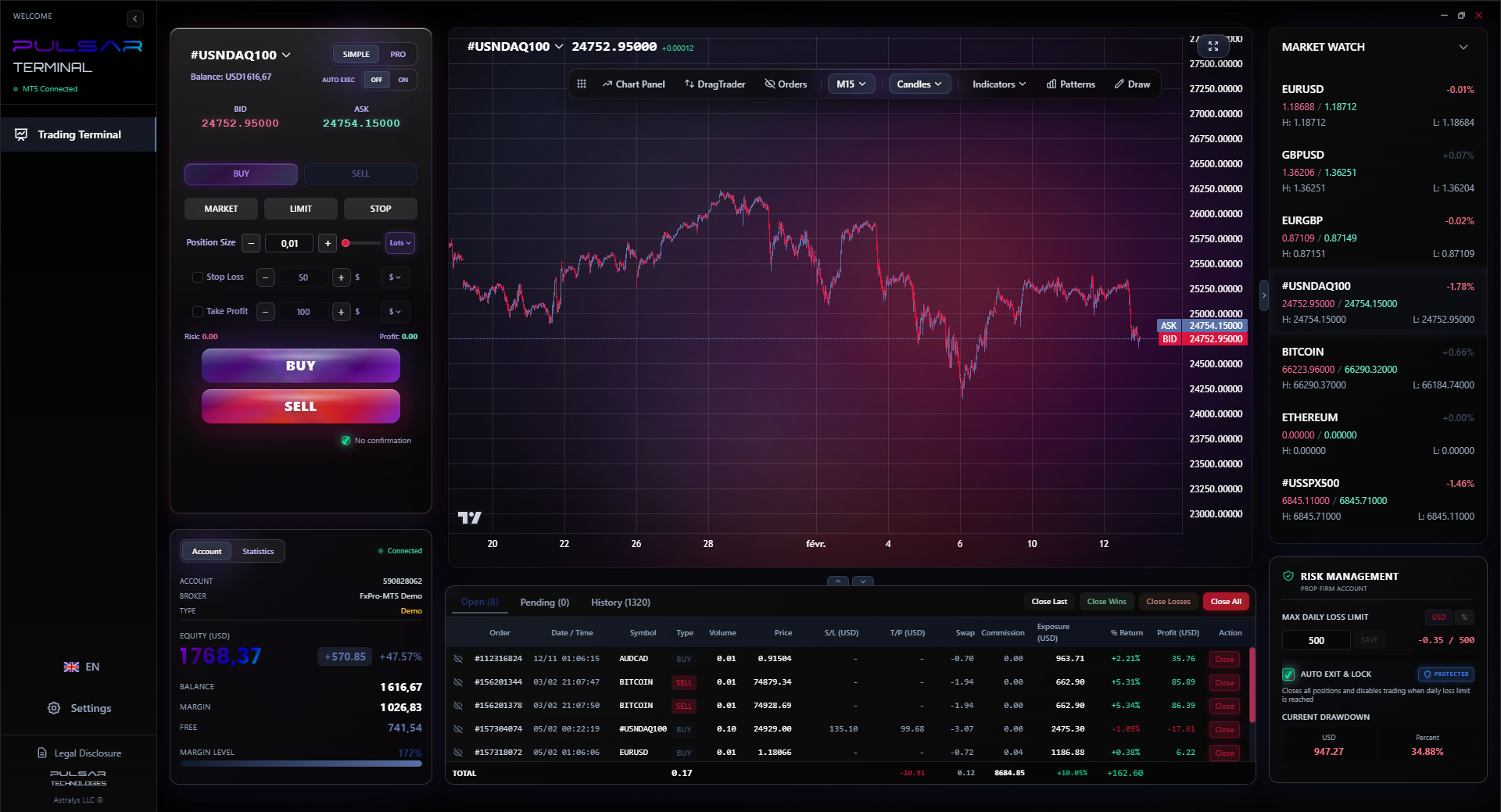
When volatility is this extreme, precise order management is non-negotiable. Pulsar Terminal's drag-and-drop orders and multi-take-profit tools let you set complex risk plans on MT5 before the news hits, so you're not fumbling when the market gaps.
Pulsar Terminal
A ferramenta MT5 tudo-em-um: ordens drag-and-drop, multi-TP/SL, trailing stop, grid trading, Volume Profile e proteção prop firm. Usado diariamente por 1.000+ traders.
“Sometimes, the best trade is no trade at all - just holding a more stable asset while the storm rages.”
Trading around the Naira requires a specific toolkit, most of which isn't on your trading platform.
Essential Tools:
- A Reliable Parallel Rate Tracker: Follow trusted sources on social media or dedicated websites. This is your primary data.
- A P2P Platform Account: To understand real-time buy/sell pressure and for practical hedging.
- A Liquid Broker for Proxy Trades: This is where you'll likely execute. A good Pepperstone or IC Markets account for trading DXY, USD pairs, or gold.
- Sentiment Gauge: Local news headlines are a powerful contrary indicator. When panic is at its peak on the front page, the short-term move might be exhausted.
The Right Mindset: You have to separate the emotional desire to 'beat the rate' from cold, analytical trading. The Naira's struggle is personal for many of us. That emotion will cloud your judgment. View it as a macroeconomic phenomenon, like the weather. You don't get angry at a storm; you prepare for it, or you avoid sailing until it passes. Sometimes, the best trade is no trade at all - just holding a more stable asset while the storm rages. Focus on preserving your capital in real terms, not just in Naira numbers on a screen. That’s the ultimate win.

FAQ
Q1What is the best platform to trade the dollar to naira rate?
For actual trading with charts and use, international brokers like Exness or IC Markets offer USD/NGN CFDs, but beware of huge spreads. For exposure to the real parallel rate, peer-to-peer (P2P) crypto platforms are where Nigerians actively set the price, though this is more of an exchange than traditional trading.
Q2Why is the spread for USD/NGN so high on my broker?
Extremely low liquidity. Unlike majors like EUR/USD traded by billions daily, the broker's USD/NGN is a niche product. The wide spread definition compensates the broker for the risk of holding an illiquid asset and protects them from sharp moves when they can't easily hedge their own exposure.
Q3Can I use technical analysis to trade USD/NGN?
It's very difficult. Fundamental news from the CBN or government consistently overpowers chart patterns. You can use support/resistance for broad areas, but treat technicals as a secondary tool. A breakout from a triangle pattern is meaningless if a new forex policy is announced.
Q4Is it better to trade gold (XAU/USD) instead of USD/NGN?
Often, yes. Gold is a classic hedge against currency instability and dollar volatility. When the Naira is under severe pressure, XAU/USD can offer a cleaner, more liquid way to trade the resulting safe-haven demand without the crippling spreads of USD/NGN.
Q5How do I protect my Naira savings from depreciation?
This is a form of hedging, not active trading. Common methods include converting a portion to stable assets like USDT on P2P platforms (understanding the counterparty risk) or, if possible, holding physical dollars. The goal is preservation, not speculation.
Q6What's the biggest mistake traders make with this pair?
Treating it like a normal forex pair. Using standard stop-loss distances, applying common scalping strategy techniques, or ignoring the massive gap between the official and parallel rates. This market operates by its own brutal rules.
Lição do Prof. Winston
Pontos-chave:
- ✓There are two dollar/nga rates: official (fiction for most) and parallel (the real price).
- ✓USD/NGN CFDs have spreads of 50+ pips, making most short-term strategies unworkable.
- ✓Trade the macro proxy (like DXY or XAU/USD) instead of the illiquid direct pair.
- ✓Use P2P rates for hedging capital, not for active chart trading.
- ✓Risk no more than 0.5% per trade on Naira volatility due to extreme gap risk.
Quão útil foi este artigo?
Clique em uma estrela
Insights de Trading Semanal
Análises e estratégias semanais grátis. Sem spam.
Sobre o autor
Olumide Adeyemi
Pioneiro do Trading na África Ocidental
Um dos educadores de trading forex mais ativos da Nigéria. 8 anos de experiência operando a partir de Lagos. Especialista em estratégias de baixo capital e desafios de prop firms para traders africanos.
Comentários
Aviso de risco
A negociação de instrumentos financeiros envolve riscos significativos e pode não ser adequada para todos os investidores. O desempenho passado não garante resultados futuros. Este conteúdo é apenas para fins educacionais e não deve ser considerado aconselhamento de investimento. Sempre conduza sua própria pesquisa antes de negociar.
Você também pode gostar

Cara Trading Forex Sukses: 7 Prinsip dari Trader Profesional
Cara trading forex sukses dengan 7 prinsip trader pro: manajemen modal, disiplin, journal trading, backtest. Data nyata, bukan janji profit palsu.
Jam Trading Forex Terbaik untuk Trader Indonesia: Panduan Lengkap dengan Tabel Waktu
Panduan jam trading forex untuk trader Indonesia. Tabel 4 sesi dunia, jam emas 20:00-00:00, sesi mana yang harus dihindari. Data akurat + tips dari trader berpengalaman.
Top 5 Sàn Forex Uy Tín Nhất 2026: Review Jujur dari Trader Indonesia
Top 5 sàn forex uy tín 2026 untuk trader Indonesia. Review jujur: spread, deposit, withdraw, dukungan lokal. Exness, XM, IC Markets & lebih.
Obter Pulsar Terminal
Todas essas calculadoras estão integradas ao Pulsar Terminal com dados em tempo real da sua conta MT5.
Obter Pulsar Terminal