


I lost $1,200 in a single morning in 2019 trying to trade the Naira.

Olumide Adeyemi
Pioneiro do Trading na África Ocidental ·  Nigeria
☕ 11 min de leitura
O que você vai aprender:
- 1The Two Nigerias: Official Rate vs. What You Can Trade
- 2What Actually Moves the Rate You See?
- 3The Smarter Play: Trading the Majors (From Lagos)
- 4Brokers, Rates, and Execution: Getting a Fair Deal
- 5Adapting Your Strategy to the Real Market
- 6Pitfalls Every Nigerian Trader Faces (And How to Fall in Fewer)
- 7Building a Sustainable Trading Process
- 8The Road Ahead: Trading in Nigeria's Evolving Market
I lost $1,200 in a single morning in 2019 trying to trade the Naira. I saw a headline about a 'CBN intervention' and went all-in on USD/NGN, convinced the Naira would spike. The rate barely moved on my broker's platform, while the news kept screaming about massive shifts. My account bled out on a 50-pip spread. That's when I learned the brutal truth: the 'forex rates today' you see on Nairametrics and the ones you can actually trade are two completely different animals. If you don't understand this split, you will lose money. Period.
Right now, as you read this, there are two parallel realities for the Naira. There's the official Nigerian Foreign Exchange Market (NFEM) rate, set by the Central Bank of Nigeria (CBN). As of April 7, 2026, that's sitting pretty at around ₦1,386.66 to the dollar. Then there's the parallel market rate - the one your cousin uses to send you dollar cash for your trading account - which is buying at roughly ₦1,392 and selling up to ₦1,420.
Here's the kicker for traders: you can't directly trade either of these rates on your standard MetaTrader platform.
When you open a USD/NGN chart with an international broker, you're not trading the physical Naira you hold in your GTB account. You're trading a non-deliverable forward (NDF) or a derivative contract. The settlement is in a major currency (usually USD), not in physical Naira. The liquidity is thin, the spreads are criminal (often 30-50 pips), and the price can disconnect wildly from the street rates you follow. I learned this the hard way. My failed $1,200 trade had a spread cost of nearly $50 just to enter. You're not trading Nigeria's economy, you're trading a poorly constructed proxy of it.

Warning: Trading USD/NGN pairs offered by international brokers is often a sucker's game for retail traders. The spreads eat your profit before the market even moves.

💡 Dica do Winston
The spread on your platform is your first opponent. If you don't know its exact cost in Naira before you click 'buy', you're already losing.
Forget the official pronouncements for a second. The 'forex rates today' on your trading screen for major pairs like EUR/USD or GBP/USD react to global forces, but with a Nigerian twist.
Global Drivers with Local Noise
The core drivers are universal: US Federal Reserve interest rate decisions, European Central Bank policy, and global risk sentiment. When the Fed is hawkish, the USD generally strengthens across the board. But for a Nigerian trader, there's an added layer of noise. News about CBN reforms, BDC recapitalization (that ₦2 billion requirement is no joke), or changes in diaspora remittance policies can cause temporary volatility in sentiment, which sometimes bleeds into other African currency pairs or even commodities like oil (XAU/USD is a popular refuge).
The Liquidity Crunch
The real issue is liquidity. Nigeria isn't a major trading bloc like Europe or North America. This means during major news events (like a surprise CBN rate change), the market for Naira-related derivatives can gap or freeze. I've seen orders sit unfilled for minutes when liquidity vanishes. This isn't the deep, always-moving pool of the EUR/USD guide. You need a broker with serious liquidity access, like the ones in our IC Markets review or Pepperstone review, just to get a fair shot.
Your job is to filter the local news. Is a story about EFEMS platform volumes moving the actual Euro? Probably not. Is a global risk-off panic because of a US bank failure crushing high-yield currencies? That will hit your screen directly. Separate the signal from the local static.
“The 'forex rates today' you see on Nairametrics and the ones you can actually trade are two completely different animals.”
This is the core lesson I had to beat into my own head: your edge as a Nigerian trader isn't in predicting the Naira. It's in using your unique perspective while trading the liquid, global markets.
Instead of fighting the 50-pip spread on USD/NGN, you trade EUR/USD, where the spread is often under 1 pip. Your analysis of how CBN policy might affect broader EMEA (Europe, Middle East, and Africa) risk appetite could give you a slight edge on the timing of a EUR/USD sell-off. Maybe you notice that every time there's a fuel subsidy crisis, Nigerian demand for stablecoins spikes, and you correlate that (loosely) with a brief dip in crypto-related stocks, which affects risk sentiment. It's a second-order connection, not a direct trade.
Your tools are the same as everyone else's: RSI indicator for overbought/oversold levels, MACD indicator for momentum shifts, and support/resistance on the daily charts. But your context is different. When you're doing swing trading, you're holding through the Lagos night while London and New York are active. You need to account for that in your stop-loss placement.

Pro Tip: Set your trading platform's default quotes to major pairs (EUR/USD, GBP/USD, USD/JPY, XAU/USD). Hide the exotic pairs like USD/NGN or USD/ZAR until you have a 6-month profitable track record. Out of sight, out of mind.
Where you trade is more important than what you trade when you're dealing with 'forex rates today'. The rate you get filled at is everything.
International brokers are your only viable option for speculative trading. Local banks? Forget it. The CBN rules prohibit them from facilitating this. So you're looking at brokers regulated abroad. But not all are equal for Nigerian clients.
Key things to scrutinize:
- Spread on Majors: This is your primary cost. A broker offering 0.8 pips on EUR/USD is fundamentally cheaper than one offering 1.5 pips. Over 100 trades, that's a massive difference. Check live accounts, not just marketing.
- Deposit/Withdrawal Methods: Can you fund with a Nigerian debit card (Mastercard/Visa) without insane fees? How about direct bank transfers in Naira? Some brokers, like Exness (see our Exness review), have localized payment channels that are a lifesaver. Others will force you into crypto or international wire transfers that lose 5-10% in FX conversion and fees.
- Execution Speed & Slippage: This is where prop firms and serious traders get burned. During high volatility, does your broker's price jump wildly, causing slippage? I once had a perfect scalping strategy entry on GBP/USD during the Brexit vote rerun, but my market order slipped 4 pips against me on a budget broker. That was the entire profit margin gone. Platforms like XM review often highlight their execution stats, look for them.
A quick comparison based on common Nigerian trader needs:
| Feature | Why It Matters for You | What to Look For |
|---|---|---|
| Naira Deposit Options | Avoids parallel market FX loss on funding. | Local transfer channels, card deposits in NGN. |
| Spread on EUR/USD | Your main trading cost. | Under 1.0 pip on standard accounts, consistently. |
| Withdrawal Time | Getting your profit out reliably. | Under 24 hours for verified payment methods. |
| Customer Support | When you have a funding crisis at 10 PM. | Live chat with actual humans, not just bots. |
Always, always use a position size calculator before entering a trade. Your broker's use might be 500:1, but that's a trap, not a tool. A 2% risk on a $1,000 account is $20. If you don't know what that means in pips for your trade, you shouldn't be placing the order.
💡 Dica do Winston
Your most valuable tool isn't a fancy indicator, it's a reliable generator or inverter. Plan your trading sessions around your power supply, not just the London open.
“Your edge as a Nigerian trader isn't in predicting the Naira. It's in using your unique perspective while trading the liquid, global markets.”
Your strategy cannot be 'watch local news, trade USD/NGN.' It has to be 'understand global flows, trade liquid pairs, and use tight risk management.'
Time Your Sessions
Your most active trading hours should align with the London (8 AM - 5 PM WAT) and London/New York overlap (1 PM - 5 PM WAT). This is when volume and volatility are highest for pairs like EUR/USD and GBP/USD. Trading at 2 AM WAT when only Sydney is open is a recipe for boredom and slow, grinding losses.
Risk Management is Your Anchor
With the added stress of unstable internet (we've all been there during a rainstorm) and power outages, your risk per trade must be lower than what any textbook suggests. If the global standard is 1-2% per trade, start at 0.5%. Why? Because a margin call due to a disconnect during a spike is a real possibility. I once had a trade go 50 pips against me in the 30 seconds it took my generator to kick in. A 0.5% risk saved my account; a 2% risk would have blown it.
Use Technology to Compensate
This is where tools beyond your broker's platform come in. You need automated trade management to guard against disconnections. Setting a stop-loss and take-profit isn't enough. You need trailing stops to lock in profit while you're dealing with real-life issues.

Example: You buy EUR/USD at 1.0850 with a 30-pip stop loss and a 60-pip take-profit. A trailing stop of 20 pips would move your stop-loss to breakeven (1.0850) once the price hits 1.0870, eliminating your risk. If the price then runs to 1.0900, your trailing stop moves up to 1.0880, locking in 30 pips of profit automatically, even if your lights go out.
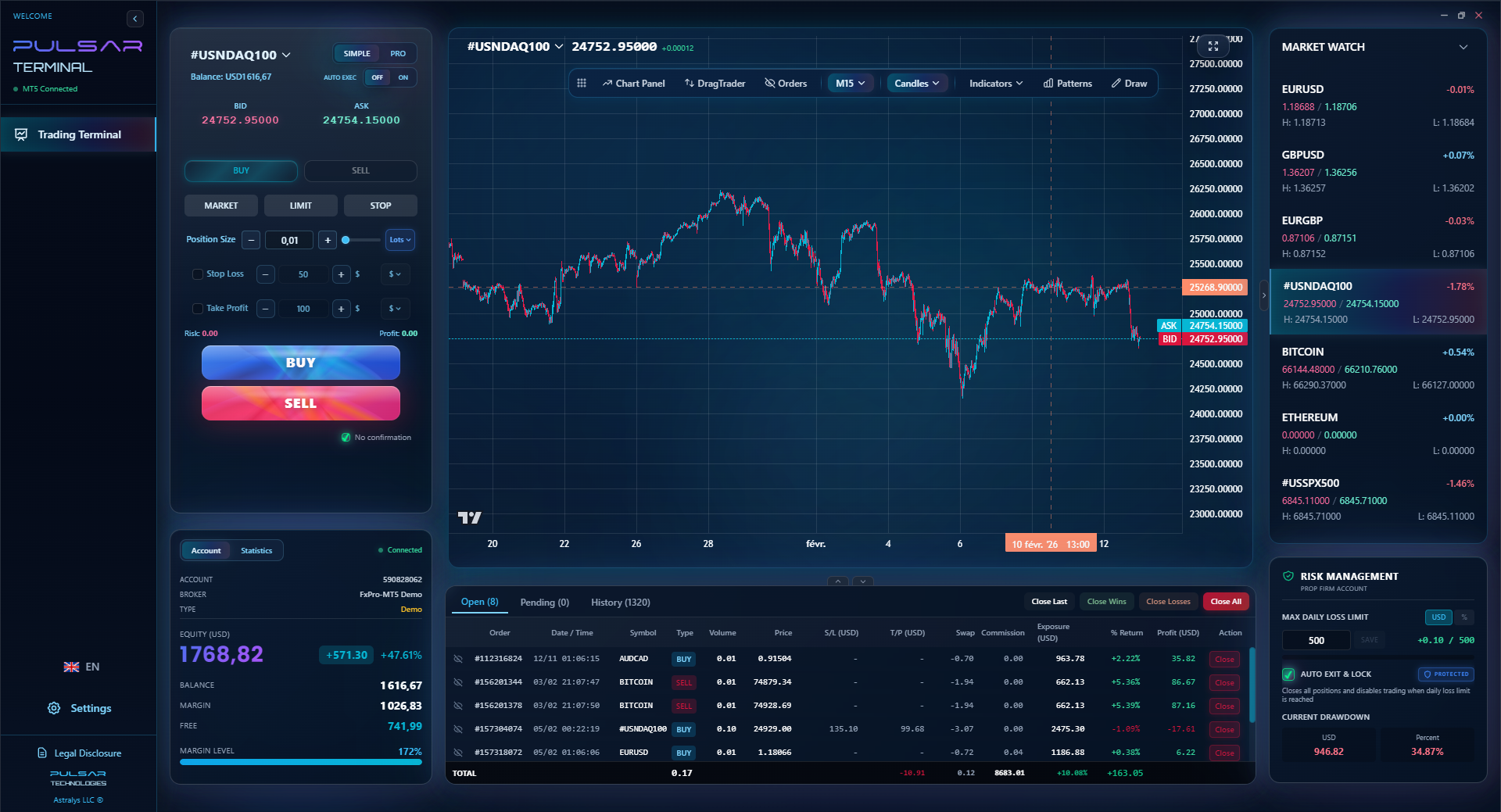
Managing trades manually during unreliable internet is a major risk, which is why automating tools like trailing stops and breakeven functions in Pulsar Terminal is non-negotible for serious traders here.
Pulsar Terminal
A ferramenta MT5 tudo-em-um: ordens drag-and-drop, multi-TP/SL, trailing stop, grid trading, Volume Profile e proteção prop firm. Usado diariamente por 1.000+ traders.
Let's be brutally honest about where we mess up.
Pitfall 1: Chasing the Parallel Market Rate. You see the black-market dollar hit ₦1,420 and think your USD/NGN buy trade is a sure thing. But your broker's derivative contract is still at ₦1,388 and isn't budging. You're trading different instruments. Don't conflate them.
Pitfall 2: Over-leveraging Because of Small Capital. Starting with ₦100,000 ($72-ish) and using 500:1 use feels like the only way to make meaningful money. It's the fastest way to lose it all. A 10-pip move against you with that setup can wipe out a huge chunk. use amplifies losses first, profits second.
Pitfall 3: Ignoring the True Cost of Trading. The spread isn't just a number. If you're paying a 3-pip spread on GBP/USD for a round-trip trade, you need the market to move 3 pips just to break even. Now add any commission. Your strategy must account for this friction. Before you even think you're right about the market, you have to overcome this built-in cost.
Pitfall 4: Emotional Trading on Local News. A positive headline about Nigeria's reserves does not mean the Euro will strengthen against the Dollar. Keep your local patriotism separate from your global chart analysis. The market doesn't care about national pride.
“Sustainable trading here is a grind. It's about process, not prophecy.”
Forget get-rich-quick schemes. Sustainable trading here is a grind. It's about process.
- Morning Check (15 mins): Don't check Naira rates first. Check the US Dollar Index (DXY), global bond yields, and the overnight price action on your 3 chosen major pairs. What happened while you slept?
- Analysis (30 mins): Look at the daily charts. Identify key support/resistance levels. Is price approaching one? Use your RSI indicator to see if it's overextended. Plan your day: will you look for breakout trades, or pullbacks to value?
- Trade Entry & Management: Enter only if your pre-defined setup triggers. Immediately set your stop-loss and take-profit. Use a position size calculator every single time. No exceptions.
- Evening Review (20 mins): Journal your trades. What was your rationale? Did you follow your plan? What was the result? Not doing this is like driving with your eyes closed.
This process removes emotion. It turns trading from a reactive gamble into a proactive business. The 'forex rates today' become data points in your system, not signals to panic-buy or sell.
💡 Dica do Winston
If you can't explain your trade setup in one sentence without mentioning 'Nigeria' or 'Naira', you're probably on the right track. You're a currency trader, not a local economist.
The reforms are real. The EFEMS platform, the BDC recapitalization, the new FX code - they're all steps towards a more transparent, unified market. In the future, maybe we'll have a liquid, deliverable Naira futures contract that retail traders can access cleanly.
But that future isn't today. Today, you have to play the hand you're dealt. That means accepting that the most actionable 'forex rates today' for building your capital are the ones from London and New York, not from the CBN's website or the BDC on your street corner.
Your goal isn't to outsmart the parallel market. Your goal is to become a consistently profitable trader of global currency markets, who happens to be based in Nigeria. Master the majors, manage your risk like your life depends on it (because your trading account does), and use your local perspective as a subtle filter, not your primary trigger. That's how you win in this game.
FAQ
Q1Can I legally trade forex in Nigeria?
Yes, it is legal for individuals to trade forex through internationally regulated brokers. However, Nigerian banks are prohibited from facilitating speculative forex trading for you. You must use a broker licensed abroad (like by the FCA or CySEC).
Q2Why is the USD/NGN rate on my trading platform different from the rate on the street?
Because you're trading different things. The street rate is for physical cash exchange. The rate on your platform is for a non-deliverable forward (NDF) derivative contract, which is settled in USD and has very low liquidity. They are fundamentally separate markets with different drivers.
Q3What is the best currency pair for a beginner in Nigeria to trade?
Stick to major pairs with high liquidity and tight spreads, specifically EUR/USD. The spreads are low (often under 1 pip), information is plentiful, and it's less prone to the wild gaps you see in exotic pairs. Avoid USD/NGN as a beginner.
Q4How can I fund my trading account from Nigeria with minimal loss?
Look for brokers that offer direct Naira deposits via local bank transfer or Nigerian debit/credit cards (Mastercard/Visa). This uses your bank's official rate, avoiding the parallel market premium. Brokers like Exness and XM have these options. Always check their specific deposit channels for Nigerian clients.
Q5What is a safe amount of use for a Nigerian trader?
Much lower than your broker offers. Even if they provide 500:1, start with 10:1 or 20:1. With the added challenges of power and internet instability, high use is a major risk. A safe rule is to never use so much use that a 20-pip move could trigger a margin call.
Q6Does the Central Bank of Nigeria's (CBN) official rate affect my EUR/USD trades?
Not directly. The CBN's rate directly affects the physical Naira. Your EUR/USD trade is between the Euro and US Dollar. However, major CBN policy shifts can influence broader investor sentiment towards emerging markets, which can indirectly affect global risk appetite and currency flows. It's a secondary, not primary, driver.
Lição do Prof. Winston
Pontos-chave:
- ✓Trade liquid majors (EUR/USD), not illiquid Naira derivatives.
- ✓A 0.5% risk per trade protects you from disconnections and spikes.
- ✓Your broker's deposit options are as important as their spreads.
- ✓The parallel market rate is irrelevant to your MT5 platform trades.
Quão útil foi este artigo?
Clique em uma estrela
Insights de Trading Semanal
Análises e estratégias semanais grátis. Sem spam.
Sobre o autor
Olumide Adeyemi
Pioneiro do Trading na África Ocidental
Um dos educadores de trading forex mais ativos da Nigéria. 8 anos de experiência operando a partir de Lagos. Especialista em estratégias de baixo capital e desafios de prop firms para traders africanos.
Comentários
Aviso de risco
A negociação de instrumentos financeiros envolve riscos significativos e pode não ser adequada para todos os investidores. O desempenho passado não garante resultados futuros. Este conteúdo é apenas para fins educacionais e não deve ser considerado aconselhamento de investimento. Sempre conduza sua própria pesquisa antes de negociar.
Você também pode gostar

Cara Trading Forex Sukses: 7 Prinsip dari Trader Profesional
Cara trading forex sukses dengan 7 prinsip trader pro: manajemen modal, disiplin, journal trading, backtest. Data nyata, bukan janji profit palsu.
Jam Trading Forex Terbaik untuk Trader Indonesia: Panduan Lengkap dengan Tabel Waktu
Panduan jam trading forex untuk trader Indonesia. Tabel 4 sesi dunia, jam emas 20:00-00:00, sesi mana yang harus dihindari. Data akurat + tips dari trader berpengalaman.
Top 5 Sàn Forex Uy Tín Nhất 2026: Review Jujur dari Trader Indonesia
Top 5 sàn forex uy tín 2026 untuk trader Indonesia. Review jujur: spread, deposit, withdraw, dukungan lokal. Exness, XM, IC Markets & lebih.
Obter Pulsar Terminal
Todas essas calculadoras estão integradas ao Pulsar Terminal com dados em tempo real da sua conta MT5.
Obter Pulsar Terminal