


My screen flashed red.

David van der Merwe
Trader de Mercados Emergentes ·  South Africa
☕ 10 min de leitura
O que você vai aprender:
My screen flashed red. It was late 2018, and a 'fund manager' I'd trusted with a portion of my capital had just blown my entire R50,000 deposit on a single, massive gold trade. The WhatsApp messages stopped. The fancy website went dark. That sickening feeling in my gut wasn't just about the money. It was the humiliation of being played. That experience, more than any winning trade, forced me to build my own mental forex scammer list. Here’s what I’ve learned the hard way, so you don't have to.
Let's be honest, the promise of forex trading hits different when you're dealing with a volatile Rand, load-shedding anxieties, and a real need for financial alternatives. Scammers know this. They prey on that specific blend of hope and frustration. I've seen it all: the Instagram gurus posing in front of rented supercars in Sandton, the WhatsApp groups promising 'guaranteed' 20% monthly returns in ZAR, the fake FSCA registration numbers. The local angle makes it feel more credible. They'll use SA success stories, reference our banks, and even tailor their trading 'hours' to our time zone. It's a sophisticated con. They're not just selling a dream of wealth; they're selling a dream of stability and escape, which is a far more powerful drug. Our market is seen as ripe because of a general hunger for better opportunities, coupled with a sometimes-overlooked fact: financial literacy isn't where it needs to be. The scammer's first job is to bridge that gap with confidence, not education.

Warning: Any 'advisor' or broker who spends more time talking about lifestyle (cars, watches, houses) than about spread definition, slippage, or risk management is selling a fantasy, not a financial service.
“Win rate is meaningless if your losses are five times the size of your wins.”
Over the years, the packaging gets slicker, but the core scams remain stubbornly consistent. If you see these, run. Don't walk.
The Signal Seller/Guru: This is the most common entry point. For a monthly fee (often in USD, but they'll accept your ZAR), they'll send you 'winning' trade alerts. Here's the catch: they send the signal to hundreds of people. If it wins, they boast. If it loses, they go quiet or blame 'market volatility.' I paid for one such service early on, R800 a month. The guy had a stunning track record posted. What he didn't post was the 1:50 risk-to-reward he was using. One win would make 50 pips, but the stops were 100 pips wide. A few losses wiped out months of gains. It's a mathematical scam disguised as mentorship.
The Managed Account/Prop Firm Clone: This is where I got burned. They offer to trade for you. All you need is to deposit a 'minimum' of R20,000 or more into an account they 'manage.' They'll show you fake MyFxBook statements. The money goes directly to a broker they control (often an unregulated offshore bucket shop). At first, you might see small 'profits' to build trust. Then, they'll make a reckless trade, blame an 'unexpected news event,' and your capital is gone. The prop firm daily loss protection mechanisms real firms use? Non-existent here.
The Broker Scam (The Bucket Shop): This is a direct attack on your trades. You sign up with a broker that isn't regulated by the FSCA or a top-tier authority like ASIC or the FCA. When you place a trade, they don't hedge it in the real market. They take the other side. Your loss is their profit. They'll manipulate spreads, cause constant requotes during news, and make withdrawing your money a bureaucratic nightmare. I learned this lesson trying to chase higher use. The platform would freeze the moment I was in profit on a scalping strategy.
The Software/EA (Robot) Scam: 'Set it and forget it! This robot made 10,000% last year!' They sell you an Expert Advisor for a one-time fee or subscription. The backtests are perfectly curve-fitted to past data. In live markets, it fails spectacularly. I once wasted $500 on a 'Gold Miner' EA. It worked for two weeks in a ranging market, then blew the account when trend conditions changed. The seller had vanished.

Example: A signal seller boasts an 80% win rate. Sounds great. But if his average winning trade is +5 pips and his average loser is -40 pips, he's bankrupting you slowly. Win rate is meaningless without risk/reward. Always ask for the average R:R.

💡 Dica do Winston
A regulated broker's license number is public. If they hesitate to give it or it doesn't match on the regulator's site, it's not a broker. It's a thief with a website.
“Your first deposit with any new broker isn't for trading. It's a withdrawal test.”
These scams have a distinct Mzansi flavour. They feel closer to home, and that's what makes them dangerous.
The 'FSCA Approved' Lie: This is a big one. They'll display the FSCA logo and even give you a fake FSP number. Always, always verify directly on the FSCA's website. Type in the number. Check the name. I've seen scammers take a legitimate company's FSP number and just use it as their own. If the details don't match exactly, it's a fraud.
The Stokvel/Investment Club Twist: They repackage the managed account scam as a high-yield stokvel or investment club. 'Pool our resources for bigger returns!' It's hosted on Facebook or WhatsApp. Contributions are made via EFT to a personal account (never a corporate, audited trust account). The 'returns' paid to early members come from the deposits of new members. It's a classic Ponzi scheme with a local name.
The Rand Hedge Narrative: They'll use genuine fear about the ZAR's weakness to push you into unregulated crypto-forex hybrids or offshore investments they claim are 'Rand-proof.' The complexity is meant to confuse you into compliance.
The Seminar at a Fancy Hotel: They rent a conference room at the Hilton or Sandton Convention Centre. It looks legit. There's a charismatic speaker. The first free seminar is just motivational fluff. The real scam is the R15,000 'platinum course' or 'inner circle' they sell you at the end, with a 'special offer' that expires today. The education is worthless, recycled from free YouTube videos.
“Your first deposit with any new broker isn't for trading. It's a withdrawal test.”
This is your first line of defense. Do this before you deposit a single cent.
- Regulation is King: Ignore everything else if this fails. For South Africans, a broker regulated by the FSCA is good. Better yet, look for global top-tier regulation: ASIC (Australia), FCA (UK), CySEC (EU). Go to the regulator's official website and search their register. Don't just trust the badge on the broker's site.
- Check the Legal Entity: Who are you actually contracting with? If you're depositing ZAR, but their company is registered in St. Vincent and the Grenadines or some other offshore haven with no oversight, that's a massive red flag. A good broker like Pepperstone or IC Markets is transparent about their regulated entities.
- Withdrawal Test: This is a pro move. Before you fund your main account, make the smallest possible deposit. Then, immediately request a withdrawal of that same amount. See how easy and fast the process is. A legitimate broker won't mind. A scammer will throw up obstacles, fees, or delays, hoping you'll start trading instead.
- Platform & Spreads: Do they offer genuine MetaTrader 4 or 5 (you can download MT5 from the official MetaQuotes site)? Or is it a proprietary, clunky platform? Check their spreads on major pairs like EUR/USD during live market hours. If their EUR/USD spread is 3 pips when everyone else is at 0.8, you're being ripped off.
- Client Reviews (Read Between the Lines): Look for patterns on independent review sites. Are all the complaints about withdrawals? That's a huge sign. Are all the 5-star reviews generic and poorly written? Probably fake. Look for detailed reviews that discuss actual trading experiences.

Pro Tip: Open a demo account first. Not just to test your strategy, but to test them. See if their quotes are in line with the broader market. Try executing trades during high volatility. If the platform freezes or requotes constantly on a demo, imagine what happens with your real money.
💡 Dica do Winston
Your greatest weapon against scams isn't skepticism, it's knowledge. If you understand how a [position size calculator](/en/calculators) works, you'll instantly see through the nonsense of 'guaranteed' returns.
“The sophistication isn't in the trading strategy they sell you; it's in the psychology they use to sell it.”
First, don't be ashamed. It happens to the smartest of us. The scammers are professionals. Your priority is damage control.
- Stop All Communication: Do not engage further. They will only feed you more lies to string you along or try to get a 'recovery fee' from you (which is another scam).
- Document Everything: Screenshots of chats, website URLs, email addresses, phone numbers, EFT receipts with beneficiary details, trade histories. Create a folder. This is your evidence.
- Report, Report, Report:
- South African Police Service (SAPS): Open a case of fraud. Get a case number. It feels futile, but it creates a paper trail.
- FSCA: Report the entity to the Financial Sector Conduct Authority. They have a dedicated enforcement division. If the scammer was pretending to be regulated, this is crucial.
- Banks: Contact your bank's fraud division immediately. Provide them with all the evidence. They may be able to flag the beneficiary account (though the money is often moved instantly).
- Beware of 'Recovery' Scams: Within days or weeks, you may be contacted by a 'law firm' or 'funds recovery specialist' who miraculously knows you lost money. They promise to get it back for an upfront fee. This is a secondary scam. No legitimate recovery service asks for money upfront. If you've reported to the authorities, that's your path.
- Mental Reset: This is important. The financial loss hurts, but the betrayal of trust can make you quit trading altogether. Don't. Separate the criminal who stole from you from the legitimate activity of trading. Use it as fuel to become your own expert. Learn proper position size calculation, understand the MACD indicator inside out, and take control.
“The sophistication isn't in the trading strategy they sell you; it's in the psychology they use to sell it.”
Your best defense isn't just a forex scammer list, it's a mindset. After my R50k loss, I rebuilt with these rules.
You Are the Strategy: Any system that relies on someone else's signals or black-box robot is inherently risky. Your goal should be to understand the why behind a trade. Study swing trading principles, learn to read price action. It's harder, but it's the only thing that can't be taken from you.
Transparency Over Promises: A legitimate educator or community will be transparent about losses. They'll show full, verified statements, not just cherry-picked wins. They'll talk about risk management first, entries second.
Start Small, painfully Small: When you find a broker that passes your checks, like XM or Exness for their local presence, start with a deposit so small that losing it wouldn't affect your life. R2,000. Not R50,000. Your goal with this account isn't to get rich. It's to test the entire cycle: funding, trading, withdrawing, and your own psychology.
Automate Your Safety: This was a game-changer for me. Using tools that enforce discipline removes emotion - and vulnerability to 'get-rich-quick' emotions. For example, setting automatic trailing stops or multi-level take-profits means you're not glued to the screen, making impulsive decisions.
The Community Check: Who is this person/company associated with? Do other reputable traders in the SA space know them? Or are they an island? Scammers often operate in a vacuum.
💡 Dica do Winston
The market doesn't owe you a recovery. Chasing losses from a scam by taking riskier trades with your remaining capital is how you lose twice.
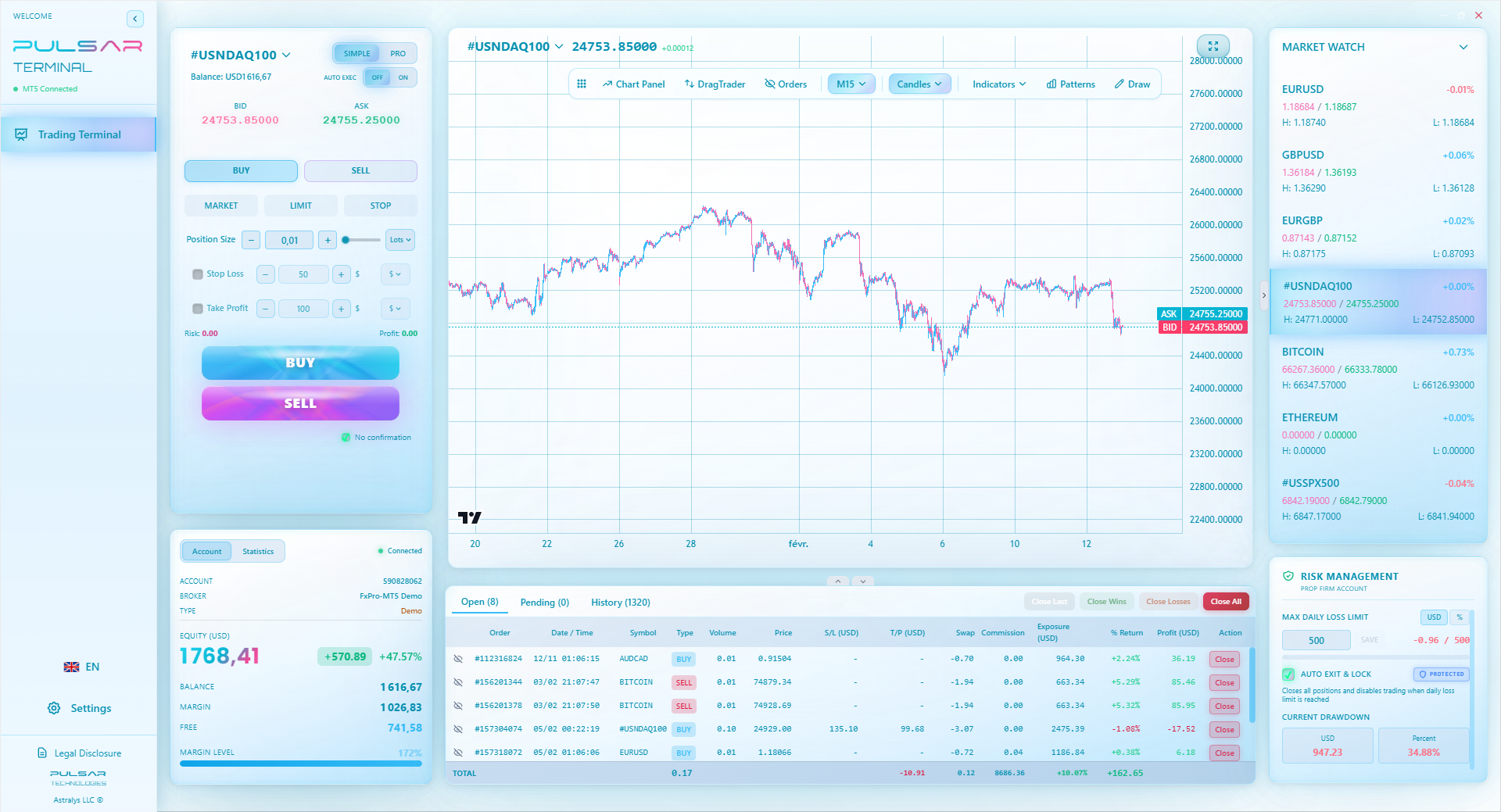
When you're focused on building a real strategy, tools that automate risk management—like setting a trailing stop or multi-level take-profits—let you trade your plan without emotion, which is your best defense against the panic scammers exploit.
Pulsar Terminal
A ferramenta MT5 tudo-em-um: ordens drag-and-drop, multi-TP/SL, trailing stop, grid trading, Volume Profile e proteção prop firm. Usado diariamente por 1.000+ traders.
“A legitimate educator shows you their losses. A scammer only shows you their rented car.”
Not everything is a scam. Here are actual, legitimate places to start your journey without getting robbed.
- The FSCA Website: Your number one resource. Use their search tool. They also have consumer education material.
- JSE Investor Education: While for stocks, the core principles of investing and scam avoidance are solid and applicable.
- Registered Financial Service Providers (FSPs): If you want true financial advice, use an FSCA-registered advisor. You can find fee-based advisors who aren't incentivized by your trading volume.
- Brokers with Local Offices: Some international brokers have physical offices or dedicated South African support teams. This isn't a guarantee of safety (they must still be regulated), but it adds a layer of accountability. Do your due diligence on them as outlined above.
- Paper Trading: Every legitimate broker offers a demo account. Use it for 3-6 months minimum. Prove to yourself that you can be consistently profitable in a simulated environment before risking real Rands. It's free and the most valuable education you'll get.
FAQ
Q1Is forex trading itself a scam in South Africa?
No, forex trading is a legitimate financial activity. The scam is in the dishonest people and unregulated companies that surround it. Trading with a properly regulated broker is as legitimate as trading stocks on the JSE. The market itself isn't the problem; the intermediaries often are.
Q2What's the most common scam targeting new South African traders?
The WhatsApp/Instagram 'guru' selling signals or managed accounts. They use local references, ZAR pricing, and social proof (fake screenshots) to build trust quickly. They appeal directly to the desire for a quick, easy solution from someone who 'looks like they made it.'
Q3I think my broker is a scam. How can I get my money back?
First, request a full withdrawal immediately. If blocked or delayed, gather all evidence (statements, chats, payment receipts) and report them to the FSCA and SAPS. Contact your bank to report fraudulent EFTs. Be realistic: recovery is very difficult once funds are sent offshore. The primary goal is to stop further loss and report them to protect others.
Q4Are 'prop firm challenges' a scam?
Not inherently. Reputable proprietary trading firms like some global ones offer a valid path to trading larger capital. The scam exists in the fake clone firms that steal your challenge fee and have no intention of funding you, or 'funded accounts' that use manipulated prices so you can never pass. Always research the prop firm's reputation independently.
Q5A friend made money with a forex group. Why is it risky?
It could be a Ponzi scheme. Early members get paid with the deposits of new members, creating the illusion of success. It works until the flow of new money stops, then it collapses. Always ask: what is the actual source of the returns? Is it from genuine market profits, or just recycling member deposits?
Q6How much should I invest as a complete beginner in SA?
An amount you are 100% comfortable losing completely. I'd suggest no more than R2,000-R5,000 for your very first live account after extensive demo trading. This money is not for profit. It's tuition fee to learn the real-world process - including emotions, fees, and execution - without crippling your finances.
Lição do Prof. Winston
Pontos-chave:
- ✓Verify regulation yourself on the official FSCA/ASIC/FCA website.
- ✓Test a broker's withdrawal process before making a large deposit.
- ✓If returns are 'guaranteed,' it's guaranteed to be a scam.
- ✓Never send trading capital to a personal bank account.
Quão útil foi este artigo?
Clique em uma estrela
Insights de Trading Semanal
Análises e estratégias semanais grátis. Sem spam.
Sobre o autor
David van der Merwe
Trader de Mercados Emergentes
Trader sediado em Joanesburgo com 11 anos em moedas de mercados emergentes. Especialista em pares ZAR, trading regulado pela FSCA e análise do mercado sul-africano.
Comentários
Aviso de risco
A negociação de instrumentos financeiros envolve riscos significativos e pode não ser adequada para todos os investidores. O desempenho passado não garante resultados futuros. Este conteúdo é apenas para fins educacionais e não deve ser considerado aconselhamento de investimento. Sempre conduza sua própria pesquisa antes de negociar.
Você também pode gostar

Cara Trading Forex Sukses: 7 Prinsip dari Trader Profesional
Cara trading forex sukses dengan 7 prinsip trader pro: manajemen modal, disiplin, journal trading, backtest. Data nyata, bukan janji profit palsu.
Jam Trading Forex Terbaik untuk Trader Indonesia: Panduan Lengkap dengan Tabel Waktu
Panduan jam trading forex untuk trader Indonesia. Tabel 4 sesi dunia, jam emas 20:00-00:00, sesi mana yang harus dihindari. Data akurat + tips dari trader berpengalaman.
Top 5 Sàn Forex Uy Tín Nhất 2026: Review Jujur dari Trader Indonesia
Top 5 sàn forex uy tín 2026 untuk trader Indonesia. Review jujur: spread, deposit, withdraw, dukungan lokal. Exness, XM, IC Markets & lebih.
Obter Pulsar Terminal
Todas essas calculadoras estão integradas ao Pulsar Terminal com dados em tempo real da sua conta MT5.
Obter Pulsar Terminal