


Here's a number that should make you sit up: Nigeria's forex market turnover hit $8.6 billion in 2025, a 56% jump from the year before.

Olumide Adeyemi
Pioneiro do Trading na África Ocidental ·  Nigeria
☕ 11 min de leitura
O que você vai aprender:
Here's a number that should make you sit up: Nigeria's forex market turnover hit $8.6 billion in 2025, a 56% jump from the year before. That's not just big money moving; it's a sign of a massive, hungry market. But here's the catch most 'gurus' won't tell you: roughly 93% of that activity is from people under 35, and a huge chunk of them are funding their first forex trading account with money they can't afford to lose. I've been there, wiring my first 50,000 Naira to a broker with sweaty palms. Let's talk about how to do this right, from picking a broker to actually keeping your profits.
First things first: trading forex is legal in Nigeria. The Central Bank of Nigeria (CBN) and the Securities and Exchange Commission (SEC) are the main watchdogs for finance. But here's the critical detail that shapes everything for us: there are no specific rules yet for online retail forex trading. This creates a grey area that's both an opportunity and a minefield.
The CBN has one iron-clad rule you must know: you cannot use the official foreign exchange window (the one banks use) to fund your forex trading account. They'll block it. This is to protect the Naira. So, when you fund your account, you're using your own already-converted dollars or a payment processor. Your broker handles the conversion.
On the profit side, the Federal Inland Revenue Service (FIRS) expects its share. Forex trading profits are subject to a 10% Capital Gains Tax. I know, I know, nobody likes taxes. But declaring it keeps you clean and avoids nasty surprises later. Consider it the cost of doing legitimate business.
Because local online regulation is still developing, most of us use international brokers regulated elsewhere - like the Seychelles, Cyprus, or South Africa. This is perfectly acceptable and common. The key is ensuring that broker is legitimately regulated somewhere reputable.

Warning: Any "broker" offering to help you use the CBN's official window to fund your account is leading you into illegal territory. Steer clear.

💡 Dica do Winston
Your first deposit isn't capital to grow. It's tuition to learn. Expect to lose it. If you don't, that's a bonus. This mindset shift alone will save you from desperate, account-killing trades.
“High use doesn't increase your chance of winning. It increases the speed at which you lose if you're wrong.”
This is where most new traders get it wrong. They see an ad promising insane use and sign up without checking the fine print. Your broker is your business partner; choose a bad one, and your business fails before it starts.
Regulation is Your Safety Net
Never, ever use an unregulated broker. Full stop. Since we often use international firms, look for regulation from bodies like the FSCA (South Africa), CySEC (Cyprus), ASIC (Australia), or the FSA (Seychelles). This information is always on the broker's website footer. If you can't find it in 30 seconds, close the tab.
Naira-Denominated Accounts: A Game Changer
This is a huge deal for managing psychology. Some brokers like Exness and HFM offer accounts where your balance is displayed in Naira. Why does this matter? When you see a $50 loss on a USD account, your brain quickly converts it to "about 70,000 Naira" and panic sets in. With a Naira account, you're trading with numbers you live with every day. It removes a layer of mental conversion fog. I switched to one years ago and my risk management improved instantly.
The Real Costs: Spreads, Commissions, and Minimums
Look beyond the flashy "$5 minimum deposit!". You need to understand the cost structure.
- Commission-Free Accounts: You pay a wider spread (the difference between buy/sell price). Good for beginners with smaller accounts where commissions would eat profits.
- Raw Spread + Commission Accounts: You get super tight spreads (sometimes 0.0 pips on EUR/USD) but pay a commission per trade. This is better for active traders or those with larger accounts.
Here’s a quick comparison of popular options for Nigerian traders:
| Broker | Key Regulation for NG | Min. Deposit (Approx.) | EUR/USD Spread (Typical) | Naira Account? |
|---|---|---|---|---|
| Exness | FSA (Seychelles) | $10 | 0.0 - 0.1 pips | Yes |
| XM | FSA (Seychelles) | $5 | From 0.8 pips | No |
| HF Markets | FSCA (SA) | 4,000 NGN | From 1.4 pips | Yes |
| Pepperstone | CMA (Kenya) | $0 | From 0.0 pips | No |
I have accounts with both Exness and Pepperstone. For my high-frequency scalping strategy, I use Pepperstone's Razor account for the raw spreads. For longer-term swings where I might hold for days, I use my Exness Standard account. It's about matching the account type to your style.

Pro Tip: Always test a broker with a demo account first. Then, fund your live account with the absolute minimum. Test withdrawals before you deposit serious money. If there's any hassle pulling out $20, imagine trying to get out $2,000.
“Your broker is your business partner; choose a bad one, and your business fails before it starts.”
This is the practical hurdle. You've got Naira in your Nigerian bank account or wallet. How does it become trading capital?
Thankfully, it's easier now than ever. Most international brokers accept a wide range of payment methods from Nigeria:
- Local Bank Transfer: Directly in Naira to the broker's local partner bank. Usually takes 1-24 hours.
- Debit/Credit Cards (Visa/Mastercard): Almost instant. Be aware your bank might flag it as an international transaction; a quick call to customer service usually clears it.
- E-Wallets: Skrill, Neteller, and others. These act as a middleman. You fund the wallet, then fund the broker from the wallet. Can be faster for withdrawals.
- Cryptocurrency: USDT (Tether) is king here. Fast, relatively low fees, and bypasses traditional banking channels. More and more traders I know use this exclusively.
My personal go-to is cryptocurrency for anything over $500. The withdrawal back to my local crypto wallet is often processed same-day. For smaller top-ups, I use a card.
One painful lesson: I once tried to withdraw $1,000 via bank transfer during a holiday period. It took 11 business days. The broker had processed it in 24 hours, but it got stuck in intermediary banking limbo. Now, I plan major withdrawals when I don't need the cash urgently.
Remember the CBN rule? This is where it applies. Your broker's payment processor handles the forex conversion. You're sending Naira, they credit your account in USD (or Naira if you have that account type).
“Your broker is your business partner; choose a bad one, and your business fails before it starts.”
Brokers offer different account types (Standard, Pro, Raw, Zero). It's not about which is "better," but which is better for you.
A Standard account might have a 1.2 pip spread on EUR/USD but no commission. If you're trading 0.1 lots, that's a cost of $1.20 per trade. A Raw account might have a 0.1 pip spread but a $3.50 commission per lot. For that same 0.1 lot trade, your cost is $0.01 (spread) + $0.35 (commission) = $0.36. Cheaper! But only if you're calculating correctly.
Now, let's talk use. This is the number one account killer for new traders in Nigeria. Brokers here offer insane use - 1:1000, 1:2000, even "unlimited." It's a marketing tool that preys on small accounts. "Turn $10 into $10,000!"
Here's the brutal truth: High use doesn't increase your chance of winning. It increases the speed at which you lose if you're wrong. I learned this the hard way in 2015. I deposited $100, used 1:500 use, and went all-in on a GBP/USD trade. The trade went 20 pips against me. My $100 was gone in under an hour. A 20-pip move! That's nothing in forex terms.
use is a tool for efficient use of capital, not a magic profit multiplier. For a beginner, I wouldn't go above 1:30, no matter what the broker offers. As your skills and account grow, you might increase it cautiously. Always use a position size calculator for every single trade. It forces discipline.

Example: You have a $1,000 account, trading EUR/USD. With 1:30 use, you can control roughly $30,000 worth of currency. That allows you to sensibly trade 0.3 standard lots. With 1:1000 use, you could control $1,000,000. One bad 10-pip trade at that size would wipe you out. It's not power; it's a loaded gun pointed at your account.
💡 Dica do Winston
The most important number on your platform isn't your profit/loss. It's your 'Free Margin.' If that number gets low, you're one volatile news event away from a margin call. Protect it fiercely.
“A Naira-denominated account removes a layer of mental conversion fog that clouds your trading decisions.”
Opening the account is easy. Managing it profitably is the real work. This is where your forex trading account becomes a reflection of your discipline.
1. Risk Per Trade is Sacred: Decide what percentage of your account you're willing to lose on one trade before you even look at a chart. 1% is the golden rule for most. On a 200,000 Naira account (~$130), that's 2,000 Naira risk per trade. It feels small, but it protects you from the string of 5 losing trades that happens to everyone.
2. The Psychology of a Naira Balance: If you have a USD account, you'll mentally convert every profit and loss to Naira. A $50 profit feels amazing ("That's my light bill!"). A $50 loss feels devastating. You must train yourself to think in percentages, not absolute Naira values. This is why I prefer Naira-denominated accounts - it short-circuits this emotional conversion.
3. Record Everything: Not just "bought EUR/USD, made money." Log the entry price, exit price, lot size, the reason for the trade (e.g., "RSI indicator divergence on 4H chart"), and your emotional state. I review my journal every Sunday. My worst trades always happen when I'm bored or trying to "make back" a loss.
4. Understand Margin and the Dreaded Margin Call: Your broker's platform will show "Margin Used" and "Free Margin." If your losses eat up all your Free Margin, you get a margin call and your positions are automatically closed at a loss. This is why proper position sizing is non-negotiable. It keeps Free Margin healthy.
I once had a fantastic swing trading idea on XAU/USD (Gold). I was right on the direction, but I got too greedy with my position size. A short-term spike against me increased my margin used, and I had to close other profitable trades to avoid a margin call. I saved the account but butchered my portfolio balance. A classic case of poor account management overshadowing good analysis.
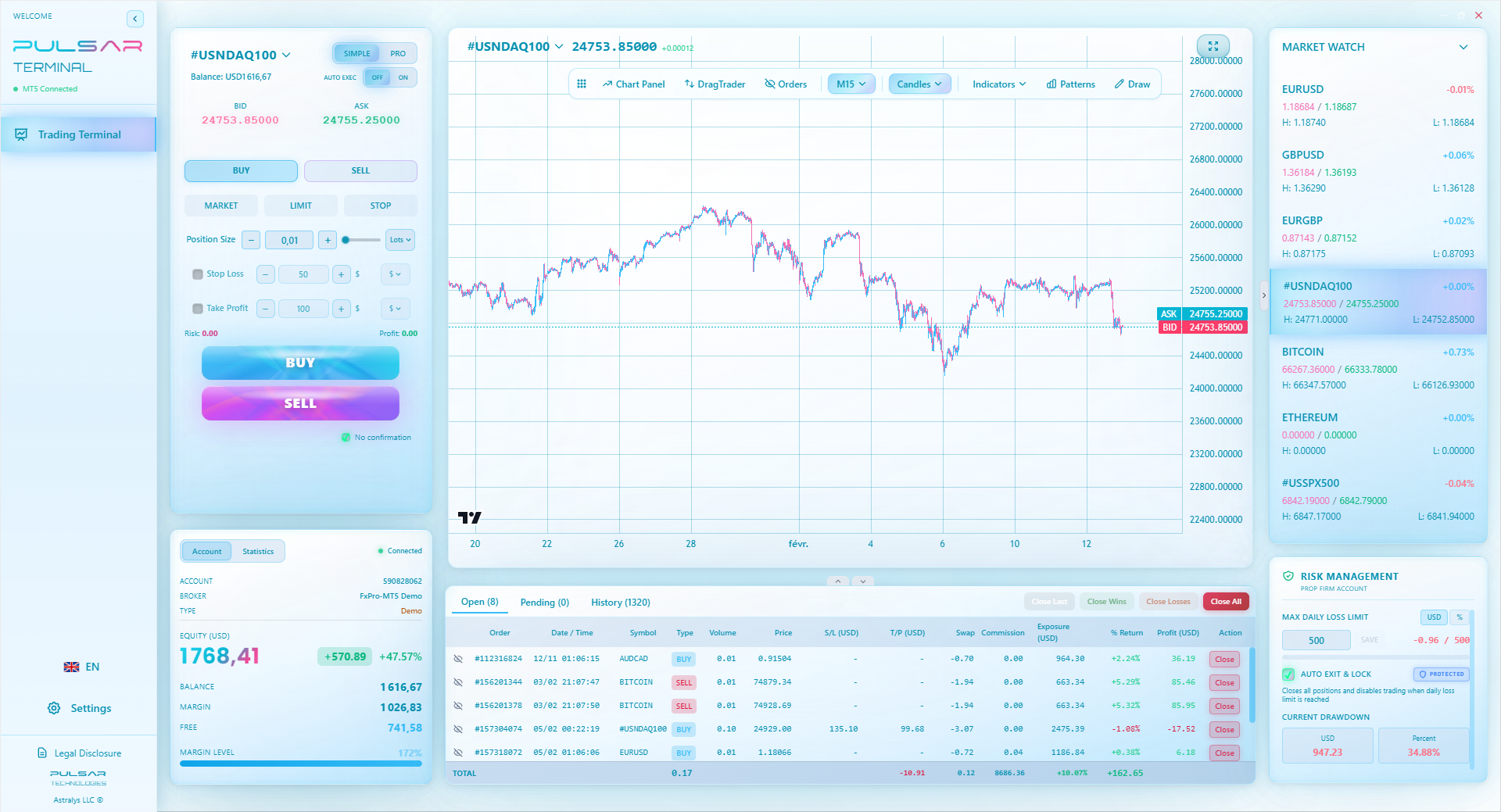
Managing a live account with strict prop firm rules or complex multi-trade strategies is nearly impossible manually, which is why tools like Pulsar Terminal that automate risk and order management on MT5 are essential.
Pulsar Terminal
A ferramenta MT5 tudo-em-um: ordens drag-and-drop, multi-TP/SL, trailing stop, grid trading, Volume Profile e proteção prop firm. Usado diariamente por 1.000+ traders.
“A Naira-denominated account removes a layer of mental conversion fog that clouds your trading decisions.”
Let's not kid ourselves: many traders ignore this. But if you start making consistent money, you need a system. The FIRS wants 10% of your net capital gains (your total profits minus total losses over a year).
How do you track this?
- Monthly Statements: Your broker provides these. Download them every single month.
- Simple Spreadsheet: Create a sheet with columns for Date, Profit/Loss (in Naira), Cumulative Total. Convert each trade's P&L to Naira using the exchange rate on the day it was closed. Yes, it's tedious. Do it anyway.
- Separate Bank Account: Consider having a separate bank account for trading funds and profits. It makes tracking inflows and outflows crystal clear for tax purposes.
I'm not a tax advisor, but I can tell you that having clean records from day one saves monumental headaches later. The first year I made significant profits, I spent a weekend reconstructing my trades from broker statements. Never again. Now, my spreadsheet updates automatically.
The bottom line: Treat your forex trading account like a serious business from the start. That includes planning for the taxman.
💡 Dica do Winston
Pick one major pair, like EUR/USD, and trade only that for your first six months. Learn its personality, its average daily range. Mastery of one instrument is infinitely more profitable than confusion across ten.
“The first year I made significant profits, I spent a weekend reconstructing my trades from broker statements. Never again.”
Your journey doesn't stop with a funded live account. Here's the progression I see with successful traders:
Phase 1: Demo Mastery. Don't just mess around. Use the demo to test a specific strategy with strict rules. Aim for 3 consecutive months of simulated profit. This builds habit, not just hope.
Phase 2: Live Micro-Account. Fund the minimum. Your goal here is not to get rich. Your goal is to execute your plan under real emotional pressure and to test funding/withdrawals. Risk 0.5% per trade.
Phase 3: Scaling Up. Only add more capital to your live account after you've doubled your initial micro deposit through trading profits, not by depositing more. This proves your edge.
Phase 4: The Prop Firm Path. This is a popular route in Nigeria. Firms like FTMO or The5%ers give you a funded account (e.g., $100,000) if you pass their trading challenge. You keep most of the profits. The catch? Their rules are brutal - strict daily loss limits and drawdown rules. This is where advanced account management tools become essential. You need iron-clad discipline, often enforced by software that can automate your risk rules.
Passing a prop firm challenge is the ultimate test of your trading system and account management skills. It forces a level of professionalism a personal account sometimes can't.
FAQ
Q1Is forex trading legal in Nigeria?
Yes, forex trading is legal for individuals in Nigeria. However, there are no specific regulations yet for the online retail forex market. The CBN prohibits using the official forex window to fund trading accounts. Most Nigerian traders legally use internationally regulated brokers.
Q2What is the minimum amount I need to open a forex trading account in Nigeria?
It varies by broker. You can start with as little as $5 (about 7,000 Naira) with brokers like XM, or with a few thousand Naira with brokers offering Naira accounts like HFM. I recommend starting with the broker's minimum to test the platform and withdrawal process first.
Q3How do I fund my forex account from Nigeria?
Common methods include direct local bank transfers (in Naira), Visa/Mastercard debit cards, e-wallets like Skrill, and cryptocurrencies like USDT. The broker's payment processor handles the conversion from Naira to USD for your trading balance.
Q4Do I pay tax on my forex trading profits in Nigeria?
Yes. Profits from forex trading are subject to a 10% Capital Gains Tax, which should be declared to the Federal Inland Revenue Service (FIRS). It's crucial to keep detailed records of all your trades for this purpose.
Q5Should I choose a Naira or USD-denominated trading account?
It depends on your psychology. A Naira-denominated account (offered by Exness, HFM) lets you see your balance in your home currency, reducing mental conversion stress. A USD account is more universal. Try both on demo to see which one helps you stick to your risk management rules better.
Q6What use should I use as a beginner?
Use the lowest use your broker allows, or self-impose a limit of no more than 1:30. High use (1:500, 1:1000) is the fastest way to blow up a small account. It magnifies losses just as much as it magnifies gains.
Q7Which trading platform is best for Nigerian traders?
MetaTrader 4 (MT4) and MetaTrader 5 (MT5) are by far the most popular and widely supported by brokers serving Nigeria. They are stable, have countless indicators, and a familiar interface. Stick with these for maximum compatibility and community support.
Lição do Prof. Winston
Pontos-chave:
- ✓Start with a broker's minimum deposit; it's a test drive.
- ✓Never use use above 1:30 as a beginner.
- ✓10% Capital Gains Tax applies to your net profits.
- ✓Fund your account via card, transfer, or crypto, NOT the CBN window.
- ✓Risk a maximum of 1% of your account on any single trade.
Quão útil foi este artigo?
Clique em uma estrela
Insights de Trading Semanal
Análises e estratégias semanais grátis. Sem spam.
Sobre o autor
Olumide Adeyemi
Pioneiro do Trading na África Ocidental
Um dos educadores de trading forex mais ativos da Nigéria. 8 anos de experiência operando a partir de Lagos. Especialista em estratégias de baixo capital e desafios de prop firms para traders africanos.
Comentários
Aviso de risco
A negociação de instrumentos financeiros envolve riscos significativos e pode não ser adequada para todos os investidores. O desempenho passado não garante resultados futuros. Este conteúdo é apenas para fins educacionais e não deve ser considerado aconselhamento de investimento. Sempre conduza sua própria pesquisa antes de negociar.
Você também pode gostar

Cara Trading Forex Sukses: 7 Prinsip dari Trader Profesional
Cara trading forex sukses dengan 7 prinsip trader pro: manajemen modal, disiplin, journal trading, backtest. Data nyata, bukan janji profit palsu.
Jam Trading Forex Terbaik untuk Trader Indonesia: Panduan Lengkap dengan Tabel Waktu
Panduan jam trading forex untuk trader Indonesia. Tabel 4 sesi dunia, jam emas 20:00-00:00, sesi mana yang harus dihindari. Data akurat + tips dari trader berpengalaman.
Top 5 Sàn Forex Uy Tín Nhất 2026: Review Jujur dari Trader Indonesia
Top 5 sàn forex uy tín 2026 untuk trader Indonesia. Review jujur: spread, deposit, withdraw, dukungan lokal. Exness, XM, IC Markets & lebih.
Obter Pulsar Terminal
Todas essas calculadoras estão integradas ao Pulsar Terminal com dados em tempo real da sua conta MT5.
Obter Pulsar Terminal