


Let's be brutally honest: most 'forex trading coaches' in Sandton are selling you a dream, not a skill.

David van der Merwe
Trader de Mercados Emergentes ·  South Africa
☕ 10 min de leitura
O que você vai aprender:
- 1The Sandton Forex Scene: A Reality Check
- 2What a Real Coach Actually Does (Vs. What You'll Probably Get)
- 3Costs in Rand and Cents: What You Should Actually Pay
- 4How to Vet a South African Coach: The FSCA Isn't Enough
- 5The DIY Path: How to Be Your Own Best Coach First
- 6When to Walk Away: Unmistakable Red Flags
- 7The Right Reasons to Hire a Coach (And What You'll Gain)
Let's be brutally honest: most 'forex trading coaches' in Sandton are selling you a dream, not a skill. They're often failed traders who found it more profitable to teach than to trade. I've seen it too many times - a slick website, promises of 'secret strategies,' and a price tag that would make a hedge fund manager blush. But here's the thing: real mentorship exists, and it can be the difference between blowing your account and building real wealth. I'm going to prove it by showing you exactly what separates the charlatans from the genuine guides, how to vet them using local regulations, and what you should realistically expect to pay and learn.
Sandton's the financial heart of South Africa, right? All those glass towers scream money and success. It's the perfect backdrop for a forex trading coach to set up shop and look legit. The problem is, the address doesn't make the trader. I've met 'coaches' with offices overlooking Nelson Mandela Square who couldn't explain a simple margin call to save their lives. They're salespeople, not traders.
The local market has its quirks. You're trading from South Africa, which means dealing with the Rand, specific tax rules from SARS, and the FSCA's 30:1 use cap for retail clients. A good coach needs to understand this environment, not just generic YouTube strategies. They should be able to talk about the real cost of converting ZAR to USD to fund an international broker account, or the implications of trading ZAR pairs. If your potential forex trading coach in Sandton can't discuss the practicalities of the South African spread on USD/ZAR during local market hours, walk away.

Warning: A fancy Sandton address is a marketing cost, not a qualification. I once paid R25,000 for a 'premium' mentorship with a guy based in one of those towers. His 'proprietary system' was just a poorly explained moving average crossover. The office rent was built into my fee.
“A Sandton address is a marketing cost, not a trading qualification.”
Let's define the job. A real trading coach doesn't give you a 'holy grail' indicator. Their primary function is to be your external prefrontal cortex - the part of your brain that manages risk and emotion, which shuts down when real money is on the line.
The Hallmarks of a Real Mentor
A genuine guide focuses on process, not predictions. They'll work with you to build a complete trading plan: entry rules, exit rules, position sizing, and daily routines. They'll then hold you accountable to it. The best session I ever had with a mentor wasn't about a trade setup; it was when he made me review every losing trade from the past month and categorize the reason for the loss. Was it a bad plan? Or did I deviate from a good plan? That exercise alone cut my reckless trades by 70%.
The Red Flags of a Fake
What you'll often get instead is a signal service in disguise. They'll message you 'BUY EUR/USD NOW' without context. This is worse than useless - it teaches you dependency. Another classic is the 'one-size-fits-all' strategy sale. Markets change. A strategy that worked in a ranging market will destroy you in a trending one. A real coach teaches you how to adapt, not just how to follow.
They should also be transparent about their own trading. They don't need to show you their live account balance (that can be faked too), but they should be able to walk you through their thought process on a recent trade, win or loss. If they only ever show you cherry-picked winners, they're selling a fantasy.

Pro Tip: Ask a potential coach this: 'What is your process for helping a student identify their specific psychological weaknesses?' If they can't give a concrete answer beyond 'we build discipline,' they haven't done the real work.

💡 Dica do Winston
A coach's most valuable tool isn't a strategy document; it's their ability to ask you the one question you've been avoiding about your own trading.
“You're not paying for predictions; you're paying for a better process.”
This is where people get robbed. I've seen 'mastermind' programs in Johannesburg advertised for over R100,000. It's insane. You don't need to take out a loan to learn how to trade.
Based on the market, here's a realistic breakdown:
- Group Courses/Webinars: R1,500 – R10,000. These are for basic education. You're learning concepts, not getting personalized mentorship. Fine for absolute beginners, but you're on your own afterward.
- 1-on-1 Coaching Packages: This is the real mentorship tier. A legitimate, experienced coach charging for their dedicated time might range from R15,000 to R50,000 for a multi-month program (e.g., 3-6 months). This should include regular review sessions, trade analysis, and direct access for questions.
- The 'Signal Guru' Trap: Often priced between R500 – R5,000 per month. You're not paying for education; you're renting their attention span. The moment they stop performing, you leave. This builds zero skill of your own.
Let's talk numbers. If you're a beginner with a R10,000 account, paying R30,000 for a coach is absurd. Your priority should be preserving capital, not buying elite training. First, learn the basics yourself (what a pip is, how use works), trade a demo, then consider coaching when you have consistent capital and hit a specific plateau. I made the mistake of hiring an expensive coach before I even knew how to use a position size calculator. I wasted his time and my money.

Example: Say a coach charges R30,000 for 3 months. That's R10,000 per month. If your trading account is only R20,000, you'd need a 50% monthly return just to pay for the coaching. That's not a realistic or sustainable expectation. Get your account size right first.
“You're not paying for predictions; you're paying for a better process.”
Here's a common misconception: 'I'll only use a coach who is FSCA-licensed.' The FSCA regulates financial service providers (brokers, advisors). An individual trading coach is not necessarily providing a financial service as defined by the FAIS Act, unless they're giving specific, ongoing advice on financial products. Many operate in a grey area. So, an FSCA license might not be present, and its absence isn't an automatic red flag.
The vetting needs to be more rigorous. You need to become a detective.
- Ask for Verifiable Track Record: Not a MyFxBook link (easily manipulated). Ask if they have audited statements from a prop firm challenge, or if they trade with a local broker like Khwezi Trade where statements are straightforward. A genuine coach might show a broker statement (with personal details blurred) to demonstrate consistency.
- Interview Their Former Students: Any legitimate coach should have testimonials, but go further. Ask if you can speak to one or two past students directly. A real student will give you a balanced view - what they liked, what was tough, what they actually learned.
- Analyze Their Public Content: Do they teach solid concepts like risk management and psychology, or do they just flash luxury cars and talk about 'the mindset of abundance'? A good forex trading coach in Sandton should have free content (blogs, videos) that proves they know their stuff before you ever pay them.
- Check for Conflict of Interest: Do they get a kickback for signing you up with a specific broker? This is a major red flag. Their advice should be broker-agnostic, steering you toward reputable, well-regulated firms like IC Markets or Pepperstone based on your needs, not their affiliate commission.
💡 Dica do Winston
The cost of a bad coach isn't just the fee. It's the months of reinforced bad habits and shattered confidence you'll have to unlearn later.
“The internet teaches you what to do. A coach tells you why you didn't do it.”
Before you spend a single rand on a forex trading coach in Sandton, you need to coach yourself. This is non-negotiable. You can't outsource the foundational work.
Start with a trading journal. And I don't mean 'bought EUR/USD, won R200.' I mean a brutal, detailed log. Entry price, exit price, position size, the chart setup (attach a screenshot), your emotional state ('felt FOMO after two losing days'), and the reason for the trade according to your plan. Review this weekly. This single habit will teach you more about yourself than 90% of coaches ever could.
Next, build your own basic strategy. Pick one major pair like EUR/USD and one simple indicator like the RSI indicator. Paper trade it for a month. Define everything: Where do you enter (e.g., RSI below 30 and crossing up)? Where is your stop loss (e.g., recent swing low)? Where is your take profit (e.g., 1.5x your risk)? Use a position size calculator for every single simulated trade.
Only after you have 100+ journal entries and a tested, paper-traded plan should you even think about hiring someone. Then, you're not a clueless beginner seeking magic. You're a practitioner seeking to refine your craft. You can ask specific questions: 'My plan works in trends but fails in ranges, how can I adapt it?' or 'I keep moving my stop loss, how do I stop?' This turns a coach from a storyteller into a precision tool.
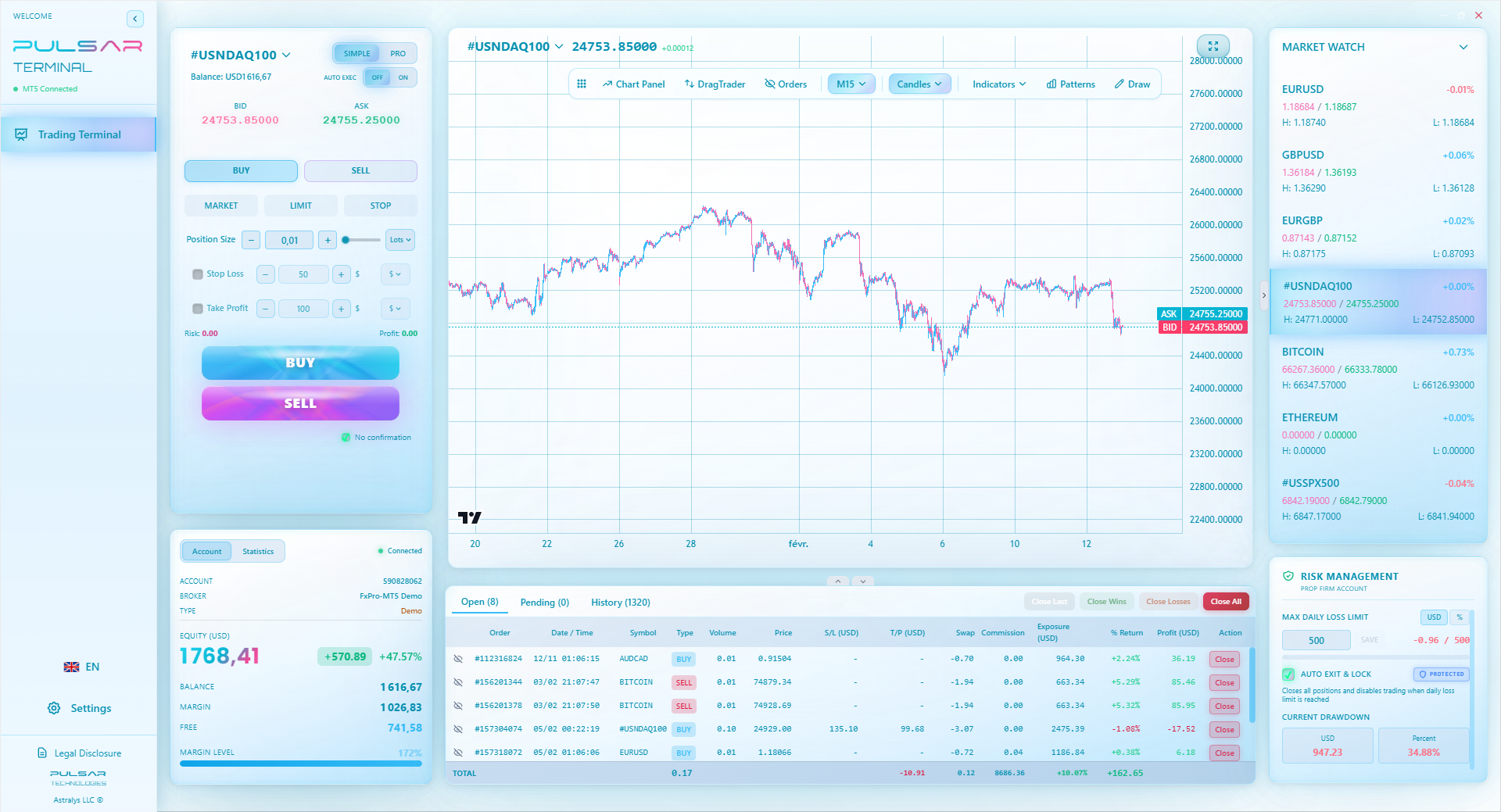
This is where technology can act as a 'system coach.' Using a tool like Pulsar Terminal on MT5 can enforce the discipline you lack. You can pre-set your multi-level take-profits and stop-losses on the chart, and the tool will execute the plan mechanically, removing your emotional fingers from the button.
Building trading discipline is hard, but tools like Pulsar Terminal can automate your plan's rules on MT5, acting as a 24/7 system coach that never gets emotional.
Pulsar Terminal
A ferramenta MT5 tudo-em-um: ordens drag-and-drop, multi-TP/SL, trailing stop, grid trading, Volume Profile e proteção prop firm. Usado diariamente por 1.000+ traders.
“The internet teaches you what to do. A coach tells you why you didn't do it.”
Your B.S. detector needs to be on high alert. Here are the deal-breakers.
- Guaranteed Returns: If they promise any specific weekly or monthly return, run. This is illegal for a reason. Trading is probabilistic, not certain.
- The 'Copy My Trades' Model: This isn't coaching. It's parasitism. You learn nothing, and your financial survival is tied to their ongoing performance.
- Focus on Luxury Lifestyle: The Lamborghini profile pic, the private jet shots. This is marketing 101 to attract greed, not students seeking skill. I've never met a serious full-time trader who has time for all those photoshoots.
- No Discussion of Risk or Losses: If every conversation is about winning, they're not preparing you for reality. A real coach spends as much time on loss management and drawdowns as they do on entries.
- Pressure to Deposit More Money: A coach's job is to make you a better trader, not to increase your broker's assets under management. If they're pushing you to fund a larger account before you're consistently profitable on a small one, their incentives are misaligned.
Have an exit strategy for the mentorship itself. Agree on a trial period or a set number of sessions before the full package. If after 4 sessions you're just getting generic advice you could find on Google, you need a clause that lets you walk away without paying for the whole program. Any coach confident in their value will offer this.
💡 Dica do Winston
Your trading journal is your first coach. If you won't listen to what it's telling you, you're not ready to pay someone else to talk.
“Hire a coach when you have a plan, not when you want one.”
So when does it make sense? When you're stuck. You've done the self-work, you have a journal, a plan, and you've demo-traded it. But you keep hitting the same wall.
Maybe you're profitable but your wins are tiny and your losses are huge - a classic risk-reward problem. A good coach will spot that in your journal and drill into your exit strategy. Perhaps you're great at scalping but panic during swing trading setups. A coach can help you build the patience or adjust your timeframe.
The real gain is acceleration. What might take you two years of painful trial and error to figure out on your own, a good mentor can help you compress into six months. They provide accountability, an experienced eye to spot your blind spots, and, crucially, emotional support during the inevitable losing streaks. They've been there. They can tell you, 'This is normal, stick to your plan,' which is worth its weight in gold when you're doubting everything.
I hired my first real mentor after a brutal 8-month drawdown. I was following my plan, but it had stopped working. For R18,000 over three months, he didn't give me a new plan. He helped me analyze the changed market volatility and adjust my position sizing and stop-loss distances accordingly. He saved me from blowing up, and that fee was a fraction of what I would have lost.
FAQ
Q1Is it legal to hire a forex trading coach in South Africa?
Yes, it's perfectly legal. However, the coach themselves may not be a regulated financial advisor unless they are providing specific, ongoing advice on products. The key is that they are teaching a skill (trading), not managing your money or giving you regulated financial advice. Always ensure they are not promising regulated outcomes like guaranteed returns.
Q2What's a fair price for a good forex trading coach in Sandton?
For genuine, personalized 1-on-1 mentorship from a proven trader, expect to pay between R15,000 and R50,000 for a complete program spanning 3-6 months. Anything significantly higher should come with extraordinary, verifiable proof of value. Anything much lower, especially monthly subscriptions under R2,000, is often just a signal service or very basic group content.
Q3Can't I just learn everything from free resources online?
You can learn the mechanics and theory for free, absolutely. What you can't get for free is personalized feedback on your specific mistakes and psychology. The internet won't look at your trade journal and say, 'You're entering too early because you're afraid of missing the move - wait for this confirmation.' That tailored insight is what you pay for.
Q4Should my coach be a profitable trader?
This is non-negotiable. Would you take swimming lessons from someone who can't swim? You need verifiable evidence, not just claims. Ask for broker statements (with private info redacted) or proof of passing reputable prop firm challenges. Be deeply skeptical of anyone who can't or won't provide some form of proof.
Q5What's the first thing I should do before contacting a coach?
Trade. Seriously. Start a demo account, develop a simple plan, and keep a detailed journal for at least 2-3 months. This does two things: it filters out the coaches who prey on total beginners, and it allows you to ask intelligent, specific questions that will get you real value from a mentor's time.
Q6How do I know if the coaching is working?
You shouldn't measure it by your P&L in the first month. Measure it by your process. Are you journaling consistently? Is your pre-trade checklist becoming automatic? Are you deviating from your plan less often? Improved discipline and consistency are the leading indicators. Profitable trades are the lagging result.
Lição do Prof. Winston
Pontos-chave:
- ✓Vet coaches on process teaching, not profit promises.
- ✓Spend less than 10% of your trading capital on initial education.
- ✓Require a verifiable track record, not just testimonials.
- ✓Master a demo journal before seeking paid mentorship.
Quão útil foi este artigo?
Clique em uma estrela
Insights de Trading Semanal
Análises e estratégias semanais grátis. Sem spam.
Sobre o autor
David van der Merwe
Trader de Mercados Emergentes
Trader sediado em Joanesburgo com 11 anos em moedas de mercados emergentes. Especialista em pares ZAR, trading regulado pela FSCA e análise do mercado sul-africano.
Comentários
Aviso de risco
A negociação de instrumentos financeiros envolve riscos significativos e pode não ser adequada para todos os investidores. O desempenho passado não garante resultados futuros. Este conteúdo é apenas para fins educacionais e não deve ser considerado aconselhamento de investimento. Sempre conduza sua própria pesquisa antes de negociar.
Você também pode gostar

Cara Trading Forex Sukses: 7 Prinsip dari Trader Profesional
Cara trading forex sukses dengan 7 prinsip trader pro: manajemen modal, disiplin, journal trading, backtest. Data nyata, bukan janji profit palsu.
Jam Trading Forex Terbaik untuk Trader Indonesia: Panduan Lengkap dengan Tabel Waktu
Panduan jam trading forex untuk trader Indonesia. Tabel 4 sesi dunia, jam emas 20:00-00:00, sesi mana yang harus dihindari. Data akurat + tips dari trader berpengalaman.
Top 5 Sàn Forex Uy Tín Nhất 2026: Review Jujur dari Trader Indonesia
Top 5 sàn forex uy tín 2026 untuk trader Indonesia. Review jujur: spread, deposit, withdraw, dukungan lokal. Exness, XM, IC Markets & lebih.
Obter Pulsar Terminal
Todas essas calculadoras estão integradas ao Pulsar Terminal com dados em tempo real da sua conta MT5.
Obter Pulsar Terminal