


Let's cut through the biggest myth first: most of what you see advertised as 'forex trading' for Indians is illegal.

Rajesh Sharma
Analista Forex Sênior ·  India
India
☕ 10 min de leitura
O que você vai aprender:
- 1The Legal Minefield: What You Can Actually Trade in India
- 2The Three Islamic Deal-Breakers: Riba, Gharar, Maysir
- 3How to Structure Your Trading for Sharia Compliance
- 4Costs, Brokers, and the Reality of INR Trading
- 5Where Traders (Including Me) Go Wrong
- 6New RBI Rules (2026): What They Mean for You
- 7The Final Verdict & Your Action Plan

Let's cut through the biggest myth first: most of what you see advertised as 'forex trading' for Indians is illegal. I've seen too many students get excited about trading EUR/USD on some slick offshore platform, only to realize they're breaking the law and potentially violating their faith. The question of forex trading halal or haram isn't just about swap fees; it starts with whether you're even allowed to do it. I'll walk you through the exact legal framework, the Sharia principles that matter, and how to operate within both. Forget the hype, this is the reality check.
Right off the bat, you need to understand this: as an Indian resident, your forex trading world is defined by the Foreign Exchange Management Act (FEMA). It's not a suggestion, it's the law. Trading the popular majors like EUR/USD or GBP/USD through an international broker? That's prohibited. Full stop. The RBI has an 'Alert List' of unauthorized entities, and getting caught can mean fines up to three times your transaction amount. I'm not trying to scare you, I'm telling you the stakes.
You are only permitted to trade currency pairs that include the Indian Rupee (INR) on SEBI-regulated exchanges like the NSE or BSE. Your menu is limited: USD/INR, EUR/INR, GBP/INR, JPY/INR. That's your playground. Platforms like Zerodha Kite or Upstox Pro are your gateways, not MetaTrader with some offshore broker. Even the Liberalised Remittance Scheme (LRS), which lets you send $250,000 abroad, explicitly bans using that money for speculative forex or margin trading.

Warning: Using an international broker like Exness or Pepperstone to trade non-INR pairs from India violates FEMA. You are risking legal penalties, not just trading losses. Your bank account is in India, and the authorities can trace it.
Why does this matter for the halal/haram discussion? Because engaging in an illegal activity (haram in itself) immediately taints everything else. You can't have a 'halal' trade on an illegal platform. Your first step towards Sharia compliance is legal compliance.

💡 Dica do Winston
A 'swap-free' account from an illegal broker is a halal sticker on a haram foundation. Legality comes first, always.

“The question of forex trading halal or haram isn't just about swap fees; it starts with whether you're even allowed to do it.”
Assuming you're trading legally on a SEBI platform, we now get to the core Islamic finance principles. You need to judge your activity against three big prohibitions.
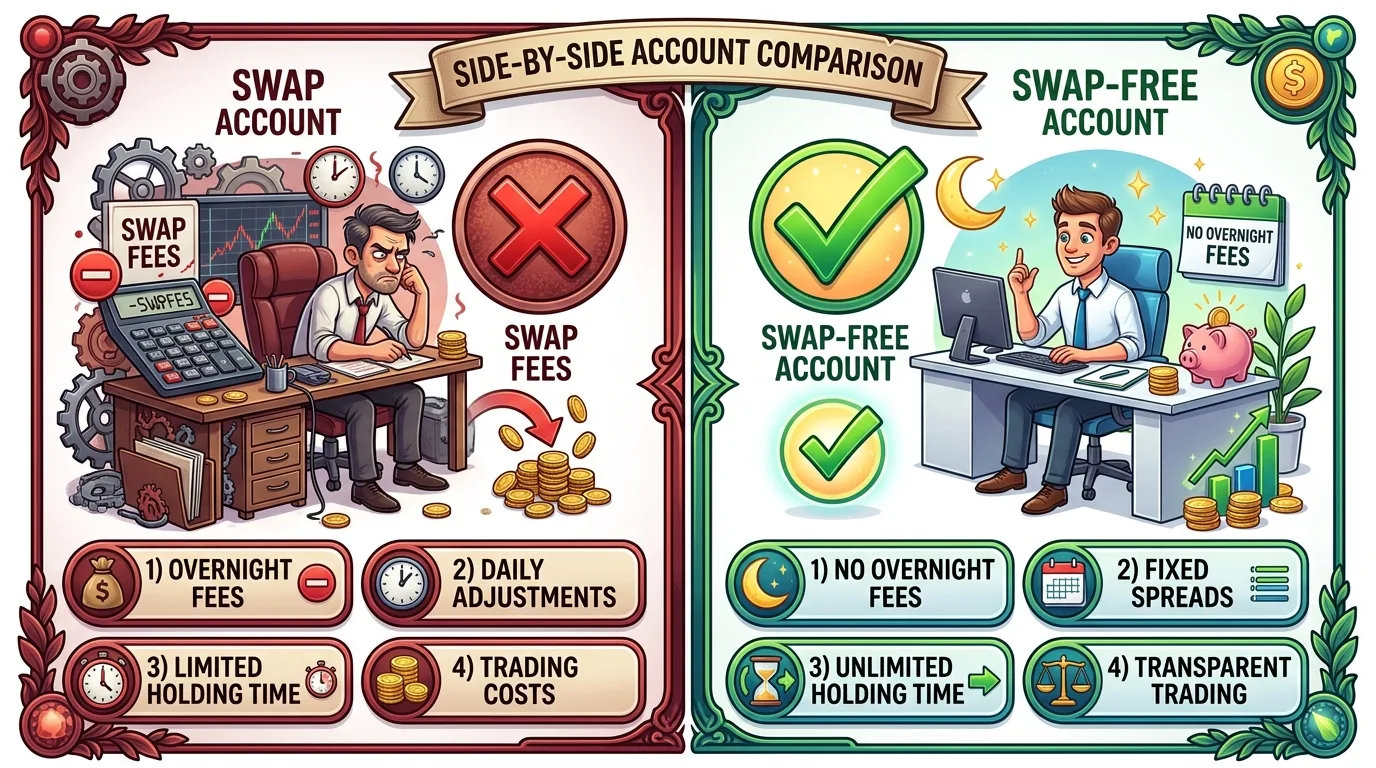
Riba (Interest): This is the most concrete one. In conventional forex, if you hold a position overnight, you pay or receive a swap fee (rollover interest). That's Riba. It's not a maybe; it's a direct interest charge based on the differential between the two currencies' interest rates. This makes most overnight position holding problematic.
Gharar (Excessive Uncertainty): This is about ambiguity and risk. Are you trading based on a wild guess or a proper analysis? Trading a highly volatile news event with massive use where the outcome is a coin toss could be considered Gharar. It's about the nature of the contract and the level of unknown.
Maysir (Gambling): This is where your intent and method matter. Are you placing trades like you're buying a lottery ticket? Clicking buttons based on a 'feeling' or a random signal from a Telegram group? That's speculation that borders on gambling. Trading based on technical or fundamental analysis, with defined risk (using a stop-loss), is seen as a commercial enterprise, not Maysir.
The use Problem
Here's a personal lesson. Early on, I used the maximum use available on an INR futures contract. It was something like 20:1. I put on a trade that was way too big for my account, convinced by a 'sure thing' setup. A tiny move against me wiped out a significant chunk of my capital. The anxiety was immense. That kind of excessive, disproportionate risk-taking? Many scholars would argue it injects Gharar and Maysir into the trade. You're not just trading; you're betting the farm. Managing your position size calculator religiously is not just good practice, it's a spiritual discipline.

“An illegal activity cannot be made halal. Your first obligation is to the law of the land.”
So, is it possible? Can you trade forex in a halal manner from India? The answer is a cautious 'yes', but it requires a specific framework. You have to build constraints around your trading.
First, the Riba problem. On Indian exchanges, you're trading futures and options contracts, not the spot forex you see internationally. These contracts have an expiry date. There's no overnight 'swap' charge in the same way. However, the pricing of the futures contract inherently includes interest rate expectations (this is called 'cost of carry'). Some scholars accept this as a market price factor, not direct Riba, while others remain cautious. You must seek your own qualified guidance on this precise point.
To avoid Gharar and Maysir, your entire process needs rigor.
- Trade with a Plan: Every entry must have a reasoned basis. Are you using support/resistance? A MACD indicator crossover? A fundamental view on RBI policy? Write it down.
- Define Risk Before Entry: Always, always set a stop-loss. Knowing your maximum loss upfront removes ambiguity. This is non-negotiable.
- Avoid Scrambled Mind Trades: Don't trade when emotional, tired, or chasing losses. That's when it becomes gambling.
- Consider Timeframes: Some argue that very short-term scalping strategy resembles gambling more than longer-term swing trading based on broader trends. Reflect on your method.

Pro Tip: Treat your trading capital as 'amanah' (a trust). You are its custodian, not its owner. This mindset shift alone will force you into better risk management. Every trade is a responsible business decision, not a punt.
A real example from my logs: I took a short on USD/INR futures at 83.40, anticipating RBI intervention. My stop was at 83.60 (20 paise risk). My target was 83.00. I based it on chart structure and news flow. I held for three days and exited at 83.10. The profit wasn't massive, but the process was clear, defined, and low on 'unknowns'. That's the model.
💡 Dica do Winston
If you can't write down your reason for a trade in one clear sentence, it's not analysis. It's a guess. That's the doorstep of Maysir.
“An illegal activity cannot be made halal. Your first obligation is to the law of the land.”
Let's talk numbers, because dreams die on the rocks of transaction costs. You're not trading zero-spread EUR/USD here. The economics are different.
Brokerage: On platforms like Zerodha, you might pay a flat ₹20 per executed order for intraday currency trades. Upstox has similar structures. This is transparent and, in Islamic finance terms, a permissible service fee.
Other Charges: You pay Exchange Transaction Charges (say, ₹0.05 per lakh for futures), GST (18% on brokerage), and SEBI charges. These add up. On a ₹1,00,000 position, your total cost to enter and exit might be around ₹50-70. That means the market needs to move in your favor by at least that amount just to break even.
Minimum Capital: You can start small. Some brokers allow you to start with just ₹500-1000. But be realistic. With a minimum contract size for USD/INR futures being $1000 (roughly ₹83,000 notional), your margin required might be around ₹5,000-8,000. Don't trade with money you can't afford to lose.
| Aspect | International (Illegal for INR Pairs) | SEBI-Regulated (Legal) |
|---|---|---|
| Example Pairs | EUR/USD, GBP/USD, XAU/USD | USD/INR, EUR/INR, GBP/INR |
| Typical Spread | As low as 0.0 pips + commission | Built into futures price; broker fee per order |
| Overnight Swap | Yes (Riba concern) | No, but priced into futures contract |
| Platform | MT4, MT5, cTrader | Zerodha Kite, Upstox Pro, proprietary |
| Legal Risk | High (FEMA violation) | None if using authorized broker |
The key takeaway? Your spread definition and cost structure is completely different. Your analysis must account for this. A 10-pip move on USD/INR is significant. You're not scalping for 2-3 pips here.
“A swap-free account doesn't make a losing strategy halal. It's like putting a 'halal' sticker on a casino chip.”
I've messed this up. You probably will too. But learn from these mistakes instead of paying for them.
Pitfall 1: The Offshore Lure. The marketing is relentless. 'Trade Gold with 500:1 use!' It's illegal for you. The platform might even offer an 'Islamic account' with no swap. Doesn't matter. The foundation is illegal. I know a trader who built a $5,000 account on an offshore broker, only to have his withdrawals frozen and face a tough tax notice. The stress made him quit trading altogether.
Pitfall 2: Confusing Halal with 'Easy'. A swap-free account doesn't make a losing strategy halal. If your method is pure gambling, removing swap fees is like putting a 'halal' sticker on a casino chip. The core activity is still Maysir.
Pitfall 3: Ignoring the 'Why'. Why are you trading? Is it to provide for your family through skilled effort? Or is it to get rich quick? Your intention (niyyah) matters. Trading to chase luxury cars is a different spiritual space than trading to secure your children's education. Check your heart.
Pitfall 4: No Risk Management. This is the ultimate failure. I once didn't set a stop-loss on a GBP/INR trade, thinking 'it'll come back'. It didn't. I watched a 0.5% loss turn into a 5% loss, violating every principle of defined risk (Gharar) and disciplined business. I was gambling, not trading. I was lucky to avoid a margin call.
Your trading journal should audit not just profits, but your adherence to your own ethical and risk rules. Did you follow your plan? Was your risk predefined? If not, the trade was a failure even if it made money.
💡 Dica do Winston
Your biggest threat isn't a losing trade; it's a winning trade made with poor discipline. It rewards the wrong behavior.
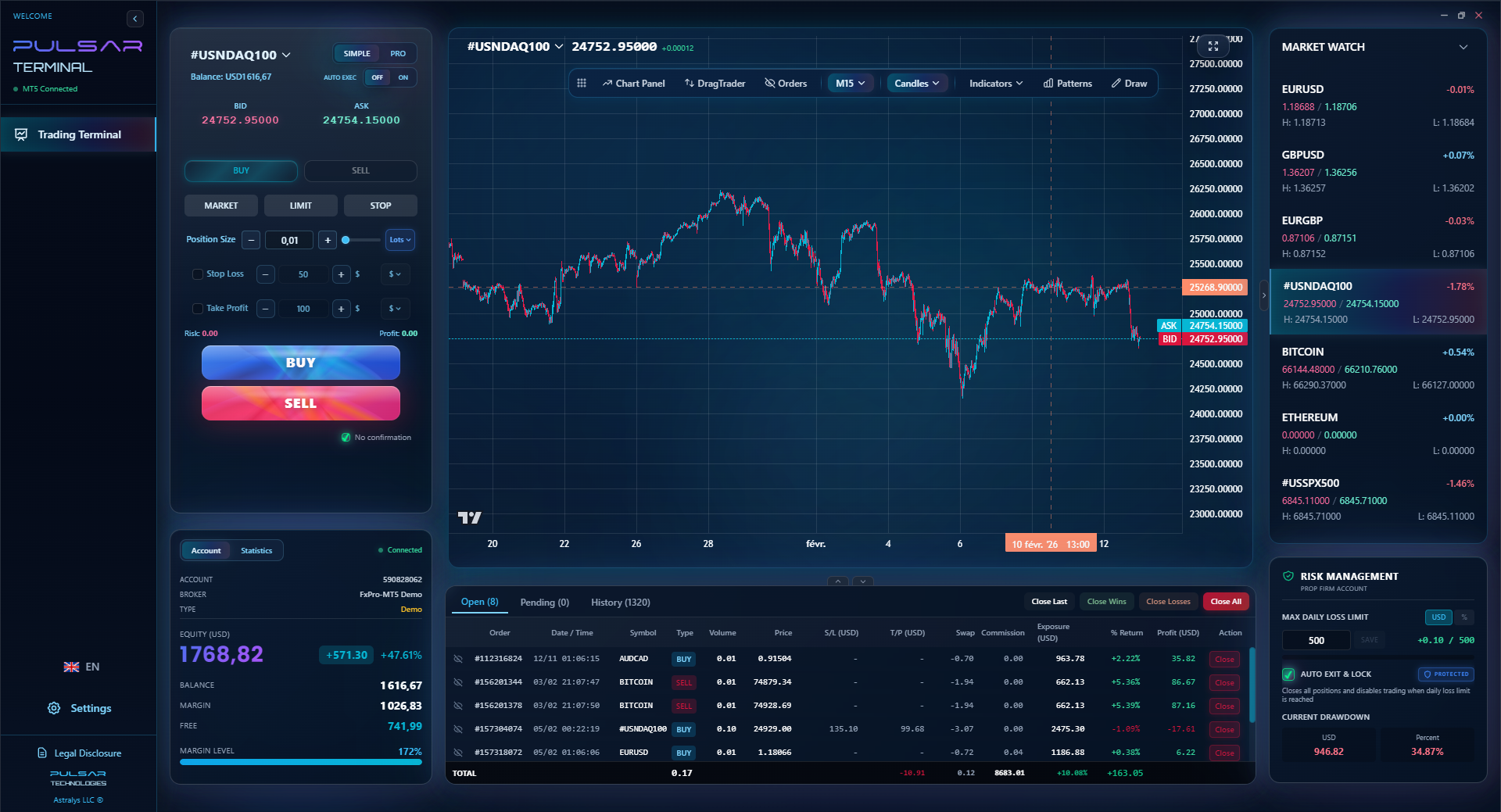
When your trading plan depends on strict risk rules like stop-losses and partial closures, a tool like Pulsar Terminal lets you automate and manage those orders directly on your MT5 charts without hesitation.
Pulsar Terminal
A ferramenta MT5 tudo-em-um: ordens drag-and-drop, multi-TP/SL, trailing stop, grid trading, Volume Profile e proteção prop firm. Usado diariamente por 1.000+ traders.
“A swap-free account doesn't make a losing strategy halal. It's like putting a 'halal' sticker on a casino chip.”
The landscape is tightening. The RBI's new norms effective from April 2026 are a game-changer for the institutional market, and they ripple down to you.
They've banned banks from offering certain non-deliverable forward (NDF) contracts involving the rupee to curb speculation. More crucially, they've forced banks to drastically reduce their net open rupee positions in the market. This means less liquidity and potentially sharper, more volatile moves in the INR pairs you trade.
What this means for your trading:
- Expect More Gaps: With reduced liquidity from big banks, the market might be more prone to gaps, especially around news events or RBI interventions. Your stop-loss orders might get filled at worse prices than you set.
- Respect the RBI: The central bank is clearly in a defensive mood about rupee volatility. Trading against clear RBI policy statements or suspected intervention levels is now even more dangerous. It's not just bad analysis; it's ignoring the biggest player in the market.
- Focus on Quality: This environment punishes sloppy trading. It rewards patience and high-probability setups. The days of placing a dozen trades a day profitably are likely over. It demands a more strategic, swing trading oriented approach based on clearer trends.
The regulatory evolution is making the Indian forex market more transparent but also more challenging for the retail speculator. Your edge must come from discipline and analysis, not use or frequency.

“Your trading capital is 'amanah' (a trust). You are its custodian, not its owner.”
So, is forex trading halal or haram in India? It's a spectrum, not a binary yes/no. Here’s your actionable path to stay on the permissible side.
Step 1: Legality First. Open an account only with a SEBI-regulated broker (Zerodha, Upstox, etc.). Trade only INR pairs. This is your non-negotiable base.
Step 2: Eliminate Riba Concerns. Since you're trading futures/options on exchange, the direct swap charge isn't there. Consult a knowledgeable scholar on the permissibility of the 'cost of carry' pricing model. If uncomfortable, consider only intraday trades you close before market close, avoiding any overnight holding.
Step 3: Eradicate Gambling (Maysir). Develop a written trading plan with clear entry, stop-loss, and take-profit rules. Use a position size calculator for every single trade. Never risk more than 1-2% of your capital on a trade. Backtest your strategy.
Step 4: Reduce Uncertainty (Gharar). Trade only during liquid market hours. Avoid major news events if your strategy isn't built for them. Understand the pip definition and value for your specific INR contract.
Step 5: Continuous Audit. Regularly review your trades. Were they according to plan? Was your mindset one of a businessperson or a gambler? Be brutally honest.
Forex trading can be a halal business activity if conducted as a skilled, disciplined profession within the legal framework. It is haram if it's an illegal, interest-based, speculative gamble. The difference isn't in the market; it's in you, your method, and your intention. Choose wisely.
FAQ
Q1Can I use an international broker's Islamic account to trade halal forex from India?
No. The 'Islamic' or swap-free feature only addresses the Riba (interest) concern. Trading non-INR pairs (like EUR/USD) through any offshore broker violates Indian law (FEMA). An illegal activity cannot be made halal. Your first obligation is to the law of the land.
Q2Are there any halal forex trading platforms in India?
The concept is slightly misapplied. SEBI-regulated platforms like Zerodha Kite or Upstox Pro are the only legal platforms for retail forex trading in India. They offer INR-based currency derivatives. Whether your trading on them is halal depends on your specific actions - avoiding gambling-like behavior, using proper risk management, and consulting on the permissibility of futures contracts - not on the platform itself.
Q3What is the difference between swap charges on international brokers and charges on Indian platforms?
International brokers charge an overnight swap/rollover interest fee (Riba) if you hold a spot forex position past 5 PM EST. Indian exchanges don't have this fee for futures contracts. Instead, you pay a brokerage fee per trade (e.g., ₹20) plus statutory charges. The futures price itself factors in interest rate expectations, which is a different scholarly discussion.
Q4Is day trading currency futures on NSE considered halal?
It has a stronger case than overnight trading. By closing all positions before the market closes, you avoid any debate about overnight interest pricing. However, it is only halal if the day trading itself is done with a clear plan, defined risk (stop-loss), and analysis - not as random, high-use gambling. The method defines the permissibility.
Q5How much money do I need to start halal forex trading in India?
You can start with a small amount, say ₹5,000-10,000, as some brokers have low minimums. However, be practical. The margin for one USD/INR futures contract might require ₹5,000-8,000. Starting with only the minimum margin leaves no room for error. A safer start is ₹25,000-50,000, allowing you to trade small and manage risk properly without immediate pressure.
Q6Does high use make forex trading haram?
Excessive use significantly increases Gharar (uncertainty) and makes the activity resemble Maysir (gambling). Using 50:1 or 100:1 use means a tiny market move wipes you out or doubles your money - that's a bet, not a business. Using moderate use (like the 10:1-20:1 typical on Indian exchanges) as part of a disciplined risk management plan is viewed differently by scholars. The higher the use, the closer to haram it gets.
Lição do Prof. Winston
Pontos-chave:
- ✓Trade only SEBI-regulated INR pairs (USD/INR, EUR/INR).
- ✓Overnight swaps are Riba; Indian futures have different pricing.
- ✓Define risk with a stop-loss on EVERY trade.
- ✓Excessive use turns trading into gambling (Maysir).
- ✓Audit your intention: business provider or gambler?
Quão útil foi este artigo?
Clique em uma estrela
Insights de Trading Semanal
Análises e estratégias semanais grátis. Sem spam.
Sobre o autor
Rajesh Sharma
Analista Forex Sênior
Mais de 10 anos operando nos mercados indianos e do sul da Ásia. Começou com derivativos cambiais na NSE antes de migrar para o forex internacional. Especialista em USD/INR e pares de mercados emergentes.
Comentários
Aviso de risco
A negociação de instrumentos financeiros envolve riscos significativos e pode não ser adequada para todos os investidores. O desempenho passado não garante resultados futuros. Este conteúdo é apenas para fins educacionais e não deve ser considerado aconselhamento de investimento. Sempre conduza sua própria pesquisa antes de negociar.
Você também pode gostar

Cara Trading Forex Sukses: 7 Prinsip dari Trader Profesional
Cara trading forex sukses dengan 7 prinsip trader pro: manajemen modal, disiplin, journal trading, backtest. Data nyata, bukan janji profit palsu.
Jam Trading Forex Terbaik untuk Trader Indonesia: Panduan Lengkap dengan Tabel Waktu
Panduan jam trading forex untuk trader Indonesia. Tabel 4 sesi dunia, jam emas 20:00-00:00, sesi mana yang harus dihindari. Data akurat + tips dari trader berpengalaman.
Top 5 Sàn Forex Uy Tín Nhất 2026: Review Jujur dari Trader Indonesia
Top 5 sàn forex uy tín 2026 untuk trader Indonesia. Review jujur: spread, deposit, withdraw, dukungan lokal. Exness, XM, IC Markets & lebih.
Obter Pulsar Terminal
Todas essas calculadoras estão integradas ao Pulsar Terminal com dados em tempo real da sua conta MT5.
Obter Pulsar Terminal