


Let's get one thing straight: the dream of quitting your 9-to-5 to become a lone wolf forex trader from your bedroom is, for 99% of people in India, a fast track to losing your savings.
Rajesh Sharma
Analista Forex Sênior ·  India
India
☕ 11 min de leitura
O que você vai aprender:
- 1The Legal Landscape: What You Can Actually Trade
- 2Real Forex Jobs vs. Get-Rich-Quick Schemes
- 3The Skills You Actually Need (It's Not Just Trading)
- 4Realistic Salary Expectations & The Hidden Costs
- 5How to Start Building Your Career Today
- 6Common Pitfalls & Red Flags to Run From
- 7The Long-Term Path: What Success Actually Looks Like
Let's get one thing straight: the dream of quitting your 9-to-5 to become a lone wolf forex trader from your bedroom is, for 99% of people in India, a fast track to losing your savings. The ads sell freedom, but the reality is a maze of regulations, high risk, and fierce competition. But that doesn't mean there aren't real, legitimate forex trading jobs in India. You just have to know where to look and what skills actually matter. I've been on both sides of this - blowing up an account and later building a sustainable income. This guide cuts through the hype.
This is the most critical starting point, and most "gurus" gloss over it. In India, forex trading isn't a free-for-all. The Reserve Bank of India (RBI) and SEBI call the shots under FEMA (Foreign Exchange Management Act).
You are legally allowed to trade currency pairs, but only those that include the Indian Rupee (INR). Think USD/INR, EUR/INR, GBP/INR, and JPY/INR. You must trade these on recognized Indian exchanges like the NSE, BSE, or MSE through a SEBI-regulated broker like Zerodha or Upstox.
What's off-limits? Trading major global pairs like EUR/USD or GBP/JPY through offshore, international brokers. Technically, it's prohibited. The RBI publishes an "Alert List" of unauthorized platforms. Now, I'll be honest: a huge number of Indian traders still use brokers like Exness or IC Markets to access these pairs. They operate in a grey area. I did it for years. But you need to understand the risk: your funds aren't protected by Indian law, and in a worst-case scenario, you could face penalties.

Warning: If you're considering a career in this, starting on the wrong side of the law is a terrible foundation. Understanding and respecting the regulatory framework is Job #1 for any professional.
Why The Restrictions Exist
It's not just bureaucracy. These rules are about capital control and protecting the rupee's stability. The RBI doesn't want massive speculative flows of rupees shooting out of the country overnight. Recent moves, like the April 2026 ban on banks offering certain rupee derivatives, show they're serious about curbing pure speculation.

💡 Dica do Winston
The market doesn't care about your opinion, your rent, or your ego. Trade the price you see, not the price you wish for.
“The dream of quitting your 9-to-5 to become a lone wolf forex trader is, for 99% of people in India, a fast track to losing your savings.”
When people search for "forex trading jobs in India," they're often imagining two very different things. Let's separate them.
The Fantasy Job: Sitting at home, making 10% daily returns, answering to no one. This is a recipe for disaster. This isn't a job; it's high-stakes gambling without a safety net.
The Actual Career Paths:
- Proprietary (Prop) Firm Trader: This is the closest you get to the "lone wolf" dream, but with structure. You trade the firm's capital, and you split the profits. Your risk is limited to your job, not your life savings. Passing their evaluation challenges is tough - it tests discipline, not genius.
- Quantitative Analyst/Developer: The big money here. Banks, hedge funds, and even some domestic firms need people who can code (Python, C++) and build statistical models, algorithmic trading systems, or risk management tools. This is a salaried, tech-focused role.
- Risk Manager or Analyst: Working for a bank, financial institution, or corporate treasury. You monitor currency exposure, hedge company risks (e.g., an IT firm's USD revenue), and ensure compliance with FEMA. Stable, in-demand, and crucial.
- Market Analyst or Economist: Research roles at brokerages, financial news outlets, or economic research firms. You analyze RBI policy, global flows, and produce reports that guide trading decisions.
- Brokerage Associate: Working for a SEBI-regulated broker, helping clients with currency derivatives on the NSE. It's sales and client service, but it gets you inside the legitimate environment.
My first real "win" in this world wasn't a huge trade. It was landing a contract to build a simple automated hedging script for a small export company. It paid ₹80,000 for two weeks of work. That showed me the value of solving a real business problem with forex knowledge, not just betting on charts.
“Understanding and respecting the regulatory framework is Job #1 for any professional.”
If you want a real forex trading job in India, your P&L from a demo account is your last concern. Here’s what hiring managers and prop firms actually look for.
Hard Skills:
- Programming: Python is king. Pandas for data, NumPy for calculations. Knowing how to pull historical data, backtest a simple idea, or automate a report is useful.
- Statistics & Probability: You don't need a PhD. But you must understand concepts like standard deviation, Sharpe ratio, and win rate vs. risk/reward. Can you calculate your expected value? If not, you're guessing.
- Regulatory Knowledge: A working knowledge of FEMA, RBI circulars, and SEBI guidelines for currency derivatives. This instantly sets you apart.
- Accounting & Corporate Finance: Especially for risk management roles. Understanding how currency moves affect a company's balance sheet is key.
Soft Skills:
- Discipline: This is everything. I once broke my own rule on a USD/INR trade, ignored my stop-loss because I was "sure" it would reverse, and turned a planned ₹5,000 loss into a ₹27,000 nightmare. That lesson was more valuable than any winning trade.
- Risk Management: This is a technical skill and a mindset. Knowing how to use a position size calculator religiously is the bare minimum.
- Analytical Writing: Can you clearly explain why the rupee might weaken, citing RBI policy and oil prices, in a one-page memo?

Pro Tip: Build a "proof of work" portfolio. Don't just say you know Python. Have a GitHub repo with a backtested strategy (even if it's simple). For analysis, write a public Substack on RBI policy. This tangible proof beats any certificate from a random forex academy.
“Understanding and respecting the regulatory framework is Job #1 for any professional.”
Let's talk numbers, because the fantasy is always about Lamborghinis, but the reality is about paying rent.
Salaried Roles (Starting, in major metros):
- Risk Analyst: ₹6-9 lakh per annum.
- Quantitative Analyst (Entry-level): ₹8-15 lakh per annum. Can skyrocket with experience and a top-tier firm.
- Market Analyst at a Brokerage: ₹5-8 lakh per annum.
Performance-Based (Prop Trader): This is all over the place. A typical structure might be a 70/30 or 80/20 profit split in your favor after you pass the challenge. If you manage a ₹50 lakh capital allocation and make a 10% annual return (₹5 lakh), you might take home ₹3.5-4 lakh as your share. But you have to be consistently profitable first. Most aren't.
The Brutal Costs & Fees: This is where dreams die. When you trade, you're not just battling the market. You're paying for the privilege.
- Brokerage & Spreads: On Indian exchanges, you'll pay brokerage fees. With international brokers, you pay the spread. On a standard account with a broker like XM, that's often 1.5-2 pips on EUR/USD. That means your trade is down ₹150-₹200 per standard lot the moment you enter.
- Payment Gateway Fees: Funding an international account? The cost is brutal. PayPal takes about 4.4% + $0.30. If you're depositing ₹50,000, over ₹2,200 is gone before you even place a trade. Services like Wise are better (~1.6-2%), but it's still a huge drag on your capital. This is a massive, often ignored, reason why scalping strategies with tiny targets are almost impossible to win at as a retail trader in India.
- Taxes: Remember, your trading profits are considered "Business Income" or "Speculative Business Income" and are taxed according to your income slab. There's no lower-rate "capital gains" benefit here. Keep careful records.
📊 Example: You make a 5% return on a ₹2 lakh account in a year. That's ₹10,000 profit. Sounds okay. But subtract payment fees on deposits/withdrawals (₹3,000), the cost of your internet, charts, and education (₹5,000), and your effective return is just 1%. Then tax takes a chunk. The math is harsh.
💡 Dica do Winston
Your first ₹100,000 in trading capital is for learning, not earning. If you manage to preserve it for a full year, you've passed the most important test.
“Your goal for the first year isn't profit; it's survival and learning.”
Forget about depositing money tomorrow. Your first investment should be time, not capital.
Step 1: Education (The Right Kind) Don't buy a ₹50,000 "masterclass." Start with the free resources from NSE and RBI. Understand the currency futures contract specifications on the NSE website. Read RBI's bi-monthly monetary policy statements. This is the real stuff.
Step 2: Practice in the Legal Sandbox Open a demo account with a SEBI-regulated broker. Trade USD/INR futures. Get a feel for the liquidity, the tick size (0.0025), and the market hours. Treat it like a real job. Keep a journal. Note how RBI news events cause volatility. This legitimate experience is a valid talking point in an interview.
Step 3: Develop a Tangible, Marketable Skill
Pick one: Learn Python for finance (use libraries like yfinance, backtrader). Or, deep-dive into fundamental analysis of emerging market currencies. Build a simple model that tracks INR correlation with oil prices and the Dollar Index.
Step 4: Get Connected LinkedIn is your friend. Follow economists from Indian banks, RBI veterans, and heads of treasury at Indian companies. Engage thoughtfully with their content. The goal isn't to ask for a job, it's to learn the language of the industry.
Step 5: The First Real Step Apply for internships in risk management or as a research assistant. Look for entry-level jobs at domestic brokerages. Consider a prop firm challenge, but only after months of disciplined demo trading. Use a tool like a position size calculator until it's second nature. Your goal for the first year isn't profit; it's survival and learning.
I made every mistake early on. I chased the exotic pairs on MT4, ignored the legal setup, and blew ₹1.5 lakh of my savings trying to be a hero. I only turned it around when I went back to basics, focused solely on USD/INR, and treated it like a business with strict rules. My first consistent profitable month netted just ₹8,400. But it was sustainable.
“Your goal for the first year isn't profit; it's survival and learning.”
The path to real forex trading jobs in India is littered with traps. Here's what to avoid.
Red Flag 1: "Managed Account" Services. Anyone offering to trade for you for a fee or a share of profits is almost certainly a scam. No legitimate, profitable trader needs your ₹50,000 account.
Red Flag 2: Guaranteed Returns. The market guarantees nothing. Any course, mentor, or signal service promising monthly returns is lying. Period.
Red Flag 3: Pressure to Use a Specific Offshore Broker. If a "guru" is pushing you hard to sign up under their affiliate link for an unregulated broker, their loyalty is to their commission, not your success or legal safety.
Red Flag 4: Ignoring Risk Management. If your "strategy" doesn't have a clear rule for where your stop-loss is on every single trade, you don't have a strategy. You have a hope. A single bad trade without a stop can trigger a margin call and wipe you out.
The Emotional Pitfall: You will have losing streaks. The professional separates their ego from the trade. The amateur doubles down to "get back to even." I've been the amateur. After three losing trades in a row on GBP/INR, I doubled my position size on the fourth trade out of frustration. It lost too. That one emotional session erased two weeks of careful gains. Now, if I have two losses in a row, I shut down the platform for the day. No exceptions.
Warning: The biggest pitfall is conflating a few lucky wins with skill. Last year, I had a fantastic week, up 22% on my capital. I felt invincible. The next week, I gave back 18% because I started breaking my rules, thinking I'd "figured it out." The market is always waiting to humble you.
💡 Dica do Winston
Spend 80% of your time analyzing your losing trades and 20% on your winners. The losses teach you everything about your flaws.
“The market is always waiting to humble you.”
A sustainable career in forex isn't about one massive trade. It's about consistency, compounding, and managing drawdowns.
For the Independent Trader (Prop or Personal): Success is a CAGR (Compound Annual Growth Rate) of 15-25% with controlled risk. That's phenomenal. A 20% CAGR turns ₹10 lakh into over ₹62 lakh in 10 years. But the key is the "controlled risk" part - your worst annual drawdown should never exceed 10-15%. This requires insane discipline and a system you trust more than your gut. Tools that help automate risk, like setting multiple take-profit levels or a trailing stop, become essential to remove emotion.
For the Corporate Professional: Success is a promotion to Head of Treasury, Senior Risk Manager, or Lead Quant. It's about the depth of your expertise, your network, and your ability to save your company money or generate alpha through smart hedging.
The Mindset Shift: Stop thinking in terms of "making money today." Start thinking in terms of "protecting my capital for the next 10 years." Your job is risk management first, speculation second. The best traders I know are the most boring. They have a playbook, and they follow it whether the sun is shining or the sky is falling.
Your edge in India won't be some secret indicator. It will be your superior understanding of local macroeconomics (monsoon impact, election cycles, RBI vs. Fed policy divergence), combined with robotic discipline. It's a marathon where most people sprint the first 100 meters and collapse. Stay in the race.
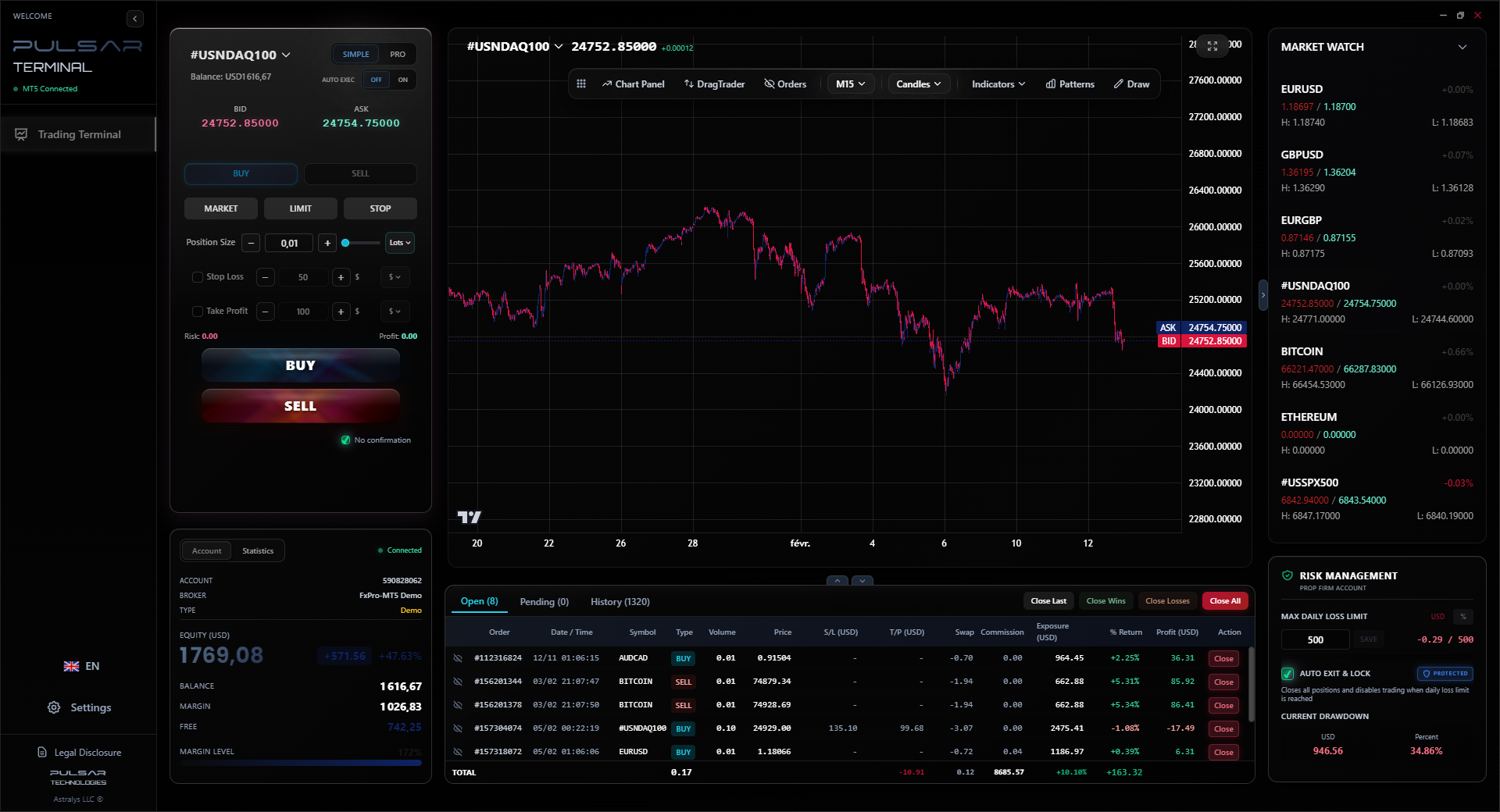
Maintaining the discipline required for long-term success is exhausting; Pulsar Terminal automates your trade management rules directly on MT5, so your psychology can't sabotage your system.
Pulsar Terminal
A ferramenta MT5 tudo-em-um: ordens drag-and-drop, multi-TP/SL, trailing stop, grid trading, Volume Profile e proteção prop firm. Usado diariamente por 1.000+ traders.
FAQ
Q1Is forex trading a valid full-time job in India?
It can be, but it's one of the hardest ways to earn a living. For 95% of people, it should start as a side hustle while you build proven, consistent profitability over several years. The more reliable path to a full-time career is through salaried roles like risk analysis, quant development, or working for a regulated brokerage.
Q2Can I legally trade EUR/USD from India?
No, not through legal channels. The RBI only permits trading of currency pairs that include the Indian Rupee (INR) on Indian exchanges. Trading EUR/USD requires using an international broker, which operates in a regulatory grey area and is not protected under Indian law. You assume all legal and financial risk.
Q3What is the minimum salary I can expect from a forex-related job?
For an entry-level salaried position like a Risk Analyst or Junior Market Analyst in a metro city, expect between ₹5-9 lakh per annum. Performance-based roles (like prop trading) have no salary; your income is a share of your profits, which could be zero or negative for long periods while you're learning.
Q4Do I need a finance degree to get a forex job?
Not necessarily for all paths. For quant or risk roles, a strong background in mathematics, statistics, or computer science is often more valuable than a generic finance degree. For independent trading, your documented profitability and discipline matter more than any degree. However, knowledge of economics and accounting is crucial.
Q5How much capital do I need to start trading forex for a living?
Realistically, far more than you think. To generate a modest monthly income of ₹50,000 from trading (assuming a conservative 2% monthly return), you'd need a dedicated trading capital of at least ₹25 lakh that you can afford to lose. Most beginners severely underestimate the capital required to withstand drawdowns and live off the returns.
Q6What's the difference between a prop firm and a regular broker?
A broker (like Zerodha or IC Markets) provides you a platform to trade your own money. A prop firm provides you with their capital to trade. You pass an evaluation challenge to prove your skills, and then you trade their larger pool of money for a profit split. Your personal risk is limited to the challenge fee.
Q7Are forex trading earnings taxable in India?
Yes. Profits from forex trading are treated as "Business Income" or "Speculative Business Income" and are added to your total income, taxed according to your applicable income tax slab. You must maintain detailed records of all trades for ITR filing.
Lição do Prof. Winston
Pontos-chave:
- ✓Legal pairs only: USD/INR, EUR/INR, GBP/INR, JPY/INR.
- ✓Real careers are in risk, quant, or analysis, not just speculation.
- ✓Python and statistics are more valuable than any "secret indicator".
- ✓Aim for 15-25% CAGR with max 15% drawdown for sustainable success.
Quão útil foi este artigo?
Clique em uma estrela
Insights de Trading Semanal
Análises e estratégias semanais grátis. Sem spam.
Sobre o autor
Rajesh Sharma
Analista Forex Sênior
Mais de 10 anos operando nos mercados indianos e do sul da Ásia. Começou com derivativos cambiais na NSE antes de migrar para o forex internacional. Especialista em USD/INR e pares de mercados emergentes.
Comentários
Aviso de risco
A negociação de instrumentos financeiros envolve riscos significativos e pode não ser adequada para todos os investidores. O desempenho passado não garante resultados futuros. Este conteúdo é apenas para fins educacionais e não deve ser considerado aconselhamento de investimento. Sempre conduza sua própria pesquisa antes de negociar.
Você também pode gostar

Cara Trading Forex Sukses: 7 Prinsip dari Trader Profesional
Cara trading forex sukses dengan 7 prinsip trader pro: manajemen modal, disiplin, journal trading, backtest. Data nyata, bukan janji profit palsu.
Jam Trading Forex Terbaik untuk Trader Indonesia: Panduan Lengkap dengan Tabel Waktu
Panduan jam trading forex untuk trader Indonesia. Tabel 4 sesi dunia, jam emas 20:00-00:00, sesi mana yang harus dihindari. Data akurat + tips dari trader berpengalaman.
Top 5 Sàn Forex Uy Tín Nhất 2026: Review Jujur dari Trader Indonesia
Top 5 sàn forex uy tín 2026 untuk trader Indonesia. Review jujur: spread, deposit, withdraw, dukungan lokal. Exness, XM, IC Markets & lebih.
Obter Pulsar Terminal
Todas essas calculadoras estão integradas ao Pulsar Terminal com dados em tempo real da sua conta MT5.
Obter Pulsar Terminal